
OSH Legal Register Malaysia: Recurring DOSH Deadlines and a Compliance Calendar
An OSH legal register lists each duty that applies to your workplace, how often it repeats and the law behind it. In Malaysia, the recurring dates come mainly from the Noise Exposure Regulations 2019, USECHH 2000 and the Safety and Health Committee Regulations 1996, plus DOSH guidelines for first aid and HIRARC. Enter your last-done dates below.
- MD (NNSMA, Rus)
- MScCH (Occ. Health, UKM)
- MBA (ARU, UK)
- OHD (NIOSH)
- MRO (AOEMM)
- TTT (HRDF)
- SSM 202001013523 (OSHMED Solutions Sdn Bhd)
- DOSH registered training provider SL/22/22/181036, valid to 21 July 2028
- MMC Full Registration 55275 (Dr. Wan Muhammad Zulhusni)
- DOSH Occupational Health Doctor HQ/16/DOC/00/454
- DMAC/EDTCmed 263
- OEUK OEUK/2024/3751
OSHMed Solutions Sdn Bhd is an occupational safety and health consultancy and DOSH-registered training provider (ergonomics) in Kajang, Selangor. We are not a clinic. Medical tests are arranged through approved centres.
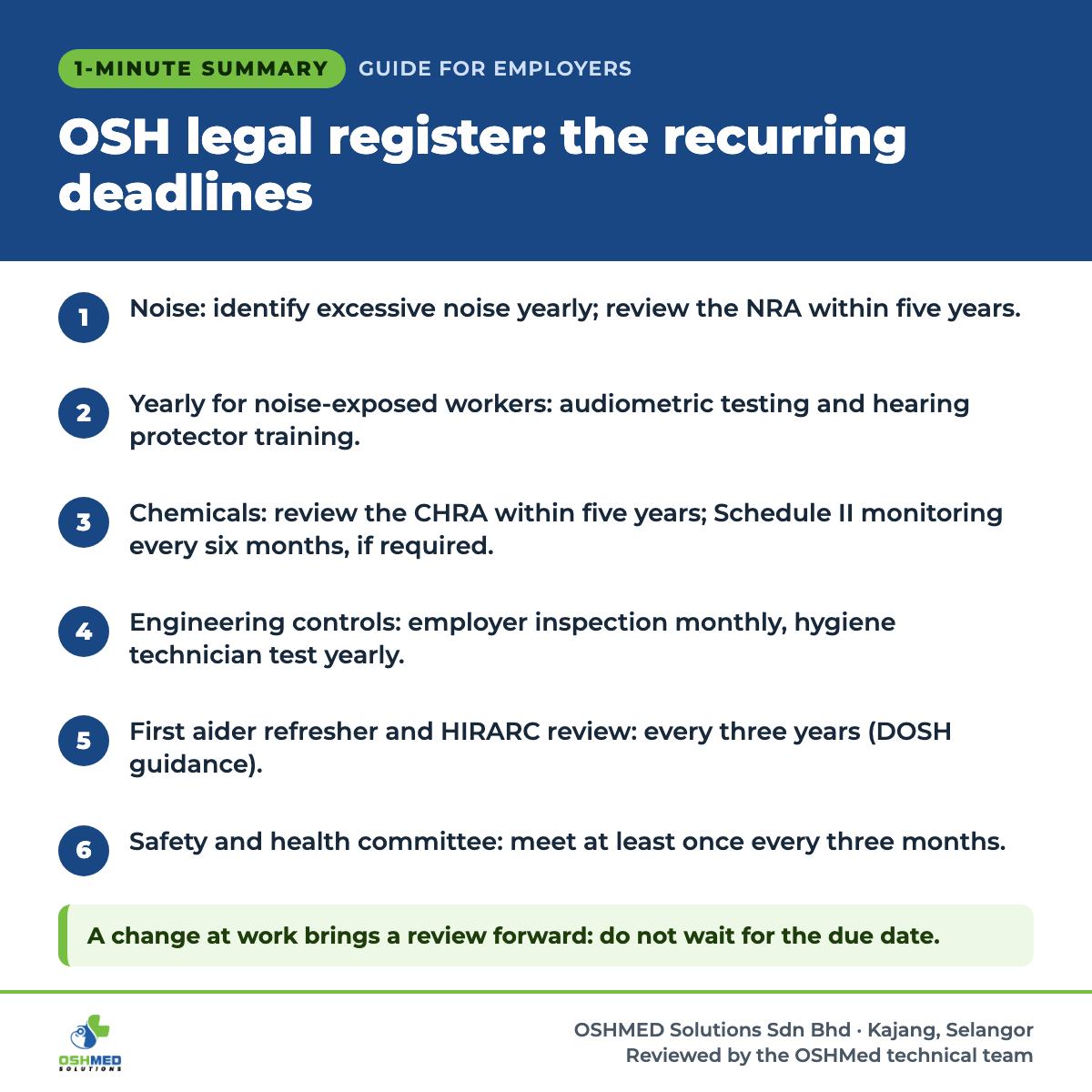
- Noise: identify excessive noise yearly; review the NRA within five years.
- Yearly for noise-exposed workers: audiometric testing and hearing protector training.
- Chemicals: review the CHRA within five years; Schedule II monitoring every six months, if required.
- Engineering controls: employer inspection monthly, hygiene technician test yearly.
- First aider refresher and HIRARC review: every three years (DOSH guidance).
- Safety and health committee: meet at least once every three months.
A change at work brings a review forward: do not wait for the due date.
What is an OSH legal register in Malaysia?
An OSH legal register lists the laws that apply to your workplace, the duty each creates, who carries it out and when it is next due. In Malaysia, the recurring dates come mainly from regulations under Act 514, plus a few DOSH guidelines and a code of practice.
This register covers noise, chemicals, first aid, risk assessment and committees only; check the DOSH list of regulations for others.
Which OSH deadlines repeat, and how often?
Fourteen duties repeat on a fixed cycle, from a monthly check of engineering controls to a five-yearly review of the noise and chemical risk assessments. Each interval is the longest gap allowed since the item was last done; a change or a DOSH direction can bring it forward.
| Duty | How often | Who does it | Basis | OSHMed guide or service |
|---|---|---|---|---|
| Excessive noise identification, each area | Every 12 months | Employer | Noise Regs 3(2)(b); ICOP 6.3 | Noise checklist |
| Noise risk assessment (NRA) review | Every 5 years | Registered noise risk assessor | Noise Regs 4(8)(a) | NRA service |
| Audiometric testing, above the exposure limit | Every year | Approved audiometric testing centre | Noise Regs 9(1); ICOP 13.2.4 | HCP guide |
| Hearing protector training | Every year | Employer | Noise Regs 5(2); ICOP 11.4.1 | HCP page |
| Hearing conservation programme (HCP) review | Every year | Employer, with the hearing conservation administrator | ICOP 5.1.3, 5.1.4 | HCP guide |
| CHRA review | Every 5 years | Registered assessor | USECHH 10(b), 11 | CHRA service |
| Exposure monitoring, Schedule II chemicals, if the CHRA requires it | Every 6 months | Hygiene technician | USECHH 26(2), (3) | CEM guide |
| Medical surveillance, Schedule II chemicals, if required | Every 12 months | Occupational health doctor | USECHH 27(2), (3) | OHD service |
| Engineering control equipment | Inspection monthly; examination and test every 12 months | Employer; hygiene technician | USECHH 17(1) | USECHH guide |
| Chemical training programme | Every 2 years | Employer | USECHH 22(3)(a) | Training |
| First aider refresher course (guidance) | Every 3 years | First aiders | First-Aid Guidelines 4.4.2 | BOFA course |
| HIRARC review (guidance) | Every 3 years | HIRARC team | HIRARC Guidelines 6.2 | HIRARC guide |
| Committee meeting and workplace inspection | Every 3 months | Safety and health committee | SHC Regs 12(a), 21(1) | Regulations |
| Yearly extract of the accident and disease register | Before 31 January | Employer | NADOPOD 10(3) | Regulations |
A committee is required where 40 or more persons are employed or DOSH directs (Act 514, section 30). The ICOP is guidance under section 37 of Act 514; the first aid and HIRARC intervals come from DOSH guidelines.
How do you use the OSH compliance calendar?
Enter the date each item was last done, only for items that apply to you. The calendar adds the interval, shows the next due date and days left, and lists overdue items first. Download the .ics file for your phone or Outlook, or the CSV for Excel.
- Use the date the work was done, not the date the report arrived.
- After each item is done, enter the new date and download the file again.
OSH compliance calendar: turn last-done dates into due dates
Enter the date each item was last done. The calendar adds the legal interval, shows the next due date and the days left, and puts overdue items first. Download a .ics file for your phone or Outlook, or a CSV for Excel.
| Item | Last done | Next due | Days left | Basis |
|---|
Enter dates only for the items that apply: Schedule II items apply only where the CHRA requires monitoring or surveillance, and committee meetings only where a committee is required. The .ics file sets a reminder 30 days before each due date. Dates stay in this browser and are not sent to OSHMed. Items marked (guidance) come from DOSH guidelines, not regulations. Reviews triggered by a change, an incident or a DOSH direction are not covered: see the event table below.
Which OSH duties are triggered by an event, not a date?
Many duties start when something happens: a process change, a new starter in a noisy area, an abnormal audiometric result, an accident or a DOSH direction. They have no fixed date, so the calendar cannot track them. Check this table whenever something changes.
| Event | Duty | Deadline | Basis |
|---|---|---|---|
| Change in machinery, process or controls | Re-identify excessive noise; NRA if it may be present | None set | Noise Regs 3(2)(a); ICOP 6.5 |
| NRA report received | Tell exposed employees; carry out the recommendations | 14 days; 30 days | Noise Regs 4(6), 4(7) |
| New starter in an area above the limit | Baseline audiometric test | 3 months | Noise Regs 10(1)(b) |
| Temporary standard threshold shift | Audiometric retest | 3 months | Noise Regs 9(9)(a) |
| Noise-induced hearing loss or a permanent shift | Notify the nearest DOSH office | 7 days | Noise Regs 9(10)(a) |
| Significant change in work with chemicals | Review the CHRA | None set | USECHH 10(a) |
| CHRA report received | Carry out the required controls | 1 month | USECHH 14(1) |
| New tasks, hazard information or controls | Review and conduct chemical training | None set | USECHH 22(3)(b), (c) |
| Death, serious bodily injury or dangerous occurrence | Notify DOSH by the quickest means; send the report | Immediately; 7 days | NADOPOD 5(1) |
| Injury off work for over 4 days, or a listed occupational disease | Send the report | 7 days | NADOPOD 5(2), 7(1) |
| Serious accident, near miss or dangerous occurrence | Committee meeting and workplace inspection | Immediately | SHC Regs 21(3), 13(1) |
A process change also calls for a HIRARC review (HIRARC Guidelines 6.2); musculoskeletal complaints call for an ERA review (ERA Guidelines 2017, 7.0): see our ERA guide and ERA page.
Items overdue or due soon on your calendar?
Send us your calendar CSV or the list of items due. OSHMed will reply in writing with what each item needs, who must carry it out and a quote for the work we arrange: request a quote.
How long must you keep OSH records?
From three to thirty years. NRA and CHRA reports, health surveillance records and personal exposure monitoring records are kept for at least 30 years, committee minutes for seven and the accident register for five. Disposal needs three months’ written notice to DOSH (Noise Regs 11(3); USECHH 30(3)).
| Record | Keep for | Basis |
|---|---|---|
| NRA report | 30 years | Noise Regs 11(1)(a) |
| Audiometric reports | Employment plus 5 years | Noise Regs 11(1)(b) |
| CHRA report | 30 years | USECHH 13(1) |
| Exposure monitoring | 30 years (personal exposure) or 5 years | USECHH 26(4) |
| Health surveillance | 30 years from the last entry | USECHH 27(4) |
| Committee minutes and inspection reports | 7 years | SHC Regs 14(3), 27(2) |
| Accident and disease register | 5 years from each entry | NADOPOD 10(2) |
| First aid records (guidance) | 5 years | First-Aid Guidelines 4.5.2 |
| HIRARC records (guidance) | 3 years | HIRARC Guidelines 6.1 |
What can DOSH ask to see during an inspection?
The regulations name several records that an officer or the Director General may ask for. Keep them at the workplace, filed by item and date, so you can produce each one quickly. The list below quotes only what the regulations themselves say.
- The CHRA report, on request (USECHH 13(2)).
- Engineering control equipment records, when directed (USECHH 19).
- Chemical training programme records (USECHH 22(4)).
- Health surveillance records, on request (USECHH 27(5)).
- Committee minutes, for inspection and copying (SHC Regs 27(2), (3)).
- The noise control assessment report, within 30 days of a written request (Noise Regs 6(5)).
What are the common mistakes with OSH due dates?
Four errors are easy to make: counting from the report date, applying the six-month rule to every chemical, forgetting new starters and merging two checks into one. Each is checked below against the regulation that sets the date, followed by the penalties.
- Report date: the NRA limit runs from the previous assessment date (Noise Regs 4(8)(a)), not the report date.
- Six-month rule: it covers only Schedule II chemicals that need monitoring (USECHH 26(2)).
- New starters: baseline audiometry is due within three months (Noise Regs 10(1)(b)).
- Engineering controls: the monthly employer inspection does not replace the yearly hygiene technician test (USECHH 17(1)). Our LEV inspection guide explains both.
Missing a duty is an offence: up to RM10,000, one year in prison, or both under the Noise Regulations 2019 and NADOPOD 2004, and up to RM100,000, one year, or both under section 51 of Act 514 for USECHH 2000.
OSHMED Solutions Sdn Bhd in Kajang, Selangor, serves employers across Malaysia and quotes in writing. In our NRA service and CHRA service, a DOSH-registered assessor carries out each assessment and signs a written report. We coordinate medical surveillance through our occupational health doctor service, with tests carried out and billed by our partner clinic. See our assessments, workplace health and training pages.
- An NRA or CHRA review is overdue or due within 90 days.
- You changed a machine, process, chemical or control.
- You cannot find the last NRA, CHRA or monitoring report.
Is a spreadsheet, a consultant or your last report enough?
Each helps, but none replaces the register. A spreadsheet misses event-driven duties, a consultant cannot take over the legal duties of the employer, and a report inside its five-year window may still need an earlier review. Each objection is answered below.
"We already track this in Excel."
The CSV opens in Excel, but dates alone miss change-triggered duties such as noise re-identification (Noise Regs 3(2)(a)).
"Our consultant keeps the dates."
The duty stays with the employer, who must ensure the NRA is reviewed and keep the reports (Noise Regs 4(8), 11).
"Our last report is under five years old."
Five years is the maximum. A significant change triggers a CHRA review (USECHH 10(a)) and, for noise, re-identification and possibly a new NRA (ICOP 6.5).
Frequently asked questions
How often must a noise risk assessment be reviewed?
Within five years of the previous assessment, or sooner if DOSH directs (Noise Exposure Regulations 2019, regulation 4(8)). Excessive noise is re-identified at least yearly (regulation 3(2)).
How often is a CHRA required?
A CHRA is reviewed when more than five years have passed, after a significant change in the work, or when DOSH directs (USECHH 2000, regulation 10).
How often is audiometric testing required?
Every year for employees exposed above the noise exposure limit, with a baseline test within three months of starting work there (regulations 9(1) and 10(1)(b)).
What are the DOSH reporting requirements for accidents?
Notify the nearest DOSH office immediately of a death, serious bodily injury or dangerous occurrence, and report within 7 days; report other injuries off work for over four days, and listed occupational diseases, within 7 days (NADOPOD 2004, regulations 5 and 7).
How often must the safety and health committee meet?
At least once every three months (Safety and Health Committee Regulations 1996, regulation 21(1)), where a committee is required: 40 or more persons employed (Act 514, section 30).
Your next step
Fill in the calendar and download the .ics file. If anything is overdue or due soon, send us the CSV via WhatsApp for a written quote.
For the rules behind the dates, see our Noise Regulations 2019, USECHH 2000 and section 18B guides.
Turn your due dates into a written plan
Share your calendar CSV via WhatsApp or through the quote form. We will tell you which items need a DOSH-registered competent person and what to prepare before each visit.
- LEV inspection in Malaysia: DOSH rules, frequency and records
- DOSH training requirements: mandatory OSH training in Malaysia by regulation
- OSHA 1994 amendment 2022 (Act A1648): what changed for employers
- Noise Exposure Regulations 2019: employer duties, limits and deadlines
- USECHH 2000: a plain guide to all 30 regulations and 3 schedules
- DOSH noise identification checklist: 10 questions, examples and next steps
- HIRARC form (DOSH): template, examples and how to fill it in
- First aid training Malaysia: how many first aiders do you need?
Sources and references
Checked against the official documents listed below on 9 November 2026. Laws change: always confirm the current version on the DOSH (JKKP) website.
- Occupational Safety and Health (Noise Exposure) Regulations 2019, P.U. (A) 60/2019 (regulations 3, 4, 5, 6, 9, 10, 11), Attorney General's Chambers, published by DOSH
- Industry Code of Practice for Management of Occupational Noise Exposure and Hearing Conservation 2019 (foreword; 5.1.3, 5.1.4, 6.3 to 6.7, 11.4.1, 13.2.4), DOSH Malaysia
- Occupational Safety and Health (Use and Standards of Exposure of Chemicals Hazardous to Health) Regulations 2000, P.U. (A) 131/2000 (regulations 10, 11, 13, 14, 17, 19, 22, 26, 27, 30), Attorney General's Chambers, published by DOSH
- Occupational Safety and Health (Safety and Health Committee) Regulations 1996, P.U. (A) 616/1996 (regulations 12, 13, 14, 21, 27, 32), Attorney General's Chambers, published by DOSH
- Occupational Safety and Health (Notification of Accident, Dangerous Occurrence, Occupational Poisoning and Occupational Disease) Regulations 2004, P.U. (A) 128/2004 (regulations 5, 7, 10, 11, 13), Attorney General's Chambers, published by DOSH
- Guidelines on First-Aid in the Workplace, 2nd Edition 2004 (4.4.2, 4.4.3, 4.5.2), DOSH Malaysia
- Guidelines for Hazard Identification, Risk Assessment and Risk Control (HIRARC) 2008 (6.1, 6.2), DOSH Malaysia
- Guidelines on Ergonomics Risk Assessment at Workplace 2017 (section 7.0), DOSH Malaysia
- Occupational Safety and Health Act 1994 (Act 514), reprint incorporating Act A1648 (sections 30, 37, 51), DOSH Malaysia
- Regulations under Act 514 (current list), DOSH Malaysia
Disclaimer: This article is general information for employers and is not legal advice. Requirements depend on your workplace, processes and the current law. For a decision on your premises, speak to a DOSH-registered competent person or contact DOSH (JKKP).