
HIRARC Form (DOSH): Template, Examples and How to Fill It In
A HIRARC form is the DOSH record for Hazard Identification, Risk Assessment and Risk Control. Each row of the Appendix C form (2008 guideline) lists a work activity, hazard, effect, existing controls, likelihood and severity from 1 to 5, the risk (L x S), recommended controls and a person in charge. Scores of 15 to 25 are High.
- MD (NNSMA, Rus)
- MScCH (Occ. Health, UKM)
- MBA (ARU, UK)
- OHD (NIOSH)
- MRO (AOEMM)
- TTT (HRDF)
- SSM 202001013523 (OSHMED Solutions Sdn Bhd)
- DOSH registered training provider SL/22/22/181036, valid to 21 July 2028
- MMC Full Registration 55275 (Dr. Wan Muhammad Zulhusni)
- DOSH Occupational Health Doctor HQ/16/DOC/00/454
- DMAC/EDTCmed 263
- OEUK OEUK/2024/3751
OSHMed Solutions Sdn Bhd is an occupational safety and health consultancy and DOSH-registered training provider (ergonomics) in Kajang, Selangor. We are not a clinic. Medical tests are arranged through approved centres.
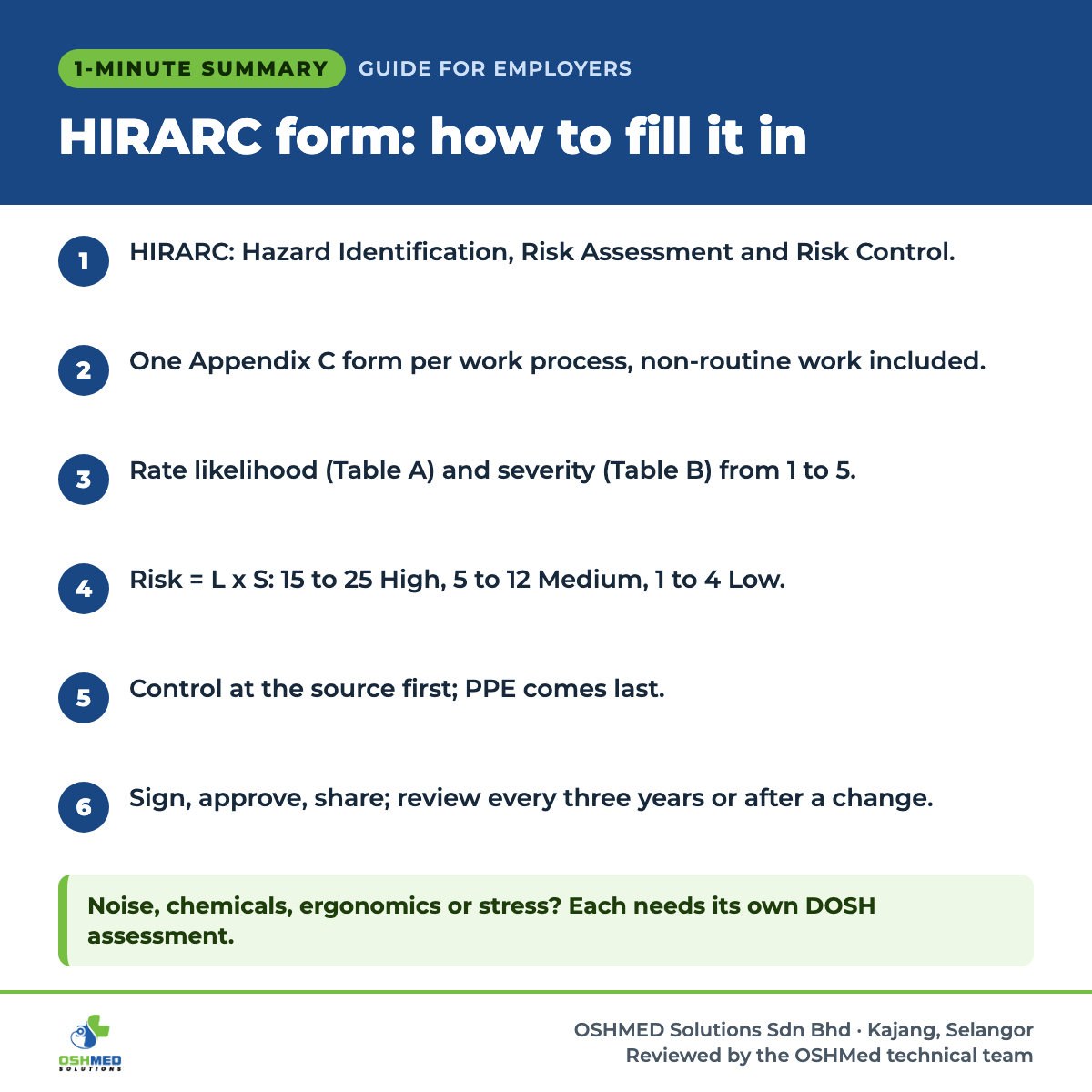
- HIRARC: Hazard Identification, Risk Assessment and Risk Control.
- One Appendix C form per work process, non-routine work included.
- Rate likelihood (Table A) and severity (Table B) from 1 to 5.
- Risk = L x S: 15 to 25 High, 5 to 12 Medium, 1 to 4 Low.
- Control at the source first; PPE comes last.
- Sign, approve, share; review every three years or after a change.
Noise, chemicals, ergonomics or stress? Each needs its own DOSH assessment.
What is HIRARC, and who carries it out?
HIRARC means Hazard Identification, Risk Assessment and Risk Control, the general method in the DOSH Guidelines for HIRARC 2008. The employer assigns trained personnel to lead a team of employees from the process concerned, and the managers, supervisors and safety and health representatives who assess risks must be trained in it.
Plan one where a hazard appears to pose a significant threat, where existing controls may be inadequate, or before corrective or preventive measures (4.2).
In DOSH’s words, the risk assessment process “should be continuous and should not be regarded as a one-off exercise” (Preface).
What are the stages and steps of the HIRARC process?
HIRARC has three stages, hazard identification, risk assessment and risk control, which the guideline runs as four steps: classify work activities, identify hazards, assess the risk from likelihood and severity, then decide whether the risk is tolerable and apply controls. The DOSH flowchart adds consultation, an action plan if necessary, implementation and review.
- Classify work activities by area, stage or task: not too big (building a car), not too small (fixing a nut) (4.3.1).
- Identify hazards from inspections, job hazard analysis, incident records and complaints (4.3.2).
- Assess the risk: likelihood times severity (4.3.3).
- Control: act on the Table D level and record it (section 5).
How do you fill in the DOSH HIRARC form?
Use the Appendix C form, one per work process as DOSH recommends. Fill in the header, then add one row per hazard across three blocks: (1) hazard identification, (2) risk analysis and (3) risk control. Rate each hazard with its existing controls in place, as section 6.2 instructs.
| Column | What to write | Block |
|---|---|---|
| No. | Row number | 1 |
| Work activity | Each routine and non-routine activity | 1 |
| Hazard | The source or situation with potential for harm | 1 |
| Which can cause / effect | The injury, ill health or damage | 1 |
| Existing risk control (if any) | Controls already in place | 2 |
| Likelihood | 1 to 5 from Table A | 2 |
| Severity | 1 to 5 from Table B | 2 |
| Risk | L x S and its Table D level | 2 |
| Recommended control measures | Controls chosen by the hierarchy of control | 3 |
| PIC (due date / status) | Who acts, by when, and the status | 3 |
The header also holds the dates and review dates. DOSH calls Appendix C an example and allows electronic records (4.3.2.5); the builder below keeps its layout.
HIRARC form builder: fill in Appendix C online
Fill in the header once, then add one row per hazard. Choose likelihood from Table A and severity from Table B, and the builder calculates the risk and its Table D level. Download the finished form as a CSV file that opens in Excel, or print it. No medical details are needed.
| No. | Work activity | Hazard | Which can cause / effect | Existing risk control | L | S | Risk (L x S) | Recommended control measures | PIC |
|---|
This builder follows the Appendix C form and Tables A to D of the DOSH HIRARC 2008 guideline: risk = L x S, with 15 to 25 High, 5 to 12 Medium and 1 to 4 Low. Rows are saved only in this browser; the WhatsApp button sends just the row count and risk summary. The CSV opens in Excel. Use one form per work process, signed by the person in charge of the area and approved by management (section 6).
How do you rate likelihood, severity and risk?
Pick a likelihood from Table A and a severity from Table B, both scored 1 to 5, and multiply them: risk = L x S. Table D then sets the level: 15 to 25 is High, 5 to 12 is Medium and 1 to 4 is Low. Existing controls count when you rate.
| Rating | Likelihood | Description (DOSH) |
|---|---|---|
| 5 | Most likely | The most likely result of the hazard or event being realised |
| 4 | Possible | Has a good chance of occurring and is not unusual |
| 3 | Conceivable | Might occur at some time in future |
| 2 | Remote | Has not been known to occur after many years |
| 1 | Inconceivable | Is practically impossible and has never occurred |
| Rating | Severity | Description (DOSH) |
|---|---|---|
| 5 | Catastrophic | Numerous fatalities, irrecoverable property damage and productivity |
| 4 | Fatal | Approximately one single fatality, major property damage if the hazard is realised |
| 3 | Serious | Non-fatal injury, permanent disability |
| 2 | Minor | Disabling but not permanent injury |
| 1 | Negligible | Minor abrasions, bruises, cuts, first aid type injury |
| L / S | 1 | 2 | 3 | 4 | 5 |
|---|---|---|---|---|---|
| 5 | 5 | 10 | 15 | 20 | 25 |
| 4 | 4 | 8 | 12 | 16 | 20 |
| 3 | 3 | 6 | 9 | 12 | 15 |
| 2 | 2 | 4 | 6 | 8 | 10 |
| 1 | 1 | 2 | 3 | 4 | 5 |
| Risk | Level | Action (DOSH) |
|---|---|---|
| 15 to 25 | High | Immediate action under the hierarchy of control; record actions and completion date |
| 5 to 12 | Medium | Planned approach, temporary measures if required; record actions and completion date |
| 1 to 4 | Low | May be acceptable; if it can be resolved quickly and efficiently, implement and record the control |
Of the 25 cells in Table C, 6 are High, 11 are Medium and 8 are Low. High risk requires both L and S to be 3 or more, and any severity 5 hazard is at least Medium.
Which control measures should the HIRARC form recommend?
Follow the hierarchy of control in section 5: remove or replace the hazard at its source, then use engineering controls, then administrative controls, with personal protective equipment (PPE) last. Where a permanent fix takes time, use short-term measures to protect workers until the long-term control is in place (5.1).
| Order | Control | Guideline examples |
|---|---|---|
| 1 | Elimination, substitution | Stop the hazardous process; use a less hazardous chemical |
| 2 | Engineering | Redesign, isolation, automation, guarding, noise baffles, ventilation |
| 3 | Administrative | Safe work procedures, training, job rotation, housekeeping, hygiene |
| 4 | PPE | When other controls are not feasible; the least desirable control |
What does a HIRARC example look like for a factory and an office?
The two tables below show how a filled-in form reads. They are illustrations written for this guide, not a client record, so rate your own tasks with your own team. DOSH’s Appendix D adds two worked examples: wood panel cutting and exterior wall plastering.
Appendix D scores its wood cutting rows from 3 (Low) to 16 (High) for machine repair, with a caution that examples may not apply to your workplace.
HIRARC example: factory (metal stamping line)
| No. | Work activity | Hazard | Which can cause / effect | Existing control | L | S | Risk | Recommended control measures | PIC |
|---|---|---|---|---|---|---|---|---|---|
| 1 | Feeding the power press | Unguarded die | Amputation | Two-hand start | 3 | 3 | 9 Medium | Fixed guard; daily check | Supervisor |
| 2 | Running presses all shift | Noise | Hearing loss | Ear plugs | 4 | 3 | 12 Medium | Noise identification, then NRA | Safety officer |
| 3 | Degreasing with solvent | Solvent vapour, skin contact | Dizziness, skin irritation | Gloves | 4 | 2 | 8 Medium | CHRA under USECHH 2000 | Safety officer |
| 4 | Changing dies | Accidental start | Crushing, fatal | Verbal warning | 4 | 4 | 16 High | Lockout and tag now; safe work procedure | Maintenance lead |
HIRARC example: office (administration floor)
| No. | Work activity | Hazard | Which can cause / effect | Existing control | L | S | Risk | Recommended control measures | PIC |
|---|---|---|---|---|---|---|---|---|---|
| 1 | Computer work | Poor workstation, long sitting | Neck and back pain | Some adjustable chairs | 4 | 2 | 8 Medium | Adjust workstations; initial ERA | Admin manager |
| 2 | Reaching top shelves | Falling files | Bruises | Step stool | 2 | 1 | 2 Low | Store heavy files low | Admin manager |
| 3 | Month-end closing | Excessive workload | Work-related stress | Overtime approval | 3 | 2 | 6 Medium | PRisMA psychosocial assessment | HR manager |
Factory rows 2 and 3 and office rows 1 and 3 need their own DOSH assessment.
Has your HIRARC flagged noise, chemicals or ergonomics?
Send us those rows (the CSV from the builder works). OSHMed will suggest which specialist assessments apply and how to scope them together: ask about specialist assessments.
Who signs the HIRARC, and when must it be reviewed?
The HIRARC team completes the form, the person in charge of the area signs it, and management endorses and approves the results. The employer then communicates the HIRARC to employees, monitors follow-up action and keeps the records. Review it every three years or whenever there are changes in process or activities.
- Keep assessment records for at least three years; some laws set a longer minimum (6.1).
- Run another round of HIRARC after the controls are implemented (6.2).
- Where practicable, consult the safety and health representatives (section 7).
What are the common HIRARC mistakes?
Many errors break a rule in the guideline itself: rating hazards without the existing controls, one form for a whole site, no person in charge or due date, no management approval, and no second round after controls. Each one weakens the record that section 6 asks for.
- Wrong size: “building a car” or “fixing a nut” hides the real tasks (4.3.1).
- Routine work only: maintenance and cleaning belong on the form too (6.2).
- A copied template: DOSH warns that its examples may not fit your workplace (Appendix D).
- Health hazards scored and closed: the method is intended for physical hazards (Preface).
When does a HIRARC point to a specialist assessment?
When a row involves a health hazard. The guideline’s Preface says its method is intended for physical hazards, and that health hazards should be assessed with guidelines designed for them. Noise, chemicals, ergonomics and psychosocial risks each have their own DOSH method, so the HIRARC row should lead to that assessment.
| Hazard in your HIRARC | DOSH rule | Next step | Guide |
|---|---|---|---|
| Noise | Noise Regulations 2019 | Noise identification, then NRA by a registered assessor | Checklist; NRA |
| Chemicals hazardous to health | USECHH 2000 | CHRA by a registered assessor | CHRA; Assessor |
| Manual handling, repetitive work, workstation design | ERA Guidelines 2017 | Initial ERA, then advanced if needed | Initial ERA |
| Workload, bullying, shift work | PRisMA 2024 | Psychosocial risk assessment | PRisMA |
Through our NRA service and CHRA service, each assessment is carried out by a DOSH-registered assessor, as the law requires, and ends with a written report. Every report names the responsible registered assessor and their myKKP registration number, so you can verify it on the DOSH register. For ergonomic rows, see our ERA service or ETP course, and all our workplace assessments.
Section 18B of Act 514 makes risk assessment a duty for every employer, self-employed person and principal; a breach carries a fine of up to RM500,000, up to two years in prison, or both (section 19). See our section 18B guide.
- Your HIRARC lists noise, chemicals, manual handling or workload with no specialist assessment.
- A machine, chemical or process has changed since the last assessment.
- Your last NRA or CHRA report cannot be found.
Frequently asked questions
Is there a HIRARC form template in Excel?
DOSH gives the form as Appendix C in its PDF guideline and calls it an example. The builder on this page uses the same columns and downloads a CSV that opens in Excel.
How is the risk in a HIRARC table calculated?
Likelihood (Table A, 1 to 5) multiplied by severity (Table B, 1 to 5). Table D: 15 to 25 High, 5 to 12 Medium, 1 to 4 Low.
Can we copy a HIRARC from another company?
Only as a prompt. DOSH warns that even its own examples may not apply to similar work in your workplace, and the team should be employees who know the process (4.2).
Our HIRARC already scores noise and chemicals. Is that enough?
No. DOSH intends HIRARC for physical hazards. Noise and chemicals each have their own regulation and assessment, so use the score only as a flag.
We did a HIRARC once. When must it be redone?
DOSH calls risk assessment continuous: run another round after new controls, and review every three years or whenever processes or activities change.
Your next step
Fill in the builder for one work process at a time, download the CSV, and get it signed and approved.
Rows on noise, chemicals, manual handling or workload? Send them to OSHMed on WhatsApp for one specialist assessment scope.
Turn your HIRARC rows into one assessment scope
Share your HIRARC on WhatsApp or through the form. We will suggest which assessments apply, who must carry them out and the order to do them in.
- Section 18B OSHA 1994: risk assessment duty, HIRARC and specialists
- DOSH noise identification checklist: 10 questions, examples and next steps
- Chemical health risk assessment (CHRA) under USECHH 2000: when it is required
- Initial vs advanced ergonomic risk assessment (ERA)
- Psychosocial risk assessment under PRisMA 2024
Sources and references
Checked against the official documents listed below on 8 November 2026. Laws change: always confirm the current version on the DOSH (JKKP) website.
- Guidelines for Hazard Identification, Risk Assessment and Risk Control (HIRARC) 2008, JKKP DP 127/789/4-47 (Preface, sections 1 to 8, Appendices A, C and D), DOSH Malaysia
- Garis Panduan bagi Pengenalpastian Hazard, Penaksiran Risiko dan Kawalan Risiko (HIRARC) 2008 (Malay edition), DOSH Malaysia
- Guidelines: Risk Assessment (DOSH list of risk assessment guidelines), DOSH Malaysia
- Occupational Safety and Health Act 1994 (Act 514), reprint incorporating Act A1648 (sections 18B and 19), DOSH Malaysia
- Occupational Safety and Health (Noise Exposure) Regulations 2019, P.U. (A) 60/2019 (regulations 3 and 4), Attorney General's Chambers, published by DOSH
- Occupational Safety and Health (Use and Standards of Exposure of Chemicals Hazardous to Health) Regulations 2000, P.U. (A) 131/2000 (regulations 9 and 11), Attorney General's Chambers, published by DOSH
- Guidelines on Ergonomics Risk Assessment at Workplace 2017 (section 2.2), DOSH Malaysia
- Guidelines on Psychosocial Risk Assessment and Management at the Workplace (PRisMA) 2024 (section 08.1), DOSH Malaysia
Disclaimer: This article is general information for employers and is not legal advice. Requirements depend on your workplace, processes and the current law. For a decision on your premises, speak to a DOSH-registered competent person or contact DOSH (JKKP).