
Chemical Health Risk Assessment (CHRA) under USECHH 2000: When It Is Required and How to Prepare
Under regulation 9 of the USECHH Regulations 2000, an employer must not carry out work that may expose employees to chemicals hazardous to health unless a written chemical health risk assessment (CHRA) has been made by a DOSH-registered assessor. Review it after a significant change in the work, when more than five years have passed, or when DOSH directs.
- MD (NNSMA, Rus)
- MScCH (Occ. Health, UKM)
- MBA (ARU, UK)
- OHD (NIOSH)
- MRO (AOEMM)
- TTT (HRDF)
- SSM 202001013523 (OSHMED Solutions Sdn Bhd)
- DOSH registered training provider SL/22/22/181036, valid to 21 July 2028
- MMC Full Registration 55275 (Dr. Wan Muhammad Zulhusni)
- DOSH Occupational Health Doctor HQ/16/DOC/00/454
- DMAC/EDTCmed 263
- OEUK OEUK/2024/3751
OSHMed Solutions Sdn Bhd is an occupational safety and health consultancy and DOSH-registered training provider (ergonomics) in Kajang, Selangor. We are not a clinic. Medical tests are arranged through approved centres.
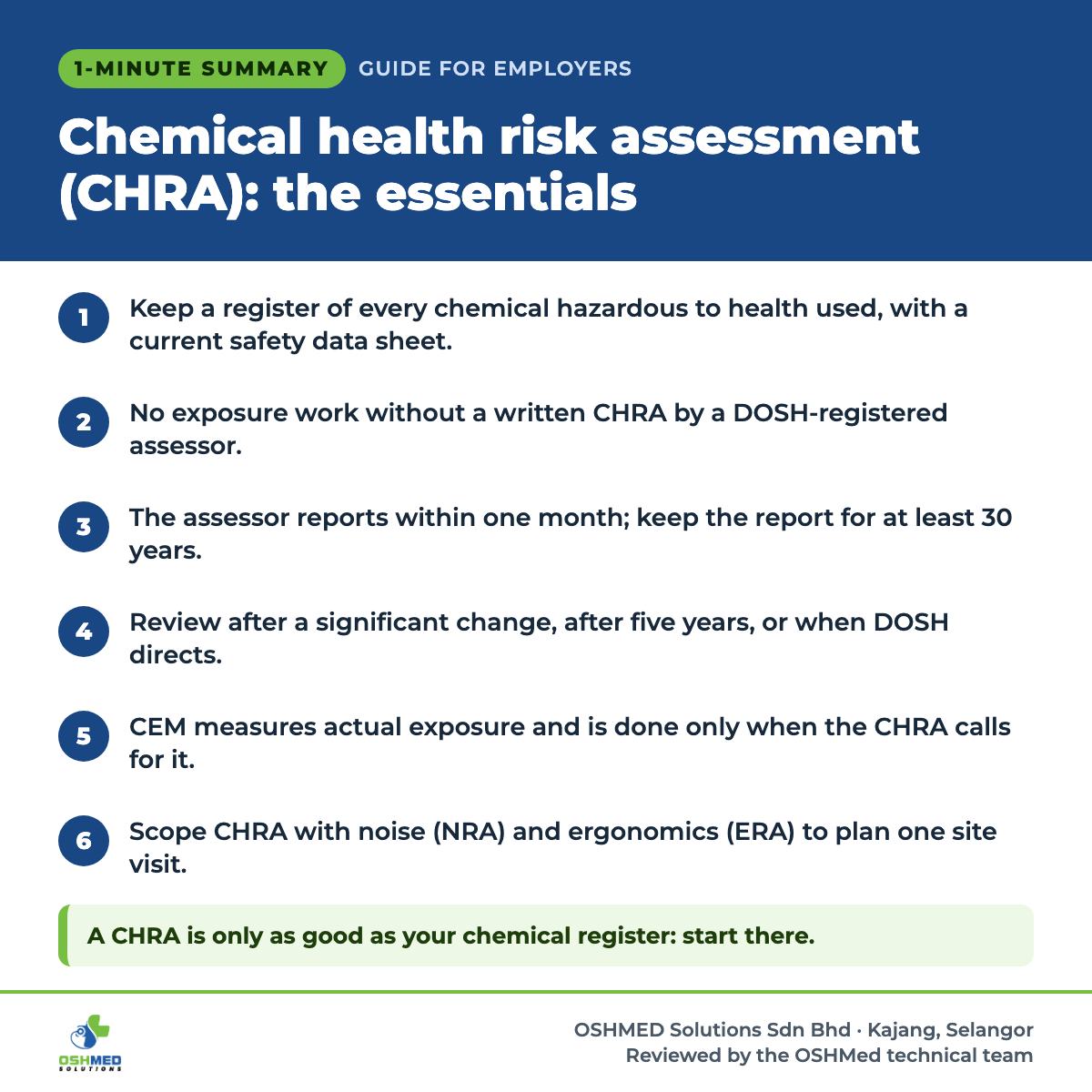
- Keep a register of every chemical hazardous to health used, with a current safety data sheet.
- Do not carry out work that may expose employees without a written CHRA by a DOSH-registered assessor.
- The assessor submits the report within one month; keep it for at least 30 years.
- Review after a significant change, after five years, or when DOSH directs.
- CEM measures actual exposure and is done only when the CHRA calls for it.
- Scope CHRA with noise (NRA) and ergonomics (ERA) to plan one site visit.
What is a chemical health risk assessment (CHRA)?
A chemical health risk assessment is a written evaluation of the health risks created by chemicals hazardous to health in your work, carried out by an assessor registered with DOSH. It covers how chemicals are used, the degree of exposure, the controls needed, and whether exposure monitoring, health surveillance and training are required.
The rules are set out in the Occupational Safety and Health (Use and Standards of Exposure of Chemicals Hazardous to Health) Regulations 2000, usually called USECHH 2000 (P.U. (A) 131/2000), under the Occupational Safety and Health Act 1994 (Act 514). Regulation 9(2) states what the assessment must contain:
- The potential risks to employees from exposure, and the nature of the hazard to health.
- The methods and procedures used with the chemicals, and the degree of exposure.
- The risk from the use and release of chemicals from work processes.
- Measures to control exposure, including accidental releases from leaks, spills or equipment failure.
- Whether an exposure monitoring programme and a health surveillance programme are needed.
- Training and retraining requirements under regulation 22.
When is a CHRA required under USECHH 2000?
Before any work that may expose, or is likely to expose, an employee to a chemical hazardous to health (regulation 9(1)). The assessment must be done by an assessor, defined as a person appointed by the employer and registered with the Director General to assess risks to health (regulations 2 and 11).
USECHH applies to all workplaces under Act 514 where chemicals hazardous to health are used. Regulation 3 excludes radioactive materials, foodstuffs, pharmaceutical products, and chemicals that are hazardous only because they are explosive, flammable, at a high or low temperature, or under high pressure. The definition of “chemicals hazardous to health” in regulation 2 covers listed chemicals (Schedules I and II), chemicals classified as hazardous, pesticides and certain scheduled wastes.
Section 31B and the Fifth Schedule of Act 514 also require a registered competent person to conduct a health risk assessment for chemicals hazardous to health.
Chemical register prep checklist (USECHH regulation 5)
Tick what you already have. Regulation 5 lists what the register must contain; the other items help the assessor finish faster. Print it or send your score to us.
0 of 10 ready
How often must a CHRA be reviewed?
Regulation 10 requires the assessment to be reviewed if there has been a significant change in the work it relates to, if more than five years have elapsed since the last assessment, or if directed by the Director General, Deputy Director General or a Director of Occupational Safety and Health.
| Item | Rule | Regulation |
|---|---|---|
| Written assessment | Before work that may expose employees | 9(1) |
| Who assesses | DOSH-registered assessor | 2, 11 |
| Report to employer | Within one month of completing the assessment | 12(1) |
| Immediate danger found | Assessor informs the employer immediately | 12(2) |
| Review | Significant change, more than five years, or when directed | 10 |
| Keep the report | Not less than 30 years; available to DOSH and exposed employees | 13 |
A “significant change” in practice can mean a new chemical, a change in quantity or process, a new work unit, or a change to ventilation. If in doubt, ask your assessor to confirm in writing.
CHRA vs chemical exposure monitoring (CEM): what is the difference?
A CHRA evaluates risk and recommends controls. Chemical exposure monitoring (CEM) measures how much of a chemical workers actually breathe in, using an approved sampling and analysis method. Under regulation 26, monitoring is required when the assessment says it is needed, and it must be done by a registered hygiene technician.
| Chemical health risk assessment (CHRA) | Chemical exposure monitoring (CEM) | |
|---|---|---|
| Purpose | Evaluate health risk and decide controls | Measure actual airborne exposure |
| Legal basis | Regulations 9 to 13 | Regulation 26 |
| Who does it | DOSH-registered CHRA assessor | DOSH-registered hygiene technician |
| When | Before work with potential exposure; review under regulation 10 | When the CHRA requires it; for Schedule II chemicals at intervals of not more than six months unless the assessor decides otherwise |
| Records | At least 30 years | Personal exposure records at least 30 years; other records at least five years |
In one line: the CHRA decides whether you need CEM; CEM does not replace the CHRA.
Want a CHRA scope based on your chemical register?
Send us your chemical register or a list of chemicals and work areas. OSHMed will propose a CHRA scope and tell you whether noise or ergonomics should be assessed in the same visit.
What happens after the CHRA?
You implement the recommended controls, train exposed employees, and start exposure monitoring or health surveillance if the assessment calls for them. Regulation 22 requires the training programme to be reviewed and conducted at least once every two years, and whenever hazard information, work practices or tasks change.
- Controls. Engineering controls such as local exhaust ventilation, safe work systems and suitable personal protective equipment.
- Information and training. Employees must know the risks and precautions (regulation 22). OSHMed can deliver in-house OSH training for your teams.
- Monitoring. CEM by a registered hygiene technician if required (regulation 26).
- Health surveillance. If the CHRA indicates it is necessary, the medical surveillance component must be carried out by a DOSH-registered occupational health doctor (regulation 27). OSHMed is not a clinic; this is arranged through a registered clinic and occupational health doctor. See workplace health services.
Ask the assessor to rank recommendations by priority and name the work units clearly, so the action plan is easier to budget.
Can CHRA, NRA and ERA be scoped together?
Yes, as a planning exercise. Many sites need a CHRA, a noise risk assessment (NRA) and an ergonomic risk assessment (ERA). Scoping them together lets you share inputs such as the layout, process list and headcount, and plan one series of site visits. Each still needs its own competent person and its own report.
| Assessment | Legal basis | Who | Key inputs you provide |
|---|---|---|---|
| CHRA | USECHH 2000, regulation 9 | Registered CHRA assessor | Chemical register, SDS, process and work unit list |
| NRA | Noise Exposure Regulations 2019, regulation 4 | Registered noise risk assessor | Machine list, layout, shifts, excessive noise identification |
| ERA | DOSH Guidelines on Ergonomics Risk Assessment 2017; Act 514 section 18B | Ergonomic trained person | Task list, complaints, self-assessment forms |
A combined scope saves repeat walkthroughs, not legal steps: each assessment keeps its own assessor, method and report.
Who can do your CHRA, and how does OSHMed help?
Only an assessor registered with DOSH may carry out the CHRA (regulation 11), and Act 514 section 31B makes health risk assessment of chemicals an activity for registered competent persons. Before you appoint anyone, check their registration in the DOSH myKKP register and ask for the registration number on the proposal.
OSHMed, an occupational safety and health consultancy in Kajang, Selangor, scopes CHRAs for employers across Malaysia and coordinates them with noise and ergonomic assessments. The CHRA is carried out by a DOSH-registered CHRA assessor, whose name and registration number appear in the report. Chemical exposure monitoring, if recommended, is done by a DOSH-registered hygiene technician. See our workplace assessments.
- You are introducing a new chemical or process, or changing ventilation.
- Your last CHRA is close to five years old, or you cannot find it.
- Workers report symptoms they link to chemicals at work.
- DOSH has directed you to review the assessment.
Before you decide: three common objections
Three questions come up in almost every CHRA discussion: whether small quantities are exempt, whether safety data sheets are enough, and whether monitoring can replace the assessment. Here is what USECHH 2000 actually says on each, so the decision rests on the regulation rather than habit.
"We only use small amounts."
USECHH has no general small-quantity exemption. The register requires average quantities so the assessor can judge the degree of exposure; small amounts may lead to a simpler assessment, but do not remove the need for one.
"Our suppliers give us safety data sheets, so we are covered."
Safety data sheets (SDSs) are an input to the register and the CHRA, not a substitute. The CHRA looks at how your workers use the chemical in your processes.
"Can we just do monitoring instead?"
Monitoring under regulation 26 follows the assessment. Without a CHRA you do not know which chemicals, tasks and workers to monitor, or which controls are required.
Frequently asked questions
When is a CHRA required in Malaysia?
Before any work that may expose, or is likely to expose, employees to chemicals hazardous to health. Regulation 9 of the USECHH Regulations 2000 requires a written assessment, and regulation 11 requires it to be carried out by an assessor registered with DOSH.
How long is a CHRA valid?
USECHH does not use the word “valid”, but regulation 10 requires a review when the work changes significantly, when more than five years have elapsed since the last assessment, or when DOSH directs. Keep every CHRA report for not less than 30 years (regulation 13).
What is the difference between CHRA and CEM?
A CHRA evaluates the health risk and decides the controls. Chemical exposure monitoring (CEM) measures actual exposure and is required when the CHRA says it is needed. CEM must be done by a registered hygiene technician under regulation 26.
Do our workers need medical surveillance after a CHRA?
Only if the assessment indicates that health surveillance is necessary, or the chemical is listed in Schedule II. The medical surveillance must be carried out by a DOSH-registered occupational health doctor (regulation 27). OSHMed does not provide medical services; this is arranged through a registered clinic.
What must a USECHH chemical register contain?
Regulation 5 requires a list of all chemicals hazardous to health used, a current safety data sheet for each, the average quantity used or stored per month or year, the process and work area, and each supplier’s name and address. Employees who may be exposed must be able to access it.
Your next step
Update your chemical register first: it is the input for everything else. Then appoint a DOSH-registered CHRA assessor and check whether your last assessment is due for review.
If your site is also noisy or has manual handling tasks, scope the CHRA together with a noise risk assessment and an initial ergonomic risk assessment.
Get your CHRA, NRA and ERA scoped together
One conversation, one site plan. We will tell you which assessments your site needs and what each assessor will ask for.
Sources and references
Checked against the official documents listed below on 21 October 2026. Laws change: always confirm the current version on the DOSH (JKKP) website.
- Occupational Safety and Health (Use and Standards of Exposure of Chemicals Hazardous to Health) Regulations 2000, P.U. (A) 131/2000 (regulations 2, 3, 5, 9 to 13, 22, 26, 27). Text copy hosted by Universiti Malaya OSHE resources; official listing on dosh.gov.my, Attorney General's Chambers / DOSH
- Occupational Safety and Health Act 1994 (Act 514), reprint incorporating Act A1648 (sections 18B, 31B, Fifth Schedule), DOSH Malaysia
- Occupational Safety and Health (Noise Exposure) Regulations 2019, P.U. (A) 60/2019, DOSH Malaysia
- Guidelines on Ergonomics Risk Assessment at Workplace 2017, DOSH Malaysia
Disclaimer: This article is general information for employers and is not legal advice. Requirements depend on your workplace, processes and the current law. For a decision on your premises, speak to a DOSH-registered competent person or contact DOSH (JKKP).