
DOSH Training Requirements: Mandatory OSH Training in Malaysia by Regulation
DOSH training requirements come from three levels. Act 514 (section 15(2)(c)) and its regulations make some training compulsory: chemical training under USECHH 2000, yearly noise training, committee member training and SHO registration. A code of practice adds confined space courses, and DOSH guidelines recommend first aid, ETP and PTP training.
- MD (NNSMA, Rus)
- MScCH (Occ. Health, UKM)
- MBA (ARU, UK)
- OHD (NIOSH)
- MRO (AOEMM)
- TTT (HRDF)
- SSM 202001013523 (OSHMED Solutions Sdn Bhd)
- DOSH registered training provider SL/22/22/181036, valid to 21 July 2028
- MMC Full Registration 55275 (Dr. Wan Muhammad Zulhusni)
- DOSH Occupational Health Doctor HQ/16/DOC/00/454
- DMAC/EDTCmed 263
- OEUK OEUK/2024/3751
OSHMed Solutions Sdn Bhd is an occupational safety and health consultancy and DOSH-registered training provider (ergonomics) in Kajang, Selangor. We are not a clinic. Medical tests are arranged through approved centres.
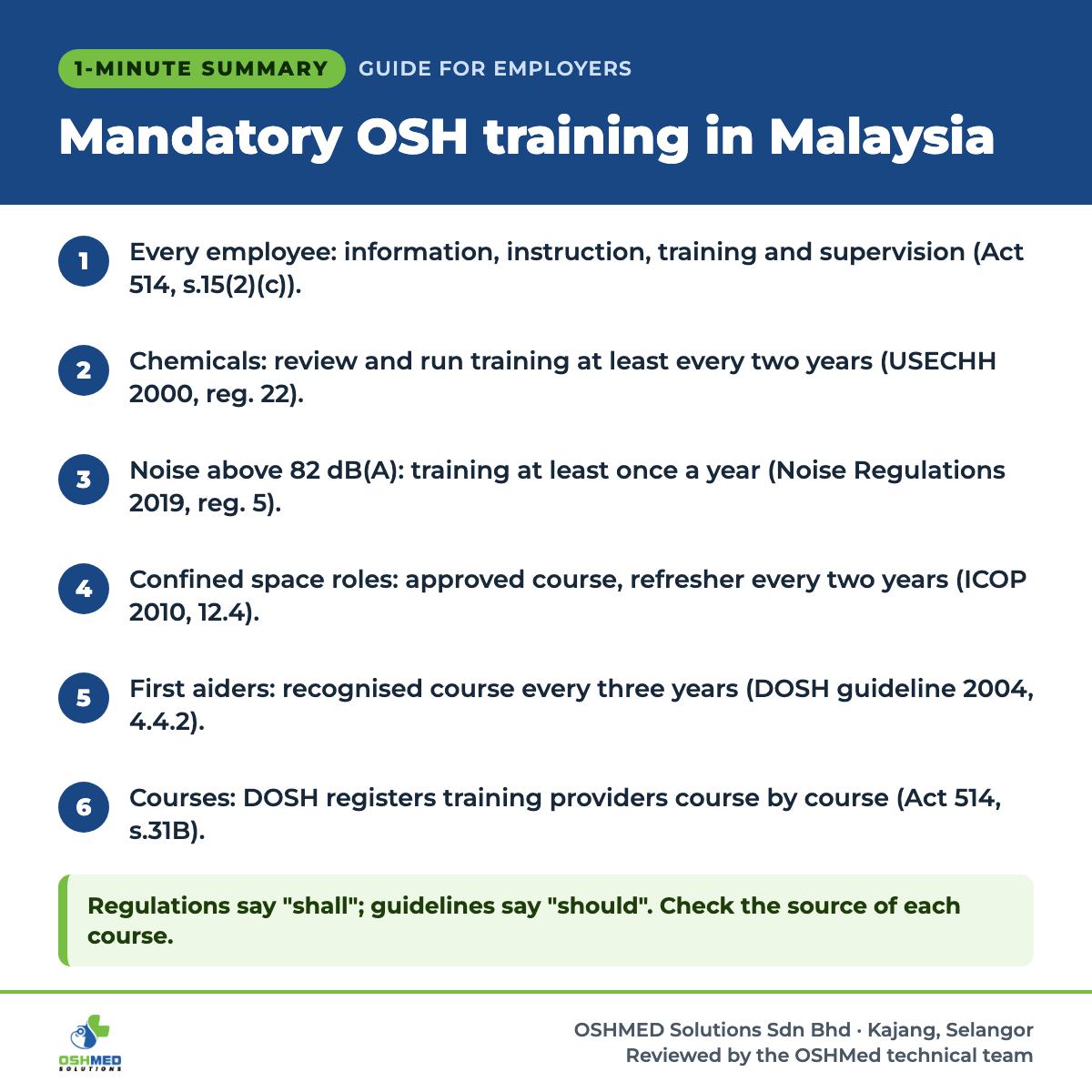
- Every employee: information, instruction, training and supervision (Act 514, s.15(2)(c)).
- Chemicals: review and run training at least every two years (USECHH 2000, reg. 22).
- Noise above 82 dB(A): training at least once a year (Noise Regulations 2019, reg. 5).
- Confined space roles: approved course, refresher every two years (ICOP 2010, 12.4).
- First aiders: recognised course every three years (DOSH guideline 2004, 4.4.2).
- Courses: DOSH registers training providers course by course (Act 514, s.31B).
Regulations say "shall"; guidelines say "should". Check the source of each course.
What OSH training is mandatory in Malaysia?
Training is mandatory where Act 514 or a regulation made under it says “shall”. Section 15(2)(c) covers every employee, and four sets of regulations add specific courses. DOSH codes of practice and guidelines then set or recommend more.
Act 514 applies to all places of work throughout Malaysia, including Sabah and Sarawak, except the work in its First Schedule, such as domestic employment (section 1). The tables below sort each item by its source.
Which OSH training do Act 514 and its regulations require?
Six rules make training a legal duty: the general duty in section 15(2)(c), chemical training under USECHH 2000, yearly noise training, committee member training, SHO registration with continuous education, and site induction on construction sites. Each row links to its in-depth guide.
| Training | Legal basis | Who needs it | How often | Who can teach |
|---|---|---|---|---|
| Information, instruction, training and supervision | Act 514, s.15(2)(c); s.18A(3)(c) for contractors | Every employee; contractors under a principal’s direction | As necessary; no interval set | Not specified |
| Chemical hazards and precautions | USECHH 2000, reg. 22 (guide) | Employees who may be exposed to chemicals hazardous to health | At least every two years, after changes and before new tasks | Not specified; documented programme |
| Noise, hearing protectors and audiometric testing | Noise Regulations 2019, reg. 5 (guide) | Employees the NRA report identifies as exposed to excessive noise | At least once a year | Not specified; in a language workers understand (ICOP 12.3.3) |
| Committee functions and OSH | Committee Regulations 1996, regs. 28 and 29 (guide) | Members, where 40 or more persons are employed (s.30) | Not set | Not specified |
| Safety and health officer (SHO) | SHO Regulations 1997, regs. 4, 6, 8 and 10; SHO Order 1997 | The SHO, in the classes listed in the Order | Continuous education yearly; registration valid for three years | One route: an approved course and examination (reg. 6(1)(b)) |
| Site induction; site safety supervisor | Construction (Design and Management) Regulations 2024, regs. 15(2)(e)(i), 17(1)(e), 39 | Workers on construction sites; principal contractors | For each site; training for each task | DOSH lists providers of the site safety supervisor course |
DOSH publishes the 2024 construction regulations in Malay; the wording above is our translation.
Which OSH training do DOSH codes of practice and guidelines set?
Five more courses come from DOSH documents rather than regulations: confined space roles under the 2010 code of practice, the OSH coordinator course, first aiders, the Ergonomic Trained Person (ETP) and the Psychosocial Trained Person (PTP). The table quotes the wording each document uses.
| Training | DOSH document | Who needs it | How often | Who can teach |
|---|---|---|---|---|
| Confined space: authorised entrant, standby person, gas tester, entry supervisor | ICOP Confined Space 2010, 12.3 and 12.4 (“has to attend”) | Anyone with a confined space role | Before the first assignment; refresher every two years | NIOSH or a DOSH-registered training provider; approved module and examination |
| OSH coordinator | Act 514, s.29A (appointment); DOSH conditions for training centres (guide) | One employee where five or more are employed and no SHO is required | Not stated | A DOSH-recognised centre; full attendance, 21 hours over three days |
| First aider | First-Aid Guidelines 2004, 4.4 (“need to”); guide | First aiders, in the numbers in Table 4.1.1 | Recognised course every three years | Appendix 1 bodies, or organisations whose trainers were trained by them, approved by the Director General |
| Ergonomic Trained Person (ETP) | ERA Guidelines 2017, 1.4.7 and 9.2.2 (“necessary”); guide | The person who runs your ERA | Not stated | A DOSH-registered provider of the Ergonomic Management Course |
| Psychosocial Trained Person (PTP) | PRisMA 2024, 09.4 (“should”); guide | The PTP the employer appoints | Not stated | A centre on the DOSH list of PTP training centres |
Gas testers and entry supervisors must also register with the Director General (12.3.2(b)).
Plan your training list in one call
Send your headcount, shifts, main hazards and the last date of each course. OSHMed will reply with the training your workplace needs and a written quote for the courses we run: the ETP course, BOFA training or hearing conservation training.
What is the difference between required and recommended training?
The wording and the penalty. Regulations say “shall” and make a breach an offence. Guidelines say “should” and carry no penalty of their own; DOSH issues them to help employers meet the general duty in section 15. An approved code of practice can be used as evidence in court.
- Act and regulations: a breach is an offence, for example under regulation 5(3) of the Noise Regulations 2019.
- Approved codes of practice: failing to follow a relevant provision can be taken as proof of a breach, unless you show another way of complying (section 38; see our ICOP Noise 2019 summary).
- Guidelines: they create no offence, but breaching the section 15 duty is an offence under section 19.
Who is allowed to conduct OSH training in Malaysia?
A registered training provider. Section 31B(1)(b) of Act 514 says no person shall conduct an OSH training course unless registered under the Act, and DOSH registers providers course by course. The noise, chemical and committee rules do not name a trainer, so check what each provider’s registration covers.
The DOSH lists of registered training providers cover courses such as CHRA, CLASS 2013, confined space, ergonomics, hygiene technician, OSH coordinator, SHO, crane, scaffold, site safety supervisor and steam boiler, but not first aid. Section 31A lets the Minister gazette an order making a course compulsory; none of the five orders on the DOSH orders page on 23 November 2026 is such an order.
Operating cranes, boilers and other plant is a competent person activity instead (Fifth Schedule, item 2): see our DOSH competent person list guide.
Which training records should employers keep?
Keep a dated record of each course: who attended, what it covered, the result and the trainer. USECHH 2000 requires written chemical training records, the confined space code lists what the record must hold, and the first aid guideline asks for the date of every course.
- Chemicals: training programmes documented and kept for inspection by a DOSH officer (USECHH 22(4)).
- Confined space: names, examination or test results, trainer signatures or initials and dates (ICOP 12.5).
- First aid: the date of each first aider’s training and refresher (guideline 4.4.3).
- OSH coordinator: the centre’s attendance certificate; DOSH states that the MyKKP listing is not a certificate of competency.
Which OSH training does your workplace need?
Start from your hazards and headcount, not a course catalogue. Noise above 82 dB(A), chemicals hazardous to health, confined spaces, construction work, 40 or more employees and the SHO classes each bring their own training. The self-check below maps each Yes to its rule.
Self-check: which OSH training does your workplace need?
Answer ten questions about your workplace. Each Yes points to a training duty or a DOSH recommendation, listed in the result with its legal basis. This is a planning aid, not legal advice. No personal data is collected, and your answers stay in your browser unless you choose WhatsApp.
1. Do workers use, mix or clean with products that carry a hazard label or come with a safety data sheet?
2. Does your noise risk assessment (NRA) report show any worker exposed to excessive noise, above 82 dB(A)?
3. Are 40 or more persons employed at the place of work?
4. Does the place of work have five or more employees?
5. Is your workplace in a class listed in the SHO Order 1997, such as large building projects, shipbuilding, or chemical, metal or woodworking plants with more than 100 employees?
6. Does anyone enter tanks, pits, sewers, silos or other confined spaces?
7. Do you carry out construction work as a principal contractor or a contractor?
8. Is any shift without a trained first aider, or is any first aid certificate more than three years old?
9. Do tasks involve repeated lifting, awkward postures, repetitive motion or long periods of sitting or standing?
10. Are there signs of work-related stress, such as heavy workloads, long hours or bullying complaints?
- 1: chemical training at least every two years if the products are hazardous to health (USECHH reg. 22); see our USECHH guide.
- 2: yearly noise training (Noise Regulations 2019, reg. 5(2)); OSHMed runs hearing conservation training.
- 3: training for safety and health committee members (1996 Regulations, regs. 28 and 29).
- 4: an OSH coordinator (s.29A), trained at a DOSH-recognised centre, unless you have an SHO.
- 5: a registered SHO with yearly continuous education (SHO Regulations 1997, reg. 8).
- 6: confined space courses and refreshers every two years (ICOP 2010, 12.3 and 12.4).
- 7: site induction and a site safety supervisor (Construction Regulations 2024, regs. 15 and 39).
- 8: a recognised first aid course every three years (DOSH guideline, 4.4.2); see BOFA training.
- 9: an Ergonomic Trained Person to run your ERA; see the ETP course.
- 10: a PTP with appropriate training for PRisMA (guideline 09.4).
Which of these courses does OSHMed run?
Three: the Ergonomic Trained Person (ETP) course, as a DOSH-registered training provider, and in-house Basic Occupational First Aid (BOFA) and hearing conservation training. OSHMed does not run the SHO, OSH coordinator, confined space or PTP courses; use the DOSH lists for those.
OSHMED Solutions Sdn Bhd in Kajang, Selangor (DOSH registration SL/22/22/181036, valid until 21 July 2028) trains at employers’ premises across Malaysia, including Sabah and Sarawak. See our ETP course, BOFA training and one-day hearing conservation training. For first aid, ask any provider, us included, how its course maps to Appendices 1 and 2 of the DOSH guideline.
- An NRA report shows exposure above 82 dB(A) and the last noise training was over 12 months ago.
- A shift has no first aider, or a first aid certificate is over three years old.
- Your ERA reports do not name a trained person with a certificate.
Before you decide: three common objections
Three objections delay training plans: induction covered everything, the rules are only for factories, and any trainer will do. Each is checked below against Act 514 and its regulations, so your plan rests on the law itself.
"We covered safety at induction, so we are done."
Induction meets part of the section 15(2)(c) duty. Noise training is required yearly (regulation 5(2)), and chemical training at least every two years (USECHH 22(3)(a)).
"Training rules are only for factories."
Act 514 covers all places of work in Malaysia, including offices and public services, except the work in its First Schedule (section 1).
"Any trainer can run the course."
Section 31B(1)(b) bars unregistered persons from conducting OSH training courses. Check the provider on the DOSH list for that course before you book.
Frequently asked questions
What are the DOSH training requirements for employers?
Every employer must provide the information, instruction, training and supervision needed for safety and health (Act 514, section 15(2)(c)). Specific courses then depend on hazards and headcount: chemicals, noise, committees, SHOs, construction sites and confined spaces.
Is first aid training mandatory in Malaysia?
The number of first aiders and the three-year refresher come from the DOSH First-Aid Guidelines 2004, which are guidance, not a regulation. The general duty in section 15 of Act 514 still applies.
How often is OSH training required?
Noise training at least once a year (Noise Regulations 2019, regulation 5(2)); chemical training at least every two years (USECHH 22(3)(a)); confined space refreshers every two years (ICOP 12.4); first aid every three years (guideline 4.4.2).
Is CLASS 2013 training mandatory?
The CLASS 2013 Regulations contain no employee training duty. DOSH recognises training providers for CLASS courses on classification, labelling and safety data sheets (CLASS FAQ, question 1). Training for exposed workers falls under USECHH 2000, regulation 22.
Do these training rules apply in Sabah and Sarawak?
Yes. Act 514 and its regulations apply to all places of work throughout Malaysia, including the public services, except the work listed in its First Schedule (section 1).
Your next step
Run the self-check above and match each Yes to a row in the tables. Put the due dates in your OSH compliance calendar and see all our OSH training courses.
Need ergonomics, first aid or noise training? Ask for a quote for the ETP course, BOFA training or hearing conservation training at your premises.
Turn your self-check into a training plan
Share your self-check result on WhatsApp or through the quote form. We will tell you which records to keep for each course.
- Ergonomic Trained Person (ETP) course: DOSH rules and buyer’s guide
- First aid training Malaysia: how many first aiders you need
- Noise Exposure Regulations 2019: employer duties, limits and deadlines
- USECHH 2000: a plain guide to all 30 regulations
- Safety and Health Committee Regulations 1996: members, meetings and duties
- OSH coordinator requirement under the OSHA 1994 amendment
- Psychosocial risk assessment in Malaysia: PRisMA 2024 and the PTP
- OSH legal register Malaysia: recurring DOSH deadlines
- DOSH competent person list: who, for which task, and how to check
- OSHMed OSH training courses
Sources and references
Checked against the official documents listed below on 23 November 2026. Laws change: always confirm the current version on the DOSH (JKKP) website.
- Occupational Safety and Health Act 1994 (Act 514), reprint as at 1 June 2024 (sections 1, 15, 18A, 19, 29, 29A, 30, 31A, 31B, 37, 38; First and Fifth Schedules), DOSH Malaysia
- Occupational Safety and Health (Use and Standards of Exposure of Chemicals Hazardous to Health) Regulations 2000 (regulation 22), DOSH Malaysia
- Occupational Safety and Health (Noise Exposure) Regulations 2019, P.U. (A) 60/2019 (regulation 5), Attorney General's Chambers, published by DOSH
- Occupational Safety and Health (Safety and Health Committee) Regulations 1996 (regulations 28 and 29), DOSH Malaysia
- Occupational Safety and Health (Safety and Health Officer) Regulations 1997, P.U. (A) 315/1997 (regulations 4, 6, 7, 8 and 10), DOSH Malaysia
- Occupational Safety and Health (Safety and Health Officer) Order 1997, P.U. (A) 316/1997 (order 3), DOSH Malaysia
- Occupational Safety and Health (Construction Work) (Design and Management) Regulations 2024, P.U. (A) 147/2024 (regulations 15, 17 and 39; Malay text), Attorney General's Chambers, published by DOSH
- Industry Code of Practice for Safe Working in a Confined Space 2010 (paragraphs 4.2.8 and 12.1 to 12.5), DOSH Malaysia
- Guidelines on First-Aid in the Workplace, 2nd Edition 2004 (section 4.4 and Appendix 1), DOSH Malaysia
- Guidelines on Ergonomics Risk Assessment at Workplace 2017 (sections 1.4.7 and 9.2), DOSH Malaysia
- Guidelines on Psychosocial Risk Assessment and Management at the Workplace (PRisMA) 2024 (sections 09.2 and 09.4), DOSH Malaysia
- Maklumat terkini berkaitan OSH Coordinator (DOSH briefing on OSH coordinators and training centres), DOSH Malaysia, SME and Non-Factory Sector Division
- Semakan: registered training provider lists by course, checked 23 November 2026, DOSH Malaysia
- Orders under Act 514, checked 23 November 2026, DOSH Malaysia
- Occupational Safety and Health (Classification, Labelling and Safety Data Sheet of Hazardous Chemicals) Regulations 2013, DOSH Malaysia
- Frequently asked questions on the CLASS Regulations (question 1), DOSH Malaysia
Disclaimer: This article is general information for employers and is not legal advice. Requirements depend on your workplace, processes and the current law. For a decision on your premises, speak to a DOSH-registered competent person or contact DOSH (JKKP).