
Hearing Conservation Programme (HCP) and Audiometric Testing: What Employers Must Do
A hearing conservation programme (HCP) is the employer’s system for protecting workers exposed to excessive noise. Under the 2019 Noise Exposure Regulations and the DOSH ICOP, it has five parts: noise risk assessment, noise reduction, audiometric testing, information and training, and record keeping. Workers above the exposure limit must have audiometric testing every year at a DOSH-approved centre.
- MD (NNSMA, Rus)
- MScCH (Occ. Health, UKM)
- MBA (ARU, UK)
- OHD (NIOSH)
- MRO (AOEMM)
- TTT (HRDF)
- SSM 202001013523 (OSHMED Solutions Sdn Bhd)
- DOSH registered training provider SL/22/22/181036, valid to 21 July 2028
- MMC Full Registration 55275 (Dr. Wan Muhammad Zulhusni)
- DOSH Occupational Health Doctor HQ/16/DOC/00/454
- DMAC/EDTCmed 263
- OEUK OEUK/2024/3751
OSHMed Solutions Sdn Bhd is an occupational safety and health consultancy and DOSH-registered training provider (ergonomics) in Kajang, Selangor. We are not a clinic. Medical tests are arranged through approved centres.
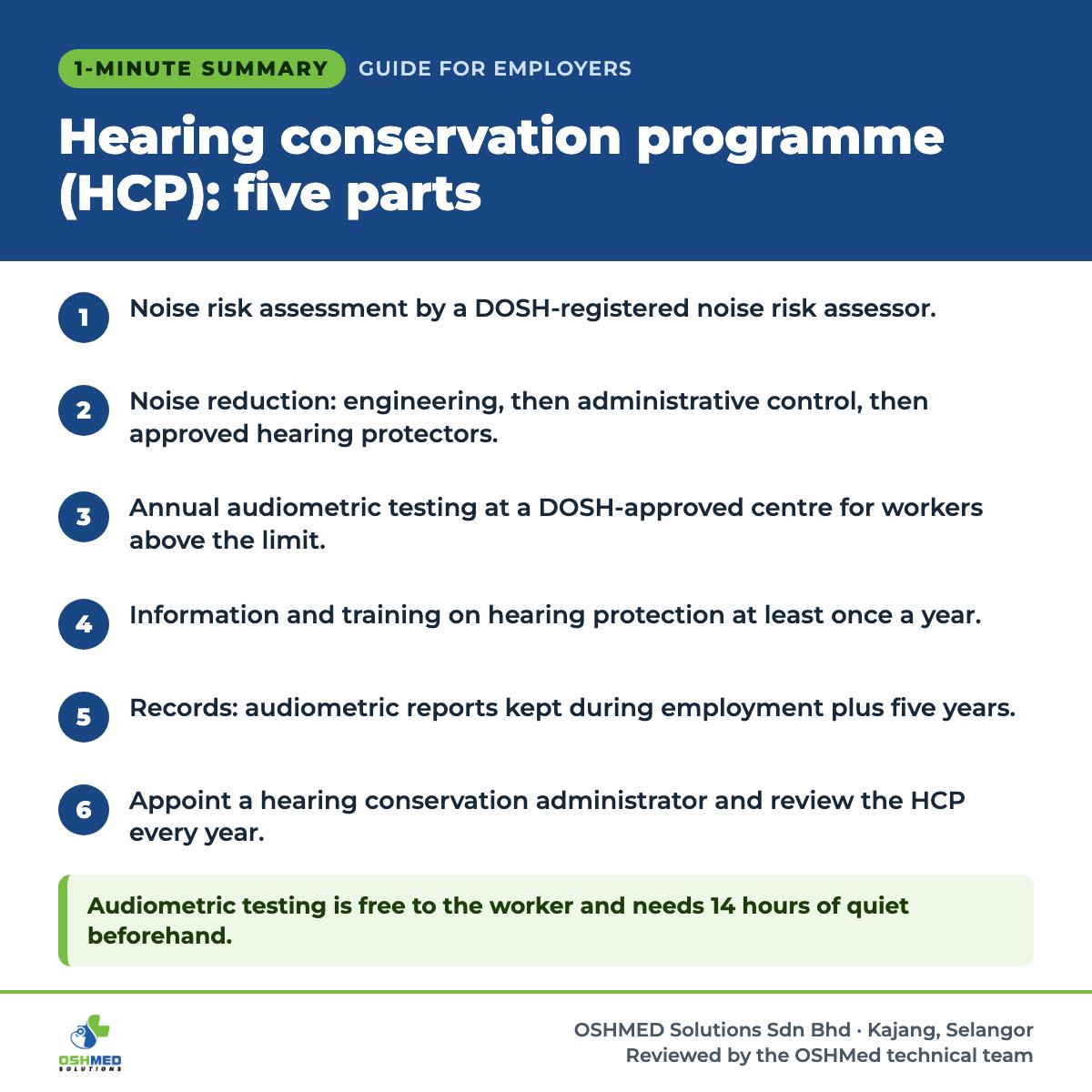
- Noise risk assessment by a DOSH-registered noise risk assessor.
- Noise reduction: engineering, then administrative control, then approved hearing protectors.
- Annual audiometric testing at a DOSH-approved centre for workers above the limit.
- Information and training on hearing protection at least once a year.
- Records: audiometric reports kept during employment plus five years.
- Appoint a hearing conservation administrator and review the HCP every year.
What is a hearing conservation programme (HCP)?
A hearing conservation programme is a structured set of measures that prevents occupational noise-related hearing disorders among workers exposed to excessive noise. The DOSH Industry Code of Practice on Noise Exposure and Hearing Conservation (2019) states that every workplace with excessive noise shall implement a comprehensive HCP covering workers over their entire working lifetimes.
The legal duties come from the Occupational Safety and Health (Noise Exposure) Regulations 2019 (P.U. (A) 60/2019). The ICOP explains how to meet them and sets out the programme structure. It also states that management commitment and active worker involvement are critical to an effective HCP.
What are the five parts of an HCP?
Section 5.3 of the ICOP lists five components: noise risk assessment; noise reduction measures (engineering control, administrative control and personal hearing protectors); audiometric testing; information, instruction and training; and record keeping. The employer appoints a hearing conservation administrator to run it, and the HCP is reviewed once a year.
| Component | What it involves | Regulation |
|---|---|---|
| Noise risk assessment | Registered noise risk assessor; report within one month; review within five years. See our NRA guide. | 4 |
| Noise reduction | Engineering control first, then administrative control, then other measures including hearing protectors; hearing protection zones | 6, 7, 8 |
| Audiometric testing | Annual testing for employees above the exposure limit, at a DOSH-approved audiometric testing centre | 9, 10 |
| Information and training | Effects of noise, audiometric testing, correct use of hearing protectors; at least once a year | 5 |
| Record keeping | NRA reports at least 30 years; audiometric reports during employment plus five years | 11 |
Who needs audiometric testing, and how often?
Regulation 9 requires annual audiometric testing for every employee whose noise risk assessment shows exposure above the limit in regulation 6: a daily exposure above 85 dB(A), a dose above 100%, a maximum level above 115 dB(A) or a peak above 140 dB(C). New workers in such areas are tested within three months.
Regulation 10 adds three practical conditions. The test is at no cost to the employee. It is carried out within three months of the employee starting work in the area. And the employee must have been in a quiet state for at least 14 hours beforehand without relying on hearing protectors, where quiet means no exposure above 80 dB(A).
In one line: training is triggered above 82 dB(A); annual audiometric testing is triggered above the 85 dB(A) limit.
HCP gap checklist
Tick what your workplace already has. The items follow regulations 4 to 11 of the 2019 Regulations and section 5 of the ICOP. Print it for your next safety committee meeting or send your score to us.
0 of 12 ready
Who can perform audiometric testing?
Only an audiometric testing centre approved by the Director General (regulation 9(2)). The centre appoints a DOSH-registered occupational health doctor (OHD) to interpret each audiogram. If the audiogram is abnormal, the OHD carries out a medical examination. A consultancy that is not an approved centre cannot do the test itself.
After testing, the timelines are set out in regulation 9:
| Step | Who | Deadline |
|---|---|---|
| Report of the audiometric testing to the employer | Approved audiometric testing centre | Within 30 days of the test |
| Tell the employee the result | Employer | Within 21 days of receiving the report |
| Retest after a temporary standard threshold shift | Employer arranges with the centre | Within three months of the previous test |
| Notify the Director General of occupational noise-induced hearing loss | Occupational health doctor | Within seven days of the medical examination |
| Notify the nearest DOSH office of any hearing loss, impairment or permanent shift, and provide hearing protectors and training | Employer | Within seven days of receiving the report |
Want your hearing conservation programme reviewed?
Send us your latest noise risk assessment and HCP documents. OSHMed will map the gaps against the 2019 Regulations and the ICOP, and propose a plan for training and programme management.
Who does what in your HCP?
The employer owns the programme and appoints the hearing conservation administrator. Registered specialists handle the regulated parts: the noise risk assessor measures exposure, the approved audiometric testing centre tests hearing, and the occupational health doctor interprets results. A consultant can coordinate, train and keep the programme on schedule.
| Role | Responsibility |
|---|---|
| Employer | Owns the HCP, funds controls and testing, notifies workers and DOSH, keeps records |
| Hearing conservation administrator (HCA) | Appointed by the employer to manage policies, procedures, NRA, testing, training, controls, records and reviews (ICOP 5.1.3) |
| Registered noise risk assessor | Carries out and reviews the noise risk assessment |
| Approved audiometric testing centre | Carries out audiometric testing and reports to the employer |
| Occupational health doctor | Interprets audiograms, examines abnormal cases, notifies DOSH |
| OSHMed | HCP gap review and programme coordination |
OSHMed, an occupational safety and health consultancy in Kajang, Selangor, supports employers with the programme side of the HCP: gap reviews, scheduling, worker training and record organisation. OSHMed is not a clinic and does not perform audiometric tests. Audiometric testing is arranged through our partner Nova Care Sdn Bhd, which is listed by DOSH as an approved static audiometric testing centre at No. 32, Jalan Reko Sentral 4, Kajang (approval JKKP/2025/11-02/00027, valid until 11 February 2028).
See our workplace health page for how testing is arranged, our training page, and the earlier hearing conservation programme overview.
Book the annual audiometric testing round in the same month each year and plan production around the 14-hour quiet period. For night-shift workers, schedule the test so the quiet period is still respected.
- Your noise risk assessment shows any worker above 85 dB(A).
- Audiometric testing has not been done in the last 12 months.
- New workers joined noisy areas more than three months ago without a baseline test.
- A report shows a threshold shift and no retest or notification has been made.
Before you decide: three common objections
Three objections often slow HCP work: the factory already tests hearing every year, only a few workers are exposed, and hearing protectors are already issued. Below, each is checked against the 2019 Regulations and the ICOP, so you can see whether the gap is real before committing any budget.
"We already conduct hearing tests every year."
Testing is one of five parts. Check that it is done at an approved centre, that results reach workers within 21 days, that threshold shifts lead to retests, and that training and records are also in place.
"Only a handful of workers are exposed."
The duties apply per employee exposed. A small exposed group means a smaller programme, not none. The NRA tells you exactly who is in scope.
"Everyone already has earmuffs."
Hearing protectors are the last layer under regulation 6 and must be approved and maintained (regulation 7). Training on proper use is required at least once a year (regulation 5).
Frequently asked questions
How often should audiometric testing be done?
Annually for each employee whose noise risk assessment shows exposure above the limit in regulation 6 of the 2019 Regulations. New employees in those areas are tested within three months of starting. A temporary threshold shift requires a retest within three months.
Who can perform audiometric testing in Malaysia?
Only an audiometric testing centre approved by DOSH may perform audiometric testing. The centre appoints a DOSH-registered occupational health doctor to interpret the audiograms and examine abnormal cases (regulation 9). OSHMed does not perform audiometric testing; we arrange this through an approved centre.
Does the employer have to pay for audiometric testing?
Yes. Regulation 10 requires the employer to ensure that audiometric testing is carried out at no cost to the employee.
What is a hearing conservation administrator?
A person appointed by the employer to administer and supervise the hearing conservation programme. Under section 5.1.3 of the DOSH ICOP, the HCA helps manage policies, noise risk assessment, audiometric testing, training, noise controls, record keeping and programme reviews.
How long must audiometric test records be kept?
For as long as the employee works for you and five years after they leave (regulation 11(1)(b)). Noise risk assessment reports are kept for at least 30 years. Records pass to a new owner if the business is taken over.
Your next step
Run the HCP gap checklist above with your safety committee. Fix the items with fixed deadlines first: annual testing, annual training and the 21-day result notice.
If your noise data is old, start with a noise risk assessment. If chemicals are also used, see our CHRA guide.
Close your HCP gaps before the next annual cycle
We coordinate the programme side; audiometric testing is arranged through a DOSH-approved audiometric testing centre.
Sources and references
Checked against the official documents listed below on 21 October 2026. Laws change: always confirm the current version on the DOSH (JKKP) website.
- Occupational Safety and Health (Noise Exposure) Regulations 2019, P.U. (A) 60/2019 (regulations 5 to 11), Attorney General's Chambers, published by DOSH
- Industry Code of Practice for Management of Occupational Noise Exposure and Hearing Conservation 2019 (section 5, Hearing Conservation Program), DOSH Malaysia
- List of approved audiometric testing centres (Pusat Ujian Audiometrik), entry for Nova Care Sdn. Bhd., DOSH Malaysia
- Occupational Safety and Health Act 1994 (Act 514), reprint incorporating Act A1648 (section 31B, Fifth Schedule), DOSH Malaysia
Disclaimer: This article is general information for employers and is not legal advice. Requirements depend on your workplace, processes and the current law. For a decision on your premises, speak to a DOSH-registered competent person or contact DOSH (JKKP).