
Noise Exposure Regulations 2019: Employer Duties, Limits and Deadlines
The Noise Exposure Regulations 2019 (P.U. (A) 60/2019) apply to places of work under Act 514. Employers must identify excessive noise at least yearly, appoint a DOSH-registered noise risk assessor where noise may exceed 82 dB(A), train exposed workers yearly, keep daily exposure within 85 dB(A), mark hearing protection zones, arrange annual audiometric testing and keep records.
- MD (NNSMA, Rus)
- MScCH (Occ. Health, UKM)
- MBA (ARU, UK)
- OHD (NIOSH)
- MRO (AOEMM)
- TTT (HRDF)
- SSM 202001013523 (OSHMED Solutions Sdn Bhd)
- DOSH registered training provider SL/22/22/181036, valid to 21 July 2028
- MMC Full Registration 55275 (Dr. Wan Muhammad Zulhusni)
- DOSH Occupational Health Doctor HQ/16/DOC/00/454
- DMAC/EDTCmed 263
- OEUK OEUK/2024/3751
OSHMed Solutions Sdn Bhd is an occupational safety and health consultancy and DOSH-registered training provider (ergonomics) in Kajang, Selangor. We are not a clinic. Medical tests are arranged through approved centres.
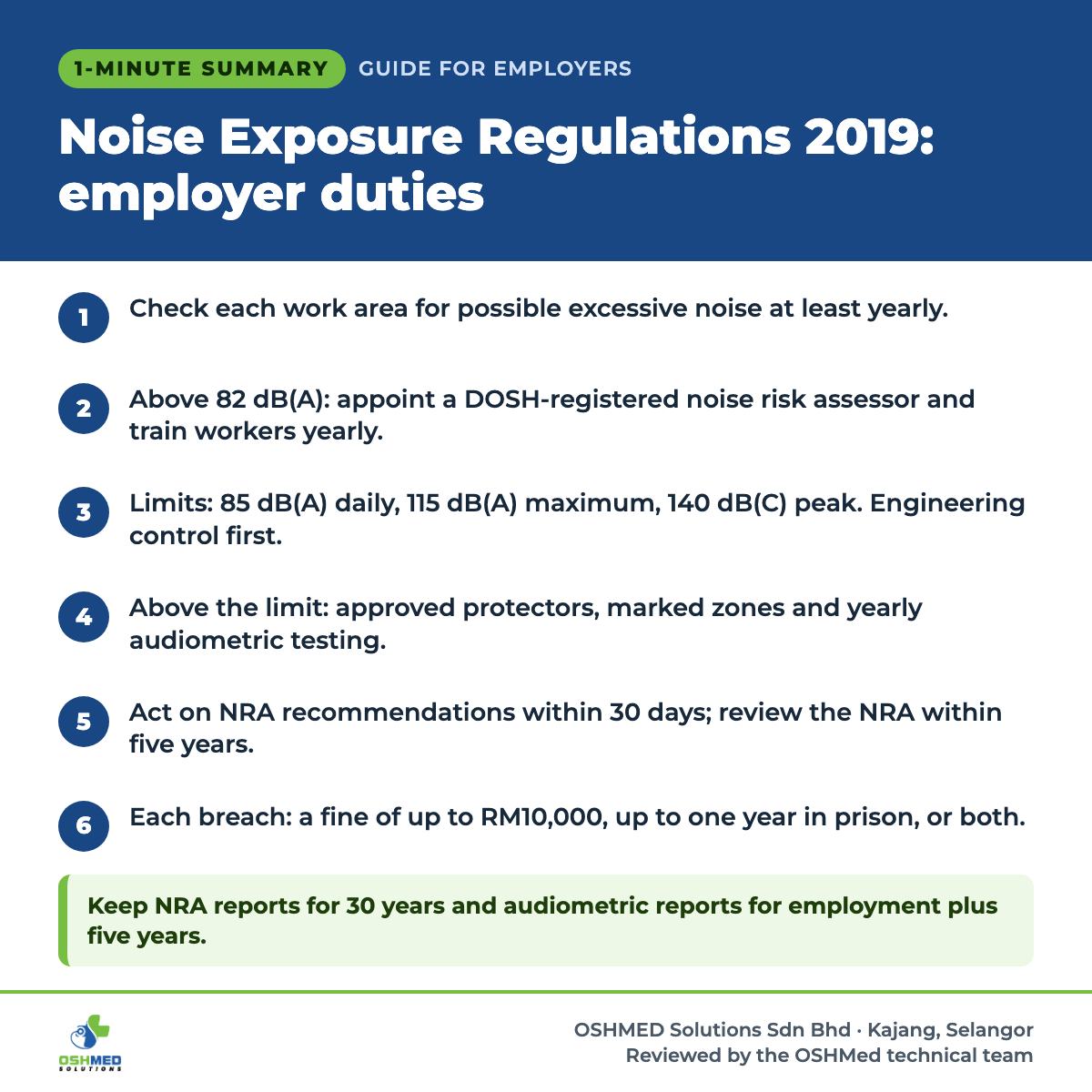
- Check each work area for possible excessive noise at least yearly.
- Above 82 dB(A): appoint a DOSH-registered noise risk assessor and train workers yearly.
- Limits: 85 dB(A) daily, 115 dB(A) maximum, 140 dB(C) peak. Engineering control first.
- Above the limit: approved protectors, marked zones and yearly audiometric testing.
- Act on NRA recommendations within 30 days; review the NRA within five years.
- Each breach: a fine of up to RM10,000, up to one year in prison, or both.
What are the Noise Exposure Regulations 2019?
They are the Occupational Safety and Health (Noise Exposure) Regulations 2019, P.U. (A) 60/2019, made under section 66 of Act 514 and in force since 1 June 2019. They replaced the 1989 factory noise rules and were made to extend noise duties to every sector under Act 514.
The DOSH Industry Code of Practice (ICOP) for Management of Occupational Noise Exposure and Hearing Conservation 2019 explains how to comply. Its foreword notes that noise-related hearing disorders are reported more often than any other occupational disease in Malaysia.
Why the ICOP matters: a court takes a failure to follow a relevant ICOP provision as proof of the breach, unless you show you met the law another way (Act 514, section 38).
The 2019 rules are stricter: the 1989 regulations set the limit at 90 dB(A) and the action level at 85 dB(A); the 2019 Regulations set the limit at 85 dB(A) and excessive noise above 82 dB(A).
What do 82 dB(A), 85 dB(A), 115 dB(A) and 140 dB(C) mean?
Daily exposure above 82 dB(A), or a daily dose above 50%, is excessive noise and triggers the NRA and training duties. Above 85 dB(A), or a 100% dose, breaches the exposure limit, as does any level above 115 dB(A) or a peak above 140 dB(C).
| Measured level | What it triggers | Rule |
|---|---|---|
| Above 82 dB(A) daily, or dose above 50% (excessive noise) | NRA by a registered assessor; training at least once a year | Reg. 2, 4, 5 |
| Above 85 dB(A) daily, or dose above 100% (the limit) | Noise reduction, approved protectors, a hearing protection zone and annual audiometric testing | Reg. 6 to 9 |
| Above 115 dB(A) at any moment, or a peak above 140 dB(C) | The same duties as above the limit, whatever the daily average | Reg. 6(1)(b), (c) |
What must employers do under each regulation?
Regulations 3 to 11 each set a duty. Identification applies to every employer; the rest start when the NRA report shows excessive noise or exposure above the limit. The table maps each duty to what you need to buy or arrange for the year.
| Regulation | What the employer must do | What to buy or arrange |
|---|---|---|
| 3: Identification | Check each area; repeat after changes and at least yearly | In-house, with the ICOP Appendix 1 checklist |
| 4: Noise risk assessment | Registered assessor; findings to workers in 14 days; act in 30 days; review in five years | An NRA by a registered assessor |
| 5: Information and training | Noise effects, audiometric testing and protector use; supervise controls; yearly | Yearly hearing conservation training |
| 6: Exposure limit | Engineering, then administrative controls, where practicable; a written assessment; maintenance | A practicability report; an acoustic consultant |
| 7: Hearing protectors | Suitable, maintained, available, DOSH-approved, attenuating below the limit | Models on the DOSH approved list |
| 8: Hearing protection zones | Mark zones above the limit; everyone inside wears protectors | Signs and protectors at entry points |
| 9: Audiometric testing | Yearly above the limit at an approved centre; results to workers in 21 days | A DOSH-approved testing centre |
| 10: Test conditions | No cost to the worker; within three months of starting; 14 hours below 80 dB(A) first | A schedule that fits your shifts |
| 11: Records | NRA reports for 30 years; audiometric reports for employment plus five years | A file that passes to any new owner |
The ICOP groups these duties into a hearing conservation programme, reviewed yearly (ICOP 5.1.4). How to run it: our hearing conservation programme guide.
Noise Exposure Regulations 2019 compliance self-check
Tick each duty already in place at your workplace. The 12 items follow regulations 3 to 11 of the Noise Exposure Regulations 2019 in order. Print the result for your safety and health committee, or send your score to OSHMed on WhatsApp.
0 of 12 ready
Which duties repeat, and how often?
Four duties are due every year: identification, training, audiometric testing above the limit and the ICOP programme review. The NRA is reviewed within five years. Deadlines, such as the 14 and 30 days after an NRA report, are in the duty table above.
- Identification: within a year of the last one (regulation 3(2)(b)).
- Training: at least once a year (regulation 5(2)).
- Audiometric testing: every year above the limit (regulation 9(1)).
- Programme review: once a year (ICOP 5.1.4).
- NRA review: within five years, or sooner if DOSH directs (regulation 4(8)).
What must the yearly noise training cover?
Regulation 5 requires information on how noise affects hearing and why audiometric testing is needed, training in the proper use of hearing protectors, and supervision of noise controls. It applies at least once a year to every worker the NRA report shows as exposed to excessive noise.
ICOP section 12.3.1 lists seven topics:
- The 2019 Regulations.
- How noise affects hearing.
- The purpose of the hearing conservation programme.
- Hearing protector types, attenuation, fitting and care.
- Audiometric testing and pre-test instructions.
- What audiometric results mean.
- Your noise control plan.
Deliver it in a language every exposed worker understands (ICOP 12.3.3). The ICOP also recommends training managers, supervisors and buyers of machinery or protectors (12.4.2): this is where noise awareness training fits.
OSHMed’s one-day hearing conservation programme training is for exposed workers, supervisors and OSH committee members. It covers how noise affects hearing, what your NRA results mean, hearing protection, audiometric testing and duties under the 2019 Regulations. It runs in-house; the trainer is confirmed in your quote. See all OSH training courses.
Is your yearly noise training due?
Regulation 5(2) requires training for exposed workers at least once a year. OSHMed runs a one-day hearing conservation programme course at your premises and can also provide a quote for your NRA review. Request an in-house training quote.
How do you choose providers for the NRA, training and testing?
Check each provider against what the law specifies: a DOSH-registered noise risk assessor, a DOSH-approved audiometric testing centre with an occupational health doctor, and DOSH-approved hearing protectors. For training, compare the content with ICOP section 12 and ask for the attendance record.
| Service | What to check | Where to verify |
|---|---|---|
| Noise risk assessment | Named assessor, registration valid on the fieldwork date, area and personal monitoring | myKKP lookup; ICOP 14.1.3 |
| Audiometric testing | Centre on the DOSH list; doctor interprets; report in 30 days | DOSH list of approved centres |
| Hearing protectors | Approved model, with attenuation data from the supplier | DOSH ear protection list |
OSHMED Solutions Sdn Bhd in Kajang, Selangor, serves employers across Malaysia. We run the yearly noise training and coordinate noise risk assessments by a DOSH-registered assessor, named in every report with their myKKP number. Where needed, audiometric testing is carried out and billed by our partner Nova Care Sdn Bhd, a DOSH-approved audiometric testing centre (JKKP/2025/11-02/00027, valid until 11 February 2028). See our assessment services and workplace health page.
What are the penalties under the Noise Exposure Regulations 2019?
Each breach of regulations 3 to 9 or 11 can bring a fine of up to RM10,000, up to one year in prison, or both. Act 514 adds penalties of up to RM500,000 for wider failures, and directors and managers can be charged with the company (section 52).
Failing to implement risk controls under section 18B carries a fine of up to RM500,000, up to two years in prison, or both (section 19). Regulations 4 and 9 apply to “any person”, so assessors and testing centres can be charged too.
- Exposed workers were last trained over 12 months ago.
- Your NRA shows exposure above 82 dB(A) but no training record exists.
- Your NRA is over four and a half years old, or machinery or shifts have changed.
- New workers started in areas above the limit without a baseline test.
Before you decide: three common objections
Three objections delay compliance: the rules are only for factories, an old noise survey still counts, and induction training is enough. Each is checked below against the 2019 Regulations, the 2019 revocation rules and the ICOP, so you can decide based on the text of the law.
"We are not a factory, so the noise rules do not apply."
The 2019 Regulations cover every sector under Act 514, and since 1 June 2024 the Act covers all places of work, public services included, except domestic service, the armed forces and work on ships (section 1).
"Our noise survey from before 2019 is still valid."
No. Monitoring under the 1989 rules stayed valid for only 12 months after 1 June 2019, and employers had to complete an NRA within that year (P.U. (A) 59/2019, regulation 3).
"We trained everyone at induction."
Induction is a start. Regulation 5(2) requires training at least once a year, updated when controls or processes change (ICOP 12).
Frequently asked questions
Is there an English version of the Noise Exposure Regulations 2019?
Yes. The gazette, P.U. (A) 60/2019, is bilingual: Malay text from page 2, English from page 15. The ICOP has English and Malay (Tataamalan Industri) editions with matching section numbers.
What is the noise exposure limit in Malaysia?
Regulation 6 sets three limits: a daily noise exposure level of 85 dB(A) or a daily dose of 100%, a maximum of 115 dB(A) at any time, and a peak of 140 dB(C). No employee may be exposed above any of them.
What does 82 dB(A) mean for employers?
A daily level above 82 dB(A), or a dose above 50%, is “excessive noise” (regulation 2). Possible exposure triggers the NRA; confirmed exposure triggers yearly information and training. Annual audiometric testing starts only above 85 dB(A).
How often must noise training be given?
At least once a year for every employee the NRA report shows as exposed to excessive noise (regulation 5(2); ICOP 11.4.1), in a language they understand (ICOP 12.3.3).
What is the penalty for breaching the Noise Exposure Regulations 2019?
A fine of up to RM10,000, up to one year in prison, or both, for each breach of regulations 3 to 9 or 11. Act 514 adds heavier penalties, up to RM500,000 under section 19 for failing to implement risk controls.
Your next step
Run the 12-point self-check above with your safety and health committee. Training gap? Book the yearly hearing conservation training. NRA missing or over five years old? Ask OSHMed for a scoped quote.
Planning the NRA first? Read what an NRA covers and what sets its price.
Close the gaps from your self-check
Send us your self-check score or your latest NRA report. OSHMed will reply with a written quote for the yearly training and, where needed, the NRA review. Ask for a written quote.
Sources and references
Checked against the official documents listed below on 29 October 2026. Laws change: always confirm the current version on the DOSH (JKKP) website.
- Occupational Safety and Health (Noise Exposure) Regulations 2019, P.U. (A) 60/2019 (regulations 1 to 11; Malay text pages 2 to 14, English text pages 15 to 26), Attorney General's Chambers, published by DOSH
- Industry Code of Practice for Management of Occupational Noise Exposure and Hearing Conservation 2019 (Foreword, Preface, sections 5, 6, 7, 11 to 15, Appendix 1), DOSH Malaysia
- Factories and Machinery (Noise Exposure) (Revocation) Regulations 2019, P.U. (A) 59/2019 (regulations 2 and 3), DOSH Malaysia
- Factories and Machinery (Noise Exposure) Regulations 1989, P.U. (A) 1/1989 (revoked; regulations 2 and 5), DOSH Malaysia
- Occupational Safety and Health Act 1994 (Act 514), reprint incorporating Act A1648 (sections 1, 18B, 19, 38, 52, 66, First Schedule), DOSH Malaysia
- Regulations under the Occupational Safety and Health Act 1994 (Act 514), DOSH Malaysia
- List of approvals: ear protection (Perlindungan Telinga), DOSH Malaysia
- List of approvals (Senarai Kelulusan / Kebenaran), including the myKKP competent person lookup, DOSH Malaysia
- List of approved audiometric testing centres (Pusat Ujian Audiometrik), entry for Nova Care Sdn. Bhd., DOSH Malaysia
Disclaimer: This article is general information for employers and is not legal advice. Requirements depend on your workplace, processes and the current law. For a decision on your premises, speak to a DOSH-registered competent person or contact DOSH (JKKP).