
First Aid Training Malaysia: How Many First Aiders Do You Need?
How much first aid training Malaysia employers need depends on headcount, risk and shifts. The DOSH Guidelines on First-Aid in the Workplace (2004) suggest one first aider for a low-risk site under 20 workers, two for 21 to 150, and one for every 20 workers on each shift at high-risk sites. First aiders should attend a recognised course every three years.
- MD (NNSMA, Rus)
- MScCH (Occ. Health, UKM)
- MBA (ARU, UK)
- OHD (NIOSH)
- MRO (AOEMM)
- TTT (HRDF)
- SSM 202001013523 (OSHMED Solutions Sdn Bhd)
- DOSH registered training provider SL/22/22/181036, valid to 21 July 2028
- MMC Full Registration 55275 (Dr. Wan Muhammad Zulhusni)
- DOSH Occupational Health Doctor HQ/16/DOC/00/454
- DMAC/EDTCmed 263
- OEUK OEUK/2024/3751
OSHMed Solutions Sdn Bhd is an occupational safety and health consultancy and DOSH-registered training provider (ergonomics) in Kajang, Selangor. We are not a clinic. Medical tests are arranged through approved centres.
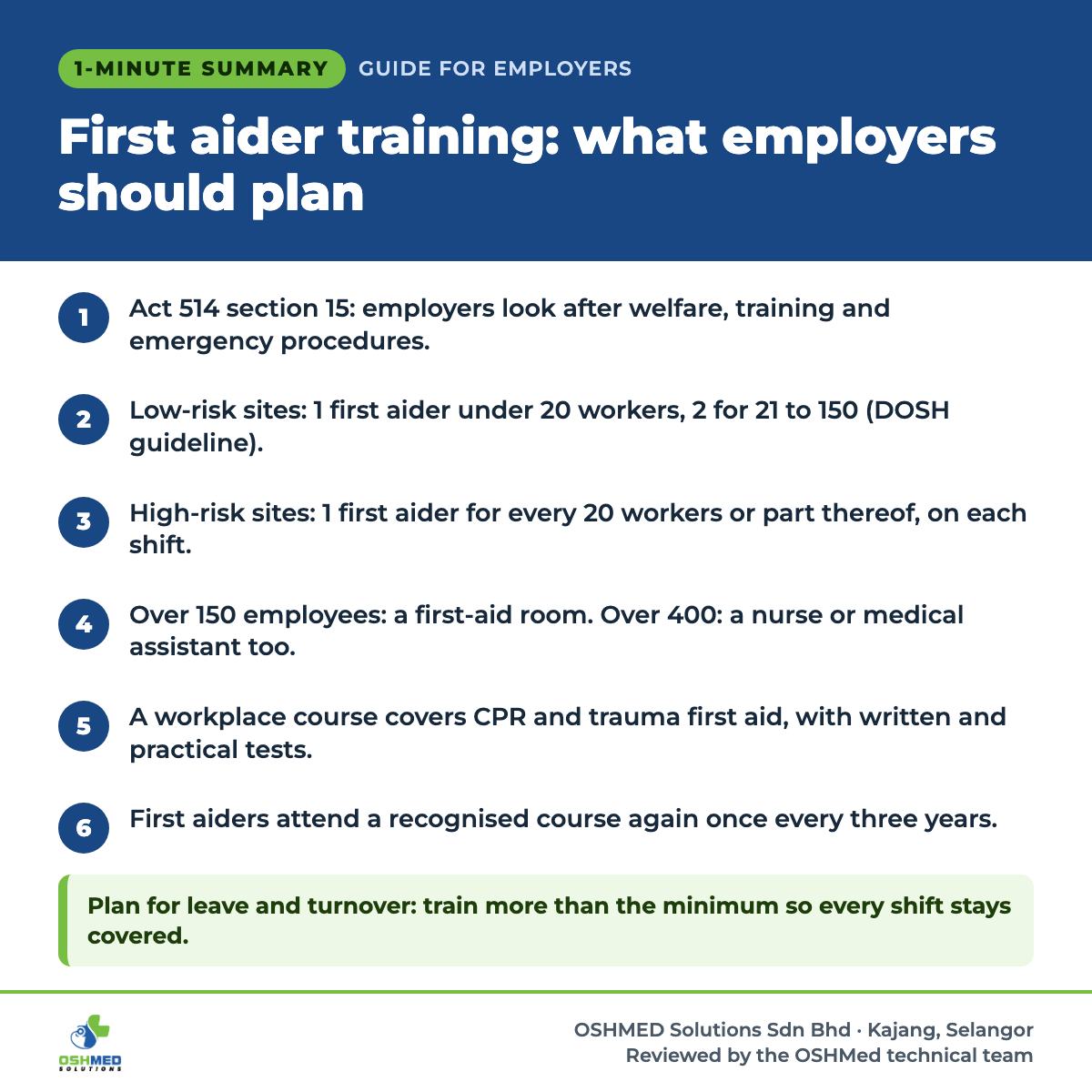
- Act 514 section 15: employers look after welfare, training and emergency procedures.
- Low-risk sites: 1 first aider under 20 workers, 2 for 21 to 150 (DOSH guideline).
- High-risk sites: 1 first aider for every 20 workers or part thereof, on each shift.
- Over 150 employees: a first-aid room. Over 400: a nurse or medical assistant too.
- A workplace course covers CPR and trauma first aid, with written and practical tests.
- First aiders attend a recognised course again once every three years.
Do employers in Malaysia have to train first aiders?
In practice, yes. Section 15 of the Occupational Safety and Health Act 1994 requires employers to ensure, so far as is practicable, the safety, health and welfare of employees, including training and emergency procedures. DOSH states that providing first-aid facilities and first aiders meets the welfare part of this duty.
The numbers come from the DOSH Guidelines on First-Aid in the Workplace (2nd Edition, 2004), which are guidance, not a regulation. The old factory rule, regulation 38 of the 1970 Safety, Health and Welfare Regulations, is listed by DOSH as repealed since the Factories and Machinery Act 1967 was repealed on 1 June 2024.
Breaching the section 15 duty is an offence under section 19, with a fine of up to RM500,000, imprisonment of up to two years, or both.
How many first aiders does your workplace need?
Table 4.1.1 of the DOSH guideline is the benchmark. Low-risk workplaces such as offices need one first aider below 20 workers, two for 21 to 150, and two per 150 above that. High-risk sites need one for every 20 workers or part thereof, on every shift.
| Workplace | Workers | First aiders |
|---|---|---|
| Low risk (for example an office) | Less than 20 | One |
| Low risk | 21 to 150 | Two |
| Low risk | More than 150 | Two per 150 or part thereof |
| High risk (for example chemical plant, shipyard, construction site) | Less than 20 | One per shift |
| High risk | 20 or more | One per 20 or part thereof |
| Any workplace | More than 400 | Two per 150 or part thereof, plus a registered nurse or medical assistant on site |
| Logging | Each tree-felling gang | One |
Examples: an office of 60 on one shift needs two first aiders; an office of 320 needs six (three blocks of 150) and a first-aid room; a high-risk factory with 85 workers on each of two shifts needs five per shift, ten in total.
First aider planner: how many should you train?
Enter your largest shift, the number of shifts and your type of workplace. The planner applies Table 4.1.1 of the DOSH first aid guideline and rounds up where a band is unclear. Print the result or send it to us for a training plan.
Planning estimate based on Table 4.1.1 of the DOSH Guidelines on First-Aid in the Workplace (2nd Edition, 2004). The guideline is guidance, not a regulation. Logging work needs one first aider per tree-felling gang. Add cover for leave and turnover. Training details: BOFA course.
- Shifts. Each shift needs its own first aiders (paragraph 4.1.2); add cover for leave and turnover.
- Shared sites. The principal employer provides cover, or the employers agree in writing who will (paragraph 4.1.3).
- Chemicals. First aiders need extra training on chemical poisoning and decontamination (paragraph 7.2). See our CHRA guide.
- Remote sites. Weigh the distance to the nearest clinic or hospital (paragraph 3.2).
What should a workplace first aider course cover?
Appendix 2 of the DOSH guideline sets a two-part minimum. Part One is basic life support: CPR, choking and the recovery position. Part Two is first aid and basic trauma life support: patient assessment, spinal injury, shock, fractures and wounds. Both parts end with a theory and practical assessment.
| Topic | Short CPR and AED session | Workplace course (DOSH Appendix 2) |
|---|---|---|
| CPR and choking | Yes | Yes |
| Patient assessment | Usually not | Yes |
| Spinal injury and casualty transport | Usually not | Yes |
| Shock, fractures and wounds | Usually not | Yes, with bandaging and splinting |
| Written and practical tests | Varies | Yes |
AED (automated external defibrillator) use is not in the 2004 guideline, but OSHMed’s BOFA includes it for workplaces that keep a defibrillator.
How long is a first aid certificate valid?
The DOSH guideline recommends that first aiders attend a recognised course once every three years, and that employers record each training date. Competency certificates from St John Ambulance of Malaysia and the Malaysian Red Crescent run for up to three years, so book refreshers before they lapse.
Keep a register of each first aider’s shift, course date and certificate expiry. The guideline also asks for casualty records kept for five years and a yearly review using its Appendix 5 checklist.
Book refresher training three months before the first certificate expires, so no shift is left without a first aider while you wait for a class date.
Need first aiders trained for every shift?
Tell us your headcount, shifts and site hazards. OSHMed will propose an in-house Basic Occupational First Aid (BOFA) session at your premises, or you can request a written quote now.
In-house or public class: which suits your company?
Public classes suit one or two staff, or replacements between training cycles. In-house training suits employers who need several first aiders at once: one session covers every shift, scenarios use your own site and hazards, and nobody travels. In-house classes are usually quoted per group, public classes per seat.
Course length varies from one-day sessions to two-day programmes. Compare the content and assessment against Appendix 2, not only the number of days.
How do you compare first aid training providers?
Compare what the certificate proves, not only the fee. Ask each provider how the course maps to Appendix 2 of the DOSH guideline, how participants are assessed, who issues the certificate and for how long, and what instructor training the trainers hold, in writing.
- Recognition route. Appendix 1 lists Ministry of Health institutions, Ministry of Education hospitals, NIOSH, MASTEM, the Malaysian Red Crescent Society, St John Ambulance Malaysia, and organisations whose trainers were trained by these bodies and approved by the DOSH Director General.
- Syllabus and assessment. Both Appendix 2 parts, with written and practical tests.
- Certificate. The issuer, the validity period and the record you receive.
- Trainers. Names, instructor training and the trainer to participant ratio.
DOSH registers training providers course by course, and its list of categories has no first aid category. Check what any provider’s registration covers.
What else must be in place besides trained first aiders?
First aiders need equipment and visibility. The DOSH guideline asks for a clearly marked, well-stocked first aid box within easy reach, a first-aid room where there are more than 150 employees, a notice naming your first aiders and their locations, and a badge or armband for each.
- First aid box. Appendix 4 recommends 25 items, from bandages and gloves to a CPR barrier device. Keep only first aid materials inside and restock quickly.
- Large sites. Provide enough boxes for the area, and review the set-up yearly with the Appendix 5 checklist.
For background on why first aid skills matter at work, see our earlier article on why BOFA matters in the workplace.
OSHMed Solutions Sdn Bhd, an occupational safety and health consultancy in Kajang, Selangor, runs in-house Basic Occupational First Aid (BOFA) training at employers’ premises across Malaysia, covering CPR and AED use, cuts, burns, fractures, sprains, workplace injuries, choking and poisoning. OSHMed is a DOSH-registered training provider for the Ergonomic Trained Person (ETP) course. For BOFA, ask for the outline, assessment method and certificate details with your quote. See our training services.
- More than 150 employees, or more than 400 workers.
- Chemical handling that may need decontamination first aid.
- Contractors sharing the site without a written first aid agreement.
- Night shifts, a remote site, or certificates older than three years.
Before you decide: three common objections
Three objections often delay first aider training: staff already did a CPR class, the workplace is only an office, and the first aiders were trained years ago. Each is checked below against the DOSH guideline before you set a budget.
"Our staff already attended a CPR class."
CPR is only Part One of Appendix 2. A workplace first aider also needs Part Two, with a practical test.
"We are only an office."
Low-risk sites still need one first aider below 20 workers and two from 21 to 150. Offices also face fainting, falls and cardiac arrest.
"Our first aiders were trained four years ago."
The guideline asks for a recognised course every three years. Book a refresher and update your register.
Frequently asked questions
How many first aiders does a workplace in Malaysia need?
The DOSH first aid guideline (2004) suggests one first aider for low-risk workplaces under 20 workers, two for 21 to 150, and two per 150 above that. High-risk sites need one per 20 workers or part thereof on each shift.
Is first aid training a legal requirement for employers in Malaysia?
Section 15 of Act 514 requires employers to ensure, so far as is practicable, the safety, health and welfare of employees, including training and emergency procedures. DOSH links first aiders to this welfare duty. The 1970 factory first aid regulation is listed by DOSH as repealed.
How long is a first aid certificate valid?
The DOSH guideline asks first aiders to attend a recognised course once every three years. St John Ambulance of Malaysia and the Malaysian Red Crescent issue competency certificates valid for up to three years. Record every training date and book refreshers early.
Which first aid courses does DOSH recognise?
Appendix 1 of the DOSH guideline lists Ministry of Health institutions, Ministry of Education hospitals, NIOSH, MASTEM, the Malaysian Red Crescent Society and St John Ambulance Malaysia, plus organisations whose trainers were trained by these bodies and approved by the DOSH Director General.
What should a workplace first aid box contain?
Appendix 4 of the DOSH guideline recommends 25 items, including triangular and roller bandages, sterile gauze and eye pads, a burn dressing, gloves, bandage scissors, a CPR barrier device, a thermometer, a first aid manual and a contents checklist.
How much does first aid training cost in Malaysia?
Fees depend on format, group size, course length and location. Public classes are priced per seat; in-house classes are usually quoted per group. Compare syllabus, assessment, certificate validity and trainers, not only the fee.
Your next step
Run the planner, then compare the result with your current first aider list and certificate dates. Close the gaps shift by shift.
Then see the BOFA course page or send us your result on WhatsApp. Using chemicals too? Read our CHRA guide and the OSH coordinator guide.
Plan your first aider cover before the next audit
Use the planner above, then send us the result. We will reply with a training plan for your group, or fill in the quote form.
Sources and references
Checked against the official documents listed below on 28 October 2026. Laws change: always confirm the current version on the DOSH (JKKP) website.
- Guidelines on First-Aid in the Workplace (2nd Edition) 2004, JKKP GP(I) 06/2004 (paragraphs 2 to 7, Appendices 1, 2, 4 and 5), DOSH Malaysia
- Occupational Safety and Health Act 1994 (Act 514), reprint incorporating Act A1648 (sections 15 and 19), DOSH Malaysia
- Factories and Machinery (Repeal) Act 2022 (Act 835), Attorney General's Chambers, published by DOSH
- Appointment of date of coming into operation, Factories and Machinery (Repeal) Act 2022, P.U. (B) 127/2024, Attorney General's Chambers, published by DOSH
- Regulations that have been repealed (Peraturan Yang Telah Dimansuhkan), regulations under Act 139, DOSH Malaysia
- Registered training provider categories (Semakan: Penyedia Latihan Berdaftar), DOSH Malaysia
Disclaimer: This article is general information for employers and is not legal advice. Requirements depend on your workplace, processes and the current law. For a decision on your premises, speak to a DOSH-registered competent person or contact DOSH (JKKP).