
LEV Inspection in Malaysia: DOSH Rules, Frequency and Records
LEV inspection in Malaysia follows regulation 17 of USECHH 2000: the employer inspects each local exhaust ventilation system at least monthly, and a DOSH-registered Hygiene Technician 2 examines and tests it at least every 12 months. A registered professional engineer designs and commissions a new LEV (regulation 18).
- MD (NNSMA, Rus)
- MScCH (Occ. Health, UKM)
- MBA (ARU, UK)
- OHD (NIOSH)
- MRO (AOEMM)
- TTT (HRDF)
- SSM 202001013523 (OSHMED Solutions Sdn Bhd)
- DOSH registered training provider SL/22/22/181036, valid to 21 July 2028
- MMC Full Registration 55275 (Dr. Wan Muhammad Zulhusni)
- DOSH Occupational Health Doctor HQ/16/DOC/00/454
- DMAC/EDTCmed 263
- OEUK OEUK/2024/3751
OSHMed Solutions Sdn Bhd is an occupational safety and health consultancy and DOSH-registered training provider (ergonomics) in Kajang, Selangor. We are not a clinic. Medical tests are arranged through approved centres.
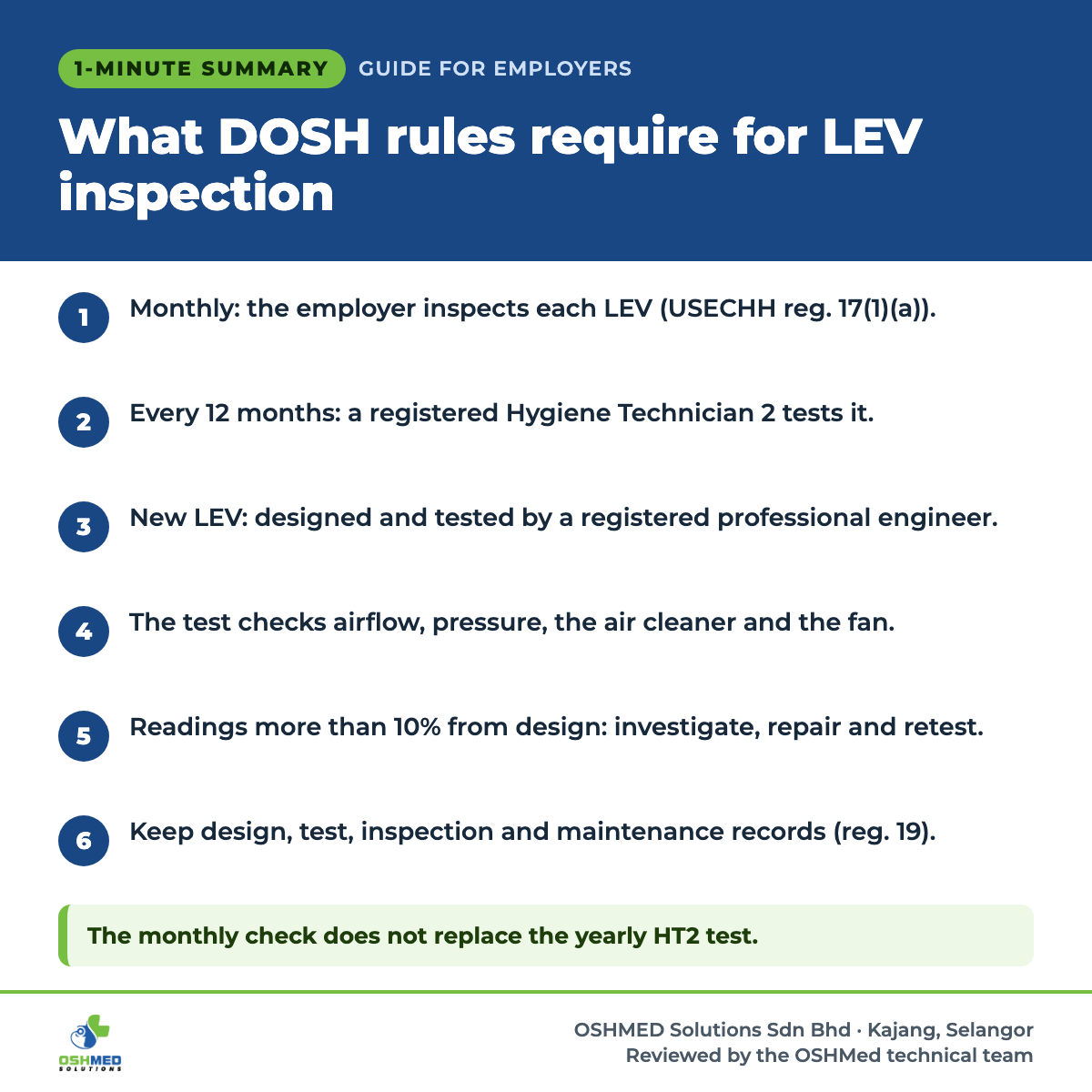
- Monthly: the employer inspects each LEV (USECHH reg. 17(1)(a)).
- Every 12 months: a registered Hygiene Technician 2 tests it.
- New LEV: designed and tested by a registered professional engineer.
- The test checks airflow, pressure, the air cleaner and the fan.
- Readings more than 10% from design: investigate, repair and retest.
- Keep design, test, inspection and maintenance records (reg. 19).
The monthly check does not replace the yearly HT2 test.
What is LEV inspection under DOSH rules?
LEV inspection covers the checks USECHH 2000 requires on local exhaust ventilation, a type of engineering control equipment (regulation 2): a commissioning test by a registered professional engineer, the employer’s monthly inspection, and a yearly examination and test by a registered hygiene technician.
An LEV captures a contaminant at or near its source with up to four parts: hood, ducting, air cleaner and fan (DOSH LEV Guidelines 2008, 1.1, 1.2). The duties apply when it is a control measure under regulation 15(1)(f).
| Check | Who does it | When | Rule |
|---|---|---|---|
| Commissioning test | Registered professional engineer (Act 138) | After construction and installation | Reg. 18(1)(b) |
| Inspection | The employer, through a person taught the procedure | At least once a month | Reg. 17(1)(a); Guidelines 4.1 |
| Examination and test | Hygiene Technician 2 registered with DOSH | At least every 12 months | Reg. 17(1)(b); Guidelines 4.2 |
The DOSH LEV guidelines (2008) explain the method but are guidance; the duties sit in the regulations (USECHH 2000 guide).
How often must an LEV be inspected and tested?
At least monthly for the employer’s inspection and at least every 12 months for the hygiene technician’s test (regulation 17(1)). These are maximum intervals: the designer can set shorter ones, and signs of reduced airflow call for testing sooner (Guidelines 4.1, 4.2).
| Trigger | What to do | Basis |
|---|---|---|
| Every month | Employer’s inspection | Reg. 17(1)(a) |
| Every 12 months | Examination and test by a Hygiene Technician 2 | Reg. 17(1)(b) |
| New LEV | Engineer’s test; readings become the baseline | Reg. 18(1)(b); Guidelines 4.2 |
| Signs of reduced airflow | Test without waiting for the yearly due date | Guidelines 4.1 |
| After a repair | Retest the equipment | CHRA Manual 7.2.1.3; Guidelines 5 |
Who can carry out LEV inspection and testing?
Three different people. A registered professional engineer designs and commissions a new LEV (regulation 18). Anyone taught the procedure can do the monthly inspection (Guidelines 4.1). The yearly examination and test requires a hygiene technician registered with DOSH in the Hygiene Technician 2 (HT2) category.
- Hygiene Technician 2: DOSH’s HT2 page says employers shall appoint, employ or engage an HT2 for this work (how to check one).
- Not Hygiene Technician 1: DOSH registers HT1 for chemical exposure monitoring (CEM guide); LEV testing falls under the HT2 category.
- Registered professional engineer (Act 138): no specific LEV design standard exists, so the designer submits the chosen standard to the Director General for approval (Guidelines 3).
What does the monthly LEV inspection cover?
Seven items, listed in section 4.1 of the DOSH 2008 guidelines: physical condition, how work is done at the hood, a smoke tube test, obstructions, the area around the hood, the air cleaner and the fan motor. Record each inspection: regulation 19 requires inspection records.
- Physical condition: no abrasion, corrosion, dents or damaged coating.
- Work practice: the hood suits the job without hindering the worker.
- Smoke tube test, system running: smoke is drawn completely into the hood, not escaping or lingering.
- Obstructions: nothing blocking the hood opening.
- Surroundings: no cross draughts or fans disturbing the hood.
- Air cleaner: filter, cyclone or scrubber in working order.
- Fan motor: maintenance checked.
Fix damage first: Appendix A of the guidelines says rectification has to be done before inspection can proceed. Its tables can also serve as your monthly form.
What does the yearly LEV examination and test measure?
It repeats the monthly inspection, then measures capture or face velocity, hood and duct static pressure, velocity pressure and transport velocity, air cleaner efficiency, and fan capacity and efficiency (Guidelines 4.2). Results are compared with the design specification or the commissioning baseline.
| Measurement | Typical instrument | Indicator in the 2008 guidelines |
|---|---|---|
| Capture or face velocity | Anemometer; enclosure hoods split into at least 16 equal areas | Within 10% of the design value or standard |
| Hood static pressure | Manometer | No more than 10% from the design static pressure |
| Duct static pressure and duct velocity | Manometer; pitot tube traverse | Within 10% of the baseline |
| Air cleaner | Manometer | 10% above or below design suggests plugging, wear or damage |
| Fan | Tachometer; belt, rotation and bearing checks | As specified in the design |
A result more than 10% from the design specification, or below the standard, signals a fault: investigate, rectify and retest (Guidelines 5). Without commissioning data, there is no baseline.
What must the LEV report and records include?
DOSH’s Hygiene Technician 2 page sets out the reporting duties: a complete report to the employer within 30 days of the test, a presentation of results with proposed improvements, and a brief report to the Director General, also within 30 days. Regulation 19 covers the records.
- Records (regulation 19): design, construction, testing, inspection, examination and maintenance, produced when the Director General directs.
- How long: regulation 19 sets no period. DOSH’s CHRA Manual (Table 19) recommends five years for monthly and hygiene technician records, and the lifetime of use for design and construction records.
- Change of owner: records pass to the successor, or to DOSH if there is none (regulation 30).
- Format: the 2008 guidelines include no report template; Appendix A lists each item, procedure and pass indicator.
LEV test due, or CHRA out of date?
Send your list of LEV systems, the last hygiene technician report and your current CHRA. OSHMed will reply with a written quote. The LEV test is arranged through an external Hygiene Technician 2 registered with DOSH, and the CHRA is carried out by a registered assessor: request a quote.
How does LEV testing connect to your CHRA?
Directly. A CHRA assessor asks for the LEV design parameters, monthly inspection records and the hygiene technician’s report (CHRA Manual 2.1.5), then judges whether the LEV controls exposure. If controls must improve, regulation 14(1) gives you one month after receiving the report to act.
- An adequate LEV (CHRA Manual 7.2.1.2): no build-up around the hood, good suction in the smoke tube test, velocity meeting the recommended value, and a hood enclosing the source or within one hood diameter of it.
- A ventilation change can be a significant change that triggers a CHRA review (regulation 10(a); CHRA guide, report guide).
- An underperforming LEV: if it could cause serious harm, the CHRA Manual (chapter 8) considers exposure monitoring necessary (CEM guide).
- Respirators are an interim measure while controls are installed (regulation 16(1)(b); fit test guide).
What are the common LEV inspection mistakes?
Six recur: counting the monthly check as the yearly test, hiring the wrong technician, having no baseline, testing with the process stopped, skipping the retest after a repair and leaving dampers open to tampering. The fix for each is below.
- Both checks are required: regulation 17(1)(a) and (b).
- LEV testing falls under the HT2 category, not HT1.
- Commissioning data are the baseline for later tests (Guidelines 4.2).
- Judge the hood while the process runs (Appendix A).
- Retest after every repair (CHRA Manual 7.2.1.3; Guidelines 5).
- Workers should not be able to tamper with dampers (Guidelines 1.2.2).
Is your LEV ready for its yearly examination?
Run these 12 checks before the hygiene technician visits. They cover design and commissioning records, monthly inspections, the last HT2 report, readings outside the 10% limit, maintenance and retention, each citing its USECHH regulation or DOSH guideline section.
LEV checklist: 12 checks before the yearly examination
Tick each check you can back up with a record today. Each item cites the USECHH 2000 regulation or the section of the DOSH 2008 LEV guidelines it comes from. Print the list for your file or safety and health committee, or send your score to OSHMed on WhatsApp. No personal data is collected, and your ticks are not stored or sent unless you choose WhatsApp.
0 of 12 ready
USECHH 2000 has no penalty of its own, so breaching regulation 17, 18 or 19 falls under section 51 of Act 514: a fine of up to RM100,000, up to one year in prison, or both (section 52 extends this to directors).
OSHMED Solutions Sdn Bhd, based in Kajang, Selangor, serves employers across Malaysia, including Sabah and Sarawak, and quotes in writing. OSHMed arranges LEV examination and testing through an external Hygiene Technician 2 registered with DOSH. Through our chemical health risk assessment services, each CHRA is carried out by a DOSH-registered assessor, and the report names the assessor and their myKKP registration number.
- Your last HT2 test was over 11 months ago, or you cannot find the report.
- You installed or changed an LEV and your CHRA has not been reviewed.
- Your CHRA recommends better controls and the one-month deadline is close.
Before you decide: three common objections
Three objections delay LEV testing: the contractor services the fan, the LEV was tested at installation, and workers wear respirators anyway. Each is checked below against USECHH 2000 and the DOSH 2008 LEV guidelines, so the decision rests on the rules.
"Our contractor services the fan, so the LEV is tested."
Servicing is maintenance. Regulation 17(1)(b) requires a registered hygiene technician to test effectiveness.
"The LEV was tested when it was installed."
That commissioning test (regulation 18) is “without prejudice” to regulation 17(1), so the yearly test still applies.
"Our workers wear respirators."
Respirators are for when controls are impracticable, inadequate or still being installed (regulation 16(1)); the LEV must run whenever the plant operates (regulation 17(2)).
Frequently asked questions
Is LEV testing a legal requirement in Malaysia?
Yes, where an LEV controls chemicals hazardous to health: regulation 17 of USECHH 2000 requires a monthly employer inspection and a registered hygiene technician’s test at least every 12 months.
What is the LEV testing frequency?
At least every 12 months, or sooner if the designer sets a shorter interval or airflow drops (DOSH LEV Guidelines 2008, 4.1, 4.2). The employer’s inspection is at least monthly.
What is the difference between Hygiene Technician 1 and 2?
DOSH registers Hygiene Technician 1 for chemical exposure monitoring and Hygiene Technician 2 for examining and testing engineering control equipment such as LEV.
Is there a DOSH guideline for LEV?
Yes: the Guidelines on Occupational Safety and Health for Design, Inspection, Testing and Examination of Local Exhaust Ventilation System, published by DOSH in 2008 in English (linked in the sources below).
Does OSHMed test LEV systems itself?
No. OSHMed arranges LEV testing through an external Hygiene Technician 2 registered with DOSH for employers across Malaysia, including Sabah and Sarawak.
Your next step
Run the checklist and diarise the next HT2 test within 12 months. If your CHRA is due or the LEV has changed, request a CHRA quote.
Need monitoring too? Ask about chemical exposure monitoring, or see our workplace assessments.
Ready for your next LEV examination?
Share your checklist score on WhatsApp or through the quote form. We will tell you which records to prepare before the hygiene technician visits.
- USECHH 2000: A plain guide to all 30 regulations and 3 schedules
- Chemical health risk assessment (CHRA) under USECHH 2000
- CHRA report: DOSH format, sample outline, validity and retention period
- Chemical exposure monitoring (CEM) in Malaysia: when, how often, who
- DOSH competent person list: categories, duties and how to check
- CHRA assessor in Malaysia: how to check one and what sets the cost
- Respirator fit test in Malaysia: DOSH requirements, methods and frequency
- OSH legal register Malaysia: recurring DOSH deadlines and a compliance calendar
- OSHMed chemical health risk assessment services
Sources and references
Checked against the official documents listed below on 23 November 2026. Laws change: always confirm the current version on the DOSH (JKKP) website.
- Occupational Safety and Health (Use and Standards of Exposure of Chemicals Hazardous to Health) Regulations 2000, P.U. (A) 131/2000 (regulations 2, 10, 14, 15, 16, 17, 18, 19 and 30), Attorney General's Chambers, published by DOSH
- Guidelines on Occupational Safety and Health for Design, Inspection, Testing and Examination of Local Exhaust Ventilation System, 2008 (sections 1 to 7, Appendices A and D), DOSH Malaysia
- Industrial Hygiene guidelines page listing the 2008 LEV guidelines, checked 23 November 2026, DOSH Malaysia
- Hygiene Technician 2: duties, reporting and qualifications, DOSH Malaysia
- Hygiene Technician 1: role, DOSH Malaysia
- A Manual of Recommended Practice on Assessment of the Health Risks Arising from the Use of Chemicals Hazardous to Health at the Workplace, 3rd edition, first reprint 2018 (sections 2.1.5, 7.2.1.2 and 7.2.1.3, chapters 8 and 13, Appendix 12), DOSH Malaysia
- Occupational Safety and Health Act 1994 (Act 514), reprint as at 1 June 2024 (sections 51 and 52), DOSH Malaysia
- Approval and Authorization List, with the myKKP Competent Person (Individual) lookup, DOSH Malaysia
Disclaimer: This article is general information for employers and is not legal advice. Requirements depend on your workplace, processes and the current law. For a decision on your premises, speak to a DOSH-registered competent person or contact DOSH (JKKP).