
JKKP 8, JKKP 6 and JKKP 7: NADOPOD 2004 Forms, Deadlines and myKKP
NADOPOD 2004 (P.U. (A) 128/2004) requires reports in DOSH-approved forms: JKKP 6 for a death, serious bodily injury, dangerous occurrence or injury keeping someone off normal work over four calendar days, and JKKP 7 for a listed occupational poisoning or disease, each within 7 days. JKKP 8 is the register of every case, with an extract due before 31 January.
- MD (NNSMA, Rus)
- MScCH (Occ. Health, UKM)
- MBA (ARU, UK)
- OHD (NIOSH)
- MRO (AOEMM)
- TTT (HRDF)
- SSM 202001013523 (OSHMED Solutions Sdn Bhd)
- DOSH registered training provider SL/22/22/181036, valid to 21 July 2028
- MMC Full Registration 55275 (Dr. Wan Muhammad Zulhusni)
- DOSH Occupational Health Doctor HQ/16/DOC/00/454
- DMAC/EDTCmed 263
- OEUK OEUK/2024/3751
OSHMed Solutions Sdn Bhd is an occupational safety and health consultancy and DOSH-registered training provider (ergonomics) in Kajang, Selangor. We are not a clinic. Medical tests are arranged through approved centres.
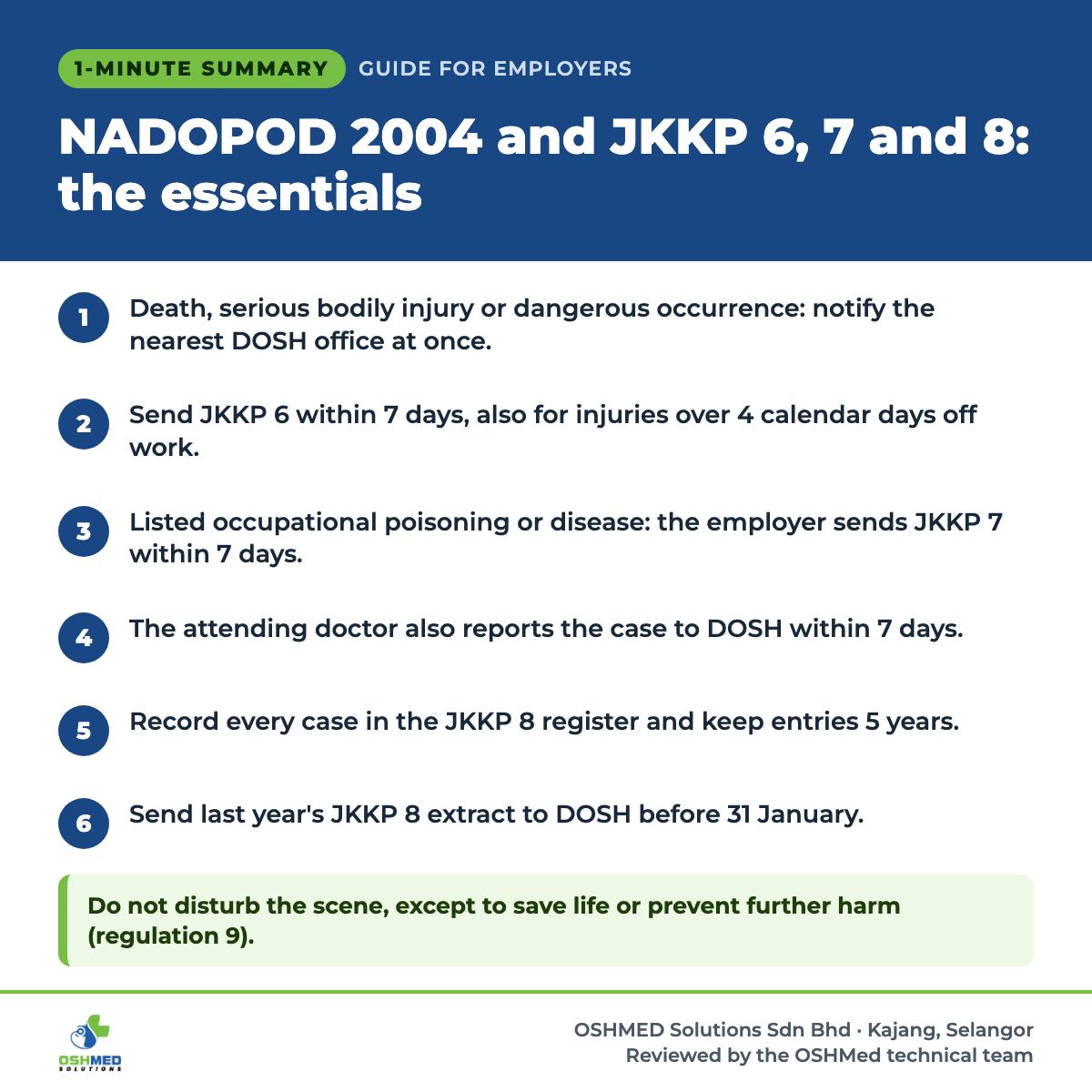
- Death, serious bodily injury or dangerous occurrence: notify the nearest DOSH office at once.
- Send JKKP 6 within 7 days, also for injuries over 4 calendar days off work.
- Listed occupational poisoning or disease: the employer sends JKKP 7 within 7 days.
- The attending doctor also reports the case to DOSH within 7 days.
- Record every case in the JKKP 8 register and keep entries 5 years.
- Send last year's JKKP 8 extract to DOSH before 31 January.
Do not disturb the scene, except to save life or prevent further harm (regulation 9).
What is NADOPOD 2004?
NADOPOD is the short name for the Occupational Safety and Health (Notification of Accident, Dangerous Occurrence, Occupational Poisoning and Occupational Disease) Regulations 2004, P.U. (A) 128/2004, under Act 514. Its 13 regulations and four schedules set what employers report to DOSH, how fast, on which form, and which records they keep.
Section 32 of Act 514 sets the base duty to notify DOSH; NADOPOD adds the deadlines (regulations 5 and 7), scene protection (9), the register (10) and the penalty (13), and applies to all places of work (regulation 3).
What are the JKKP 6, JKKP 7 and JKKP 8 forms for?
They are the DOSH forms behind the “approved form” in the regulations: JKKP 6 for an accident or dangerous occurrence, JKKP 7 for an occupational poisoning or occupational disease, and JKKP 8 for the register of every case, including cases that need neither. DOSH’s FAQ and myKKP manuals use these numbers.
| Form | Used for | Who submits | Deadline | Basis |
|---|---|---|---|---|
| JKKP 6 | Death; injury with over four calendar days off normal work; dangerous occurrence | Employer (self-employed: regulation 6) | Within 7 days (serious cases: notify at once first) | Reg. 5 |
| JKKP 7 | Third Schedule occupational poisoning or disease | Employer; the attending doctor also reports | Within 7 days | Reg. 7 |
| JKKP 8 | Register of all accidents, dangerous occurrences, poisonings and diseases | Employer or self-employed person; one per branch | Annual extract before 31 January | Reg. 10; DOSH FAQ (branches) |
When must you notify DOSH immediately?
Notify the nearest DOSH office immediately, by the quickest means available, when a work accident causes a death or a First Schedule serious bodily injury, or when a Second Schedule dangerous occurrence takes place, even if nobody is hurt. Then send JKKP 6 within 7 days (regulation 5(1)).
Regulation 5(1)(b) covers a First Schedule injury that keeps the person off normal work for more than four calendar days, but DOSH’s FAQ says to report a serious bodily injury immediately, by telephone or fax if needed. The 11 listed injuries include a fracture or dislocation, loss of consciousness from lack of oxygen or a substance, and hospital admission for more than 24 hours.
Second Schedule Part I applies anywhere, for example a scaffold over 5 metres high collapsing, an uncontrolled release of a substance, a fire or explosion in a hazardous substance store, or a crane or lift collapsing or overturning. Parts II to V cover mines, quarries, forestry and agriculture.
Leave the scene of a death, serious bodily injury or serious plant damage undisturbed unless authorised, except to save life, relieve suffering, keep essential services open or prevent further damage (regulation 9). First aid comes first: see our first aider guide and BOFA course.
How do you count the four calendar days?
Start counting on the day after the accident and count calendar days, so weekends and public holidays count. This is how NADOPOD defines lost time. If the injured person cannot follow their normal occupation for more than four of those days, the employer sends JKKP 6 within 7 days (regulation 5(2)).
- Accident on Monday: Tuesday is day 1.
- Off normal work Tuesday to Friday: four days, so JKKP 8 register only.
- Still off on Saturday: day 5, so send JKKP 6.
Self-check: do we need to notify DOSH, and with which form?
Answer eight quick questions about one incident or case. This is a screening aid based on NADOPOD 2004, not legal advice, and it needs no names or medical details. If you are in doubt about a serious case, call the nearest DOSH office.
1. Did a work accident cause a death, either at the time or within one year of the accident?
2. Did someone suffer a First Schedule serious bodily injury, such as a fracture or dislocation, loss of consciousness from lack of oxygen or a substance, or hospital admission for more than 24 hours?
3. Has a work injury kept the person from their normal job for more than four calendar days, counted from the day after the accident?
4. Did a Second Schedule dangerous occurrence happen, even with no one hurt, such as the collapse of a scaffold over 5 metres high, an uncontrolled chemical release, or a crane or lift overturning?
5. Does a worker have, or seem likely to have, a Third Schedule occupational poisoning linked to their work, such as from lead, mercury, benzene or pesticides?
6. Does a worker have, or seem likely to have, a Third Schedule occupational disease linked to their work, such as noise-induced hearing loss, occupational asthma, dermatitis or silicosis?
7. Was this a minor injury, with the person back at normal work within four calendar days?
8. Is it January, and have you not yet sent last year's JKKP 8 extract to DOSH?
Which occupational poisonings and diseases need JKKP 7?
Those listed in the Third Schedule, where the work matches the activity in column 2. The schedule has 36 items: 26 poisoning entries, then infections, skin diseases, lung diseases and other conditions. The employer reports within 7 days when a worker suffers, or is likely to suffer, one of them (regulation 7(1)).
| Group | Examples | Linked work |
|---|---|---|
| Poisoning (item 1) | Lead, mercury, benzene, carbon monoxide, organophosphates | Use of, or exposure to, the substance |
| Infections (2 to 8) | Leptospirosis, tuberculosis, viral hepatitis | Infected animals, patients or blood |
| Skin (9 to 19) | Occupational dermatitis, chrome ulceration | Handling oils, acids, alkalis or chromates |
| Lung (20 to 28) | Occupational asthma, silicosis, lung cancer from asbestos | Listed dusts, gases or vapours |
| Other (29 to 36) | Hearing impairment caused by noise, heat stroke, vibration disease | Noise above 85 dB over 8 hours; heat; vibration |
The attending registered medical practitioner or medical officer also reports within 7 days and tells the employer (regulation 7(2)); in myKKP, a doctor files as Medical Practitioner (OHD), which needs a registered OHD certification slip.
For hearing loss, the Noise Exposure Regulations 2019 add parallel 7-day notices by the occupational health doctor and by the employer (regulation 9(6) and 9(10)): see our hearing conservation programme guide.
Suspect a work-related disease or poisoning?
Under regulation 7(2), the doctor who sees the worker reports to DOSH and tells you at the same time. OSHMed coordinates an occupational health doctor through our partner clinic and can scope the noise or chemical assessment for the work area involved: ask about occupational health doctor support.
What is JKKP 8, and when is it due?
JKKP 8 is the register of accidents, dangerous occurrences, occupational poisonings and occupational diseases. Under regulation 10, every employer and self-employed person records all cases under their control, reported or not, keeps each entry at least 5 years, and sends the extract for the calendar year to DOSH before 31 January.
- Keep the register where the work is done, or at your usual place of business if that is not practicable (regulation 10(2)).
- A company with several branches sends one JKKP 8 per branch to DOSH headquarters, according to DOSH’s FAQ.
- In myKKP, JKKP 8 entries sit under the reporting year of the incident date and can be updated until the JKKP 8 declaration (Perakuan JKKP8) period closes.
How do you submit JKKP 6, 7 and 8 on myKKP?
Use the Pelaporan Sepanjang Masa module, open only to the employer representative (PATK Level 1) of a workplace registered in myKKP. Choose Pelaporan Baru, pick JKKP 6, JKKP 7 or a JKKP 8 entry, complete the tabs and submit, as DOSH’s myKKP user manuals (version 02, March 2025) show.
- First, activate your workplace registration number in myKKP, with a letter of authorisation from the workplace.
- Log in at mykkp.dosh.gov.my, select the Tempat Kerja/Kilang module, open Pelaporan Sepanjang Masa, choose Majikan (PATK L1) and set the year with Tukar Profil Tahun.
- Click Pelaporan Baru: JKKP6, 7 Dan 8 and choose Kemalangan Pekerjaan or Kejadian Berbahaya (JKKP 6), or Keracunan dan Penyakit Pekerjaan (JKKP 7). Injuries with four days or fewer off work go in as JKKP 8 entries.
- Complete the tabs and declaration, click Hantar and keep the reference number.
What happens after you report?
The state DOSH office for the incident address investigates. The Director General may serve written notice for Fourth Schedule information, such as the circumstances, plant design, safety procedures, staff training and airborne exposure levels (regulation 11), and may direct an inquiry under section 33 of Act 514.
Keep training, plant inspection and CHRA or exposure monitoring records ready. Then close the gap: a noise risk assessment via our NRA service for hearing cases; a CHRA via our CHRA service and medical surveillance for chemical cases; our workplace health services or training otherwise. OSHMed coordinates medical review through our occupational health doctor service, with tests carried out and billed by our partner clinic.
What is the penalty for not reporting?
Regulation 13 makes any breach of NADOPOD an offence, with a fine of up to RM10,000, up to one year in prison, or both. That includes a late or missing JKKP 6 or JKKP 7, a missing register or extract, and disturbing a scene. Directors and managers can be charged with the company (section 52 of Act 514).
- A doctor has linked a worker’s condition to work.
- A worker fell ill after chemical exposure.
- A reportable accident needs its hazard assessed.
- Some shifts have no trained first aider.
Before you decide: three common objections
Three objections come up when employers weigh reporting: the injury looked minor, the doctor will report anyway, and the area needs clearing first. Each is answered below from the text of NADOPOD 2004, so the decision rests on the rules.
"It was only a minor injury."
More than four calendar days off normal work means JKKP 6 (regulation 5(2)); shorter absences go in the JKKP 8 register.
"The doctor will report it."
The doctor’s duty (regulation 7(2)) does not replace the employer’s own (regulation 7(1)). Both reports are required.
"We will clear the area first."
Regulation 9 allows changes only to save life, prevent injury, keep essential services open or prevent further damage.
Frequently asked questions
What is JKKP 8 used for?
It is the register of every accident, dangerous occurrence, occupational poisoning and occupational disease, reported or not. Keep each entry for at least 5 years and send last year’s extract to DOSH before 31 January (regulation 10).
What is JKKP 7 used for?
Reporting a Third Schedule occupational poisoning or disease, such as lead poisoning, occupational dermatitis or hearing impairment caused by noise, within 7 days. The attending doctor reports separately (regulation 7).
Can JKKP 8 be submitted on myKKP?
Yes, under Pelaporan Sepanjang Masa, by the employer representative (PATK Level 1) of a workplace registered in myKKP, until the JKKP 8 declaration period ends.
What if the worker dies months after the accident?
If death follows within one year of a reportable accident, inform the Director General in writing as soon as you know, whether or not you reported it before (regulation 5(3)).
Does OSHMed submit JKKP forms for us?
No. The reporting duty and the myKKP workplace account belong to the employer, and the doctor reports under regulation 7(2). OSHMed coordinates occupational health doctor reviews through our partner clinic.
Your next step
Use the self-check above to match your case to a form and set a reminder for the 31 January extract. For a work-linked condition, OSHMed coordinates an occupational health doctor review through our partner clinic.
See also our HIRARC form guide and USECHH 2000 guide.
Involve an occupational health doctor early
Share the type of case on WhatsApp (no names or medical details needed) or through the contact form. We will reply with the next steps for the medical review and any assessment of the work area.
- Audiometric test in Malaysia: DOSH procedure, baseline and STS results
- Medical surveillance Malaysia: how to set up a USECHH programme
- Hearing conservation programme and audiometric testing: what employers must do
- Chemical health risk assessment (CHRA) under USECHH 2000: when it is required
- First aid training Malaysia: how many first aiders do you need?
- Noise Exposure Regulations 2019: employer duties, limits and deadlines
Sources and references
Checked against the official documents listed below on 9 November 2026. Laws change: always confirm the current version on the DOSH (JKKP) website.
- Occupational Safety and Health (Notification of Accident, Dangerous Occurrence, Occupational Poisoning and Occupational Disease) Regulations 2004, P.U. (A) 128/2004 (regulations 1 to 13; First to Fourth Schedules), Attorney General's Chambers, published by DOSH
- Peraturan-Peraturan Keselamatan dan Kesihatan Pekerjaan (Pemberitahuan Mengenai Kemalangan, Kejadian Berbahaya, Keracunan Pekerjaan dan Penyakit Pekerjaan) 2004 (Malay text of the same regulations), Attorney General's Chambers, published by DOSH
- myKKP user manual: Pemberitahuan Kemalangan (JKKP6) dan JKKP9, version 02 (March 2025), DOSH Malaysia
- myKKP user manual: Pemberitahuan Keracunan dan Penyakit Pekerjaan (JKKP7) dan JKKP10, version 02 (11 March 2025), DOSH Malaysia
- myKKP user manual: Pemberitahuan JKKP8, version 02 (11 March 2025), DOSH Malaysia
- myKKP user manual: Permohonan Aktif No Daftar Tempat Kerja (workplace activation), DOSH Malaysia
- Frequently asked questions: JKKP 6, JKKP 7 and JKKP 8, accidents and complaints, occupational poisoning and disease, DOSH Malaysia
- Occupational Safety and Health (Noise Exposure) Regulations 2019, P.U. (A) 60/2019 (regulation 9), Attorney General's Chambers, published by DOSH
- Occupational Safety and Health Act 1994 (Act 514), reprint incorporating Act A1648 (sections 32, 33 and 52), DOSH Malaysia
- Regulations under Act 514 (current list), DOSH Malaysia
Disclaimer: This article is general information for employers and is not legal advice. Requirements depend on your workplace, processes and the current law. For a decision on your premises, speak to a DOSH-registered competent person or contact DOSH (JKKP).