
Audiometric Test in Malaysia: DOSH Procedure, Baseline and STS Results
An audiometric test measures a worker’s hearing threshold with pure tones from 500 to 8000 Hz, one ear at a time. Under the Noise Exposure Regulations 2019, workers exposed above the noise limit need a baseline test within three months and yearly tests at a DOSH-approved centre, and an occupational health doctor interprets each audiogram.
- MD (NNSMA, Rus)
- MScCH (Occ. Health, UKM)
- MBA (ARU, UK)
- OHD (NIOSH)
- MRO (AOEMM)
- TTT (HRDF)
- SSM 202001013523 (OSHMED Solutions Sdn Bhd)
- DOSH registered training provider SL/22/22/181036, valid to 21 July 2028
- MMC Full Registration 55275 (Dr. Wan Muhammad Zulhusni)
- DOSH Occupational Health Doctor HQ/16/DOC/00/454
- DMAC/EDTCmed 263
- OEUK OEUK/2024/3751
OSHMed Solutions Sdn Bhd is an occupational safety and health consultancy and DOSH-registered training provider (ergonomics) in Kajang, Selangor. We are not a clinic. Medical tests are arranged through approved centres.
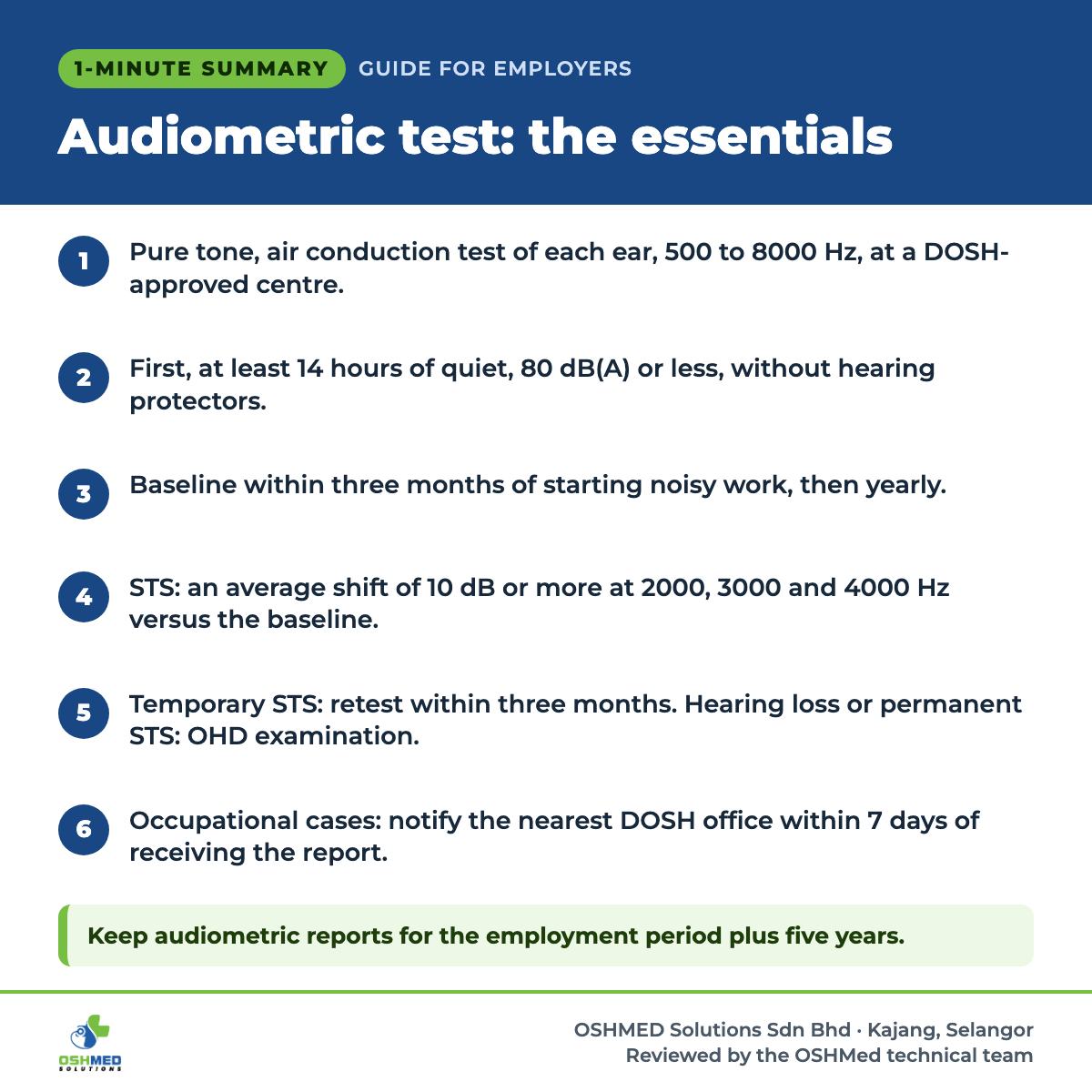
- Pure tone, air conduction test of each ear, 500 to 8000 Hz, at a DOSH-approved centre.
- First, at least 14 hours of quiet, 80 dB(A) or less, without hearing protectors.
- Baseline within three months of starting noisy work, then yearly.
- STS: an average shift of 10 dB or more at 2000, 3000 and 4000 Hz versus the baseline.
- Temporary STS: retest within three months. Hearing loss or permanent STS: OHD examination.
- Occupational cases: notify the nearest DOSH office within 7 days of receiving the report.
Keep audiometric reports for the employment period plus five years.
What is an audiometric test?
It is the measurement of a person’s hearing threshold levels by monaural pure tone air conduction threshold tests (ICOP section 3). The audiometer plays pure tones to one ear at a time, and the worker presses a signal switch at each tone heard. The result, an audiogram, charts the threshold of hearing at each frequency.
The ICOP adds that testing alone is not a preventive mechanism: any change in hearing over time must be investigated for its cause (13.1.1).
Who must be tested, and how often, is covered in our hearing conservation programme guide.
What happens during an audiometric test?
A trained audiometric technician at an approved centre runs a screening questionnaire, checks both ears and explains the procedure. The worker then sits in an audiometric test room while the audiometer presents pure tones at 500, 1000, 2000, 3000, 4000, 6000 and 8000 Hz, each ear separately (ICOP 13.2 and 15.7).
| Step | What happens | ICOP |
|---|---|---|
| Questionnaire | Recent loud noise, ear illness, medicines, noisy hobbies and past noisy jobs (Appendix 4) | 13.2.2 |
| Ear check | Visual check for infection or excess wax, then a briefing | 15.7.1(d), (e) |
| Pure tone test | Seven frequencies, each ear separately, using the patient signal switch | 13.2.5 |
| Interpretation | An occupational health doctor (OHD) appointed by the centre reads the audiogram | 13.3.2; reg. 9(3) |
ICOP Table 14.1 caps the test room’s background noise (27 dB at 500 Hz, for example); the audiometer is calibrated to ISO 389 yearly (14.2.1.4 to 14.2.1.6).
How should workers prepare for an audiometric test?
The worker must be in a quiet state, with no exposure above 80 dB(A), for at least 14 hours before the test, without relying on hearing protectors (regulation 10). If the worker was exposed to loud noise in that period, the technician aborts and reschedules the test (ICOP Appendix 4).
- Shift timing: test before the worker returns to noisy work; earplugs worn in a noisy area do not count.
- On the day: a cold, giddiness, tinnitus, ear discharge or impacted wax can postpone the test (Appendix 4).
- Send ahead: the baseline audiogram (13.2.8) and personal noise exposure data (13.2.9). Book early: the centre notifies the state DOSH office two weeks before testing (15.8.1(d)).
Baseline, annual or retest: which audiometric test is due?
The baseline audiogram is the reference for every later audiogram and must be done within three months of the worker starting work exposed above the limit (ICOP 13.2.7). The test is then repeated every year, and a temporary standard threshold shift triggers a retest within three months (regulation 9(9)).
| Test | When | Source |
|---|---|---|
| Baseline | Within three months of starting work above the limit | Reg. 10(1)(b); ICOP 13.2.7 |
| Annual | Every year while exposure stays above the limit | Reg. 9(1); ICOP 13.2.4 |
| Retest | Within three months of a temporary STS, after 14 hours of quiet | Reg. 9(9); ICOP 13.3.4 |
An audiogram showing a permanent STS or improved thresholds replaces the baseline (13.3.7). Hearing impairment or noise-induced hearing loss in a baseline done within three months of starting is not notified to DOSH; a late baseline loses that exemption (13.5.4).
How do you read an audiogram?
An audiogram charts each ear’s hearing threshold, in decibels, at each test frequency. A higher threshold means a louder tone was needed. Under the ICOP, a threshold worse than 25 dB at any test frequency is hearing loss: mild (26 to 40 dB), moderate (41 to 70), severe (71 to 90) or profound (91 or more).
The ICOP guidance notes describe the first sign of noise-induced hearing loss as a “notch” at 3000, 4000 or 6000 Hz with recovery at 8000 Hz; this loss is irreversible (Appendix 5).
Hearing impairment uses the same audiogram: an average threshold at 500, 1000, 2000 and 3000 Hz, (T500 + T1000 + T2000 + T3000) ÷ 4, of 25 dB or more (regulation 2). In the ICOP example, 20, 35, 30 and 30 dB average 28.8 dB.
What is a standard threshold shift (STS), and how is it calculated?
A standard threshold shift is an average shift of 10 dB or more at 2000, 3000 and 4000 Hz compared with the baseline audiogram (regulation 2). Subtract each baseline threshold from the current one, add the three differences and divide by three. Each ear is calculated separately, with no age correction (ICOP Appendix 5).
STS = [(T2000 − B2000) + (T3000 − B3000) + (T4000 − B4000)] ÷ 3, with T the current and B the baseline threshold in dB. ICOP Example 1: shifts of +10, +15 and +20 dB average +15 dB, an STS.
A temporary STS, or auditory fatigue, improves once exposure stops; the ICOP calls it a risk indicator for permanent noise-induced hearing loss if exposure continues. An STS that persists on the retest within three months is permanent (Appendix 5).
Standard threshold shift calculator: check an audiogram against the baseline
Enter the hearing thresholds in dB from the baseline audiogram and the current audiogram for each ear. The checker applies the definitions in regulation 2 of the Noise Exposure Regulations 2019 and the ICOP: the average shift at 2000, 3000 and 4000 Hz, the hearing impairment average at 500 to 3000 Hz, and any threshold above 25 dB.
| Hz | Baseline, dB | Current, dB |
|---|---|---|
| 500 | ||
| 1000 | ||
| 2000 | ||
| 3000 | ||
| 4000 | ||
| 6000 | ||
| 8000 |
| Hz | Baseline, dB | Current, dB |
|---|---|---|
| 500 | ||
| 1000 | ||
| 2000 | ||
| 3000 | ||
| 4000 | ||
| 6000 | ||
| 8000 |
This checker is a screening aid for employers and does not diagnose: under regulation 9(3), only the occupational health doctor appointed by the approved centre interprets audiograms. It applies the definitions in regulation 2 and the ICOP worked examples (Appendix 5), with no age correction, to thresholds you read from the audiogram. Nothing you enter is stored or sent unless you choose WhatsApp.
What must the employer do after the audiometric test results?
The centre reports within 30 days of the test, and the employer informs each worker within 21 days of receiving the report (regulation 9(7) and (8)). The next step depends on the result: continue annual testing, arrange a retest, or arrange a medical examination and notify DOSH.
| Result | Employer action | Source |
|---|---|---|
| Normal | Inform the worker within 21 days; continue annual tests | ICOP 13.3.5 |
| Temporary STS | Protect hearing; retest within three months after 14 hours of quiet | Reg. 9(9) |
| Hearing loss, impairment or permanent STS | Prompt OHD medical examination; inform the worker within 21 days; issue, refit and retrain on hearing protectors | Reg. 9(4); ICOP 13.3.6, 13.4 |
| Occupational cases of the above | Notify the nearest DOSH office within 7 days of receiving the report, with the Appendix 6 details | Reg. 9(10)(a); ICOP 13.5 |
The OHD’s examination covers medical history, a physical examination and other investigations (regulation 9(5)); for an occupational case, the OHD also notifies the Director General within 7 days (9(6)).
Noise-induced hearing impairment is item 35 of the NADOPOD 2004 Third Schedule; DOSH’s occupational disease form is JKKP 7 (see our JKKP 6, 7 and 8 guide). Breaching regulation 9 can mean a fine of up to RM10,000, up to one year in prison, or both (9(11)).
Need baseline or annual audiometric testing arranged?
Send us your noise risk assessment summary, the number of exposed workers and their shift patterns. OSHMed will propose a testing schedule through a DOSH-approved audiometric testing centre: request an audiometric testing quote.
How long must audiometric test records be kept?
Keep each worker’s audiometric reports while they work for you and for five years after they leave (regulation 11(1)(b)). A new owner of the business keeps them for the same period (11(2)), and the Director General gets three months’ written notice before disposal (11(3)).
Static or mobile: how do you check an audiometric testing centre?
Only a centre approved by the Director General may test (regulation 9(2)). A static centre tests at its premises; a mobile centre must also carry a class 1 sound level meter, sound calibrator and artificial ear set (ICOP 14.2.1.2). Check the centre’s approval and expiry date on the DOSH list before booking. Our DOSH competent person list guide shows how to check every DOSH register.
On 13 November 2026, the DOSH list held 499 entries, 78 of them for mobile centres. Testing must fall within the centre’s valid registration period (ICOP 15.8.1(b)).
OSHMED Solutions Sdn Bhd in Kajang, Selangor, is not a clinic and does not perform audiometric tests. We arrange testing for employers across Malaysia through our partner Nova Care Sdn Bhd, a DOSH-approved static audiometric testing centre in Kajang (JKKP/2025/11-02/00027, valid until 11 February 2028). See our workplace health services.
- Your noise risk assessment shows workers above 85 dB(A).
- New workers in noisy areas have no baseline audiogram yet.
- A temporary STS retest is due within three months.
Before you decide: three common objections
Three objections come up when employers plan audiometric testing: workers already wear earplugs, testing straight after a shift saves time, and a phone app is good enough. Each is checked below against the 2019 Regulations and the ICOP.
"Our workers wear earplugs, so testing is not needed."
Protectors do not remove the duty: regulation 9(1) ties annual testing to exposure, and each audiogram shows whether hearing is changing anyway.
"We will test them straight after the shift."
That breaks the 14-hour quiet rule (regulation 10(1)(c)); the technician must abort and reschedule (Appendix 4).
"A hearing app is enough."
Not under the Regulations: only an approved centre may test (regulation 9(2)), and an OHD must interpret the audiogram (ICOP 13.3.2).
Frequently asked questions
What is an audiometric test in Malay?
Official Malay texts say “ujian audiometrik”, and many people search for “ujian audiometri”: the pure tone, air conduction hearing test described here.
What is the DOSH requirement for audiometric testing?
Under regulation 9 of the Noise Exposure Regulations 2019, every worker exposed above the regulation 6 limit is tested yearly at a DOSH-approved centre, first within three months of starting.
Can audiometric testing be done at our workplace?
Yes, by a DOSH-approved mobile audiometric testing centre with its own approved test room and equipment (ICOP 14.2.1.2). Check its classification on the DOSH list.
Is age taken into account when calculating an STS?
No. The ICOP says age correction is not required when determining occupational permanent STS, hearing impairment and noise-induced hearing loss for notification (Appendix 5).
Who pays for the audiometric test and how is it quoted?
The employer: the test is at no cost to the worker (regulation 10(1)(a)). OSHMed quotes in writing once you share headcount, site location and shift patterns.
Your next step
Check your noise risk assessment for workers above the limit and confirm each has a baseline audiogram. If not, or if a retest is due, request an audiometric testing quote or WhatsApp us your headcount.
Unsure who is exposed? Start with a noise risk assessment or our noise dose calculator, and see our hearing conservation programme page.
Plan your next audiometric testing round
Share your headcount and site on WhatsApp or through the quote form. Testing is carried out by a DOSH-approved audiometric testing centre, and every audiogram is interpreted by an occupational health doctor.
- Spirometry test for workers in Malaysia: DOSH guidance, results and frequency
- DOSH competent person list: categories, duties and how to check
- ICOP noise 2019: summary of all 15 sections and 9 appendices (DOSH)
- Hearing conservation programme (HCP) and audiometric testing: what employers must do
- Noise dose calculator: how to calculate LEX,8h and daily noise dose
- Noise Exposure Regulations 2019: employer duties, limits and deadlines
- JKKP 8, JKKP 6 and JKKP 7: NADOPOD 2004 forms, deadlines and myKKP
- Hearing protection zone: DOSH signage rules and a printable sign
- Noise risk assessment (NRA) in Malaysia: when you need one
- OSHMed occupational health doctor service
Sources and references
Checked against the official documents listed below on 13 November 2026. Laws change: always confirm the current version on the DOSH (JKKP) website.
- Occupational Safety and Health (Noise Exposure) Regulations 2019, P.U. (A) 60/2019, English and Malay texts (regulations 2, 6, 9, 10 and 11), Attorney General's Chambers, published by DOSH
- Industry Code of Practice for Management of Occupational Noise Exposure and Hearing Conservation 2019 (sections 3, 13, 14.2, 15.6 to 15.8 and Appendices 3 to 7), DOSH Malaysia
- Tataamalan Industri bagi Pengurusan Pendedahan Bising Pekerjaan dan Pemuliharaan Pendengaran 2019, Malay edition (sections 3, 13 and 14.2), DOSH Malaysia
- List of approved audiometric testing centres (Pusat Ujian Audiometrik), checked 13 November 2026, DOSH Malaysia
- Occupational Safety and Health (Notification of Accident, Dangerous Occurrence, Occupational Poisoning and Occupational Disease) Regulations 2004, P.U. (A) 128/2004 (regulation 7, Third Schedule item 35), Attorney General's Chambers, published by DOSH
- Frequently asked questions: JKKP 6, JKKP 7 and JKKP 8, occupational poisoning and disease, DOSH Malaysia
Disclaimer: This article is general information for employers and is not legal advice. Requirements depend on your workplace, processes and the current law. For a decision on your premises, speak to a DOSH-registered competent person or contact DOSH (JKKP).