
Safety and Health Committee Regulations 1996: Members, Meetings and Duties
Under section 30 of Act 514, an employer must set up a safety and health committee when 40 or more persons are employed at the place of work, or when the DOSH Director General directs it. The 1996 Regulations govern its membership, quarterly meetings and inspections, minutes within two weeks, seven-year record retention and member training.
- MD (NNSMA, Rus)
- MScCH (Occ. Health, UKM)
- MBA (ARU, UK)
- OHD (NIOSH)
- MRO (AOEMM)
- TTT (HRDF)
- SSM 202001013523 (OSHMED Solutions Sdn Bhd)
- DOSH registered training provider SL/22/22/181036, valid to 21 July 2028
- MMC Full Registration 55275 (Dr. Wan Muhammad Zulhusni)
- DOSH Occupational Health Doctor HQ/16/DOC/00/454
- DMAC/EDTCmed 263
- OEUK OEUK/2024/3751
OSHMed Solutions Sdn Bhd is an occupational safety and health consultancy and DOSH-registered training provider (ergonomics) in Kajang, Selangor. We are not a clinic. Medical tests are arranged through approved centres.
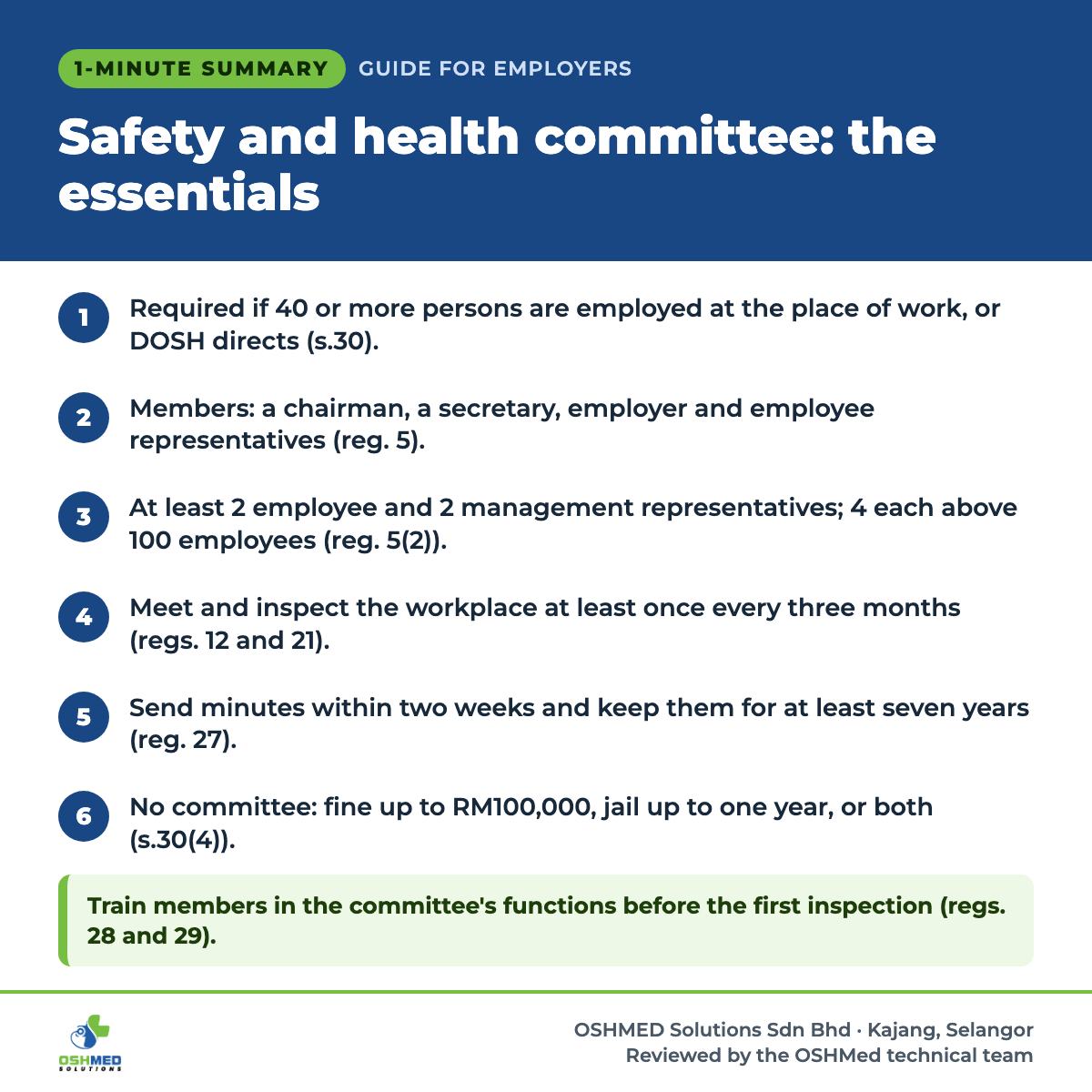
- Required if 40 or more persons are employed at the place of work, or DOSH directs (s.30).
- Members: a chairman, a secretary, employer and employee representatives (reg. 5).
- At least 2 employee and 2 management representatives; 4 each above 100 employees (reg. 5(2)).
- Meet and inspect the workplace at least once every three months (regs. 12 and 21).
- Send minutes within two weeks and keep them for at least seven years (reg. 27).
- No committee: fine up to RM100,000, jail up to one year, or both (s.30(4)).
Train members in the committee's functions before the first inspection (regs. 28 and 29).
What is a safety and health committee?
It is a workplace committee of management and employee representatives that the employer must consult on safety and health. Section 30 of the Occupational Safety and Health Act 1994 (Act 514) says when one is required; the Occupational Safety and Health (Safety and Health Committee) Regulations 1996 say how it works.
The regulations, P.U. (A) 616/1996, came into force on 1 January 1997 (regulation 1) and contain 32 regulations in six Parts. Download the English PDF or the Malay PDF from DOSH. If your workplace calls the committee the JKKP, note that JKKP also abbreviates DOSH in Malay.
When must an employer set up a safety and health committee?
Section 30(1) of Act 514 requires a committee if 40 or more persons are employed at the place of work, or if the Director General of DOSH directs one. Act A1648, the 2022 amendment, did not change the 40-person threshold; it raised the penalty in section 30(4).
Section 30(3) also requires the employer to consult the committee on promoting safety and health measures and checking that they work. Below 40, an employer with five or more employees must still appoint an OSH coordinator unless a safety and health officer is appointed (section 29A).
Who sits on the safety and health committee?
Regulation 5 requires a chairman, a secretary, and employer and employee representatives. The chairman is the employer or an authorised manager. The secretary is the safety and health officer; if there is none, the chairman appoints a secretary or the members elect one by ballot (regulation 6).
| Persons employed | Employee representatives | Management representatives |
|---|---|---|
| 100 or fewer | At least 2 | At least 2 |
| More than 100 | At least 4 | At least 4 |
| Role | Example holder | Basis |
|---|---|---|
| Chairman | Plant manager authorised by the employer | Reg. 6(1) |
| Secretary | Safety and health officer | Reg. 6(2) |
| Management representatives (4) | Heads of production, engineering, HR and quality | Reg. 5(2) |
| Employee representatives (4) | Nominated from production, warehouse, maintenance and office | Reg. 7, 8 |
How are employee representatives elected or appointed?
The employer invites employees to nominate their representatives. A ballot is held if nominations exceed the seats; if there are too few, the employer appoints the rest (regulation 7). Vacancies are filled in the same way (regulation 9), and members must not be penalised for absence from normal duties while carrying out committee functions (regulation 7(3)).
A committee may remove a member who misses three consecutive meetings without the chairman’s leave, among other grounds (regulation 10). Section 27 of Act 514 bars an employer from dismissing or disadvantaging an employee for committee work.
What are the functions of the safety and health committee?
Section 31 of Act 514 requires the committee to keep safety and health measures under review, investigate matters raised as unsafe or a risk to health, and try to resolve them, asking the Director General to inspect if it cannot. Regulations 11 to 20 add inspections, investigations, complaints and rules.
| Function | Scope | Basis |
|---|---|---|
| Review | Measures, programmes, policy and reports | Act s.31(a); reg. 11(b), (d), 15 |
| Rules | Safety and health rules and safe systems of work | Reg. 11(a), 19 |
| Trends | Accidents, near-misses, dangerous occurrences, poisoning and disease | Reg. 11(c) |
| Inspect | The workplace at least once every three months, findings recorded | Reg. 12 |
| Investigate | After an incident, with measures to prevent a recurrence | Reg. 13 |
| Complaints | Unresolved complaints; may ask the Director General to inspect | Reg. 16, 17; Act s.31(b), (c) |
| Promote | Competitions, talks and other promotional activities | Reg. 18 |
Your risk assessments give the committee something concrete to review: the section 18B duty, recorded on a HIRARC form, and specialist reports such as a noise risk assessment or CHRA. See all OSHMed assessments.
How often must the safety and health committee meet?
At least once every three months, and more often if the risks of the work require it (regulation 21(1)), with written notice and the agenda sent to every member. A meeting must be called immediately after an accident causing death or serious bodily injury, a near-miss, a dangerous occurrence or any situation needing immediate attention.
- Quorum: the chairman, the secretary and at least half of the remaining members (regulation 24).
- Inaugural meeting: convened by the employer, who presents the safety and health policies and plans (regulation 23).
| Agenda item | Basis |
|---|---|
| Attendance and quorum | Reg. 24 |
| Previous minutes and the employer’s decisions | Reg. 14(2), 27 |
| Quarterly inspection findings | Reg. 12 |
| Accidents, near-misses and dangerous occurrences | Reg. 11(c), 13 |
| Complaints and reports, including risk assessments | Reg. 15, 16 |
| Rules, policy, training and campaigns | Reg. 11, 18, 19 |
| Next meeting and inspection, within three months | Reg. 12(a), 21(1) |
Four meetings and four inspections a year are the minimum, not the target (regulations 12 and 21).
Safety and health committee compliance checklist
Tick each item already in place at your place of work. The 14 items follow section 30 of Act 514 and the 1996 Regulations in order. Print the result for your next committee meeting, or send your score to OSHMed on WhatsApp.
0 of 14 ready
What records must the committee keep, and for how long?
Minutes go to each member and the employer within two weeks, and the employer keeps a copy at the workplace for at least seven years (regulation 27). Inspection and investigation reports, with the employer’s decision recorded, are kept for the same period (regulation 14). A DOSH officer may require a copy at any time.
| Record | Rule | Regulation |
|---|---|---|
| Notice and agenda | Written notice to every member, agenda attached | 21(2) |
| Minutes | To members and the employer within two weeks; kept for at least seven years | 27 |
| Inspection and investigation reports | Employer’s decision recorded; kept for at least seven years | 12, 14 |
Keep one committee file per year, ready for a DOSH officer under regulation 27(3).
Want your committee members trained for their role?
OSHMed runs in-house OSH training and talks for supervisors, safety committees and workers. Tell us your headcount, sites and the duties your members cover, and we will propose a programme: request a training proposal.
What training must committee members receive?
Regulation 28 requires the employer to ensure that members have a basic understanding of the committee’s functions under the Act. Regulation 29 adds adequate training in occupational safety and health, so far as is reasonably practicable, so members can perform those functions effectively. No course, syllabus or duration is prescribed.
- Committee functions and the Act (regulation 28).
- Inspection and risk assessment with the HIRARC form.
- Topic courses such as the DOSH-registered ETP course, or BOFA first aid for members who are first aiders.
The employer must also give the committee the Act, its regulations, codes of practice and hazard information (regulation 30). OSHMED Solutions Sdn Bhd, in Kajang, Selangor, provides in-house OSH training and talks for safety committees, supervisors and workers; talks such as the OSH Talk: Stress and Mental Health support regulation 18 activities. See our training courses.
What are the penalties under section 30 and the 1996 Regulations?
Failing to establish or consult a committee under section 30 carries a fine of up to RM100,000, up to one year in prison, or both (section 30(4), raised by Act A1648). Breaching the 1996 Regulations, such as skipping quarterly meetings, carries a fine of up to RM5,000, up to six months in prison, or both (regulation 32).
| Offence | Maximum penalty | Basis |
|---|---|---|
| No committee where required, or no consultation | Fine up to RM100,000, jail up to one year, or both | Act s.30(4) |
| Contravening the 1996 Regulations | Fine up to RM5,000, jail up to six months, or both | Reg. 32 |
| Disadvantaging a member for committee work | Fine up to RM100,000, jail up to one year, or both, plus possible compensation or reinstatement | Act s.27(3), (4) |
Directors and managers can also be charged with the company (section 52).
- Headcount has reached 40, or passed 100.
- The last meeting or inspection was over three months ago.
- An accident or near-miss has not been discussed.
Before you decide: three common objections
Three objections come up: the headcount is under 40, managers can run the committee alone, and meetings make inspections unnecessary. Each is checked below against Act 514 and the 1996 Regulations, so your decision rests on the law, not habit.
"We have fewer than 40 people."
Only until the Director General directs a committee (section 30(1)(b)).
"Management can run the committee alone."
No. Regulation 5 requires employee representatives, nominated by employees or chosen by ballot (regulation 7).
"We meet every quarter, so inspections are covered."
Meetings and inspections are separate duties: regulation 12 requires a recorded workplace inspection at least once every three months.
Frequently asked questions
Are the Safety and Health Committee Regulations 1996 still in force?
Yes: DOSH lists them among current regulations under Act 514, not revoked ones, with no amendments (checked 9 November 2026).
Where can I download the Safety and Health Committee Regulations 1996 PDF?
DOSH publishes an English PDF and a Malay PDF of P.U. (A) 616/1996 on its page of regulations under Act 514.
How many members must a safety and health committee have?
There must be at least two employee and two management representatives where 100 or fewer persons are employed, four of each above 100, plus a chairman and a secretary (regulations 5 and 6).
Who can be the chairman and secretary of the committee?
The employer or an authorised manager chairs it. The safety and health officer is the secretary; otherwise the chairman appoints one or the members elect one by ballot (regulation 6).
Do we need a committee if we have fewer than 40 employees?
Only if the DOSH Director General directs it (section 30(1)(b)). The OSH coordinator duty in section 29A still applies to employers with five or more employees.
Your next step
Run the checklist with your chairman and secretary. Do members need training? Ask OSHMed for an in-house training proposal.
Reviewing risks? Start with our section 18B guide and the HIRARC form builder.
Plan committee training and risk reviews together
Share your committee structure on WhatsApp or through the contact form. We will suggest training for members and tell you which risk assessments the committee should be reviewing.
- DOSH training requirements: mandatory OSH training in Malaysia by regulation
- OSHA 1994 amendment 2022 (Act A1648): what changed for employers
- Section 18B OSHA 1994: risk assessment duty, HIRARC and specialists
- HIRARC form (DOSH): template, examples and how to fill it in
- OSH coordinator requirement under the OSHA 1994 amendment (Act A1648)
- First aid training Malaysia: how many first aiders do you need?
- Psychosocial risk assessment in Malaysia: PRisMA 2024
Sources and references
Checked against the official documents listed below on 9 November 2026. Laws change: always confirm the current version on the DOSH (JKKP) website.
- Occupational Safety and Health (Safety and Health Committee) Regulations 1996, P.U. (A) 616/1996 (regulations 1 to 32), Attorney General's Chambers, published by DOSH
- Peraturan-Peraturan Keselamatan dan Kesihatan Pekerjaan (Jawatankuasa Keselamatan dan Kesihatan) 1996, P.U. (A) 616/1996 (Malay text), Attorney General's Chambers, published by DOSH
- Occupational Safety and Health Act 1994 (Act 514), reprint incorporating Act A1648 (sections 27, 29, 29A, 30, 31, 43 and 52), DOSH Malaysia
- Regulations under the Occupational Safety and Health Act 1994 (Act 514): current list, DOSH Malaysia
- Revoked regulations, DOSH Malaysia
Disclaimer: This article is general information for employers and is not legal advice. Requirements depend on your workplace, processes and the current law. For a decision on your premises, speak to a DOSH-registered competent person or contact DOSH (JKKP).