
Psychosocial Risk Assessment in Malaysia: PRisMA 2024 and the PTP
A psychosocial risk assessment checks whether the way work is designed, organised and managed can harm employees, for example through excessive workload, unclear roles or poor support. DOSH sets the method in its PRisMA 2024 guideline: a 26-item survey (LEO26) by work unit, an employer checklist (EPC23) where risk is high, and an action plan, with a Psychosocial Trained Person (PTP) assisting.
- MD (NNSMA, Rus)
- MScCH (Occ. Health, UKM)
- MBA (ARU, UK)
- OHD (NIOSH)
- MRO (AOEMM)
- TTT (HRDF)
- SSM 202001013523 (OSHMED Solutions Sdn Bhd)
- DOSH registered training provider SL/22/22/181036, valid to 21 July 2028
- MMC Full Registration 55275 (Dr. Wan Muhammad Zulhusni)
- DOSH Occupational Health Doctor HQ/16/DOC/00/454
- DMAC/EDTCmed 263
- OEUK OEUK/2024/3751
OSHMed Solutions Sdn Bhd is an occupational safety and health consultancy and DOSH-registered training provider (ergonomics) in Kajang, Selangor. We are not a clinic. Medical tests are arranged through approved centres.
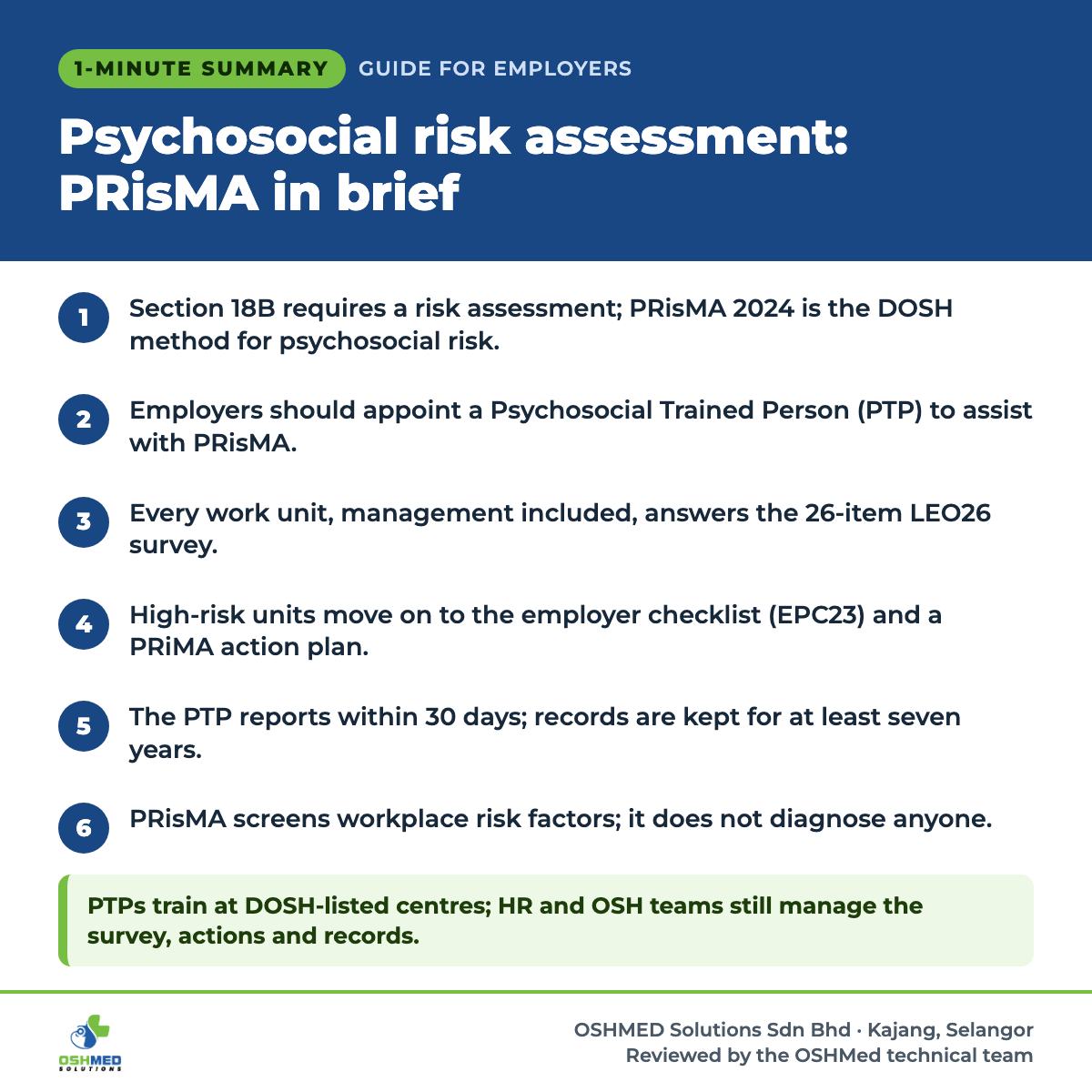
- Section 18B requires a risk assessment; PRisMA 2024 is the DOSH method for psychosocial risk.
- Employers should appoint a Psychosocial Trained Person (PTP) to assist with PRisMA.
- Every work unit, management included, answers the 26-item LEO26 survey.
- High-risk units move on to the employer checklist (EPC23) and a PRiMA action plan.
- The PTP reports within 30 days; records are kept for at least seven years.
- PRisMA screens workplace risk factors; it does not diagnose anyone.
What is a psychosocial risk assessment?
It identifies work-related hazards that can harm employees’ mental and physical health, such as excessive workload, unclear roles, poor support or bullying, and determines how to control them. DOSH sets out the method in the PRisMA 2024 guideline, launched on 26 October 2024.
PRisMA stands for Psychosocial Risk Assessment and Management at the Workplace. Aligned with ISO 45003:2021, it lists eight example hazards: excessive workload or unrealistic deadlines; poor communication or conflict; monotonous tasks; lack of job control; unclear roles; bullying, harassment or discrimination; inflexible or long working hours; and limited career development.
Is psychosocial risk assessment a legal requirement in Malaysia?
Yes, through section 18B of the Occupational Safety and Health Act 1994, which since 1 June 2024 requires every employer to assess safety and health risks and put controls in place. PRisMA 2024 is the DOSH guideline for doing this for psychosocial risk; it is not a separate regulation.
| Provision | What it says |
|---|---|
| Act 514, section 18B | Assess safety and health risks and implement the controls needed (cited in guideline 08.1) |
| Act 514, section 15 | Ensure safety, health and welfare at work so far as practicable, including training |
| Act 514, section 19 | Fine of up to RM500,000, up to two years in prison, or both, for breaching sections 15 to 18B |
| Act 514, section 28A | No action against an occupational health service provider who raises a health risk |
| PRisMA 2024 | All workplaces are encouraged to adopt it; an equivalent programme may continue |
In May 2026, a DOSH Deputy Director General called psychological health a legal requirement under section 18B (Bernama). No separate psychosocial regulation is in force. See our OSHA amendment guide and the section 18B duty.
Who carries out PRisMA: the employer or a Psychosocial Trained Person?
The employer owns the duty. The guideline says employers should appoint a Psychosocial Trained Person (PTP) to assist, and that the PTP should undergo appropriate training. The PTP scores the survey, checks evidence and reports; HR, the OSH team and work unit representatives each have a part.
The PTP has six processes: identify hazards, assess controls, prioritise, manage, reassess, and report and keep records (section 09.4). DOSH publishes a list of Psychosocial Trained Persons and a list of PTP training centres (five as of 18 September 2026). Check both before you appoint or train a PTP.
PRisMA training planner: scope what your team needs
Answer nine quick questions about your organisation. Your answers build a summary you can send to OSHMed on WhatsApp for the course outline and a written training quote, or print for internal approval. Do not enter names or any employee health details.
This summary is neither a psychosocial risk assessment nor a quote. OSHMed uses it to suggest training for your HR and OSH team. The assessment itself follows the DOSH guideline: the LEO26 survey for every work unit, carried out with your appointed PTP (PRisMA 2024, sections 09.4 and 10.3).
What are the steps in a PRisMA assessment?
Three stages and 11 steps: hazard identification with the LEO26 survey, risk assessment with the 23-point employer checklist (EPC23) where a work unit is high risk, and risk control through a PRiMA action plan. Reassessment and recordkeeping follow. Every work unit, management included, is assessed.
| Stage | Steps | What happens | Who |
|---|---|---|---|
| I. Hazard identification | 1 to 7 | Announce, give LEO26 to all staff, aim for a 100% response, score each person and unit | PTP with employer |
| II. Risk assessment | 8 and 9 | High-risk units complete EPC23; the PTP checks evidence for each “Yes” and sets priorities | PTP, unit representative |
| III. Risk control | 10 and 11 | PRiMA action plan: short term (1 to 6 months) and long term (12 months), then reassess | Employer; PTP |
| Records | Each cycle | Kept at least seven years; confidential under the PDPA 2010 | Employer, PTP |
Each work unit needs its own report (section 10.3). Where LEO26 shows high risk but EPC23 looks satisfactory, the LEO26 result takes priority.
How does LEO26 scoring work?
Each employee rates 26 statements from 1 (never) to 5 (always) for the past six months. The answers form three components: Job Control, Work Demand and Job Support. A person past a cut-off is high risk; a work unit is high risk when enough of its people are.
| Component | Items | Score range | Individual high risk | Work unit high risk |
|---|---|---|---|---|
| Job Control (JC) | 11 | 11 to 55 | 15.5 or above | 50% or more of the unit |
| Work Demand (WD) | 5 | 5 to 25 | 7.5 or above | 25% or more of the unit |
| Job Support (JS) | 10 | 10 to 50 | 38.5 or below | 25% or more of the unit |
Want the course outline for your HR and OSH team?
OSHMed runs psychosocial risk assessment training for HR and OSH teams and a 1-day stress management course. Send us your headcount, work units and PTP status for the course outline, or request a written quote.
What records and reports does PRisMA require?
The PTP reports to the employer within 30 days of completing the assessment, using the PRisMA Reporting Form for each work unit and the PRiMA action table. The employer keeps all records for at least seven years for DOSH audit; the PTP keeps information confidential under the PDPA 2010.
- Reporting Form (Appendix 3): participation rate, component scores and status, EPC23 “No” items, and the PTP’s name, registration number and signature.
- PRiMA table (Appendix 4): actions by theme, with assessment and reassessment dates.
What should HR and OSH teams know before PRisMA starts?
They need to run the parts the PTP cannot do alone: announce the survey, reach a high response rate, define work units, gather checklist evidence, protect confidentiality and turn the action plan into HR and OSH measures. The guideline stresses training for managers at all levels.
- List every work unit, including top and middle management.
- Announce early; the guideline aims for a 100% response.
- Gather EPC23 evidence: working hours, role descriptions, complaint procedures and ergonomic factors (see our ergonomic risk assessment guide).
- Agree who may see survey data, and budget for short-term and long-term actions.
The PRiMA table also lists training as an action, including stress management awareness and resilience-building (pp. 21 to 22). OSHMed’s 1-day Stress management and mental strengthening course covers practical skills to manage workplace stress, build resilience and stay focused under pressure. For awareness first, see the OSH Talk: Stress and Mental Health.
PTP course or team training: which do you need?
Often both, for different people. The PTP should be trained appropriately, and DOSH lists PTP training centres. HR, OSH and line managers need to understand PRisMA to support the PTP and carry out the actions. Employees may need a stress management course if the action plan calls for one.
| Training | Who it is for | Check before you book |
|---|---|---|
| PTP course at a DOSH-listed centre | The person you appoint as PTP | The centre is on the DOSH list, registration valid |
| PRisMA training for HR and OSH teams | HR, OSH officers, supervisors | The outline fits your role; trainer named in the quote |
| Stress management course | Employees, where the PRiMA plan lists it | Duration, format and group size |
OSHMED Solutions Sdn Bhd in Kajang, Selangor, serves employers across Malaysia. Its training page lists Psychosocial risk assessment, training for HR and OSH teams (ask for the course outline), and the 1-day stress management course. Its DOSH training provider registration (SL/22/22/181036) covers the Ergonomic Trained Person course. OSHMed is not a DOSH-listed PTP training centre, so its psychosocial course does not lead to a PTP listing. OSHMed is not a clinic and does not provide counselling.
- You have no PTP yet, or your PTP is not on the DOSH list.
- Absenteeism, turnover or complaints are rising in one work unit.
- A client, auditor or DOSH officer has asked about psychosocial risk.
Before you decide: three common objections
Three objections come up when employers look at PRisMA: an existing wellness programme, leaving it all to one officer, and seeing mental health as a purely medical matter. Each is checked below against the PRisMA 2024 guideline itself, so the answer rests on DOSH’s own text.
"We already run a wellness programme."
A programme on par with PRisMA may continue (Case Study 4). Check that yours screens every work unit, uses set cut-offs, links results to actions and keeps records for seven years.
"Our safety and health officer can run it alone."
The officer can lead the OSH side, but the guideline expects a trained PTP, and many actions sit with HR: working hours, staffing and role clarity.
"Mental health is a medical matter, not OSH."
PRisMA targets work design and does not diagnose anyone. Where a case needs a doctor or counsellor, the employer arranges that help (section 10.3).
Frequently asked questions
What is PRisMA 2024?
It is the DOSH Guidelines on Psychosocial Risk Assessment and Management at the Workplace, launched on 26 October 2024. Its three tools are the LEO26 survey, the EPC23 checklist and the PRiMA action plan.
Is PRisMA mandatory for employers in Malaysia?
The legal duty is section 18B of Act 514: assess safety and health risks and implement controls. PRisMA is the DOSH method for psychosocial risk; all workplaces are encouraged to adopt it, and an equivalent existing programme may continue.
Who can be a Psychosocial Trained Person (PTP)?
The employer appoints the PTP, who should undergo appropriate training. DOSH publishes a list of PTPs with their DOSH PTP numbers, and a list of PTP training centres. Check both before appointing someone.
How often must a psychosocial risk assessment be repeated?
If any LEO26 component is high risk, the PTP re-evaluates after 12 months or when needed. If none is high, reassess after two years or when needed, such as after complaints.
Does the OSHMed psychosocial course make someone a PTP?
No. OSHMed is not a DOSH-listed PTP training centre. Its psychosocial risk assessment training is for HR and OSH teams who work with the PTP. Train your PTP at a centre on the DOSH list.
Your next step
Fill in the planner above, or send us your headcount, work units and PTP status. OSHMed will reply with the course outline and a written quote.
If ergonomic or environmental factors show up in EPC23, see our assessment services.
Plan your PRisMA training in one message
Send the planner summary on WhatsApp or use the quote form. We will reply with the course outline and a written quote for in-house training.
Sources and references
Checked against the official documents listed below on 29 October 2026. Laws change: always confirm the current version on the DOSH (JKKP) website.
- Guidelines on Psychosocial Risk Assessment and Management at the Workplace (PRisMA) 2024 (sections 07 to 10, Appendices 1 to 6), DOSH Malaysia
- Psychosocial Trained Person (PTP) list: DOSH PTP number, approval date and training centre, DOSH Malaysia
- Pusat Pengajar Psychosocial Trained Person (PTP): list of PTP training centres, updated 18 September 2026, DOSH Malaysia
- Occupational Safety and Health Act 1994 (Act 514), reprint incorporating Act A1648 (sections 15, 18B, 19 and 28A), DOSH Malaysia
- Occupational Health Carnival KESUMA MADANI 2024: launch of the PRisMA 2024 guidelines, 26 October 2024, DOSH Malaysia
Disclaimer: This article is general information for employers and is not legal advice. Requirements depend on your workplace, processes and the current law. For a decision on your premises, speak to a DOSH-registered competent person or contact DOSH (JKKP).