
ICOP Noise 2019: Summary of All 15 Sections and 9 Appendices (DOSH)
ICOP Noise 2019 is the DOSH Industry Code of Practice for Management of Occupational Noise Exposure and Hearing Conservation 2019. Issued under section 37 of Act 514, its 15 sections and 9 appendices explain how to comply with the Noise Exposure Regulations 2019. It has no penalties of its own, but courts can use it as evidence (section 38).
- MD (NNSMA, Rus)
- MScCH (Occ. Health, UKM)
- MBA (ARU, UK)
- OHD (NIOSH)
- MRO (AOEMM)
- TTT (HRDF)
- SSM 202001013523 (OSHMED Solutions Sdn Bhd)
- DOSH registered training provider SL/22/22/181036, valid to 21 July 2028
- MMC Full Registration 55275 (Dr. Wan Muhammad Zulhusni)
- DOSH Occupational Health Doctor HQ/16/DOC/00/454
- DMAC/EDTCmed 263
- OEUK OEUK/2024/3751
OSHMed Solutions Sdn Bhd is an occupational safety and health consultancy and DOSH-registered training provider (ergonomics) in Kajang, Selangor. We are not a clinic. Medical tests are arranged through approved centres.
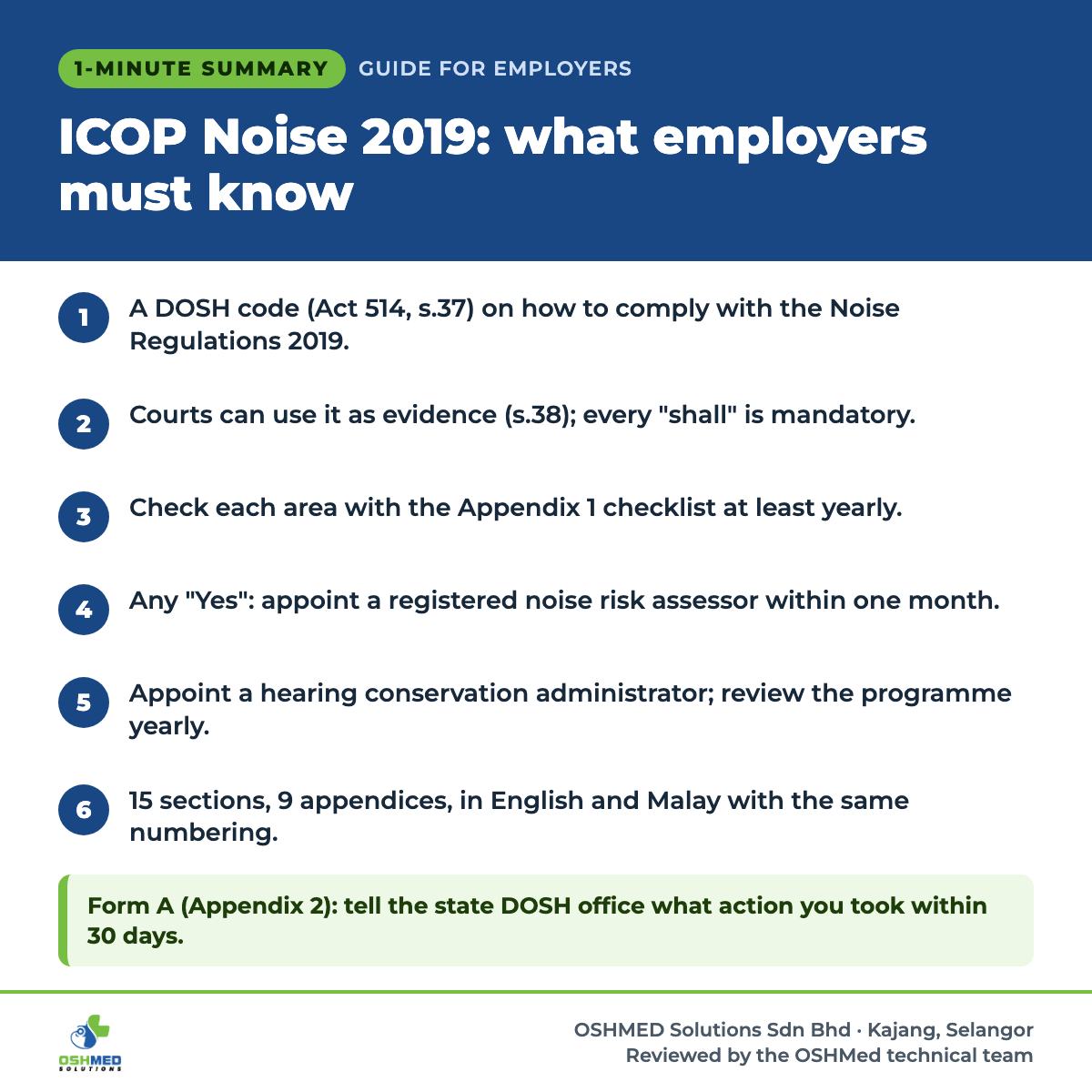
- A DOSH code (Act 514, s.37) on how to comply with the Noise Regulations 2019.
- Courts can use it as evidence (s.38); every "shall" is mandatory.
- Check each area with the Appendix 1 checklist at least yearly.
- Any "Yes": appoint a registered noise risk assessor within one month.
- Appoint a hearing conservation administrator; review the programme yearly.
- 15 sections, 9 appendices, in English and Malay with the same numbering.
Form A (Appendix 2): tell the state DOSH office what action you took within 30 days.
What is ICOP Noise 2019?
ICOP Noise 2019 is the Industry Code of Practice for Management of Occupational Noise Exposure and Hearing Conservation 2019, issued by DOSH in June 2019 under section 37 of Act 514. It guides employers on complying with the Noise Exposure Regulations 2019 (P.U. (A) 60/2019).
It has 15 sections and 9 appendices, in English and Malay with the same numbering, and covers every place of work under Act 514 where people are employed (ICOP 2). The duties themselves are in our Noise Exposure Regulations 2019 guide.
Is ICOP Noise 2019 legally binding?
Not as a regulation, but it cannot be ignored. The ICOP has no offences or penalties of its own, yet under section 38 of Act 514, failing to follow a relevant provision can be taken as proof of a breach, unless you show you met the law another way.
| Point | Regulations 2019 | ICOP 2019 |
|---|---|---|
| Legal form | Regulations under section 66 of Act 514, in force from 1 June 2019 | Code of practice under section 37 of Act 514, June 2019 |
| What it sets | Duties, limits and deadlines | Methods, formats and extra deadlines |
| Penalties | Fine, prison or both for each breach (penalties) | None of its own; admissible as evidence (section 38) |
The DOSH foreword calls the ICOP “a legally bound document to fulfill the requirements under the Regulations”. Where the Regulations leave the method to the Director General (regulations 3(1) and 4(2)(a)), the ICOP spells it out.
What does the ICOP add to the Noise Exposure Regulations 2019?
Deadlines, roles and formats the Regulations leave open: one month to appoint the noise risk assessor, a hearing conservation administrator, a yearly programme review, a set report format, notices to DOSH and extra rules on hearing protectors, each paired below with its regulation.
| Topic | Regulations 2019 | What the ICOP adds |
|---|---|---|
| Appointing the assessor | A registered assessor (reg. 4(1)), no deadline | Within one month of the identification (7.1.1) |
| Programme owner | Not named | A hearing conservation administrator (5.1.3); yearly review (5.1.4) |
| NRA report | Within one month (reg. 4(4)) | Appendix 2 format and Form A; kept at or near the premises (7.5) |
| Notices to DOSH | None for the assessor | Assessor notifies the state office 14 days before; Appendix 9 summary within 30 days (15.4.1) |
| After the report | Act on recommendations within 30 days (reg. 4(7)) | Form A: tell the state DOSH office the action taken within 30 days |
| Hearing protectors | Suitable, maintained and approved (reg. 7) | Interim only; removed only below 80 dB(A); fitting and care training yearly (11.1.2, 11.1.3, 11.4.1) |
Does your noise risk assessment meet the ICOP?
The ICOP expects a registered assessor within one month of a “Yes” on Appendix 1, a report in the Appendix 2 format and a review within five years. Send your layout plan, list of noisy machines, headcount and shift hours, and OSHMed will reply with a scoped proposal: request an NRA quote.
What do sections 1 to 6 of ICOP Noise 2019 cover?
Sections 1 to 6 set the ground rules: objective, scope, definitions, principles, the hearing conservation programme and the identification of excessive noise. Section 6 comes first in practice, because identification is every employer’s duty before anything is measured (regulation 3(1)).
- Section 3, definitions: excessive noise is above 82 dB(A) daily, a 50% dose, 115 dB(A) at any time or a 140 dB(C) peak; “quiet” means nothing above 80 dB(A).
- Sections 4 and 5: control noise at source first (4.1.1), keep a noise control plan (4.4.1(b)) and run a five-part hearing conservation programme (5.3; see our HCP guide).
- Section 6: the Appendix 1 checklist for each area, with workers who know the job, repeated after changes and at least yearly (6.2 to 6.7; use our identification checklist).
What does section 7 say about the noise risk assessment?
Section 7 is the method for the noise risk assessment (NRA): a registered assessor appointed within one month, IEC-compliant instruments verified at least every 12 months, area monitoring with a noise map, personal monitoring of each similar exposure group, and an Appendix 2 report reviewed within five years.
- 7.1 Principles: six objectives, including finding every exposed worker and marking hearing protection zones (7.1.2); see our NRA guide and NRA cost guide.
- 7.2 Equipment: meters to IEC 61672, dosimeters to IEC 61252 and calibrators to IEC 60942; results are discarded if field calibration differs by more than 0.5 dB.
- 7.3 Monitoring: at least three spot readings one metre from each source, mapped in white, yellow, red and purple zones (noise mapping), then a full-shift dosimeter on the highest-exposed worker in each group (dose calculator).
- 7.4 and 7.5 Report: results are compared with the exposure limit and written up in the Appendix 2 format.
What do sections 8 to 11 say about noise control and hearing protection?
Sections 8 to 11 set the order of control: engineering control first, administrative control next, and hearing protectors only as an interim measure. The employer assesses what is practicable and should write a justification report; hearing protection zones then follow the noise map.
- Section 8, reduction: the justification report weighs the scale of the problem, cost, effectiveness and how many people benefit (8.1.3); the DOSH noise control guideline 2024 (in Malay, section 4.3) has a sample.
- Section 9, engineering control: at the source, then the transmission path; tenders for new plant state a maximum acceptable noise level (9.2.2).
- Section 10, administrative control: job rotation, distance, rosters and quiet areas; Table 10.1 allows 8 hours at 85 dB(A) and 1 hour at 94 dB(A).
- Section 11, hearing protection: DOSH-approved protectors with attenuation data, yearly training and zones signposted from the noise map (11.2 to 11.5; see our hearing protection zone guide).
What do sections 12 to 15 cover?
Sections 12 to 15 cover people and paperwork: information and training for exposed workers, audiometric testing, registration of assessors and test centres, and the duties of suppliers, assessors, doctors and test centres. Employers act mainly on sections 12 and 13.
- Section 12, training: seven topics, in a language exposed workers understand (12.3.1, 12.3.3). OSHMed runs it as a one-day hearing conservation programme course.
- Section 13, audiometric testing: yearly above the limit at an approved centre, after 14 hours of quiet, with a baseline within three months of starting; results go to workers within 21 days (audiometric test guide).
- Section 14, registration: assessors register for up to three years, audiometric test centres for up to one year (14.1.3.1, 14.2.4.1).
- Section 15, duties: the assessor reports within 30 days; test centres send DOSH a yearly summary by 31 January (15.4.1, 15.8.1).
What are the 9 appendices in ICOP Noise 2019?
Nine forms and guides sit at the back: the identification checklist (Appendix 1), the NRA report guideline with Form A (2), five audiometric testing and hearing disorder appendices (3 to 7), plant noise information (8) and the NRA summary report (9).
| No. | Title | Who uses it |
|---|---|---|
| 1 | Checklist for Identification of Excessive Noise | Employer, per work area (guide) |
| 2 | Guidelines on Noise Risk Assessment Report Writing, with Form A | Assessor; employer signs Form A (NRA guide) |
| 3 | Audiometric Testing Flow Chart | Employer, test centre, doctor (test guide) |
| 4 | Questionnaire Form for Audiometric Testing | Technician, before each test |
| 5 | Guidance Notes for Occupational Noise-Related Hearing Disorders | Occupational health doctor |
| 6 | Report for Occupational Diseases/Poisonings | Doctor, with the DOSH notification |
| 7 | Notification of Occupational Noise-Related Hearing Disorder at Baseline Audiometric Testing and Repeated Cases | Doctor and employer |
| 8 | Guidance for Designers, Manufacturers, Importers and Suppliers on the Presentation of Information About Noise Levels Generated by Plant | Suppliers and buyers |
| 9 | Noise Risk Assessment Summary Report | Assessor, to the Director General |
What should employers do first under ICOP Noise 2019?
Start with what applies before anything is measured: complete Appendix 1 for each area, appoint a registered assessor within one month of any “Yes”, name a hearing conservation administrator and diarise the yearly reviews. The 12-item checklist below follows the ICOP section by section.
ICOP Noise 2019 employer checklist: 12 items
Tick each item already in place at your workplace. The items follow ICOP Noise 2019 section by section, with the section number in brackets. Print the list for your safety and health committee, or send your score to OSHMed on WhatsApp. No personal data is collected, and your ticks are not stored or sent unless you choose WhatsApp.
0 of 12 ready
OSHMED Solutions Sdn Bhd, based in Kajang, Selangor, serves employers across Malaysia and quotes in writing. Through our noise risk assessment service, the assessment is carried out by a DOSH-registered noise risk assessor, as the law requires, and ends with a written report. Every report names the responsible registered assessor and their myKKP registration number, so you can verify it on the DOSH register.
- An Appendix 1 checklist has a “Yes” and no assessor is appointed yet.
- Your NRA is over four and a half years old, or machines or shifts changed.
- Your NRA report does not follow Appendix 2 or has no noise map.
Before you decide: three common objections
Three objections delay action on the ICOP: it is only guidance, an existing NRA report is enough, and areas below 85 dB(A) are outside it. Each is checked below against the ICOP, the 2019 Regulations and Act 514.
"The ICOP is only guidance, so we can skip it."
Section 38 of Act 514 makes it admissible evidence, and its “shall” items are mandatory (ICOP 3).
"We have an NRA report, so we comply."
The NRA is one of five programme components (5.3). Training and the programme review recur yearly (regulation 5(2); ICOP 5.1.4).
"Our noise is under 85 dB(A), so the ICOP does not apply."
Identification applies to every employer (regulation 3(1)), and excessive noise starts above 82 dB(A), triggering the NRA and yearly training.
Frequently asked questions
Is there a Bahasa Melayu version of ICOP Noise 2019?
Yes: Tataamalan Industri bagi Pengurusan Pendedahan Bising Pekerjaan dan Pemuliharaan Pendengaran 2019, with the same section and appendix numbers. Both PDFs are linked in the sources below.
Where can I download the ICOP Noise 2019 PDF?
On the DOSH website. The English and Malay PDF links in the sources below were checked on 16 November 2026.
What is Appendix 1 in ICOP Noise 2019?
The Checklist for Identification of Excessive Noise: 10 yes or no questions for each work area. Any “Yes” indicates possible excessive noise, and a noise risk assessment follows (ICOP 6.3, 6.4).
Is ICOP Noise 2019 the same as the Noise Exposure Regulations 2019?
No. The Regulations (P.U. (A) 60/2019) are law with penalties; the ICOP explains how to comply and can be used as evidence (Act 514, section 38).
Does ICOP Noise 2019 apply outside factories?
Yes. It covers every place of work under Act 514 where people are employed (ICOP 2).
Your next step
Run the 12-item checklist above with your safety and health committee. If the NRA is missing, over five years old or out of date after changes, request an NRA quote.
Due for the yearly duties? Ask for a training quote or audiometric testing, arranged through approved centres (workplace health).
Close the gaps from your ICOP checklist
Share your checklist score on WhatsApp or through the quote form. We will tell you what the assessor needs from you before the site visit.
- Noise Exposure Regulations 2019: employer duties, limits and deadlines
- Noise risk assessment (NRA) in Malaysia: when you need one
- DOSH noise identification checklist: 10 questions, examples and next steps
- Hearing conservation programme and audiometric testing: what employers must do
- Audiometric test in Malaysia: DOSH procedure, baseline and STS results
- Noise mapping in Malaysia: DOSH colour zones and how to read a noise map
- Noise dose calculator: how to calculate LEX,8h and daily noise dose
- Hearing protection zone: DOSH signage rules and a printable sign
- Noise risk assessment cost in Malaysia: what sets your NRA quote
- OSHMed noise risk assessment service
Sources and references
Checked against the official documents listed below on 16 November 2026. Laws change: always confirm the current version on the DOSH (JKKP) website.
- Industry Code of Practice for Management of Occupational Noise Exposure and Hearing Conservation 2019 (Foreword, Preface, sections 1 to 15, Appendices 1 to 9), DOSH Malaysia
- Tataamalan Industri bagi Pengurusan Pendedahan Bising Pekerjaan dan Pemuliharaan Pendengaran 2019, Malay edition (same numbering), DOSH Malaysia
- Occupational Safety and Health (Noise Exposure) Regulations 2019, P.U. (A) 60/2019 (regulations 1 to 11), Attorney General's Chambers, published by DOSH
- Occupational Safety and Health Act 1994 (Act 514), reprint as at 1 June 2024 (sections 37, 38 and 66), DOSH Malaysia
- Panduan Mengenai Kawalan Kebisingan di Tempat Kerja 2024 (noise control guideline, section 4.3), DOSH Malaysia
Disclaimer: This article is general information for employers and is not legal advice. Requirements depend on your workplace, processes and the current law. For a decision on your premises, speak to a DOSH-registered competent person or contact DOSH (JKKP).