
Hearing Protection Zone in Malaysia: DOSH Signage Rules and a Printable Sign
A hearing protection zone is an area where a person may be exposed to noise above the noise exposure limit (NEL) in the Noise Exposure Regulations 2019. Regulation 8 requires the employer to mark it “HEARING PROTECTION ZONE”, sign its boundary where practicable, provide hearing protectors and ensure everyone inside wears them. Noise mapping in the noise risk assessment sets the boundary.
- MD (NNSMA, Rus)
- MScCH (Occ. Health, UKM)
- MBA (ARU, UK)
- OHD (NIOSH)
- MRO (AOEMM)
- TTT (HRDF)
- SSM 202001013523 (OSHMED Solutions Sdn Bhd)
- DOSH registered training provider SL/22/22/181036, valid to 21 July 2028
- MMC Full Registration 55275 (Dr. Wan Muhammad Zulhusni)
- DOSH Occupational Health Doctor HQ/16/DOC/00/454
- DMAC/EDTCmed 263
- OEUK OEUK/2024/3751
OSHMed Solutions Sdn Bhd is an occupational safety and health consultancy and DOSH-registered training provider (ergonomics) in Kajang, Selangor. We are not a clinic. Medical tests are arranged through approved centres.
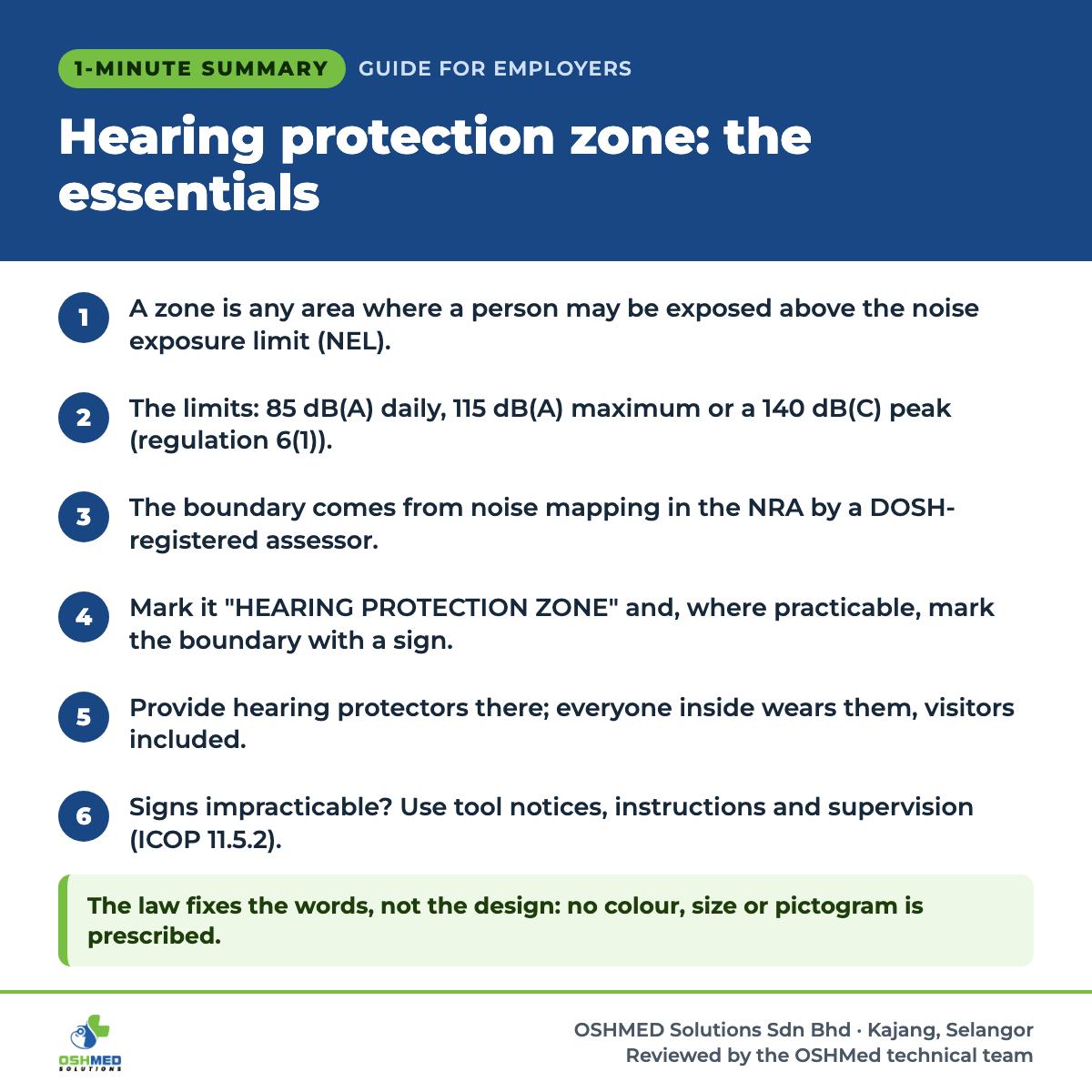
- A zone is any area where a person may be exposed above the noise exposure limit (NEL).
- The limits: 85 dB(A) daily, 115 dB(A) maximum or a 140 dB(C) peak (regulation 6(1)).
- The boundary comes from noise mapping in the NRA by a DOSH-registered assessor.
- Mark it "HEARING PROTECTION ZONE" and, where practicable, mark the boundary with a sign.
- Provide hearing protectors there; everyone inside wears them, visitors included.
- Signs impracticable? Use tool notices, instructions and supervision (ICOP 11.5.2).
What is a hearing protection zone?
It is an area of the workplace where a person may be exposed to noise above the noise exposure limit (NEL) set by regulation 6(1) of the Noise Exposure Regulations 2019 (ICOP section 3). Regulation 8 then requires the employer to mark the area, provide personal hearing protectors (PHP) there and make sure everyone inside uses them.
For the other duties under P.U. (A) 60/2019, see our Noise Exposure Regulations 2019 guide. This guide covers the zone and its sign.
When must an area be marked as a hearing protection zone?
When a person there is exposed to noise exceeding any one of the three limits in regulation 6(1): a daily noise exposure level above 85 dB(A) or a daily personal noise dose above 100 per cent, a maximum sound pressure level above 115 dB(A), or a peak sound pressure level above 140 dB(C).
| Measure | Zone required above | Basis |
|---|---|---|
| Daily noise exposure level | 85 dB(A), or a 100% daily dose | Reg. 6(1)(a), 8(1) |
| Maximum sound pressure level | 115 dB(A) | Reg. 6(1)(b), 8(1) |
| Peak sound pressure level (impact noise) | 140 dB(C) | Reg. 6(1)(c), 8(1) |
| Excessive noise only (above 82 dB(A) daily) | No zone; the NRA and training duties apply | Reg. 2, 4, 5 |
Who decides where the zone boundary goes?
The noise risk assessment does. ICOP section 7.1.2(e) lists “demarcate hearing protection zones” as an objective of the assessment, section 11.5.1 bases the zones on noise mapping, and Appendix 2 requires the report to name the areas to be posted with warning signs. The employer then marks and enforces the zone.
In noise mapping, which is part of area monitoring (ICOP 7.3.2(b)), the assessor spot-measures each machine and plots the levels on your layout plan in four colour zones (Table 7.2):
- White: 82 dB(A) or below.
- Yellow: above 82 to 85 dB(A).
- Red: above 85 to 115 dB(A).
- Purple: above 115 dB(A), or above 140 dB(C).
These colours belong to the report map, not to the sign. For what the assessment involves, see our NRA guide. Through our NRA service, the assessment is carried out by a DOSH-registered noise risk assessor, as the law requires, and ends with a written report.
Ask for the boundary and every entry point to be shown on the noise map, so each sign traces back to the report.
What must a hearing protection zone sign say?
Regulation 8(1)(a) fixes the words “HEARING PROTECTION ZONE”, or another manner determined by the Director General; the Malay text of the Regulations and the Malay ICOP use “ZON PERLINDUNGAN PENDENGARAN”. Neither the Regulations nor the ICOP prescribe a colour, size, pictogram or template, so the wording and placement are what you must get right.
| Sign element | What the law says | Basis |
|---|---|---|
| Zone wording | “HEARING PROTECTION ZONE” (Malay text: “ZON PERLINDUNGAN PENDENGARAN”), or a manner determined by the Director General | Reg. 8(1)(a) |
| Boundary and warning sign | Demarcated and identified by an appropriate warning sign, so far as practicable | Reg. 8(1)(b); ICOP 11.5.1 |
| Entry rule | No entry during normal operation without appropriate PHP | ICOP 11.5.1 |
| Colour, size, pictogram, template | Not specified | Neither text |
A bilingual sign carries the English wording of regulation 8 and the Malay wording of the ICOP. An ear protection sign or pictogram, as in the generator below, is optional; neither text requires one.
Hearing protection zone sign generator (regulation 8)
Choose the language and the instruction line, add the area or machine name if you wish, and check the preview. Print it on A4 landscape, or choose Save as PDF in the print dialogue. Make one sign for each entry point shown on your noise map.
The sign wording follows regulation 8 of the Noise Exposure Regulations 2019 and ICOP section 11.5. Neither the Regulations nor the ICOP prescribe colours, size or a pictogram, and this sign is not issued by DOSH. The zone boundary must come from noise mapping in your noise risk assessment (see our NRA service). Print on durable material and place a sign at every entry point. The text you type stays on this page unless you send it on WhatsApp.
Where should the signs go, and what if signposting is impracticable?
ICOP section 11.5.1 asks for the boundary to be clearly demarcated and identified by a warning sign so far as practicable. Because everyone inside must use protectors, put a sign at each way in, where people see it before they enter. Where signs cannot work, section 11.5.2 requires other arrangements.
- Notices on tools and equipment stating that PHP must be worn when operating them, for example a portable grinder used anywhere on site (11.5.2(a)).
- Written and verbal instructions on how to recognise when PHP are needed (11.5.2(b)).
- Effective supervision of identified hearing protection zones (11.5.2(c)).
Place protector dispensers and the point where people take protectors off outside the boundary: ICOP 11.1.3 says PHP shall be removed in areas below 80 dB(A).
What must you provide and supervise inside the zone?
Regulation 8(2) requires the employer to provide personal hearing protectors in the zone and ensure every employee or other person uses them inside, visitors and contractors included. Under regulation 7, protectors must be suitable, maintained, always available, approved by the Director General and able to bring exposure below the limit.
- Training: use, fitting, care and maintenance of protectors, at least once a year (ICOP 11.4.1; regulation 5).
- Supervision: of noise exposure control at the workplace (regulation 5(1)(c)).
- Warning sounds: protectors must not block alarms such as the emergency alarm (ICOP 11.2.7).
- Interim measure: protectors come after engineering and administrative control (regulation 6(4); ICOP 11.1.2).
Workers above the limit also need annual audiometric testing (regulation 9): see our hearing conservation programme guide. OSHMed’s yearly hearing conservation training covers hearing protection for exposed workers and supervisors; see also our training page.
Not sure where your zone boundary should be?
The boundary comes from noise mapping in a noise risk assessment. Send us your layout plan, noisy machines, headcount and shifts, and OSHMed will reply with a scoped proposal: request an NRA quote.
What are the common hearing protection zone mistakes?
Five mistakes are worth checking for: a boundary that was guessed, impact peaks that were missed, signs without the required words, protectors kept away from the zone, and zones left unchanged after machinery or the noise risk assessment changes. Each one breaches a specific regulation or ICOP section.
- Boundary guessed instead of taken from noise mapping (ICOP 11.5.1).
- Impact peaks missed: an area under 85 dB(A) daily can still pass 140 dB(C) (regulation 6(1)(c)).
- Wrong words: “Noisy area” in place of “HEARING PROTECTION ZONE” (regulation 8(1)(a)).
- Protectors kept in a store, not at the zone (regulations 7(1)(b) and 8(2)(a)).
- Zone never updated after new machinery, a re-identification or the NRA review due within five years (regulations 3(2) and 4(8)).
A zone already marked on site is a Yes on question 5 of the yearly identification checklist: see our noise identification checklist guide.
What is the penalty for not marking a hearing protection zone?
A breach of regulation 8(1) or 8(2), such as an unmarked zone, no protectors provided or people inside without them, can bring a fine of up to RM10,000, imprisonment of up to one year, or both (regulation 8(3)). Directors and managers can be charged with the company under section 52 of Act 514.
Regulation 8 sets its own penalty, so the general penalty in section 51 of Act 514 does not apply. OSHMED Solutions Sdn Bhd in Kajang, Selangor, quotes NRAs in writing for employers across Malaysia; see our assessments page.
- Your zone boundary was drawn without a noise map.
- Machinery was added, moved or modified since the last NRA.
- Your last NRA is nearly five years old, or missing.
- The report does not list the areas to signpost as zones.
Before you decide: three common objections
Three objections come up when employers plan a hearing protection zone: a sign is already up, workers wear earplugs anyway, and the boundary can be measured in-house. Each one is checked below against the Noise Exposure Regulations 2019 and the ICOP, so your decision rests on the rules.
"We already have an ear protection sign."
Check the words and the boundary. Regulation 8(1)(a) names “HEARING PROTECTION ZONE”, and ICOP 11.5.1 bases the zone on noise mapping, not on where a sign happens to hang.
"Our workers wear earplugs anyway."
The duty covers visitors and contractors too (regulation 8(2)(b)), and the sign is how they know before they walk in.
"We will map the noise ourselves."
A reading helps planning, but the mapping that sets the zone is part of the NRA, done by a DOSH-registered assessor with IEC-compliant equipment verified within 12 months (regulation 4; ICOP 7.2.2).
Frequently asked questions
What does "hearing protection zone" mean?
Section 3 of the DOSH noise ICOP 2019 defines it as an area where employees may be exposed to the noise exposure limit (NEL) in the Noise Exposure Regulations 2019. The Malay term is “zon perlindungan pendengaran”.
Is hearing protection zone signage mandatory in Malaysia?
Yes, where exposure exceeds a regulation 6(1) limit. Regulation 8(1) requires the area to be marked with the words “HEARING PROTECTION ZONE” and, so far as practicable, demarcated and identified by an appropriate warning sign.
Is there a DOSH hearing protection zone signage PDF or template?
The Regulations and the ICOP set the wording, not a design, and contain no sign template. Build a bilingual sign on this page, then print it or save it as a PDF from the print dialogue.
What colour and size must a hearing protection zone sign be?
Neither the Regulations nor the ICOP specify a colour, size or pictogram. Choose a size people can read as they approach, and print on durable material.
Do visitors and contractors need hearing protectors in the zone?
Yes. Regulation 8(2)(b) requires the employer to ensure that any employee or other person uses the protectors provided while in the hearing protection zone.
Your next step
Once your noise risk assessment has mapped the zone, print a sign for each entry point with the generator above. No noise map yet? Request an NRA quote, or send your site details via WhatsApp.
Protector training due? See our yearly hearing conservation training.
Get your zones mapped before you print the signs
Share your site details on WhatsApp or through the quote form. We will tell you what the assessor needs from you before the site visit.
- ICOP noise 2019: summary of all 15 sections and 9 appendices (DOSH)
- Noise mapping in Malaysia: DOSH colour zones and how to read a noise map
- Noise dose calculator: how to calculate LEX,8h and daily noise dose in Malaysia
- DOSH noise identification checklist: 10 questions and next steps
- Noise risk assessment (NRA) in Malaysia: when you need one
- Noise Exposure Regulations 2019: employer duties, limits and deadlines
- Hearing conservation programme (HCP) and audiometric testing
- OSHMed noise risk assessment service
Sources and references
Checked against the official documents listed below on 6 November 2026. Laws change: always confirm the current version on the DOSH (JKKP) website.
- Occupational Safety and Health (Noise Exposure) Regulations 2019, P.U. (A) 60/2019, English and Malay texts (regulations 2 to 9), Attorney General's Chambers, published by DOSH
- Industry Code of Practice for Management of Occupational Noise Exposure and Hearing Conservation 2019 (sections 3, 7.1, 7.2, 7.3.2, 11.1 to 11.5, Appendix 2), DOSH Malaysia
- Tataamalan Industri bagi Pengurusan Pendedahan Bising Pekerjaan dan Pemuliharaan Pendengaran 2019, Malay edition (sections 3, 7.1.2 and 11.5), DOSH Malaysia
- Occupational Safety and Health Act 1994 (Act 514), reprint incorporating Act A1648 (sections 51 and 52), DOSH Malaysia
- Regulations under the Occupational Safety and Health Act 1994 (Act 514), DOSH Malaysia
Disclaimer: This article is general information for employers and is not legal advice. Requirements depend on your workplace, processes and the current law. For a decision on your premises, speak to a DOSH-registered competent person or contact DOSH (JKKP).