
Noise Dose Calculator: How to Calculate LEX,8h and Daily Noise Dose in Malaysia
A noise dose calculator turns measured noise levels and durations into the two daily figures in the Noise Exposure Regulations 2019: the daily noise exposure level, LEX,8h, and the daily personal noise dose. With the DOSH ICOP formulas, 85 dB(A) for eight hours is a 100% dose. Above 82 dB(A) or 50% is excessive noise; above 85 dB(A) or 100% exceeds the limit.
- MD (NNSMA, Rus)
- MScCH (Occ. Health, UKM)
- MBA (ARU, UK)
- OHD (NIOSH)
- MRO (AOEMM)
- TTT (HRDF)
- SSM 202001013523 (OSHMED Solutions Sdn Bhd)
- DOSH registered training provider SL/22/22/181036, valid to 21 July 2028
- MMC Full Registration 55275 (Dr. Wan Muhammad Zulhusni)
- DOSH Occupational Health Doctor HQ/16/DOC/00/454
- DMAC/EDTCmed 263
- OEUK OEUK/2024/3751
OSHMed Solutions Sdn Bhd is an occupational safety and health consultancy and DOSH-registered training provider (ergonomics) in Kajang, Selangor. We are not a clinic. Medical tests are arranged through approved centres.
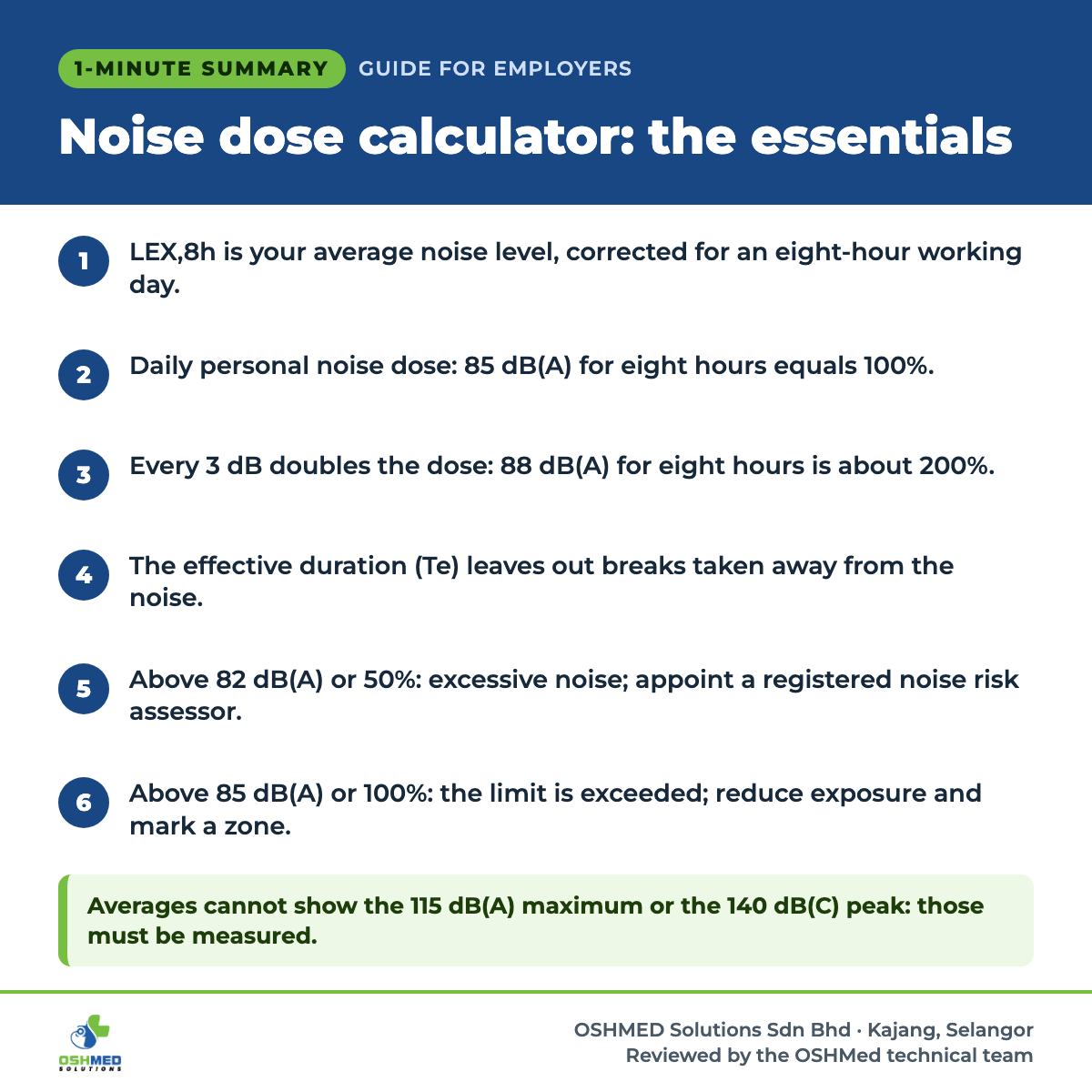
- LEX,8h is your average noise level, corrected for an eight-hour working day.
- Daily personal noise dose: 85 dB(A) for eight hours equals 100%.
- Every 3 dB doubles the dose: 88 dB(A) for eight hours is about 200%.
- The effective duration (Te) leaves out breaks taken away from the noise.
- Above 82 dB(A) or 50%: excessive noise; appoint a registered noise risk assessor.
- Above 85 dB(A) or 100%: the limit is exceeded; reduce exposure and mark a zone.
Averages cannot show the 115 dB(A) maximum or the 140 dB(C) peak: those must be measured.
What does a noise dose calculator work out?
It works out the two daily measures defined in regulation 2 of the Noise Exposure Regulations 2019. The daily noise exposure level, LEX,8h, is the equivalent continuous sound pressure level corrected for a normal working day of eight hours. The daily personal noise dose is the cumulative exposure for that day, shown as a percentage.
Noise dose calculator: LEX,8h and daily dose from your readings
Enter the A-weighted equivalent level, LAeq in dB(A), and the duration of each period of the working day. Add a period for each task or area, and exclude breaks taken away from the noise. Results update as you type, using the ICOP formulas and the 3 dB exchange rate.
This is a screening estimate from readings you enter, not a noise risk assessment: the legal result comes from a DOSH-registered noise risk assessor using IEC-compliant equipment (regulation 4). It applies the ICOP formulas (section 7.3.3(o)) and the 3 dB exchange rate (7.3.3(g)). The 115 dB(A) maximum and 140 dB(C) peak cannot be calculated from averages and must be measured. Nothing you enter is stored or sent unless you choose WhatsApp.
What is the noise dose formula in the DOSH ICOP?
ICOP section 7.3.3(o) gives two formulas. The daily noise exposure level is LEX,8h = LAeq,Te + 10 log(Te/T0), where T0 is the reference duration of 8 hours. The daily personal noise dose is Dose = 100 × (Te/8) × 10(LAeq,Te − 85)/10 %. Both formulas also appear on the personal monitoring data sheet in ICOP Appendix 2.
- LAeq,Te: the A-weighted equivalent continuous sound pressure level for the effective duration of the working day.
- Te: the effective duration of the working day, in hours.
The ICOP sets noise dosimeters to a criterion level, Lc, of 85 dB(A), a threshold level of 80 dB(A), a 3 dB exchange rate, the “Slow” time constant and a 140 dB(C) peak (7.3.3(g)). Check these on the print-out.
How do you combine several periods into one TWA noise level?
Average the sound energy of all the periods. The Regulations do not use the term TWA: the eight-hour figure they regulate is LEX,8h. With a 3 dB exchange rate this is energy averaging, LEX,8h = 10 log[(1/8) × Σ ti × 10Li/10], where Li is the level in dB(A) and ti the hours of each period.
Daily noise dose for several periods: Dose = 100 × Σ (ti/8) × 10(Li − 85)/10 %. With a single period, Te = t and LAeq,Te = L, so both expressions reduce to the ICOP formulas.
This follows the ICOP definition of the equivalent continuous sound pressure level: the steady level giving the same noise dose as the varying level over the same duration.
| Period | Level and time | Dose contribution |
|---|---|---|
| 1 | 90 dB(A) for 2 hours | 100 × (2/8) × 100.5 = 79.1% |
| 2 | 80 dB(A) for 6 hours | 100 × (6/8) × 10−0.5 = 23.7% |
| Whole day | Te = 8 hours; LAeq,Te = 85.1 dB(A) | LEX,8h = 85.1 dB(A); dose = 102.8%, about 103% |
Two hours at 90 dB(A) uses 79% of the dose alone; six quieter hours take the day over the limit.
How do you find the effective duration (Te)?
Te is the effective duration of the working day. In the ICOP example, breaks taken within the workplace and measured stay in Te, while a lunch break taken away from the noise and not measured is subtracted. The example uses a 10-hour day with 20-minute morning and tea breaks and a 45-minute lunch.
| Scenario | Breaks | Te | LEX,8h | Daily dose |
|---|---|---|---|---|
| A | Lunch outside the workplace, not measured | 10 h − 45 min = 9.25 h | 87 + 10 log(9.25/8) = 87.6 dB(A) | 100 × (9.25/8) × 10(87 − 85)/10 = 183.3% |
| B | No lunch area, so lunch is measured | 10 h | 87 + 10 log(10/8) = 88 dB(A) | 100 × (10/8) × 10(87 − 85)/10 = 198.1% |
| C | Lunch in a canteen away from the noise, not measured | 9.25 h | 87.6 dB(A) | 183.3% |
The same 87 dB(A) gives 198.1% with lunch in a noisy area and 183.3% without, which is why the ICOP requires break areas and lunch rooms away from noise (10.5.1).
Why does every 3 dB double the noise dose?
Because the ICOP sets a 3 dB exchange rate (7.3.3(g)), and in the dose formula a 3 dB rise multiplies the dose by 100.3, almost exactly 2. Each extra 3 dB halves the time for the same dose: 85 dB(A) for eight hours, 88 dB(A) for four and 91 dB(A) for two are each about 100%.
| Level, dB(A) | Dose after 8 hours | Daily exposure duration limit (ICOP Table 10.1) |
|---|---|---|
| 82 | 50% | 16 hours |
| 85 | 100% | 8 hours |
| 88 | 200% | 4 hours |
| 91 | 398% | 2 hours |
| 94 | 794% | 1 hour |
| 97 | 1,585% | 30 minutes |
| 100 | 3,162% | 15 minutes |
Eight hours at 82 dB(A) is half the dose of eight hours at 85 dB(A): the excessive noise level and the limit sit one exchange rate apart. For job rotation (10.2.1) or a mixed day, enter each period in the calculator rather than reading one row.
What does your result mean under the Noise Exposure Regulations 2019?
Compare it with regulations 2 and 6. A daily level above 82 dB(A) or a dose above 50% is excessive noise, which calls for a noise risk assessment by a DOSH-registered assessor. Above 85 dB(A) or a 100% dose exceeds the noise exposure limit, which brings exposure reduction, hearing protection zones and annual audiometric testing.
| Calculated result | Legal meaning | Next step |
|---|---|---|
| 82 dB(A) or below, and 50% or below | Not excessive noise on these readings | Re-identify after changes and within a year (reg. 3(2)) |
| Above 82 dB(A), or above 50% | Excessive noise (reg. 2) | Appoint a registered noise risk assessor (reg. 4); yearly training if the report confirms it (reg. 5) |
| Above 85 dB(A), or above 100% | Noise exposure limit exceeded (reg. 6(1)(a)) | Engineering control first (reg. 6(4)); hearing protection zone (reg. 8); annual audiometric testing (reg. 9) |
Start with the ICOP Appendix 1 checklist (noise identification checklist guide); every duty is in our Noise Exposure Regulations 2019 guide. Breaching regulation 6 can bring a fine of up to RM10,000, up to one year in prison, or both (regulation 6(7)).
Is your calculated dose above 50%?
A result above 82 dB(A) or 50% points to excessive noise, and the next step is a noise risk assessment by a DOSH-registered assessor. Send your layout plan, list of noisy machines, headcount and shift hours, and OSHMed will reply with a scoped proposal: request an NRA quote.
What is a noise dose meter, and can a calculator replace one?
A noise dose meter, or noise dosimeter, automatically integrates sound pressure level over the measurement period and shows the result as a noise dose (ICOP section 3). A calculator cannot replace it: it only repeats the arithmetic on levels you already have and cannot detect the maximum or the peak.
- Full shift: measured during normal operation, with all types of noise present, for the full working hours (7.3.3(j)).
- Equipment: meets IEC 61252, is verified at least every 12 months and is field-calibrated before and after monitoring (7.2.2 to 7.2.4).
The 115 dB(A) maximum and 140 dB(C) peak are separate limits (regulation 6(1)(b) and (c)) that apply at any moment: an area under 85 dB(A) for the day can still breach the peak.
OSHMED Solutions Sdn Bhd, based in Kajang, Selangor, serves employers across Malaysia and quotes in writing. Through our noise risk assessment service, the assessment is carried out by a DOSH-registered noise risk assessor, as the law requires, and ends with a written report. Every report names the responsible registered assessor and their myKKP registration number, so you can verify it on the DOSH register.
- Your calculated LEX,8h is above 82 dB(A), or the dose is above 50%.
- Shifts exceed eight hours in areas close to 85 dB(A).
- Your last NRA is nearly five years old, or missing.
Before you decide: three common objections
Three objections come up when employers look at a calculated dose: the machines read below 85 dB(A), the calculator result is enough for DOSH, and only the loudest machine matters. Each is checked below against the 2019 Regulations and the ICOP, so the decision rests on the rules.
"Our machines read 84 dB(A), so we are under the limit."
Not over a long shift. Twelve hours at 84 dB(A) gives an LEX,8h of 85.8 dB(A) and a 119% dose, above the limit in regulation 6(1)(a).
"The calculator result is enough for DOSH."
No. Regulation 4 requires an NRA by a registered noise risk assessor using IEC-compliant equipment; a calculation is only for screening.
"Only the loudest machine matters."
In the two-period example, six hours at 80 dB(A) added 23.7% and took the day past 100%.
Frequently asked questions
How do you calculate noise dose?
Multiply 100 by Te/8 and by 10 to the power of (LAeq,Te − 85)/10 (ICOP 7.3.3(o)). For several periods, add each share: 100 × (ti/8) × 10(Li − 85)/10.
What is the TWA noise level in Malaysia?
The Regulations use the daily noise exposure level, LEX,8h, corrected for an eight-hour day with a 3 dB exchange rate. Above 85 dB(A) exceeds the limit.
What exchange rate does DOSH use for noise dose?
3 dB, with a criterion level of 85 dB(A) and a threshold level of 80 dB(A) (ICOP 7.3.3(g)).
Does a 12-hour shift change the noise dose?
Yes. A longer effective duration at the same level raises both figures: 84 dB(A) for 12 hours gives 85.8 dB(A) and a 119% dose.
Can a noise dose calculator check the 115 dB(A) maximum or the 140 dB(C) peak?
No. Those limits apply at any moment (regulation 6(1)(b) and (c)) and must be measured; the ICOP Appendix 2 data sheet records both.
Your next step
Enter each period of a typical shift above. If the result is above 82 dB(A) or 50%, request an NRA quote or send the result on WhatsApp; a registered assessor can then confirm it by measurement.
Already above 85 dB(A)? Plan the hearing protection zone, the hearing conservation programme and our yearly hearing conservation training (training page).
Confirm your calculation with a registered noise risk assessment
Share your calculator result on WhatsApp or through the quote form. We will tell you what the assessor needs from you before the site visit.
- ICOP noise 2019: summary of all 15 sections and 9 appendices (DOSH)
- Noise mapping in Malaysia: DOSH colour zones and how to read a noise map
- Audiometric test in Malaysia: DOSH procedure, baseline and STS results
- Noise risk assessment (NRA) in Malaysia: when you need one
- DOSH noise identification checklist: 10 questions and next steps
- Noise Exposure Regulations 2019: employer duties, limits and deadlines
- Hearing protection zone: DOSH signage rules and a printable sign
- Noise risk assessment cost in Malaysia: what sets your NRA quote
- OSHMed noise risk assessment service
Sources and references
Checked against the official documents listed below on 9 November 2026. Laws change: always confirm the current version on the DOSH (JKKP) website.
- Occupational Safety and Health (Noise Exposure) Regulations 2019, P.U. (A) 60/2019, English and Malay texts (regulations 2 to 6, 8, 9 and 11), Attorney General's Chambers, published by DOSH
- Industry Code of Practice for Management of Occupational Noise Exposure and Hearing Conservation 2019 (sections 3, 7.2, 7.3.3(g) to (o), 10.2, 10.5, Table 10.1, Appendix 1 and Appendix 2), DOSH Malaysia
- Tataamalan Industri bagi Pengurusan Pendedahan Bising Pekerjaan dan Pemuliharaan Pendengaran 2019, Malay edition (sections 3, 7.3.3(o), Jadual 10.1), DOSH Malaysia
- Regulations under the Occupational Safety and Health Act 1994 (Act 514), DOSH Malaysia
Disclaimer: This article is general information for employers and is not legal advice. Requirements depend on your workplace, processes and the current law. For a decision on your premises, speak to a DOSH-registered competent person or contact DOSH (JKKP).