
Respirator Fit Test in Malaysia: DOSH Requirements, Methods and Frequency
A respirator fit test checks that one make, model and size of tight-fitting respirator seals to a worker’s face. In Malaysia, USECHH 2000 requires protective equipment to fit the employee (regulation 16(3)(b)); DOSH’s 2005 PPE guideline sets a fit test before first use, after a facepiece change and at least annually.
- MD (NNSMA, Rus)
- MScCH (Occ. Health, UKM)
- MBA (ARU, UK)
- OHD (NIOSH)
- MRO (AOEMM)
- TTT (HRDF)
- SSM 202001013523 (OSHMED Solutions Sdn Bhd)
- DOSH registered training provider SL/22/22/181036, valid to 21 July 2028
- MMC Full Registration 55275 (Dr. Wan Muhammad Zulhusni)
- DOSH Occupational Health Doctor HQ/16/DOC/00/454
- DMAC/EDTCmed 263
- OEUK OEUK/2024/3751
OSHMed Solutions Sdn Bhd is an occupational safety and health consultancy and DOSH-registered training provider (ergonomics) in Kajang, Selangor. We are not a clinic. Medical tests are arranged through approved centres.
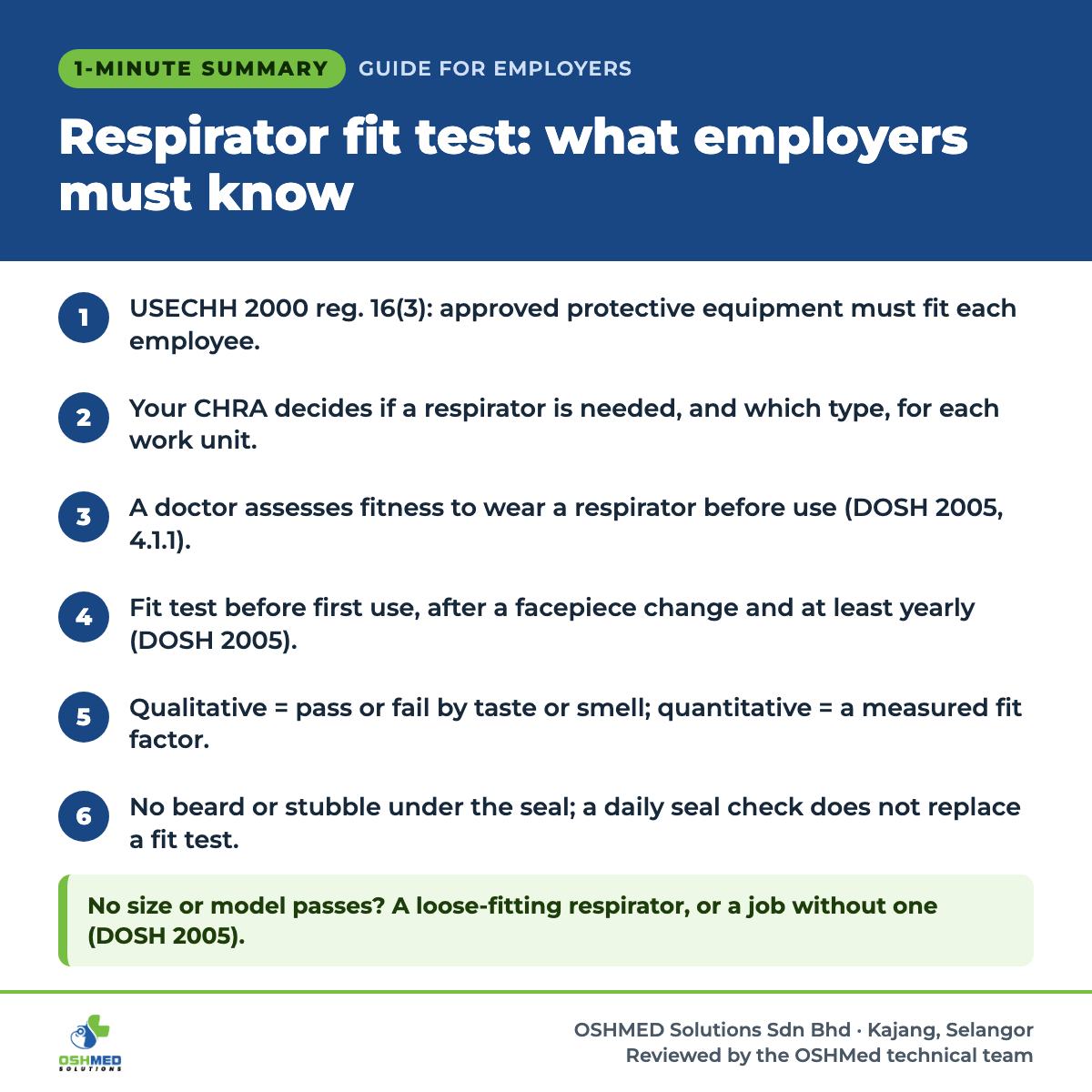
- USECHH 2000 reg. 16(3): approved protective equipment must fit each employee.
- Your CHRA decides if a respirator is needed, and which type, for each work unit.
- A doctor assesses fitness to wear a respirator before use (DOSH 2005, 4.1.1).
- Fit test before first use, after a facepiece change and at least yearly (DOSH 2005).
- Qualitative = pass or fail by taste or smell; quantitative = a measured fit factor.
- No beard or stubble under the seal; a daily seal check does not replace a fit test.
No size or model passes? A loose-fitting respirator, or a job without one (DOSH 2005).
What is a respirator fit test?
A respirator fit test checks whether one make, model and size of tight-fitting respirator seals to one worker’s face. The worker wears it while breathing, moving and talking, and the result is a pass or fail, or a measured fit factor, for that facepiece only.
| Point | Fit test | User seal check |
|---|---|---|
| Done by | A trained tester, with a test agent or instrument | The wearer |
| When | Before first use, after a facepiece change, at least yearly | Every time the respirator is put on |
| What it shows | This model and size can seal to this face | The respirator is on correctly today |
Is a respirator fit test required in Malaysia?
In effect, yes, where respirators control chemical exposure. USECHH 2000 requires approved protective equipment to fit the employee and not harm their health (regulation 16(3)). DOSH’s 2005 PPE guideline sets out how: fit test every tight-fitting respirator. It is guidance, not a regulation, and we found no official fit test certificate.
| Document | Status | What it says |
|---|---|---|
| USECHH Regulations 2000, regulation 16 | Regulation (law) | Written procedures for issue, maintenance, inspection and training (16(2)); equipment must suit the work, fit the employee and not harm their health (16(3)) |
| Guidelines on the Use of PPE Against Chemical Hazards 2005 | DOSH guideline | Fit test every tight-fitting respirator before first use, after a facepiece change and at least annually (3.2.3) |
| CHRA manual, 3rd edition 2018 | DOSH manual for assessors | PPE is adequate only if “correctly fitted”: sized and “fit tested for the worker” (7.2.1.2) |
| USECHH self-assessment checklist, 2021 | DOSH checklist | “Padan dengan pekerja” (fits the worker), shown with a fit test picture (element 3e) |
Regulation 8 counts a respirator’s protection only while it is worn (USECHH guide).
How does a CHRA decide whether workers need a respirator?
The chemical health risk assessment (CHRA) comes before any fit test. The DOSH-registered assessor rates exposure without counting respirators, judges whether existing controls are adequate and recommends what to add. Respirators come last in the hierarchy of control, for when other controls are impracticable, interim or not enough (regulation 16(1)).
The assessor checks suitability, since “a particulate respirator is not suitable to protect against organic solvent vapour” (CHRA manual 7.2.1.1), and whether it is “correctly fitted”, sized and fit tested for the worker (7.2.1.2). Form D of the report records the findings (CHRA report format).
A good fit on the wrong respirator still fails: the fit test checks the seal, but only the CHRA checks the type and protection level.
The 2005 guideline requires an assigned protection factor at least equal to the hazard ratio, exposure divided by the PEL: 10 for an air-purifying half facepiece, 100 for a full facepiece (2.2.1, Table 3). This needs exposure data; SDS section 8 is only a start (SDS guide).
Not sure which respirator your workers need?
The CHRA decides whether a respirator is needed, for which work units and of what type. Send your chemical register, SDSs and the respirators in use, and OSHMed will reply with a scoped proposal: request a CHRA quote.
Who decides if a worker is fit to wear a respirator?
A doctor, before the fit test. DOSH’s 2005 guideline puts a medical evaluation of fitness to wear at the selection stage, before workers must wear a respirator and before fit testing (4.1.1, 4.2). In USECHH medical surveillance, the occupational health doctor (OHD) assesses it and can certify a worker “not fit” (7.3.12, 7.3.13).
Appendix 2 of the 2023 guidelines lists conditions that may disqualify a wearer, such as facial hair at the seal, respiratory disease affecting lung function or some heart conditions; a spirometry test helps the assessment (DOSH spirometry guidance 2026, 6.1). See our medical surveillance guide, pre-employment check-ups and OHD services.
Qualitative vs quantitative fit test: what is the difference?
A qualitative fit test (QLFT) is pass or fail: the worker reports tasting or smelling a test agent that leaks past the seal. A quantitative fit test (QNFT) uses an instrument to measure leakage and gives a fit factor. DOSH’s 2005 guideline accepts both and points to OSHA-accepted protocols.
| Point | Qualitative (QLFT) | Quantitative (QNFT) |
|---|---|---|
| Result | Pass or fail, from the wearer’s response | A measured fit factor |
| Test agent or equipment | Isoamyl acetate (organic vapour cartridges); saccharin or Bitrex, denatonium benzoate (particulate filters); irritant smoke (high-efficiency filters such as P100 only) | Special equipment and a technician trained by the manufacturer |
| Respirators | Half masks (OSHA: where a fit factor of 100 or less is needed; HSE: not for full-face masks) | Half and full-face masks |
| Pass level | No taste, smell or reaction during the exercises | DOSH 2005: at least 10 times the assigned protection factor (100 for a half facepiece); OSHA: 100 half, 500 full; HSE: 100 half, 2,000 full |
OSHA’s protocol (Appendix A): wear the respirator for at least 5 minutes, then breathe normally, breathe deeply, turn the head side to side and up and down, talk, bend over and breathe normally again, a minute each; QNFT adds a 15-second grimace. Any adjustment voids the test.
Can a worker with a beard pass a respirator fit test?
Not with a tight-fitting respirator if hair crosses the seal. DOSH’s 2005 guideline rules out a fit test over stubble, a moustache, beard or long sideburns at the sealing surface, and says tight-fitting respirators should not be worn over facial hair between the seal and the face.
The same applies to prescription glasses with temple bars under a full facepiece. If no size or model fits, the guideline’s fallback is a loose-fitting respirator with enough protection (HSE: hoods and helmets need no fit test), or a job without respiratory protection. That also suits a worker who keeps a beard for religious or personal reasons.
How often is a respirator fit test needed, and does it expire?
Under DOSH’s 2005 guideline: before first use, whenever a different facepiece size, style, model or make is used, and at least annually. OSHA in the US sets the same and adds changes to the face. The UK’s HSE sets no fixed interval but expects a retest after such changes.
| Trigger | DOSH 2005 (Malaysia) | OSHA 1910.134 (US) | HSE INDG479 (UK) |
|---|---|---|---|
| Before first use | Yes | Yes, (f)(2) | Yes, at selection |
| Different facepiece size, style, model or make | Yes | Yes, (f)(2) | Yes, also material |
| Weight change, dental work or scarring | Not stated | Yes, (f)(3) | Yes |
| Fixed interval | At least annually | At least annually | None; review regularly |
What should a respirator fit test record include?
We found no official DOSH fit test form. OSHA’s minimum record covers the worker, test type, respirator make, model, style and size, the date and the result; HSE adds the pass level and the tester’s details.
| Field | Example |
|---|---|
| Worker | Worker A, staff no. 0000 |
| Work unit and chemical | Spray booth, solvent-based paint (CHRA work unit 3) |
| Respirator | Reusable half mask, size M, organic vapour cartridges; make and model recorded |
| Method and exercises | Qualitative, isoamyl acetate; 7 exercises |
| Result and dates | Pass; 3 March 2026, next test by 2 March 2027 |
| Tester | Name, organisation and training |
| Fitness to wear | OHD assessment dated 10 February 2026 |
Retention: 2 years for PPE programme records in the CHRA manual (Table 19); at least the length of employment in the 2005 guideline (4.7; sample issue record in Appendix 3). The longer period meets both.
What should be ready before you arrange a fit test?
Five things: a current CHRA naming the respirator for each work unit, approved respirators in more than one size, a doctor’s assessment of fitness to wear, wearers trained and clean-shaven at the seal, and written procedures for issue, maintenance, inspection and training (regulation 16(2)). Use the checklist below.
Respirator fit test readiness: 10-item checklist
Tick each item already in place for workers who wear tight-fitting respirators. Each item cites the regulation or DOSH document it comes from. Print the list for your safety and health committee, or send your score to OSHMed on WhatsApp. No personal data is collected, and your ticks are not stored or sent unless you choose WhatsApp.
0 of 10 ready
OSHMed does not run respirator fit tests or sell fit test kits. For the test itself, ask your respirator supplier or a person trained in a recognised protocol. OSHMED Solutions Sdn Bhd in Kajang, Selangor, serves employers across Malaysia and quotes in writing. Through our CHRA service, a DOSH-registered assessor carries out the assessment, as the law requires, and the written report names them with their myKKP registration number for you to verify on the DOSH register. We also plan and coordinate medical surveillance with a DOSH-registered OHD, including fitness to wear a respirator.
- Workers wear respirators, but your CHRA is over five years old or does not name the type.
- The respirator was chosen from the SDS alone, without exposure data.
- No doctor has assessed fitness to wear a respirator.
Before you decide: three common objections
Three objections delay respirator programmes: approved respirators are assumed to fit everyone, a fit test is taken to replace the CHRA, and a passed fit test is taken to cover medical fitness. Each is checked against DOSH texts.
"Our respirators are DOSH-approved, so they fit."
Approval rests on design and testing to recognised standards (2005 guideline, 5.1), and the same guideline warns that certification cannot ensure protection for every worker (3.2.3).
"Everyone passed a fit test, so the CHRA can wait."
A fit test checks the seal, not whether the respirator type and protection level suit the chemical. That is the CHRA’s job (CHRA manual 7.2.1.1).
"The fit test passed, so no medical check is needed."
Fitness to wear is a medical decision made before use (2005 guideline, 4.1.1), and in surveillance the OHD can certify a worker “not fit” (2023 guidelines, 7.3.13).
Frequently asked questions
Where can I get a respirator fit test near me?
OSHMed does not run fit tests. Ask your respirator supplier or a person trained in a recognised protocol, once the CHRA and the doctor’s assessment of fitness to wear are done.
Is a respirator fit test mandatory in Malaysia?
USECHH 2000 requires protective equipment to fit the employee (regulation 16(3)(b)), and DOSH’s 2005 PPE guideline sets fit testing as the way to show this for tight-fitting respirators.
Do N95 respirators need a fit test?
Yes, when worn as tight-fitting respirators at work. DOSH’s haze guidelines say employees who must wear respirators should be fit tested; N95 is a particulate filter class (2005 guideline, Table 4).
What is the difference between a fit test and a fit check?
A fit test, run by a trained tester, shows that a model and size seal to the wearer’s face. A fit check, or user seal check, is done by the wearer at every use and does not replace it.
How long is a respirator fit test valid?
Up to a year under DOSH’s 2005 guideline, or less if the respirator facepiece changes.
Your next step
Run the checklist above. If your CHRA is missing, over five years old or silent on respirators, request a CHRA quote; if no doctor has assessed fitness to wear, ask about medical surveillance. This guide is general information, not medical advice.
To choose the protection factor from measured exposure, ask about chemical exposure monitoring or see our assessment services.
Put the CHRA and medical surveillance in place before the fit test
Share your checklist score on WhatsApp or through the quote form. For fitness to wear a respirator, ask about medical surveillance.
- Spirometry test for workers in Malaysia: DOSH guidance, results and frequency
- Chemical health risk assessment (CHRA) under USECHH 2000
- CHRA report: DOSH format, sample outline and retention period
- CHRA assessor in Malaysia: how to check one and what sets the cost
- USECHH 2000: a plain guide to all 30 regulations
- Medical surveillance in Malaysia: how to set up a USECHH programme
- Pre-employment medical check-up: when the law requires one
- Chemical exposure monitoring (CEM): when, how often, who
- CLASS 2013: chemical labels, SDS and warning signs
- OSHMed chemical health risk assessment service
- OSHMed occupational health doctor (OHD) services
Sources and references
Checked against the official documents listed below on 17 November 2026. OSHA and HSE documents are international practice, not Malaysian law. Laws change: always confirm the current version on the DOSH (JKKP) website.
- Occupational Safety and Health (Use and Standards of Exposure of Chemicals Hazardous to Health) Regulations 2000, P.U. (A) 131/2000 (regulations 8, 9, 10 and 16), Attorney General's Chambers, published by DOSH
- Guidelines on the Use of PPE Against Chemical Hazards 2005 (sections 2.2.1, 3.2.3, 4.1.1, 4.2, 4.7 and 5.1; Tables 3 and 4; Appendix 3), DOSH Malaysia
- A Manual of Recommended Practice on Assessment of the Health Risks Arising from the Use of Chemicals Hazardous to Health at the Workplace, 3rd edition, first reprint 2018 (sections 5.2.1 and 7.2.1; Table 19; Form D; Appendix 12), DOSH Malaysia
- Senarai Semak Self Assessment Peraturan USECHH 2000 (USECHH self-assessment checklist), version 1 January 2021 (elements 3d and 3e), DOSH Malaysia
- Guidelines on Medical Surveillance Programme at The Workplace 2023 (sections 7.3.1, 7.3.12, 7.3.13 and Appendix 2), DOSH Malaysia
- Guidance on Spirometry Procedure for Occupational Health Practice 2026 (section 6.1), DOSH Malaysia
- Guidelines for the Protection of Employees Against the Effects of Haze at Workplaces (paragraphs 4(e), 10 and 11), DOSH Malaysia
- Occupational Safety and Health (Classification, Labelling and Safety Data Sheet of Hazardous Chemicals) Regulations 2013 (regulation 13(2)(h)), Attorney General's Chambers, published by DOSH
- 29 CFR 1910.134 Respiratory protection (paragraphs (e)(1), (f), (g)(1) and (m)(2)); international practice, not Malaysian law, US Occupational Safety and Health Administration (OSHA)
- 29 CFR 1910.134 Appendix A, Fit Testing Procedures (Part I.A); international practice, not Malaysian law, US Occupational Safety and Health Administration (OSHA)
- Guidance on respiratory protective equipment (RPE) fit testing, INDG479, October 2025; international practice, not Malaysian law, Health and Safety Executive (HSE), United Kingdom
Disclaimer: This article is general information for employers and is not legal advice. Requirements depend on your workplace, processes and the current law. For a decision on your premises, speak to a DOSH-registered competent person or contact DOSH (JKKP).