
CHRA Report: DOSH Format, Sample Outline, Validity and Retention Period
A CHRA report is the written assessment that a DOSH-registered assessor must give the employer within one month of completing a chemical health risk assessment (USECHH 2000, regulation 12). The DOSH manual sets eleven minimum sections and an action priority for every recommendation. Keep the report for at least 30 years; review it within five.
- MD (NNSMA, Rus)
- MScCH (Occ. Health, UKM)
- MBA (ARU, UK)
- OHD (NIOSH)
- MRO (AOEMM)
- TTT (HRDF)
- SSM 202001013523 (OSHMED Solutions Sdn Bhd)
- DOSH registered training provider SL/22/22/181036, valid to 21 July 2028
- MMC Full Registration 55275 (Dr. Wan Muhammad Zulhusni)
- DOSH Occupational Health Doctor HQ/16/DOC/00/454
- DMAC/EDTCmed 263
- OEUK OEUK/2024/3751
OSHMed Solutions Sdn Bhd is an occupational safety and health consultancy and DOSH-registered training provider (ergonomics) in Kajang, Selangor. We are not a clinic. Medical tests are arranged through approved centres.
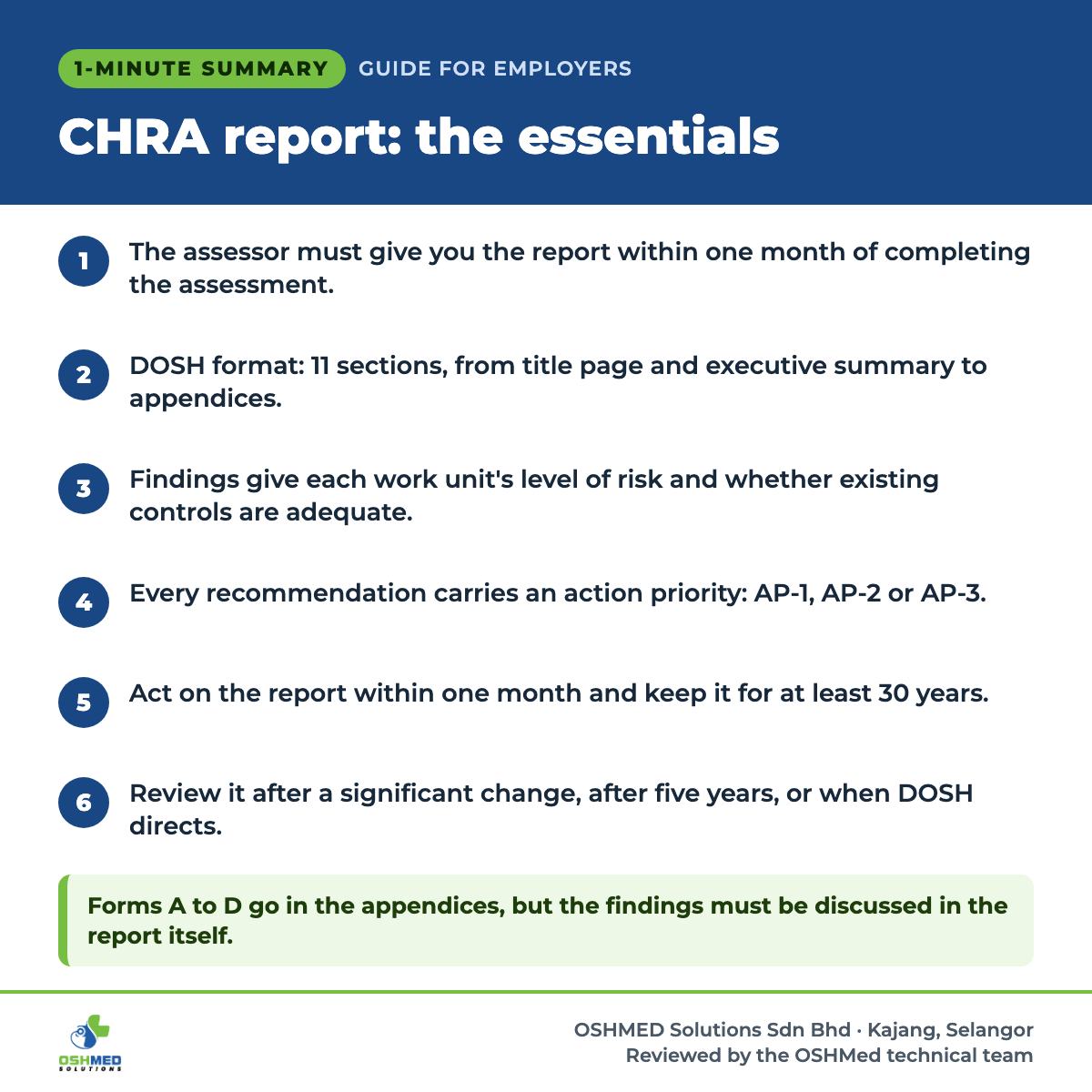
- The assessor must give you the report within one month of completing the assessment.
- DOSH format: 11 sections, from title page and executive summary to appendices.
- Findings give each work unit's level of risk and whether existing controls are adequate.
- Every recommendation carries an action priority: AP-1, AP-2 or AP-3.
- Act on the report within one month and keep it for at least 30 years.
- Review it after a significant change, after five years, or when DOSH directs.
Forms A to D go in the appendices, but the findings must be discussed in the report itself.
What is a CHRA report, and what must it contain?
A CHRA report is the written result of a chemical health risk assessment under USECHH 2000. The DOSH-registered assessor must give it to the employer within one month of completing the assessment (regulation 12(1)). It covers the ten items in regulation 9(2), from the nature of the hazard to the need for monitoring, health surveillance and training.
When a CHRA is required: our CHRA guide. Who may do it: our CHRA assessor guide. An immediate danger to life or property must be reported to the employer at once, not left for the report (regulation 12(2)).
What is the DOSH format for a CHRA report?
Chapter 11 of the DOSH CHRA manual (3rd edition, 2018 reprint) sets the minimum structure: title page, executive summary, table of contents, introduction, process and work unit description, methodology, findings, discussion, recommendations, references and appendices. The sample outline below shows what each section holds.
| Section | What to include | Manual |
|---|---|---|
| 1. Title page | Title, reference number, date submitted, assessor’s name and registration number, company and premises details | 11.1 |
| 2. Executive summary | Preferably one page, written last: location, date, objective, work units, chemicals, risk levels, action priorities, main recommendations | 11.2 |
| 3. Table of contents | Sections, figures, tables and appendices | 11.3 |
| 4. Introduction | Company and site, objective, scope and limitations, previous assessment | 11.4 |
| 5. Process and work units | Process flow chart, how work units were chosen, shifts, worker numbers | 11.5 |
| 6. Methodology | How the method was applied, briefly; other methods need the Director General’s endorsement | 11.6 |
| 7. Findings | Level of risk and control adequacy for each work unit, in labelled tables | 11.7 |
| 8. Discussion | What drives each significant risk, how well controls work, workers’ health feedback | 11.8 |
| 9. Recommendations | SMART actions, each with an action priority | 11.9 |
| 10. References | Documents referred to | 11.10 |
| 11. Appendices | Forms A to D, layout plan, process flow chart, the assessor’s valid competency slip, laboratory results | 11.11 |
SDSs and the chemical register need not be appended (11.11). See a sample cover of an OSHMed CHRA report on our assessments page.
What goes on the title page, and who signs the CHRA report?
The title page gives the report title, a reference number, the date submitted to the employer, the assessor’s name and competency registration number, company and DOSH registration details, and the premises address (manual 11.1). The assessor and the employer both sign off the report, for example on the CHRA notification form in Appendix 14.
The reference number joins the assessor’s registration number, the year and a serial number (manual example: HQ/17/ASS/00/00002-2017/001). On the form, the assessor certifies the dates and that the employer was told to act within one month; your representative signs and dates it.
Check your CHRA report: 14 items from the DOSH manual
Open your latest CHRA report and tick each item it has. The items follow chapters 10 to 12 of the DOSH CHRA manual and regulations 10 and 12 of USECHH 2000; the section number is in brackets. Print the list, or send your score to OSHMed on WhatsApp. No personal data is collected, and your ticks are not stored or sent unless you choose WhatsApp.
0 of 14 ready
How does a CHRA report reach its conclusion and action priority?
For inhalation, the risk rating is the hazard rating times the exposure rating (RR = HR × ER, each 1 to 5): 1 to 4 is low, 5 to 12 moderate and 15 to 25 high (manual 6.1). Dermal risk is low, moderate (M1, M2) or high (H1, H2). Each risk is then paired with control adequacy to set the action priority.
| Level of risk | Existing controls | Action priority | What the employer does |
|---|---|---|---|
| High | Inadequate | AP-1 | Fix technical controls now (eliminate, substitute, isolate, contain); PPE only meanwhile; consider stopping the task |
| HR or ER unknown | Not applicable | AP-1 | Get hazard data from the supplier first, or assume the worst case (10.3.2) |
| Moderate or low | Inadequate | AP-2 | Remedial action still required, after AP-1 |
| Any level | Adequate | AP-3 | Maintain existing technical controls |
The conclusion itself is one of six risk and control combinations, such as “high risk and inadequately controlled” (10.1). It is not the action priority, and within one priority the higher risk rating goes first (10.4).
| Work unit: chemical | Route | Rating | Risk | Controls | AP |
|---|---|---|---|---|---|
| Mixing: solvent A | Inhalation | HR 4 × ER 4 = RR 16 | High | Inadequate | AP-1 |
| Packing: powder B | Inhalation | HR 3 × ER 3 = RR 9 | Moderate | Inadequate | AP-2 |
| Cleaning: detergent C (H315) | Dermal | Long-term contact, small area | Moderate (M1) | Inadequate | AP-2 |
| QC laboratory: reagent D | Inhalation | HR 2 × ER 2 = RR 4 | Low | Adequate | AP-3 |
What must the recommendations and action plan include?
Recommendations must be SMART and cover technical control, organisational control with training, emergency response, exposure monitoring and medical surveillance, each with an action priority (manual 11.9). The employer builds an action plan from them and must carry out the required action within one month of receiving the report (regulation 14(1)).
- Specific: “use neoprene gloves”, not “use gloves” (10.2).
- Monitoring: name each chemical and its limit, PEL or OEL for air and BEL for biological monitoring (10.2.3); see our CEM guide. Give the completed report to the hygiene technician and occupational health doctor first (10.2).
- Medical surveillance: state the need for each work unit, with a justification (medical surveillance guide); OSHMed arranges it through approved centres (workplace health).
- Law: cite the regulation number and title, not its text (11.9).
Is your CHRA report due for review?
If your report is more than five years old, or your chemicals, processes or controls have changed, a reassessment is due. Send your last report date, chemical register, work units and headcount, and OSHMed will reply with a written quote: request a CHRA quote.
How long is a CHRA report valid?
USECHH 2000 sets no validity period. Regulation 10 requires a review after a significant change in the work, when more than five years have passed since the last assessment, or when DOSH directs. So a report more than five years old, or one that no longer matches your chemicals, processes or controls, is due for review.
The manual adds a fourth trigger, new or improved controls (chapter 12). A significant change is one that may alter the risk decision, control adequacy or conclusion: new chemicals, quantities or methods, or weaker controls.
| Trigger | Report produced |
|---|---|
| Significant change, or new or improved controls | The changes and results, appended to the previous report |
| More than five years, or directed by DOSH | A full new report |
An approved generic CHRA lapses once more than five years have passed (generic CHRA guide 7.2).
How long must a CHRA report be kept?
At least 30 years. Regulation 13 requires the employer to keep every assessment and review report in good order for not less than thirty years, and to make it available on request to the Director General or any exposed employee. Paper or electronic copies are both acceptable (manual chapter 13).
| Record | Keep for |
|---|---|
| CHRA reports | 30 years |
| Personal exposure monitoring reports | 30 years |
| Medical surveillance programmes | 30 years |
| Area monitoring reports | 5 years |
A successor business keeps the records; if the business closes without one, they go to DOSH. Give DOSH at least three months’ written notice before disposing of expired reports (regulation 30). Our OSH compliance calendar tracks these dates.
Does the CHRA report have to be submitted to DOSH?
USECHH 2000 only requires the report to go to the employer and to be shown to DOSH on request (regulations 12 and 13). DOSH’s CHRA quick guide adds, at step 10, that a summary report goes to the state DOSH office and to the Director General at DOSH headquarters. Confirm the current route with your assessor.
The DOSH FAQ says a CHRA report cannot be sent by email, though the full report may go on CD, and that soft copies of attachments are encouraged. The notification form may change, so assessors follow the latest DOSH directive (Appendix 14).
What mistakes does DOSH find in CHRA reports?
DOSH’s CHRA unit listed 14 common mistakes in assessors’ reports (11 March 2022). Three habits recur: sending the reader to Forms A to D instead of discussing the findings, copying the manual’s methodology, and recommending monitoring or medical surveillance without a justification.
| Report section | Mistake |
|---|---|
| Executive summary | Leaves out work units, risk levels, control adequacy, recommendations or action priority |
| Introduction and methodology | Previous assessment not summarised; methodology copied from the manual |
| Findings and discussion | Not discussed, including ingestion; reader sent to Forms A to D |
| Recommendations | Not set out by type of control; reader sent to the forms |
| Conclusion | Action priority treated as the conclusion |
| Form A | Mixed exposure read as mixing chemicals, not chemicals affecting the same target organ |
| Form B | Routes of exposure missed; no information source; own classification from SDS health effects |
| Form C | HR 1 not used where inhalation is possible but the SDS gives no classification for it |
| Form D | Table D5 blank despite category 1 carcinogens or respiratory sensitisers |
| Monitoring and surveillance | Manual criteria ignored, no justification; surveillance assumed for every Schedule II chemical |
| Other | Unaware of the corrigenda and 2018 reprint; method used after its approval expired |
OSHMED Solutions Sdn Bhd in Kajang, Selangor, serves employers across Malaysia and quotes in writing. Through our CHRA assessment service in Malaysia, a DOSH-registered assessor carries out the assessment, as the law requires, and the written report names them with their myKKP registration number for you to verify on the DOSH register.
- Your last CHRA report is more than five years old, or cannot be found.
- Your chemicals, quantities, processes or controls have changed since the last report.
- DOSH has directed a reassessment (regulation 10(c)).
Before you decide: three common objections
Three objections come up with an existing CHRA report: it is still valid because nothing has changed, the attached forms say everything, and the report is the assessor’s job. Each is checked below against USECHH 2000 and the DOSH manual.
"Our CHRA report is still valid; nothing has changed."
Time alone triggers a review: more than five years since the last assessment (regulation 10(b)), and that reassessment needs a full report (chapter 12).
"The forms are attached, so the report is complete."
No. Findings must be discussed and recommendations listed in the report itself (11.8, 11.9); DOSH lists “refer to Forms A to D” as a common mistake.
"The report is the assessor's job, not ours."
The employer acts on it within one month (regulation 14(1)), builds the action plan (chapter 10), spots significant changes (chapter 12) and keeps it for 30 years (regulation 13).
Frequently asked questions
What is the CHRA report format following DOSH?
Eleven sections: title page, executive summary, table of contents, introduction, process and work unit description, methodology, findings, discussion, recommendations, references and appendices (manual chapter 11).
How long is a CHRA report valid?
There is no fixed validity period. Review it after a significant change, after five years, or when DOSH directs (USECHH regulation 10).
What is the CHRA report retention period?
At least 30 years, available to DOSH and exposed employees on request (regulation 13).
Can a CHRA report be written in Malay?
Yes. The DOSH FAQ confirms that a CHRA report can be made in Bahasa Melayu.
Is there a CHRA report PDF from DOSH?
The CHRA manual PDF on the DOSH website has the report structure (chapter 11), Forms A to D and the Appendix 14 notification form; the sample outline above follows it.
Your next step
Run your latest CHRA report through the checker above. If it is more than five years old, or your chemicals or processes have changed, request a CHRA quote or send us the report date on WhatsApp.
Starting from scratch? Build your chemical register first, then read the duties in our USECHH 2000 guide.
Plan your next CHRA report with a registered assessor
Share your checker score on WhatsApp or through the quote form. We will tell you what the assessor needs from you before the site visit.
- LEV inspection in Malaysia: DOSH rules, frequency and records
- Respirator fit test in Malaysia: DOSH requirements, methods and frequency
- Chemical health risk assessment (CHRA) under USECHH 2000: when it is required
- CHRA assessor in Malaysia: how to check one and what sets the cost
- Chemical register DOSH template: how to fill in the USECHH format
- USECHH 2000: a plain guide to all 30 regulations
- Chemical exposure monitoring (CEM) in Malaysia: when, how often, who
- OSHMed chemical health risk assessment service
Sources and references
Checked against the official documents listed below on 13 November 2026. Laws change: always confirm the current version on the DOSH (JKKP) website.
- Occupational Safety and Health (Use and Standards of Exposure of Chemicals Hazardous to Health) Regulations 2000, P.U. (A) 131/2000 (regulations 9 to 14 and 30), Attorney General's Chambers, published by DOSH
- A Manual of Recommended Practice on Assessment of the Health Risks Arising from the Use of Chemicals Hazardous to Health at the Workplace, 3rd Edition, First Reprint 2018 (sections 1.6, 6, 10 to 13; Tables 16 to 19; Forms A to D; Appendix 14), DOSH Malaysia
- Corrigenda to the CHRA manual, 3rd Edition (2017), DOSH Malaysia
- Isu-isu berkaitan Penulisan Laporan oleh Pengapit CHRA (issues in CHRA report writing by assessors), 11 March 2022, DOSH Malaysia, CHRA Unit, Chemical Management Division
- Penaksiran Risiko Kesihatan Kimia (CHRA): RQTM quick guide (step 10, report), DOSH Malaysia, Chemical Management Division
- Frequently Asked Questions: CHRA section, DOSH Malaysia
- Panduan Menjalankan Penaksiran Risiko Bahan Kimia Berbahaya kepada Kesihatan Secara Generik 2021 (generic CHRA guide, sections 6.1 and 7.2), DOSH Malaysia
Disclaimer: This article is general information for employers and is not legal advice. Requirements depend on your workplace, processes and the current law. For a decision on your premises, speak to a DOSH-registered competent person or contact DOSH (JKKP).