
CHRA Assessor in Malaysia: How to Check One and What Sets the Cost
Under USECHH 2000, a CHRA assessor is an individual appointed by the employer and registered with DOSH to assess chemical health risks (regulations 2 and 11). DOSH does not set a CHRA fee schedule; your quote depends on your chemicals, work units, exposed workers, sites and whether the assessment is a first CHRA or a review. Check the assessor on myKKP first.
- MD (NNSMA, Rus)
- MScCH (Occ. Health, UKM)
- MBA (ARU, UK)
- OHD (NIOSH)
- MRO (AOEMM)
- TTT (HRDF)
- SSM 202001013523 (OSHMED Solutions Sdn Bhd)
- DOSH registered training provider SL/22/22/181036, valid to 21 July 2028
- MMC Full Registration 55275 (Dr. Wan Muhammad Zulhusni)
- DOSH Occupational Health Doctor HQ/16/DOC/00/454
- DMAC/EDTCmed 263
- OEUK OEUK/2024/3751
OSHMed Solutions Sdn Bhd is an occupational safety and health consultancy and DOSH-registered training provider (ergonomics) in Kajang, Selangor. We are not a clinic. Medical tests are arranged through approved centres.
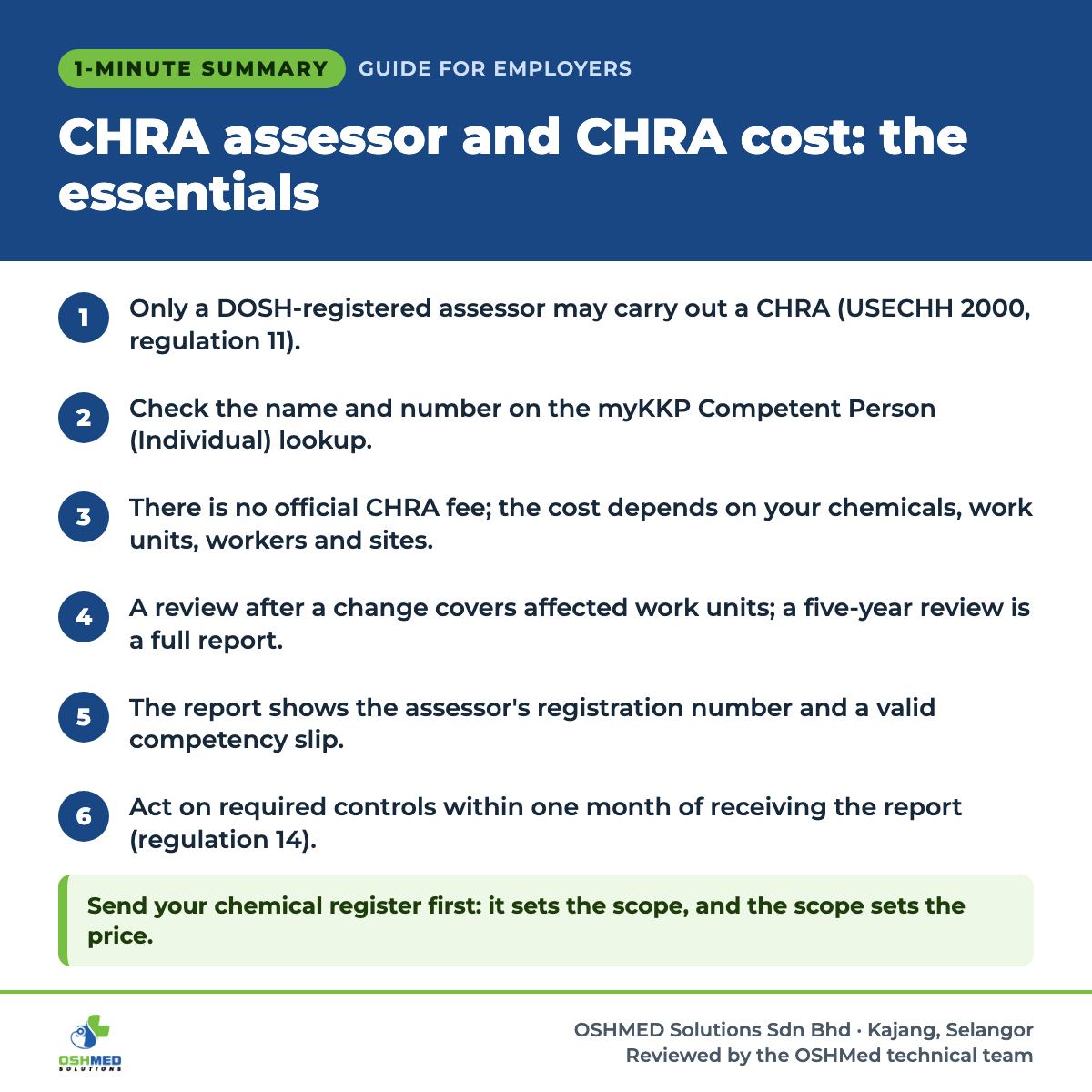
- Only a DOSH-registered assessor may carry out a CHRA (USECHH 2000, regulation 11).
- Check the name and number on the myKKP Competent Person (Individual) lookup.
- There is no official CHRA fee; the cost depends on your chemicals, work units, workers and sites.
- A review after a change covers affected work units; a five-year review is a full report.
- The report shows the assessor's registration number and a valid competency slip.
- Act on required controls within one month of receiving the report (regulation 14).
Who can carry out a CHRA in Malaysia?
Only an assessor registered with DOSH. USECHH 2000 defines an assessor as an employee or other person appointed by the employer and registered with the Director General to assess risks to health; regulation 11 requires an assessor to conduct every assessment. Act 514 lists chemical health risk assessment as a registered competent person activity.
The Malay text of the regulations calls this person a pengapit. DOSH registers Malaysian citizens certified fit by an occupational health doctor, with no conviction under Act 514, through five qualification routes, each including a pass in the CHRA assessor examination. Registration must stay valid until the assessment ends (CHRA Manual 1.6.2). For when a CHRA is required, see our CHRA guide.
How do you check that a CHRA assessor is registered?
Ask for the assessor’s full name and DOSH registration number, then search for them on the myKKP Competent Person (Individual) search page, linked from DOSH’s Approval and Authorization List. Confirm that the registration covers the assessment dates and that the report will include the same number and a valid competency slip.
- On dosh.gov.my, open the Approval and Authorization List, then select Competent Person (Individual) to open the myKKP search page.
- Search the name or registration number. If no record appears, ask for the registration certificate and confirm with DOSH before you sign.
- In the report, check the reference number: it contains the assessor’s registration number, the year and a serial number (CHRA Manual 11.1).
DOSH’s Assessor page offered no downloadable list of CHRA assessors when we checked on 30 October 2026, so use myKKP and file the result.
What sets the cost of a CHRA?
Cost is determined by your scope, as DOSH does not publish a standard fee schedule. The assessor’s workload increases with the number of chemicals hazardous to health in your register, the work units that use or release them, the workers and shifts involved, the number of sites, and whether this is a first CHRA or a review.
| Cost driver | How it affects the quote | Basis |
|---|---|---|
| Chemicals in your register | Each chemical is identified and its hazard rated | Reg. 5; Manual ch. 2, 4 |
| Work units | Each job, task or process group is assessed | Manual ch. 3 |
| Workers and shifts | Tasks are observed and workers interviewed | Manual 2.1.4, ch. 5 |
| Existing exposure data | Personal sampling enables quantitative evaluation; otherwise, exposure is estimated | Manual 5.2 |
| First CHRA or review | A change review covers affected work units; a five-year review is a full report | Manual ch. 12 |
| Sites | One CHRA per workplace, unless DOSH approves a generic CHRA | Manual 1.4.1 |
| Full or simple method | Some solid and liquid chemicals qualify for DOSH’s simple SiRAC method | Manual 1.4.2; SiRAC 2.1 |
A generic CHRA needs a DOSH pre-approval letter and at least five similar workplaces under the same management (generic CHRA guide 4.1). A change review is appended to your last report; the triggers are in our CHRA guide.
CHRA scope builder: prepare an accurate quote request
Answer nine quick questions. Your answers build a scope summary you can send to OSHMed on WhatsApp for a written quote, or print for internal approval. No personal or medical details are needed.
OSHMed uses these answers to prepare a written quote. This summary is not a price: the registered assessor confirms the work units and chemicals after reviewing your chemical register and observing the work (DOSH CHRA Manual, chapters 2, 3 and 5). Schedule II chemicals bring repeat monitoring rules if the CHRA calls for monitoring (regulation 26(2)): see our CEM guide.
What should a CHRA report contain?
The DOSH manual sets a minimum report structure: title page, executive summary, table of contents, introduction, process and work unit description, methodology, findings, discussion, recommendations, references and appendices. The title page states the assessor’s name and registration number, and the report is due within one month of completing the assessment (regulation 12).
- Title page: report reference, submission date, the assessor’s name and registration number, and your company details (11.1).
- Findings per work unit: level of risk and adequacy of existing controls (11.7).
- SMART recommendations, including exposure monitoring and medical surveillance, each with an action priority (11.9).
- Appendices: Forms A to D, layout plan, process flowchart and the assessor’s valid competency slip (11.11).
Want a CHRA quote you can compare line by line?
Send us your chemical register, work units, headcount and sites. OSHMed will reply with a written quote that lists the chemicals, work units, sites and deliverables: request a CHRA quote.
What should you ask before choosing a CHRA assessor?
Ask every provider for the same six details: a named registered assessor, the scope, the method, the team, the report structure and the handover process. Every registered assessor works to the same regulations and manual, these details demonstrate suitability, and quotes that omit or alter them cannot be compared like for like.
| Check | What to ask for | Basis |
|---|---|---|
| Registration | Name and number, valid until the assessment is completed, checked on myKKP | Reg. 2, 11; Manual 1.6.2 |
| Scope | Chemicals, work units, workers and sites, with any limits stated | Manual ch. 2, 3, 11.4.2 |
| Method | The DOSH manual, 3rd edition, or a method endorsed by the Director General | Manual 11.6 |
| Team | Named specialists where multiple chemicals or complex processes are present | Manual 1.6 |
| Report | The chapter 11 sections, action priorities and the competency slip | Manual ch. 11 |
| Handover | Report within one month, findings presented, form signed | Reg. 12; Manual 1.6.3, App. 14 |
What usually follows a CHRA, and what is priced separately?
The CHRA provides recommendations; your organisation must implement them. Regulation 14 allows one month after receiving the report to act on required controls. Exposure monitoring, health surveillance, training and engineering works are separate items handled by distinct competent persons, so budget for them when approving the CHRA.
| Item | Who provides it | Rule |
|---|---|---|
| Controls such as substitution or local exhaust ventilation | The employer, with suppliers or engineers | Reg. 14, 15 |
| Chemical exposure monitoring (CEM), if the CHRA requires it | A DOSH-registered hygiene technician | Reg. 26 |
| Medical surveillance, if the CHRA indicates it | An occupational health doctor | Reg. 27 |
| Training on chemical risks | The employer, at least once in two years | Reg. 22 |
Where a Schedule II chemical requires monitoring, monitoring must be repeated at intervals of not more than six months (regulation 26(2)): see our CEM guide. OSHMed coordinates medical surveillance through our occupational health doctor service, with tests carried out and billed by our partner clinic; see our surveillance guide and training page.
What does it cost to delay or skip a CHRA?
More than the assessment. USECHH 2000 sets no penalty of its own, so the general penalty in section 51 of Act 514 applies: a fine of up to RM100,000, up to one year in prison, or both, plus up to RM2,000 a day for a continuing offence. Directors and managers can be charged with the company (section 52).
An unregistered person who carries out a CHRA faces a fine of up to RM100,000 (section 31B). Breaching the section 18B duty to assess risk and implement controls carries a fine of up to RM500,000, up to two years in prison, or both (section 19): see our section 18B guide.
OSHMED Solutions Sdn Bhd, based in Kajang, Selangor, serves employers across Malaysia and quotes in writing. Through our assessment services, a CHRA is carried out by a DOSH-registered assessor, as the law requires, and ends with a written report. Every report names the responsible registered assessor and their myKKP registration number, so you can verify it on the DOSH register.
- You are adding a chemical, changing a process or installing new controls.
- Your last CHRA is over four years old, or you cannot find the report.
- DOSH has directed a review, or workers report chemical-related symptoms.
- Your current report shows no registered assessor or number.
Before you decide: three common objections
Three objections come up when employers review CHRA quotes: using the in-house safety officer, taking the lowest total, and trusting the old report. Each is checked below against USECHH 2000, Act 514 and the DOSH manual, so the decision rests on the rules.
"Our safety and health officer can do it."
Only if the officer is also registered with DOSH as an assessor (regulation 11). Section 31B makes unregistered assessment an offence.
"We will just take the lowest quote."
Compare scope first. If a quote leaves out work units, the skin route or the presentation of findings, the assessment may need repeating.
"Our last CHRA is still valid."
A significant change, such as a new chemical or failing control equipment, triggers a review regardless of the report’s age (regulation 10).
Frequently asked questions
Who can be a CHRA assessor in Malaysia?
A person registered with DOSH’s Director General as an assessor under USECHH 2000. DOSH’s conditions cover citizenship, fitness confirmed by an occupational health doctor, qualifications, experience and a pass in the CHRA assessor examination.
Is there a list of DOSH-registered CHRA assessors?
DOSH’s Assessor page offered no downloadable list when checked on 30 October 2026. Check an assessor on the myKKP Competent Person (Individual) lookup and ask for the registration certificate.
How much does a CHRA cost in Malaysia?
There is no official fee. Each quote follows your scope: chemicals in your register, work units, exposed workers, sites, and whether it is a first CHRA or a review. OSHMed quotes in writing.
Is a CHRA review cheaper than a new CHRA?
Often. After a significant change or new controls, the assessor reassesses only the affected work units and appends the result. A five-year or DOSH-directed review needs a full report (CHRA Manual, chapter 12).
Does the CHRA price include chemical exposure monitoring?
No. The CHRA decides whether monitoring is needed (regulation 9(2)(h)). The monitoring itself is done by a DOSH-registered hygiene technician under regulation 26 and is quoted separately.
What should we prepare before asking for a CHRA quote?
Your chemical register with current safety data sheets (regulation 5), a layout plan, process flowchart, headcount per job and shift, and previous CHRA or monitoring reports (CHRA Manual, chapter 2).
Your next step
Fill in the scope builder above, or send your chemical register, work units, headcount and sites. OSHMed will reply with a written CHRA quote.
Other assessments on the same site? See our noise risk assessment cost guide and ergonomic risk assessment price guide.
Get a written CHRA quote for your site
Share your scope summary on WhatsApp or through the quote form. We will tell you what the assessor needs from you before the site visit.
Sources and references
Checked against the official documents listed below on 30 October 2026. Laws change: always confirm the current version on the DOSH (JKKP) website.
- Occupational Safety and Health (Use and Standards of Exposure of Chemicals Hazardous to Health) Regulations 2000, P.U. (A) 131/2000 (regulations 1, 2, 5, 9 to 15, 22, 26, 27), Attorney General's Chambers, published by DOSH
- A Manual of Recommended Practice on Assessment of the Health Risks Arising from the Use of Chemicals Hazardous to Health at the Workplace, 3rd Edition, First Reprint 2018 (sections 1.4, 1.6, 2, 3, 5.2, 11, 12; Appendix 14), DOSH Malaysia
- Panduan Menjalankan Penaksiran Risiko Bahan Kimia Berbahaya kepada Kesihatan Secara Generik 2021 (generic CHRA guide, sections 3 and 4), DOSH Malaysia
- Manual on Simple Risk Assessment and Control for Chemicals (SiRAC) 2019 (sections 1.3 and 2.1), DOSH Malaysia
- Assessor: registration conditions and myKKP application, DOSH Malaysia
- Approval and Authorization List, including the myKKP Competent Person (Individual) lookup, DOSH Malaysia
- Occupational Safety and Health Act 1994 (Act 514), reprint incorporating Act A1648 (sections 18B, 19, 31B, 51, 52, Fifth Schedule), DOSH Malaysia
- Regulations under Act 514 (current list), DOSH Malaysia
Disclaimer: This article is general information for employers and is not legal advice. Requirements depend on your workplace, processes and the current law. For a decision on your premises, speak to a DOSH-registered competent person or contact DOSH (JKKP).