
CLASS 2013 Regulation in Malaysia: Chemical Labels, SDS and Warning Signs
The CLASS 2013 regulation (P.U. (A) 310/2013) requires suppliers to classify hazardous chemicals, label each package with six elements and supply a 16-section safety data sheet (SDS) in Malay and English, revised once it is over five years old. Under USECHH 2000, employers keep labels intact, relabel decanted containers, keep SDSs near each place of use and post warning signs.
- MD (NNSMA, Rus)
- MScCH (Occ. Health, UKM)
- MBA (ARU, UK)
- OHD (NIOSH)
- MRO (AOEMM)
- TTT (HRDF)
- SSM 202001013523 (OSHMED Solutions Sdn Bhd)
- DOSH registered training provider SL/22/22/181036, valid to 21 July 2028
- MMC Full Registration 55275 (Dr. Wan Muhammad Zulhusni)
- DOSH Occupational Health Doctor HQ/16/DOC/00/454
- DMAC/EDTCmed 263
- OEUK OEUK/2024/3751
OSHMed Solutions Sdn Bhd is an occupational safety and health consultancy and DOSH-registered training provider (ergonomics) in Kajang, Selangor. We are not a clinic. Medical tests are arranged through approved centres.
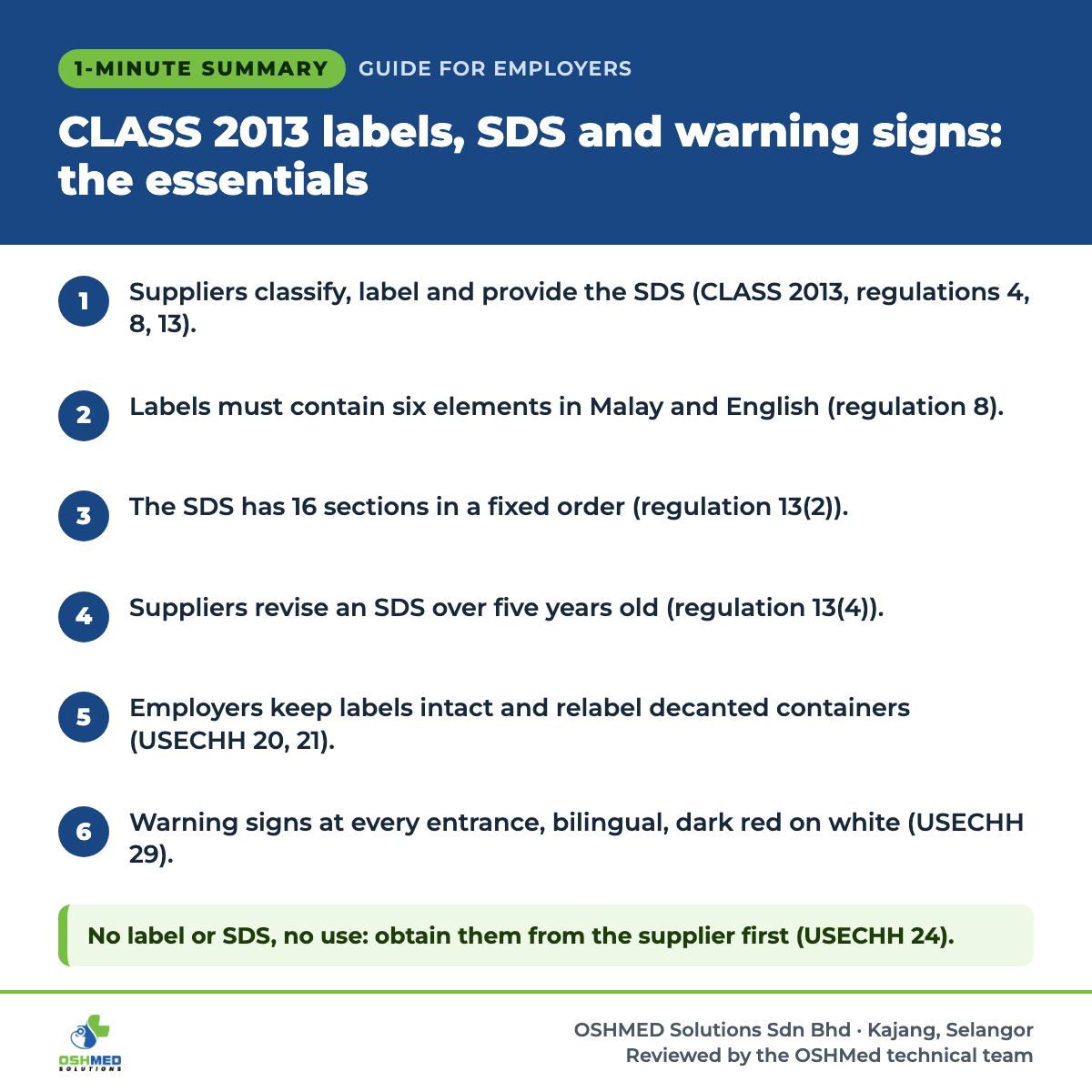
- Suppliers classify, label and provide the SDS (CLASS 2013, regulations 4, 8, 13).
- Labels must contain six elements in Malay and English (regulation 8).
- The SDS has 16 sections in a fixed order (regulation 13(2)).
- Suppliers revise an SDS over five years old (regulation 13(4)).
- Employers keep labels intact and relabel decanted containers (USECHH 20, 21).
- Warning signs at every entrance, bilingual, dark red on white (USECHH 29).
No label or SDS, no use: obtain them from the supplier first (USECHH 24).
What is the CLASS 2013 regulation, and who must comply?
CLASS 2013 is the Occupational Safety and Health (Classification, Labelling and Safety Data Sheet of Hazardous Chemicals) Regulations 2013, P.U. (A) 310/2013, gazetted on 11 October 2013 under Act 514. It covers chemicals supplied for use at work and places duties on suppliers; employers using the chemicals are governed by USECHH 2000.
Principal suppliers formulate, manufacture, import, recycle or reformulate; subsidiary suppliers repack, distribute or retail (regulation 3, DOSH’s CLASS FAQ).
Regulation 2 excludes radioactive material, scheduled waste, cosmetics, small research samples and manufactured articles. Regulation 16 revoked the CPL Regulations 1997.
For employer duties, see our USECHH 2000 guide. DOSH publishes CLASS 2013 as English and Malay PDFs.
What must a CLASS 2013 label show?
Six elements, legible, indelible and in Malay and English: product identifier, supplier identification, signal word, hazard statements, hazard pictograms and precautionary statements (regulation 8). Containers of 125 ml or less may show only the product identifier, supplier, signal word, any pictogram and “read Safety Data Sheet before use”.
- Signal word. “Danger” for the more severe categories, “Warning” for the less severe; never both (regulation 8(4)).
- Pictogram. Black symbol in a red-bordered white diamond, at least one fifteenth of the label and never under 100 mm² (regulation 9). Black borders are not allowed (DOSH CLASS FAQ).
- Updates. A new, more severe hazard means a revised label within three months (regulation 8(7)).
DOSH’s CLASS label poster shows a worked example; its ELSA checklist checks for black lettering of at least 7 points. DOSH does not approve labels.
| Package contents | Minimum label size (mm) |
|---|---|
| Up to 3 litres | 52 x 74, if practicable |
| Over 3 to 50 litres | 74 x 105 |
| Over 50 to 500 litres | 105 x 148 |
| Over 500 litres | 148 x 210 |
| Pictogram | Main hazards indicated |
|---|---|
| Exploding bomb | Explosives; some self-reactives and organic peroxides |
| Flame | Flammable gases, aerosols, liquids and solids; pyrophoric chemicals |
| Flame over circle | Oxidising gases, liquids and solids |
| Gas cylinder | Gases under pressure |
| Corrosion | Corrosive to metals; skin corrosion; serious eye damage |
| Skull and crossbones | Acute toxicity, categories 1 to 3 |
| Exclamation mark | Acute toxicity category 4; irritation; skin sensitisation |
| Health hazard | Respiratory sensitisation, mutagenicity, carcinogenicity, reproductive toxicity |
| Environment | Hazardous to the aquatic environment |
What are the 16 sections of a safety data sheet in Malaysia?
Regulation 13(2) of CLASS 2013 specifies 16 headings in a prescribed order, from identification of the chemical and supplier to other information. The SDS must be in Malay and English and meet the minimum content in Part 3 of the Industry Code of Practice on Chemicals Classification and Hazard Communication (ICOP CHC).
| Section | Heading |
|---|---|
| 1 | Identification of the hazardous chemical and supplier |
| 2 | Hazard identification |
| 3 | Composition and information on ingredients |
| 4 | First-aid measures |
| 5 | Fire-fighting measures |
| 6 | Accidental release measures |
| 7 | Handling and storage |
| 8 | Exposure controls and personal protection |
| 9 | Physical and chemical properties |
| 10 | Stability and reactivity |
| 11 | Toxicological information |
| 12 | Ecological information |
| 13 | Disposal information |
| 14 | Transportation information |
| 15 | Regulatory information |
| 16 | Other information |
Mixtures need an SDS above the Fifth Schedule cut-offs, such as 0.1% for carcinogens (regulation 13(1)). DOSH’s ESSA checklist sets out the minimum content of each section.
Read section 16 first: its dates tell you whether the SDS is over five years old.
When must the supplier revise an SDS, and in which language?
The supplier must revise an SDS when new information emerges, when more than five years have passed since it was prepared or last revised, or when a DOSH officer directs, and then send the revised sheet, in Malay and English, to each recipient as soon as practicable (regulation 13(3) to (5)).
Translations need not be certified if the meaning is preserved; an importer must prepare the Malay version if the overseas supplier cannot (DOSH CLASS FAQ). Confidential names may appear as a generic name or concentration range (regulation 15).
Labels and SDSs in order? Get your CHRA scoped next
Send us your chemical register and the current SDSs. OSHMed will reply with a written CHRA quote based on your chemicals, processes, work areas and workers: request a CHRA quote.
What does the supplier do, and what does the employer do?
The supplier classifies, packages, labels and provides the SDS under CLASS 2013. Under USECHH 2000, the employer keeps labels intact, relabels decanted containers, refuses chemicals without a label or SDS, keeps SDSs near each place of use and posts warning signs, while importers and manufacturers file a yearly inventory.
| Task | Who | Rule |
|---|---|---|
| Classify; keep the classification record | Principal supplier | CLASS 4, 5 |
| Package and seal | Supplier | CLASS 6, 7 |
| Label each package (six elements) | Supplier | CLASS 8 to 12 |
| Provide the SDS; revise once over five years old | Supplier | CLASS 13 |
| File the inventory (1 tonne or more a year) by 31 March | Importer or manufacturer | CLASS 14 |
| Keep labels intact; relabel decanted containers | Employer | USECHH 20, 21 |
| No use without a label or SDS | Employer | USECHH 24 |
| Current SDS near each place of use | Employer | USECHH 25 |
| Train workers at least once in two years | Employer | USECHH 22 |
| Warning signs at every entrance | Employer | USECHH 29 |
Importing a chemical yourself, even for own use, makes you its principal supplier (DOSH CLASS FAQ). For the old USECHH term “Chemical Safety Data Sheet”, see our register guide.
When must you relabel a chemical container at work?
Relabel when a label is removed, defaced or altered while the chemical is in use (USECHH regulation 20). For decanted containers, regulation 21 sets three cases: contents kept beyond a normal workshift need a full label, contents used within the shift need the chemical or trade name, and immediate use needs none.
- Testing laboratories. Decanted containers always carry the chemical or trade name (regulation 21(3)).
- Tanks and pipes. Storage tanks and tankers stationed at the workplace need a CLASS label; pipelines do not (DOSH CLASS FAQ).
- Which label. Regulation 21(5) still cites the revoked 1997 rules; copying the supplier’s full CLASS label onto containers you keep carries the current elements (CLASS regulation 8).
Regulation 22 also requires training at least once in two years: see our training page.
What does regulation 29 require on a chemical warning sign?
Where a chemical hazardous to health is used in a way hazardous to anyone in an area, the employer must post warning signs in a conspicuous place at every entrance. Each sign must warn of the hazards, in the national language and English, printed dark red on white, and be kept lit and clean.
People at risk must also get other relevant information (regulation 29(1)(b)). No wording, size or symbol is prescribed, so name the hazard plainly.
Chemical warning sign generator (USECHH regulation 29)
Choose a hazard warning line, add the area or work unit if you wish, and check the preview. The sign prints in both languages, dark red on white, as regulation 29 requires. Print it on A4 landscape, or choose Save as PDF in the print dialogue, and post one at every entrance to the area.
Regulation 29 of USECHH 2000 requires the sign to warn of the hazards, in the national language and English, printed dark red on white, posted at every entrance and kept lit and clean so the legend stays readily visible. It sets no wording, size or symbol, and this sign is not issued by DOSH. It does not replace CLASS 2013 container labels or the SDS. Use your CHRA findings to decide which areas need one (see our CHRA service). Nothing you type is stored or sent unless you use WhatsApp.
Print one sign per entrance and replace it once faded: the legend must stay readily visible (regulation 29(2)).
What are the penalties under CLASS 2013 and USECHH 2000?
Each CLASS 2013 offence by a supplier, importer or manufacturer carries a fine of up to RM10,000, up to one year in prison, or both, plus up to RM1,000 a day for a continuing offence. USECHH 2000 has no penalty of its own, so section 51 of Act 514 applies to employers.
Section 51: a fine of up to RM100,000, up to one year in prison, or both, and up to RM2,000 a day for a continuing offence. Directors and managers can be charged with the company (section 52).
OSHMED Solutions Sdn Bhd, based in Kajang, Selangor, serves employers across Malaysia and quotes in writing. Your SDSs and chemical register feed the CHRA: through our CHRA service, a DOSH-registered assessor carries it out, as the law requires, and issues a written report. Other assessments: our assessments page.
- Your labels and SDSs are in order but you have no CHRA yet.
- You are adding a chemical, or changing a process or control.
- Your last CHRA is over four years old, or you cannot find it.
- DOSH has directed a review of your assessment.
Three common objections, checked against the text:
"Labels and SDSs are the supplier's job."
Keeping labels intact, relabelling, refusing unlabelled stock, placing SDSs and posting signs are employer duties (USECHH regulations 20, 21, 24, 25 and 29).
"An English SDS is enough."
CLASS regulation 13(3)(b) requires Malay and English. If you import the chemical yourself, the Malay version is your duty (DOSH CLASS FAQ).
"Our SDS is old, but nothing has changed."
Age alone triggers revision once five years have passed (regulation 13(4)(b)). Ask the supplier for the current version.
Frequently asked questions
Where can I download the CLASS 2013 regulations PDF?
DOSH publishes the English and Malay texts of P.U. (A) 310/2013 as PDFs; both are linked in the sources below.
Is there an official SDS format or template in Malaysia?
Regulation 13(2) specifies the 16 headings and their order, and Part 3 of the ICOP CHC sets the minimum content, which DOSH’s ESSA checklist tests. DOSH does not approve SDSs.
How often must a safety data sheet be revised?
When new information emerges, once more than five years have passed since it was prepared or last revised, or when an officer directs (regulation 13(4)). The supplier revises it.
Do storage tanks and pipelines need CLASS labels?
DOSH’s CLASS FAQ says storage tanks need a label and pipelines do not; tankers in transport may not, but tankers stationed at the workplace do.
What colour must a chemical warning sign be?
Dark red on white, in the national language and English, warning of the hazards (USECHH regulation 29(3)).
Your next step
Check each label for the six elements and each SDS date, print a sign for every entrance, then send OSHMed your chemical register for a written CHRA quote.
Related: our CHRA guide, CEM guide and medical surveillance guide.
Turn your SDS file into a CHRA quote
Share your chemical register or SDS list on WhatsApp or through the quote form. We will tell you what the registered assessor needs before the site visit.
- Chemical register DOSH template: how to fill in the USECHH format
- USECHH 2000: a plain guide to all 30 regulations and 3 Schedules
- Chemical health risk assessment (CHRA) under USECHH 2000: when it is required
- CHRA assessor in Malaysia: how to check one and what sets the cost
- Chemical exposure monitoring (CEM) in Malaysia: when, how often, who
Sources and references
Checked against the official documents listed below on 9 November 2026. Pictogram descriptions follow DOSH’s CLASS Pictograms poster. Laws change: always confirm the current version on the DOSH (JKKP) website.
- Occupational Safety and Health (Classification, Labelling and Safety Data Sheet of Hazardous Chemicals) Regulations 2013, P.U. (A) 310/2013 (regulations 2 to 16; Second, Fourth and Fifth Schedules), Attorney General's Chambers, published by DOSH
- Peraturan-Peraturan Keselamatan dan Kesihatan Pekerjaan (Pengelasan, Pelabelan dan Helaian Data Keselamatan Bahan Kimia Berbahaya) 2013 (Malay text of the same regulations), Attorney General's Chambers, published by DOSH
- Occupational Safety and Health (Use and Standards of Exposure of Chemicals Hazardous to Health) Regulations 2000, P.U. (A) 131/2000 (regulations 10, 20 to 25 and 29), Attorney General's Chambers, published by DOSH
- Frequently Asked Questions for CLASS Regulations (questions 2, 5, 18 to 34), DOSH Malaysia
- CLASS Pictograms poster (CLASS Regulations 2013), DOSH Malaysia
- CLASS Labels poster (CLASS Regulations 2013), DOSH Malaysia
- Express SDS Self-Assessment (ESSA) checklist, DOSH Malaysia
- Express Labelling Self-Assessment (ELSA) checklist, DOSH Malaysia
- Occupational Safety and Health Act 1994 (Act 514), reprint incorporating Act A1648 (sections 51 and 52), DOSH Malaysia
- Chemical Management: CLASS and USECHH documents (current list), DOSH Malaysia
Disclaimer: This article is general information for employers and is not legal advice. Requirements depend on your workplace, processes and the current law. For a decision on your premises, speak to a DOSH-registered competent person or contact DOSH (JKKP).