
Pre-Employment Medical Check-Up in Malaysia: When Is It Required by Law?
A pre-employment medical check-up in Malaysia examines a new hire before they start, to assess whether they are fit to work. We found no rule in the OSH Act 1994 that requires one for every new employee, so it is usually employer policy. Specific rules apply to foreign workers (FOMEMA), food handlers, chemical exposure named in your CHRA and noise above the limit.
- MD (NNSMA, Rus)
- MScCH (Occ. Health, UKM)
- MBA (ARU, UK)
- OHD (NIOSH)
- MRO (AOEMM)
- TTT (HRDF)
- SSM 202001013523 (OSHMED Solutions Sdn Bhd)
- DOSH registered training provider SL/22/22/181036, valid to 21 July 2028
- MMC Full Registration 55275 (Dr. Wan Muhammad Zulhusni)
- DOSH Occupational Health Doctor HQ/16/DOC/00/454
- DMAC/EDTCmed 263
- OEUK OEUK/2024/3751
OSHMed Solutions Sdn Bhd is an occupational safety and health consultancy and DOSH-registered training provider (ergonomics) in Kajang, Selangor. We are not a clinic. Medical tests are arranged through approved centres.
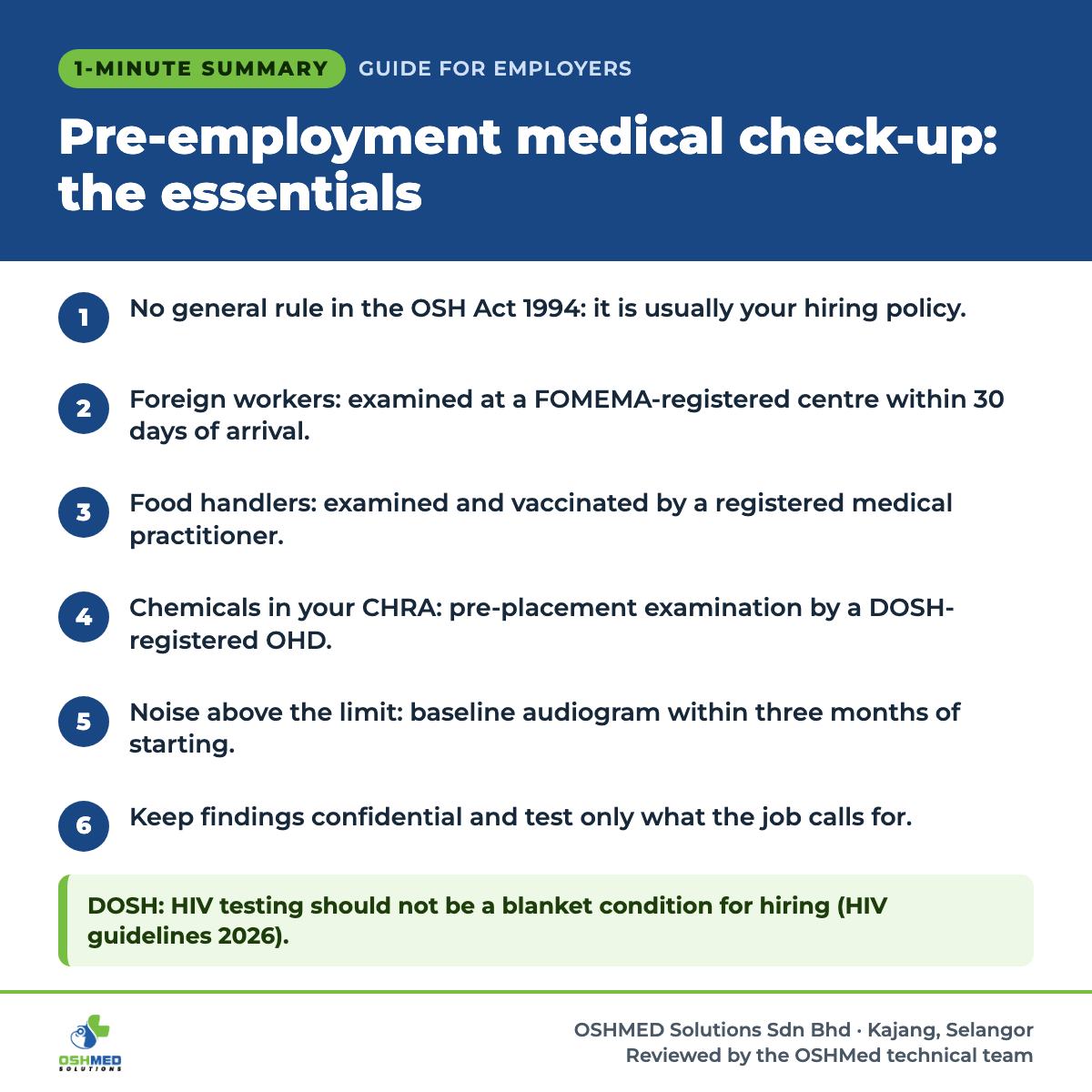
- No general rule in the OSH Act 1994: it is usually your hiring policy.
- Foreign workers: examined at a FOMEMA-registered centre within 30 days of arrival.
- Food handlers: examined and vaccinated by a registered medical practitioner.
- Chemicals in your CHRA: pre-placement examination by a DOSH-registered OHD.
- Noise above the limit: baseline audiogram within three months of starting.
- Keep findings confidential and test only what the job calls for.
DOSH: HIV testing should not be a blanket condition for hiring (HIV guidelines 2026).
What is a pre-employment medical check-up?
It is a medical examination of a prospective employee before employment starts, to assess whether they are fit to work (DOSH Guidelines on Occupational Health Services 2005, section 6.2.1). The same guideline describes a pre-placement examination for new or transferred employees in jobs with special requirements, which also records a baseline for later comparison.
The guideline gives pre-placement examinations three purposes: confirm fitness for the job and any protective equipment, record a baseline, and detect disease that can be treated early.
Is a pre-employment medical check-up compulsory in Malaysia?
Not as a general rule. We found no provision in the OSH Act 1994 that requires a medical check-up for every new hire, and the DOSH 2005 guideline, which says the examination “should be conducted”, is guidance rather than law. It becomes compulsory when a specific regulation, procedure or code covers the worker, the job or the hazard.
In one line: the job and its hazards decide the required examination; a general check-up is a policy choice.
Under Act 514, employers may not charge employees for anything the Act or its regulations require (section 26). Medical surveillance and health examination need a registered competent person (section 31B, Fifth Schedule); DOSH registers occupational health doctors (OHD) for this.
How is it different from FOMEMA and medical surveillance?
They answer different questions. A pre-employment check asks whether the person is fit for the job. FOMEMA examines foreign workers for the Immigration work pass. Medical surveillance, required by USECHH 2000 when your CHRA calls for it, follows each exposed worker for health changes caused by specific chemicals, starting with a pre-placement baseline.
| Examination | Who and when | Basis | Who examines |
|---|---|---|---|
| Pre-employment check-up | New hires, under your policy | DOSH guideline 2005 (6.2.1) | Not specified; OHD expected for pre-placement (7.1) |
| FOMEMA | Foreign workers, within 30 days of arrival, before the PL(KS) is issued | Immigration Department procedure | Health centre registered with FOMEMA |
| Medical surveillance | Chemical exposure where the CHRA requires it | USECHH 2000, reg. 27 | DOSH-registered OHD |
| Audiometric testing | Exposure above the noise exposure limit; baseline within three months | Noise Regulations 2019, reg. 9; ICOP 13.2.7 | Approved testing centre; an OHD interprets |
| Food handler examination | Food handlers, before the proprietor employs them | Food Hygiene Regulations 2009, regs. 11 and 31 | Registered medical practitioner |
| Confined space health surveillance | Confined space workers | Confined spaces ICOP 2010, as stated by DOSH | OHD |
| Radiation work | Radiation workers | Atomic Energy Licensing Act 1984 (DOSH 2005 guideline, 7.1) | Preferably an OHD (7.1) |
An OHD must carry out medical surveillance (regulation 27(2)), so a FOMEMA result or a general check-up cannot replace it. See our guides to medical surveillance, audiometric testing and diving medicals.
Which new hires need a specific examination by law?
Check the worker, the job and the hazard. Foreign workers need FOMEMA, and food handlers a doctor’s examination and vaccination. Workers joining a unit where the CHRA requires health surveillance need an OHD’s pre-placement examination, and exposure to noise above the limit needs a baseline audiogram within three months.
Which examinations does your new hire need?
Answer nine questions about the worker and the job. Each Yes points to an examination set by a regulation, an Immigration procedure or DOSH guidance, listed in the result. This is a planning aid, not medical advice: the examining doctor decides fitness. No personal data is collected; your answers stay in your browser.
1. Is the new hire a foreign worker who needs a Visit Pass (Temporary Employment), PL(KS)?
2. Will they prepare or handle food, or touch food contact surfaces, in food premises?
3. Will they join a work unit where your CHRA says health surveillance is necessary?
4. Will they be exposed to a chemical listed in USECHH Schedule II, such as lead, benzene or isocyanates?
5. Does your noise risk assessment show exposure above the noise exposure limit in their work area?
6. Will they enter confined spaces as part of the job?
7. Will they wear a respirator, or work with dust, fumes or other respiratory hazards?
8. Will they work with ionising radiation?
9. Does your pre-employment check-up policy state who examines, what HR receives and how consent is taken?
- 1: FOMEMA examination within 30 days of arrival; the PL(KS) is issued only after the worker is certified fit.
- 2: medical examination and vaccination by a registered medical practitioner (Food Hygiene Regulations 2009, reg. 31).
- 3 or 4: pre-placement examination by a DOSH-registered OHD, the baseline for medical surveillance (USECHH reg. 27).
- 5: baseline audiogram within three months (noise ICOP 13.2.7); see audiometric testing.
- 6: health surveillance by an OHD (confined spaces ICOP 2010).
- 7: baseline spirometry before exposure; fitness to wear a respirator is assessed in medical surveillance.
- 8: medical examination under the Atomic Energy Licensing Act 1984; confirm it with the licensing authority.
Your latest CHRA and noise risk assessment hold the answers to questions 3 to 5.
What tests are included in a pre-employment medical check-up?
No official test list covers a general check-up; its content is set by your policy and the examining doctor. Official documents name tests only for specific purposes: history, physical examination and target organ tests for medical surveillance, a baseline spirometry test before respiratory hazards, and a pure tone audiogram for noise above the limit.
| Test or step | When it is named | Source |
|---|---|---|
| History and physical examination | Every medical surveillance examination, including pre-placement | DOSH 2023 Guidelines, 7.3.1 |
| Target organ tests: laboratory tests, chest X-ray, spirometry | Medical surveillance, “as necessary” for the chemical | DOSH 2023 Guidelines, 7.3.1 |
| Fitness to wear a respirator | Medical surveillance, where applicable | DOSH 2023 Guidelines, 7.3.1 |
| Baseline spirometry | Pre-employment, before respiratory hazards | DOSH Spirometry Guidance 2026, 6.1 |
| Pure tone audiogram, 500 to 8000 Hz | Baseline for exposure above the noise exposure limit | Noise ICOP 2019, 13.2.5 to 13.2.7 |
HIV is a special case: the DOSH HIV guidelines 2026 say employers generally should not insist on an HIV screening test as a blanket hiring condition, and any required test must be medically justified and proportionate (question 7).
Hiring for jobs with chemical, noise or confined space exposure?
Send us the job titles, the number of new hires and your latest CHRA or noise risk assessment. OSHMed will set out which examinations each job needs and plan the pre-placement examinations with a DOSH-registered occupational health doctor: request a proposal.
Is there an official pre-employment medical check-up form?
We found no single DOSH or Ministry of Health form for a general check-up. Official forms exist for specific programmes, such as the USECHH 1 examination form, which lists pre-placement as an examination type, and the USECHH 3 certificate of fitness. Food premises must keep each food handler’s examination and vaccination records.
| Situation | Form or record | Source |
|---|---|---|
| Medical surveillance | USECHH 1 examination form and USECHH 3 certificate of fitness | DOSH 2023 Guidelines, Appendix 7 |
| Food handlers | Training, medical examination and vaccination records | Food Hygiene Regulations 2009, reg. 11(1)(c) |
| Foreign workers | FOMEMA result, needed before the PL(KS) is issued | FOMEMA and the Immigration Department |
USECHH 1 ends with the employee’s signed consent for the OHD to examine them and share the results and work capability with the employer. A general check-up form should cover the same: what is examined, who receives what, and consent.
Who sees the results, and how are they kept confidential?
The DOSH 2005 guideline says the findings of all occupational medical examinations must be treated confidentially, with care in handling, safeguarding and transfer. Disclosure is allowed when the law requires it or public health is at stake. In a USECHH programme, the detailed examination form stays with the OHD and the employee.
| Record | Kept by the OHD | Kept by the employer |
|---|---|---|
| USECHH 1: examination findings | 7 years | No; the employee keeps a copy |
| USECHH 2: the employee’s results over time | 7 years | 30 years |
| USECHH 3: certificate of fitness (fit or not fit) | 7 years | 30 years |
Employees may see their own health surveillance record after reasonable notice (USECHH regulation 27(6)). Employers keep it for 30 years and should keep it confidential (27(4); Guidelines, 9.2).
How do you set a fair pre-employment check-up policy?
Base it on the job, not a fixed panel for everyone. List each role’s hazards from your CHRA and noise risk assessment, add the legal triggers above, decide what HR receives, such as a fit or not fit decision, and take written consent. Review it when jobs or hazards change.
- List each job and its hazards, and mark the legal triggers above.
- Choose who examines: a DOSH-registered OHD for job-specific fitness, a FOMEMA-registered centre for foreign workers.
- Decide what HR receives and where medical records are kept.
- Take written consent and explain how the results will be used.
OSHMED Solutions Sdn Bhd, based in Kajang, Selangor, is an occupational safety and health consultancy serving employers across Malaysia. We are not a clinic and do not examine workers. We map the examinations each job needs, then plan and coordinate pre-placement and fitness-to-work examinations by a DOSH-registered occupational health doctor. See our OHD services and workplace health services.
- New hires join a work unit where your CHRA requires health surveillance.
- New hires are exposed above the noise exposure limit, with no baseline audiogram booked.
- New hires enter confined spaces or wear respirators.
- Your form asks for the same tests for every job, or has no consent section.
Before you decide: three common objections
Three objections often come up: a general check-up already covers chemicals, the audiogram can wait for the annual round, and testing everything is safer. Each is checked below against USECHH 2000, the noise ICOP and DOSH guidelines.
"Our general check-up already covers chemical exposure."
It cannot replace medical surveillance, which must be carried out by an OHD (USECHH regulation 27(2)) with tests chosen for the chemical.
"The baseline audiogram can wait for the annual round."
The ICOP sets three months (13.2.7). Hearing loss found in a baseline within those three months does not need to be notified to DOSH; after three months, it does (13.5.4).
"Testing everything, including HIV, protects the company."
DOSH points the other way: HIV testing should not be a blanket hiring condition and must be proportionate to the job (HIV guidelines 2026, question 7).
Frequently asked questions
Is a pre-employment medical check-up compulsory in Malaysia?
Not for every job. We found no rule in the OSH Act 1994 requiring one for all new hires. Foreign workers, food handlers, medical surveillance and noise above the limit have their own rules.
What are the pre-employment medical tests?
No official list covers a general check-up. DOSH names tests for specific purposes, such as target organ tests in medical surveillance, baseline spirometry and a baseline audiogram. Match the tests to the job.
Is there a pre-employment medical check-up form from DOSH or KKM?
We found no single form for a general check-up. For chemical exposure, the DOSH 2023 Guidelines provide USECHH 1 (examination form) and USECHH 3 (certificate of fitness).
Is a pre-employment medical check-up the same as FOMEMA?
No. FOMEMA examines foreign workers within 30 days of arrival, before the PL(KS) work pass is issued. A pre-employment check-up covers any new hire under your own policy.
Can my employer see my medical results?
Findings must be treated confidentially (DOSH 2005 guideline, 6.5.2). In medical surveillance, the employer keeps the certificate of fitness; the examination form stays with the OHD and the employee.
Your next step
Mark the legal triggers for each job with the self-check above. For jobs with chemical, noise or confined space exposure, request a proposal or WhatsApp OSHMed. This guide is general information, not medical advice; the examining doctor decides fitness.
Related: NADOPOD notification forms and our hearing conservation programme.
Get a job-by-job examination plan for your new hires
Share your hiring plan on WhatsApp or through the proposal form. We will reply with the examinations each job needs and who should carry them out.
- Spirometry test for workers in Malaysia: DOSH guidance, results and frequency
- Respirator fit test in Malaysia: DOSH requirements, methods and frequency
- Medical surveillance programme in Malaysia
- Audiometric test: DOSH requirements for employers
- Chemical health risk assessment (CHRA) under USECHH 2000
- Noise risk assessment (NRA) in Malaysia: when you need one
- Diving medical examination in Malaysia
- OSHMed occupational health doctor (OHD) services
Sources and references
Checked against the official documents listed below on 13 November 2026. Laws and procedures change: always confirm the current version with DOSH (JKKP), the Ministry of Health and the Immigration Department.
- Guidelines on Occupational Health Services 2005, JKKP GP (BI) 04/2005 (sections 3.0, 6.2.1, 6.5.2, 7.1 and Appendix I), DOSH Malaysia
- Guidelines on Medical Surveillance Programme at The Workplace 2023 (sections 7.2.1, 7.3.1, 9.2, Table 26 and Appendix 7, forms USECHH 1 to 3), DOSH Malaysia
- Occupational Safety and Health (Use and Standards of Exposure of Chemicals Hazardous to Health) Regulations 2000, P.U. (A) 131/2000 (regulation 27), Attorney General's Chambers, published by DOSH
- Occupational Safety and Health (Noise Exposure) Regulations 2019, P.U. (A) 60/2019 (regulation 9), Attorney General's Chambers, published by DOSH
- Industry Code of Practice for Management of Occupational Noise Exposure and Hearing Conservation 2019 (sections 13.2, 13.3 and 13.5.4), DOSH Malaysia
- Guidance on Spirometry Procedure for Occupational Health Practice 2026 (section 6.1), DOSH Malaysia
- Guidelines on Prevention and Management of HIV/AIDS at the Workplace 2026 (section 9.0, Table 2; section 12.0, questions 5 and 7), DOSH Malaysia
- Food Hygiene Regulations 2009, P.U. (A) 95/2009 (regulations 2, 11, 30 and 31), Ministry of Health Malaysia, text hosted by FAOLEX
- Occupational Safety and Health Act 1994 (Act 514), reprint incorporating Act A1648 (sections 26 and 31B, Fifth Schedule), DOSH Malaysia
- Foreign Workers: application procedure, phase 2 (after arrival), Immigration Department of Malaysia
- Occupational Health Doctor: roles and registration, DOSH Malaysia
Disclaimer: This article is general information for employers and is not legal advice. Requirements depend on your workplace, processes and the current law. For a decision on your premises, speak to a DOSH-registered competent person or contact DOSH (JKKP).