
Diving Medical Examination in Malaysia: Tests, Validity and Standards
A diving medical examination checks whether you are medically fit to dive at work or in training. We found no Malaysian regulation written specifically for diver medicals, so your client, contractor or dive agency usually sets the standard. Under UK HSE guidance, a certificate is valid for up to 12 months and includes an exercise test, usually the Chester step test.
- MD (NNSMA, Rus)
- MScCH (Occ. Health, UKM)
- MBA (ARU, UK)
- OHD (NIOSH)
- MRO (AOEMM)
- TTT (HRDF)
- SSM 202001013523 (OSHMED Solutions Sdn Bhd)
- DOSH registered training provider SL/22/22/181036, valid to 21 July 2028
- MMC Full Registration 55275 (Dr. Wan Muhammad Zulhusni)
- DOSH Occupational Health Doctor HQ/16/DOC/00/454
- DMAC/EDTCmed 263
- OEUK OEUK/2024/3751
OSHMed Solutions Sdn Bhd is an occupational safety and health consultancy and DOSH-registered training provider (ergonomics) in Kajang, Selangor. We are not a clinic. Medical tests are arranged through approved centres.
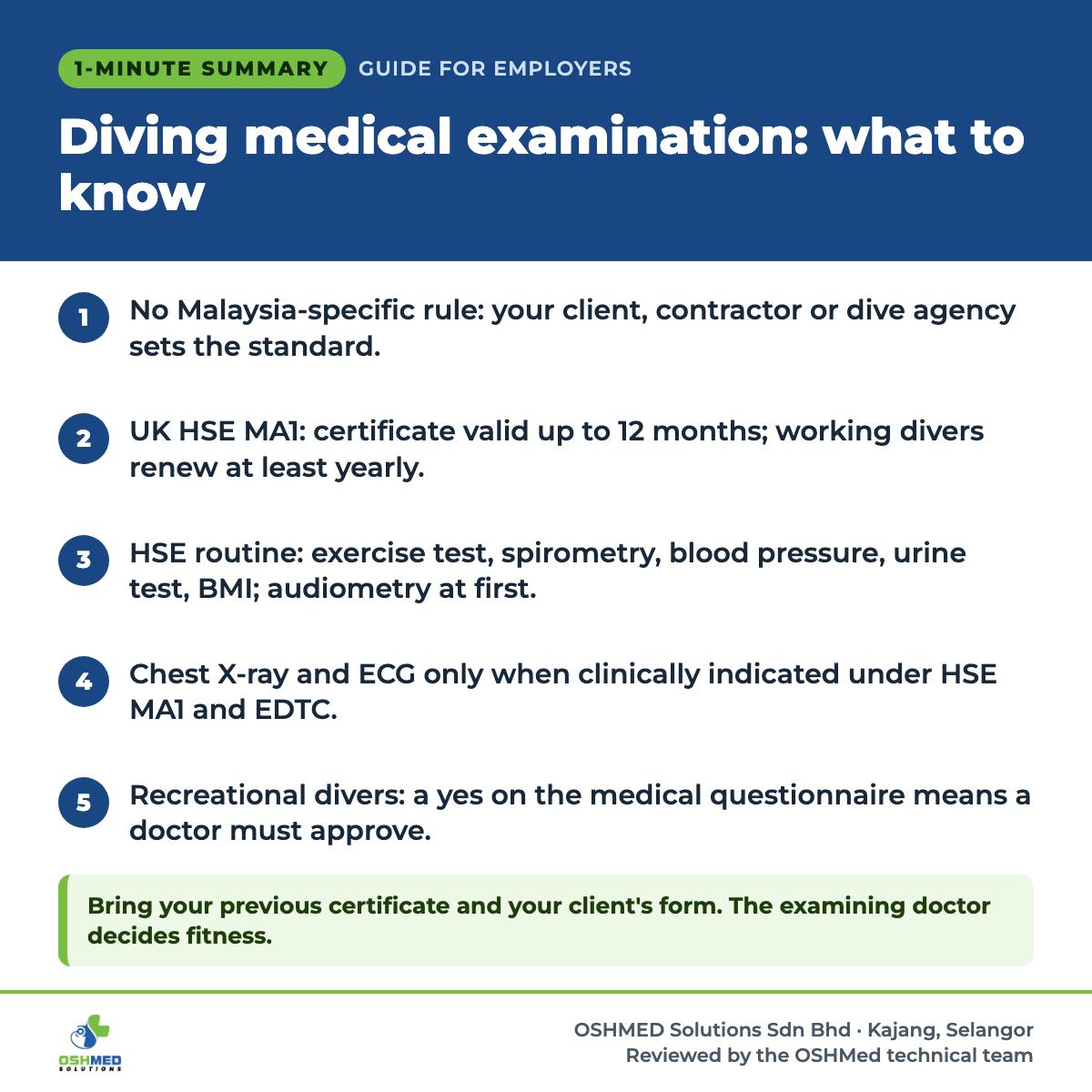
- No Malaysia-specific rule: your client, contractor or dive agency sets the standard.
- UK HSE MA1: certificate valid up to 12 months; working divers renew at least yearly.
- HSE routine: exercise test, spirometry, blood pressure, urine test, BMI; audiometry at first.
- Chest X-ray and ECG only when clinically indicated under HSE MA1 and EDTC.
- Recreational divers: a yes on the medical questionnaire means a doctor must approve.
Who needs a diving medical examination in Malaysia?
Anyone who dives for work, or starts diver training for work, should hold a current certificate of medical fitness to dive. That includes commercial, construction, offshore, aquaculture and scientific divers, plus instructors and guides at work. Recreational divers need a doctor only when the screening questionnaire says so.
UK HSE guidance (MA1, 2023) calls diving “a high hazard, safety critical activity”, so the doctor focuses on the lungs, heart, ears, fitness and anything that could cause sudden incapacity underwater.
- Construction and inshore divers, including CIDB Construction Diver holders.
- Offshore divers, whose contractors name the standard they accept.
- Fishing and aquaculture divers, covered by a DOSH guideline.
- Instructors and guides at work, which DMAC can count as occupational diving.
Is there a Malaysian regulation for diver medicals?
We found no Malaysian regulation or code of practice written specifically for diver medicals. Employers still have general duties under the OSH Act 1994: section 15 requires safe systems of work and section 18B a risk assessment. In practice, your client or contractor sets the medical standard.
The clearest Malaysian text is DOSH guideline JKKP GP (I/M) 7/2001 for fishing and aquaculture: section 8.7.2 makes each diver responsible for current medical certification from a physician competent in diving medicine. Offshore projects usually name UK HSE MA1 or the European EDTC Fitness to Dive Standards.
In one line: Malaysian law sets the duty; your client or contractor sets the medical standard.
What does a commercial diving medical examination include?
Under HSE MA1, every medical includes a history and physical examination, BMI and waist size, blood pressure, spirometry, an exercise test with peak flow or FEV1 afterwards, and a urine test. Audiometry is done at the first medical. Chest X-ray, ECG and a full blood count are done only when clinically indicated.
| Investigation | Initial medical | Annual medical |
|---|---|---|
| BMI, waist circumference, resting blood pressure | Yes | Yes |
| Exercise test (Chester step test) | Yes | Yes |
| Spirometry, plus peak flow or FEV1 after exercise | Yes | Yes |
| Urinalysis | Yes | Yes |
| Audiometry | Yes | If clinically indicated |
| Chest X-ray, resting ECG, full blood count | If clinically indicated | If clinically indicated |
EDTC differs in detail: no routine chest X-ray, a resting ECG at the first assessment, and audiometry only after ear barotrauma or under a hearing conservation programme. The divers medical package arranged through OSHMed at Nova Care covers blood and urine tests, ECG, chest X-ray, spirometry, audiometry, the Chester step test and a doctor’s consultation, so check what your client’s form needs.
Diving medical booking planner
Answer a few questions for one diver or a whole team. You will get a summary to send to OSHMed on WhatsApp, so we can confirm the form your client needs and arrange the appointment at Nova Care. Nothing is stored, and no personal data leaves this page unless you press the WhatsApp button. Please do not enter medical details here.
OSHMed will check the required standard and form with you, then arrange the appointment at our partner clinic, Nova Care Sdn Bhd in Kajang, which carries out and bills the examination. Bring your previous certificate and your client’s form. See the divers medical package.
What is the Chester step test, and why do divers take it?
The Chester step test is a submaximal, multistage aerobic fitness test. You step on and off a low step to a beat that speeds up every two minutes while your heart rate is recorded, until you reach 80% of your maximum heart rate or moderately vigorous effort, for up to 10 minutes.
Software then estimates your VO2 max. HSE MA1 asks for it at every medical because divers may need to rescue themselves or a buddy, with peak flow or FEV1 checked before the test and again afterwards. As a guide, HSE suggests a 12-month certificate for a VO2 max above 44, a shorter or restricted one for 40 to 44, and usually unfit below 40 (millilitres of oxygen per kilogram per minute). EDTC sees the estimate as an indicator, not a pass mark.
Tell the examining doctor about chest pain, breathlessness or heart medicines before the step test.
How long is a diving medical valid, and when should you renew it?
Under HSE MA1, a certificate of medical fitness to dive is valid for up to 12 months, and working divers must be examined at least every 12 months. You can attend up to one month early, and the new certificate can start from the old expiry date.
EDTC prefers an annual review with an in-depth examination about every five years for young, healthy divers, and says national rules override its guidance, so confirm the interval with your client. A recreational card, often called a diving licence, is separate: PADI certifications do not expire.
Booking a diving medical for one diver or a whole team?
Tell us the type of diving, the standard or form your client requires and your preferred dates. OSHMed coordinates the booking; the examination is carried out and billed by our partner clinic, Nova Care Sdn Bhd in Kajang.
What can make a diver unfit, and what happens after an illness?
HSE MA1 lists pregnancy, large lung cysts or bullae, seizures (with limited exceptions), claustrophobia and sickle cell anaemia as reasons not to dive. A previous spontaneous pneumothorax, asthma or diabetes needs a diving medical specialist’s opinion. The doctor can also certify you fit with restrictions on depth, duration or type of diving.
A fresh assessment is needed, even with a valid certificate, after decompression illness or any illness or injury causing more than 14 days off work.
- You have had decompression illness or a new lung, heart, ear or neurological problem.
- Illness or injury kept you off work for more than 14 days.
- You are pregnant or may be pregnant.
- Your asthma, diabetes or another long-term condition has changed.
- You feel unwell after a dive: for an emergency, call 999.
Do recreational divers need a doctor's approval?
Not always. The Diver Medical Participant Questionnaire used by dive training agencies has 10 questions. If you answer no to all of them, no medical evaluation is required. A yes to questions 3, 5 or 10, or to any item on page two, means a physician must approve diving first.
The form comes from the Diver Medical Screen Committee with UHMS and DAN. Page three is the doctor’s evaluation form, so bring all three pages.
How do you choose a provider for a diving medical examination?
Check four things: the examining doctor is trained to examine divers, the examination follows the standard your client names, the certificate states fit, fit with restrictions or unfit with a validity period, and your previous records can be compared. A certificate your client rejects means a second appointment.
| Check | Why it matters | Where to verify |
|---|---|---|
| Doctor trained as a Medical Examiner of Divers (Level 1 or higher) | Level 1 covers fitness to dive assessments (ECHM and EDTC standard) | The European Diving Medicine Databank or your contractor’s list |
| Course approved by DMAC/EDTCmed | DMAC approves courses, not doctors | The DMAC course list |
| Standard and form | Tests and intervals differ by standard | Your client or contractor |
| Previous records | Without your last record, HSE counts an annual medical as an initial one | Your previous certificate |
OSHMed Solutions Sdn Bhd is an occupational safety and health consultancy in Kajang, Selangor, serving employers across Malaysia. We are not a clinic. We coordinate bookings, check your client’s form and organise group appointments. The examination is carried out and billed by our partner clinic, Nova Care Sdn Bhd, No. 32 Jalan Reko Sentral 4, Kajang, where the examining doctor issues the certificate. On request, we can confirm the doctor’s competence listing. For a team, request a group booking quote or see our services.
Before you decide: three common objections
Three objections often delay a diving medical: a dive card seems enough, last year’s medical feels recent, and the client has not named a standard. Each is checked below against HSE MA1, EDTC and the diver questionnaire before your project starts.
"My dive card is enough."
A card shows training, not current fitness. It does not expire, but courses and work still need medical clearance.
"I had a medical last year."
An HSE certificate lasts up to 12 months, and a long illness calls for a new assessment. Check expiry against your project end date.
"The client has not named a standard."
Ask first: a medical done to the wrong form may need repeating. Without a preference, a medical recorded against HSE MA1 or EDTC gives a clear record.
Frequently asked questions
Do working divers in Malaysia need a diving medical?
We found no Malaysian regulation written only for diver medicals. Employers must still manage risks under sections 15 and 18B of the OSH Act 1994, and a DOSH guideline expects divers to hold current medical certification. Clients usually set the exact standard.
How long is a diving medical certificate valid?
Under UK HSE guidance (MA1), up to 12 months, with a medical at least every 12 months for working divers. The EDTC standard pairs an annual review with an in-depth examination about every five years for young, healthy divers.
What tests are done in a commercial diving medical examination?
HSE MA1 lists BMI, waist size, an exercise test, spirometry with post-exercise peak flow or FEV1, blood pressure and a urine test at every medical, plus audiometry at the first. Chest X-ray, ECG and blood count follow clinical need.
Does a recreational scuba diver need a doctor's approval?
Only if the Diver Medical Participant Questionnaire flags it. No to all 10 questions means no medical evaluation is required; a yes to question 3, 5 or 10, or to any item on page two, means a physician must approve diving first.
Who carries out the examination when I book through OSHMed?
OSHMed coordinates the booking and checks your client’s form. Our partner clinic, Nova Care Sdn Bhd in Kajang, carries out and bills the examination, and its examining doctor issues the certificate. OSHMed does not examine or certify divers.
Your next step
Start with the form: ask your client which standard applies, check your last expiry date and use the planner above. Then send us your group booking details or WhatsApp OSHMed. This article is general information, not medical advice; the examining doctor decides fitness to dive.
Planning other checks for the team? See medical surveillance and first aider training.
Get the right diving medical booked the first time
Send us your client’s form or the standard you were given. We will confirm what is needed and arrange the appointment at Nova Care Sdn Bhd, where the examining doctor issues the certificate of medical fitness to dive.
Sources and references
Checked against the official documents listed below on 28 October 2026. Standards and laws change: always confirm the current version with HSE, EDTC, your client or contractor, and the DOSH (JKKP) website.
- Medical examination and assessment of working divers (MA1), rev5, June 2023 (paragraphs 5, 21 to 32, 52 to 63, 69, 109; Appendix 2), Health and Safety Executive (HSE), United Kingdom
- Fitness to Dive Standards: Medical assessment for work under pressure, updated 10 December 2024 (frequency of assessments; Appendix A), European Diving Technology Committee (EDTC)
- Diver Medical Participant Questionnaire and Medical Examiner's Evaluation Form, version 2022-02-01, Diver Medical Screen Committee with UHMS, DAN US, DAN Europe and UCSD (copy hosted by PADI)
- Guidelines on Occupational Safety and Health in Fishing and Aquaculture Operation, JKKP GP (I/M) 7/2001 (section 8.7, Diving), DOSH Malaysia
- Occupational Safety and Health Act 1994 (Act 514), reprint incorporating Act A1648 (sections 15 and 18B), DOSH Malaysia
- Educational and Training Standards for Physicians in Diving and Hyperbaric Medicine (2011), section 2, Level 1 Medical Examiner of Divers, ECHM and EDTC Joint Educational Subcommittee
- Recognition of Courses in Diving Medicine: list of approved courses, Diving Medical Advisory Committee (DMAC)
- European Diving Medicine Databank: locate a diving medical examiner, International Diving Medical Expert Board (IDMEB)
- Recognition of Doctors to Perform Medical Examination of Divers, Asia-Pacific Region (last updated 27 June 2025), Diving contractors, circulated by IMCA
- Sykes K. Chester Step Test. Occupational Medicine 2018;68(1):70-71, Oxford University Press
- Do Scuba Certifications Expire? (updated 18 May 2024), PADI
Disclaimer: This article is general information for employers and is not legal advice. Requirements depend on your workplace, processes and the current law. For a decision on your premises, speak to a DOSH-registered competent person or contact DOSH (JKKP).