
Ergonomic Risk Assessment Report: Initial ERA Format and a Filled Sample (DOSH 2017)
An ergonomic risk assessment report records an ERA under the DOSH Guidelines on Ergonomics Risk Assessment at Workplace 2017. An initial ERA report is required even when no advanced ERA is needed. At a minimum, it details the workplace, the work units and tasks, the completed Appendix 6 checklist, the scores, the recommendations and the trained person with their certificate.
- MD (NNSMA, Rus)
- MScCH (Occ. Health, UKM)
- MBA (ARU, UK)
- OHD (NIOSH)
- MRO (AOEMM)
- TTT (HRDF)
- SSM 202001013523 (OSHMED Solutions Sdn Bhd)
- DOSH registered training provider SL/22/22/181036, valid to 21 July 2028
- MMC Full Registration 55275 (Dr. Wan Muhammad Zulhusni)
- DOSH Occupational Health Doctor HQ/16/DOC/00/454
- DMAC/EDTCmed 263
- OEUK OEUK/2024/3751
OSHMed Solutions Sdn Bhd is an occupational safety and health consultancy and DOSH-registered training provider (ergonomics) in Kajang, Selangor. We are not a clinic. Medical tests are arranged through approved centres.
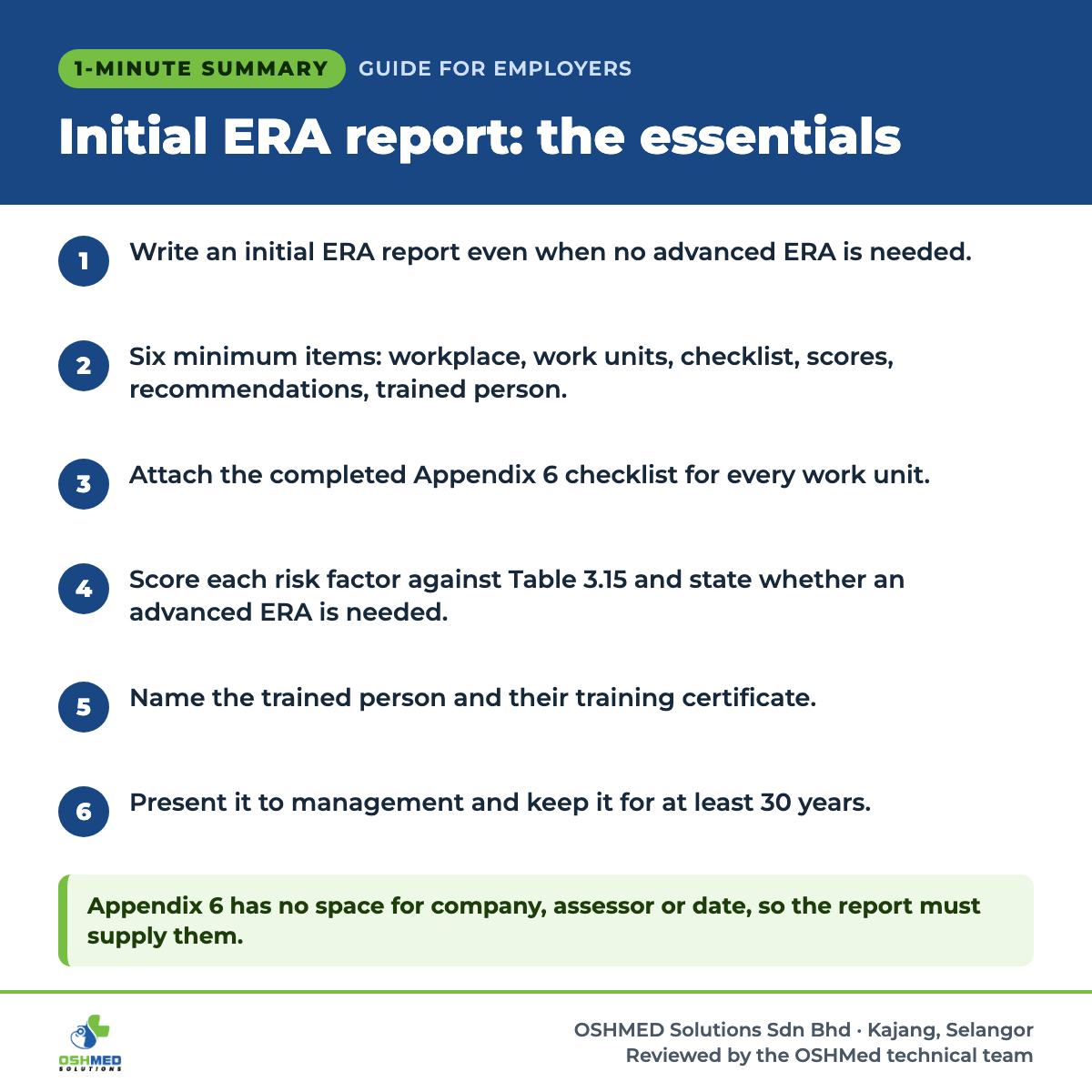
- Write an initial ERA report even when no advanced ERA is needed.
- Six minimum items: workplace, work units, checklist, scores, recommendations, trained person.
- Attach the completed Appendix 6 checklist for every work unit.
- Score each risk factor against Table 3.15 and state whether an advanced ERA is needed.
- Name the trained person and their training certificate.
- Present it to management and keep it for at least 30 years.
Appendix 6 has no space for company, assessor or date, so the report must supply them.
What is an ergonomic risk assessment report?
It is the written record of an ergonomic risk assessment (ERA). Section 6 of the DOSH 2017 guidelines says ERA activities and outcomes should be documented in a report, presented to management and kept as a record. An initial ERA report is required even when no advanced ERA follows.
Section 6.1 covers the initial report and 6.2 the advanced one; our initial vs advanced ERA guide explains when each applies. Following the guidelines also shows how you met the risk assessment duty in section 18B of Act 514 (section 18B guide).
What must an initial ERA report contain under the DOSH 2017 guidelines?
Section 6.1 sets six minimum items: the workplace name and address, the tasks and activities in each work unit, the completed Appendix 6 checklist, the risk evaluation and scores, recommendations including any need for an advanced ERA, and the trained person with their training certificate. It outlines contents, not a template.
Appendix 6 has no space for company, assessor or date, so the report must include them. This format builds the six items into nine sections:
| Report section | What to write | Basis |
|---|---|---|
| 1. Cover page | Title, workplace name and address, date, trained person | 6.1 (a), (f) |
| 2. Summary | Units assessed, factors reaching their minimum, advanced ERA yes or no | 6.1 (d), (e) |
| 3. Background and scope | Trigger, objectives, units, tools and duration agreed beforehand | 2.1, 2.3.3 |
| 4. Method | Musculoskeletal assessment form, walkthrough, checklist, photos or video | 3.1, 3.2 |
| 5. Work units and tasks | Tasks, activities, shifts and employees in each unit | 6.1 (b) |
| 6. Findings | Table 3.15 result per unit, with pain by body part | 6.1 (d), 3.3 |
| 7. Recommendations | Controls by hierarchy; advanced ERA for each flagged factor | 6.1 (e), Part 5 |
| 8. Trained person | Name and relevant training certificate | 6.1 (f) |
| 9. Appendices | Appendix 6 checklists, photos, survey summary, certificate copy | 6.1 (c) |
Sections 3 and 4 are good practice rather than minimum items; they show how each score was reached. Keep employee names out of the survey summary (2.3.3).
What does a filled initial ERA report look like?
Below is a filled sample for Kotak Contoh Sdn Bhd, a fictitious carton plant with three work units. All names, numbers and findings are illustrative. It fills in the parts that carry the decision: the scope, the scores against Table 3.15 and the recommendations.
| Report item | Sample entry |
|---|---|
| Workplace | Kotak Contoh Sdn Bhd (fictitious), Lot 0, Jalan Contoh, Selangor |
| Trigger | Self-assessment survey (Appendix 1): 9 of 41 respondents reported work-related pain |
| Work units | Palletising; die-cutter feeding; consumables store |
| Method | Cornell questionnaire (Appendix 3), walkthrough, Appendix 6 checklist, video from front, back and side |
| Dates | Assessed 3 and 4 November 2026; presented to management 18 November |
| Trained person | [Name], initial ERA certificate from a DOSH-registered training provider |
| Risk factor (minimum score) | Palletising | Die-cutter feeding | Consumables store |
|---|---|---|---|
| Awkward posture (6 of 13) | 3 | 2 | 2 |
| Static posture (1 of 3) | 0 | 1: standing still over 2 hours | 0 |
| Forceful exertion (1 of 1) | 1: cartons above limit | 0 | 0 |
| Repetitive motion (1 of 5) | 1: over twice a minute | 0 | 0 |
| Vibration (1 of 4) | 0 | 0 | 0 |
| Lighting, temperature, ventilation (1 each) | 0 | 0 | 0 |
| Noise (1 of 2) | 0 | 1: above PEL in noise report | 0 |
| Pain or discomfort | Lower back, shoulder | Lower leg, feet | None |
| Need advanced ERA? | Yes: forceful exertion, repetitive motion | Yes: static posture, noise | No |
Show the working behind each score. For palletising, Figure 3.1 gives 25 kg for a man lifting between knuckle and elbow height, close to the body; at six lifts a minute, Table 3.4 cuts it by 50% to 12.5 kg. The 14 kg cartons exceed that, so forceful exertion scores 1 (see our manual handling guide).
| Work unit | Recommendation | Control type (Part 5) |
|---|---|---|
| Palletising | Advanced ERA (MAC, ART); meanwhile, a lift table for pallets and task rotation | Engineering: lift assisted device; administrative: job rotation |
| Die-cutter feeding | Advanced ERA for standing work; review the workstation layout | Engineering: workstation design |
| Die-cutter feeding | Noise: act under the 2019 noise regulations and the latest noise risk assessment | Comply with regulations (Table 4.1) |
| Consumables store | No advanced ERA; review after a significant change or complaint | Maintain controls (section 7) |
Give each recommendation an owner and a due date; section 8 makes the employer responsible for effective, timely controls and for telling affected employees the results.
Check your initial ERA report: 12 items from the DOSH 2017 guidelines
Open your latest initial ERA report and tick each item it has. The items follow sections 2, 3, 6, 8 and 10 of the DOSH Guidelines on Ergonomics Risk Assessment at Workplace 2017; the section number is in brackets. Print the list, or send your score to OSHMed on WhatsApp. No personal data is collected, and your ticks are not stored or sent unless you choose WhatsApp.
0 of 12 ready
Who can carry out and sign an initial ERA report?
A trained person: someone who has undergone ergonomics risk assessment training and can conduct the assessment (section 1.4.7). DOSH states that ergonomically trained persons must attend its Ergonomic Management Course, initial or advanced ERA, at a registered training provider. The report names that person and their training certificate (6.1(f)).
The guidelines specify no signature block for the report; their only signature box is the trained person’s “signature and stamp” on the Appendix 1 form. In practice, the trained person signs and dates the report, and you record who in management received it (section 6). Check the named person on the DOSH Recognized List of Ergonomics Trained Persons (our ETP guide shows how).
When does an initial ERA result lead to an advanced ERA?
When a risk factor’s score reaches its Table 3.15 minimum: 6 of 13 for awkward posture, and 1 for each of the other eight factors. Give a yes or no for each work unit and name the factors; Table 3.15 also records pain or discomfort by body part.
An advanced ERA uses methods such as RULA or REBA for posture, MAC for manual handling, ART or OCRA for repetition and ROSA for workstations (Table 4.1). Its report adds occupational and medical history and the methods used (6.2).
If your team can screen but not yet run advanced methods, OSHMed can scope the advanced ERA through our workplace assessments, carried out by a trained person named in the report.
Want your own team to write this report?
An initial ERA report should name a trained person and their training certificate. The OSHMed ETP course for initial ERA is assessed partly on a workplace initial ERA report like the sample above. See the ETP course page or ask for ETP course dates.
How long must ERA reports and records be kept?
Keep assessment and investigation reports for at least 30 years, and other ERA records for at least five years (section 10.3). Print or electronic copies are both acceptable, and reports should be available to employees, DOSH and other relevant authorities at any time (section 10.1).
| Record | Keep for at least |
|---|---|
| Assessment report | 30 years |
| Investigation report | 30 years |
| Self-assessment forms | 5 years |
| Complaint records or related medical records | 5 years |
| Walkthrough inspection and initial findings | 5 years |
| Corrective action report | 5 years |
| Training records | 5 years |
File the trained person’s certificate with the training records. Our OSH compliance calendar helps you track review and retention dates.
What are common gaps in initial ERA reports?
Each common gap below breaks a specific part of the DOSH 2017 guidelines, from a report that was never written to an outdated legal reference. The table matches each gap to its fix and to the section that sets the requirement.
| Gap | Fix | Basis |
|---|---|---|
| No report, as no advanced ERA was needed | Write the initial ERA report anyway | 6.0 |
| Scores without the checklist | Attach the Appendix 6 checklist for each work unit | 6.1 (c) |
| “Production area” as one unit | Describe tasks and activities per work unit | 6.1 (b) |
| Ticks with no exposure time | Record durations against the Appendix 6 limits | 3.2, Appendix 6 |
| “Improve ergonomics” as the recommendation | Name the control, the unit and the advanced ERA decision | 6.1 (e), Part 5 |
| No trained person or certificate | Name the person; attach the certificate | 6.1 (f) |
| Noise judged under the 1989 regulations, still cited in 3.2.6.4 | Use the Noise Exposure Regulations 2019; the 1989 rules were revoked on 1 June 2019 | P.U. (A) 59/2019 |
How can your own team learn to write the ERA report?
Through ETP training. The minimum scope of initial ERA training includes report writing (9.2.2.1), and the DOSH module checklist for registered Ergonomic Management Courses covers the initial ERA report content, sample initial and advanced ERA reports, and assessment by written tests and report assignments.
The OSHMed ETP course for initial ERA runs over two days and is assessed by a one-hour written test (30 marks) and a workplace initial ERA report (70 marks) submitted within 14 days; the pass mark is 60%. So your participant’s first real report is written for your own workplace. Details are on our ETP course page.
OSHMED Solutions Sdn Bhd in Kajang, Selangor, is a DOSH-registered training provider for the Ergonomic Management Course, initial and advanced (SL/22/22/181036, valid until 21 July 2028). See our OSH training or ask for ETP dates or an in-house session.
- Your last initial ERA report names no trained person or certificate.
- Self-assessment forms or complaints show pain in a work unit.
- An occupational health doctor, DOSH or SOCSO has asked for an ERA.
Before you decide: three common objections
Three objections come up with initial ERA reports: a template is enough, no report is needed when nothing reaches the minimum, and the consultant keeps the report. Each is checked below against the DOSH 2017 guidelines.
"We can fill in a template ourselves."
A template helps, but the report should name a trained person and their training certificate (6.1(f)), and DOSH expects that training to come from a registered provider.
"Nothing reached the minimum, so no report."
Section 6 requires an initial ERA report either way, and a “no” result is the baseline for the next review.
"The consultant keeps the report."
It is presented to your management, and you keep it for at least 30 years, available to employees and DOSH (sections 6 and 10).
Frequently asked questions
Is there an official DOSH template for the initial ERA report?
No. Section 6.1 lists the minimum contents, and Appendix 6 gives the checklist and the Initial ERA Form (Table 3.15).
Where can I find an initial ergonomic risk assessment report PDF?
The DOSH guidelines PDF has the report contents (section 6), the survey forms (Appendices 1 and 2) and the checklist (Appendix 6). To keep the sample above, save this page as a PDF.
Who can sign an ERA report?
The trained person who conducted the assessment, named with their training certificate (6.1(f)). The guidelines do not specify a signature block; add a management acknowledgement.
Does an ERA report have to be submitted to DOSH?
The guidelines do not specify a submission step. Sections 6 and 10 ask for the report to be presented to management, kept as a record and made available to DOSH at any time.
How long should an ERA report be kept?
At least 30 years for assessment and investigation reports, and at least five years for other ERA records (section 10.3).
Your next step
Check your latest initial ERA report with the tool above. If item 10 is missing, or some work units were never assessed, ask about the ETP course.
Need the scores first? Use the initial ERA checklist in our ERA guide and the manual handling weight checker.
Train an ETP, or hand us the advanced ERA
Send your checker score on WhatsApp. If you need someone in-house to write ERA reports, ask about the ETP course; if work units already need an advanced ERA, request an ERA quote.
- Initial vs advanced ergonomic risk assessment (ERA): the DOSH 2017 guidelines explained
- Ergonomic trained person (ETP) course: DOSH rules and buyer’s guide
- Manual handling guidelines Malaysia: DOSH 2018 weight limits and lifting checker
- Ergonomic risk assessment price in Malaysia: what sets your ERA quote
- Section 18B OSHA 1994: risk assessment duty, HIRARC and specialists
- OSHMed Ergonomic Trained Person course for initial ERA
Sources and references
Checked against the official documents listed below on 16 November 2026. Laws change: always confirm the current version on the DOSH (JKKP) website.
- Guidelines on Ergonomics Risk Assessment at Workplace 2017 (sections 1.4.7, 2.1 to 2.4, 3.1 to 3.3, 4.3, 6 to 10; Figure 3.1; Tables 3.4, 3.15 and 4.1; Appendices 1, 3 and 6), DOSH Malaysia
- Registered Training Provider Ergonomic Management Course (ETP course requirement), DOSH Malaysia
- Ergonomic Management Course Training Module Checklist, revision 3.1.2025 (items 7, 11, 13 and 14), DOSH Malaysia
- Recognized List: Ergonomics Trained Person, Initial Ergonomic Risk Assessment, DOSH Malaysia
- Factories and Machinery (Noise Exposure) (Revocation) Regulations 2019, P.U. (A) 59/2019 (regulation 2), DOSH Malaysia
- Occupational Safety and Health (Noise Exposure) Regulations 2019, P.U. (A) 60/2019, DOSH Malaysia
- Occupational Safety and Health Act 1994 (Act 514), reprint incorporating Act A1648 (section 18B), DOSH Malaysia
Disclaimer: This article is general information for employers and is not legal advice. Requirements depend on your workplace, processes and the current law. For a decision on your premises, speak to a DOSH-registered competent person or contact DOSH (JKKP).