
Ergonomic Risk Assessment Price in Malaysia: What Sets Your ERA Quote
There is no fixed ergonomic risk assessment price in Malaysia: the DOSH 2017 guidelines set the method, not a fee. Your quote depends on your work units and tasks, the employees assessed, whether an advanced ERA is needed, extra measurements and the number of sites. Compare quotes on scope, the named trained person and deliverables, not the total alone.
- MD (NNSMA, Rus)
- MScCH (Occ. Health, UKM)
- MBA (ARU, UK)
- OHD (NIOSH)
- MRO (AOEMM)
- TTT (HRDF)
- SSM 202001013523 (OSHMED Solutions Sdn Bhd)
- DOSH registered training provider SL/22/22/181036, valid to 21 July 2028
- MMC Full Registration 55275 (Dr. Wan Muhammad Zulhusni)
- DOSH Occupational Health Doctor HQ/16/DOC/00/454
- DMAC/EDTCmed 263
- OEUK OEUK/2024/3751
OSHMed Solutions Sdn Bhd is an occupational safety and health consultancy and DOSH-registered training provider (ergonomics) in Kajang, Selangor. We are not a clinic. Medical tests are arranged through approved centres.
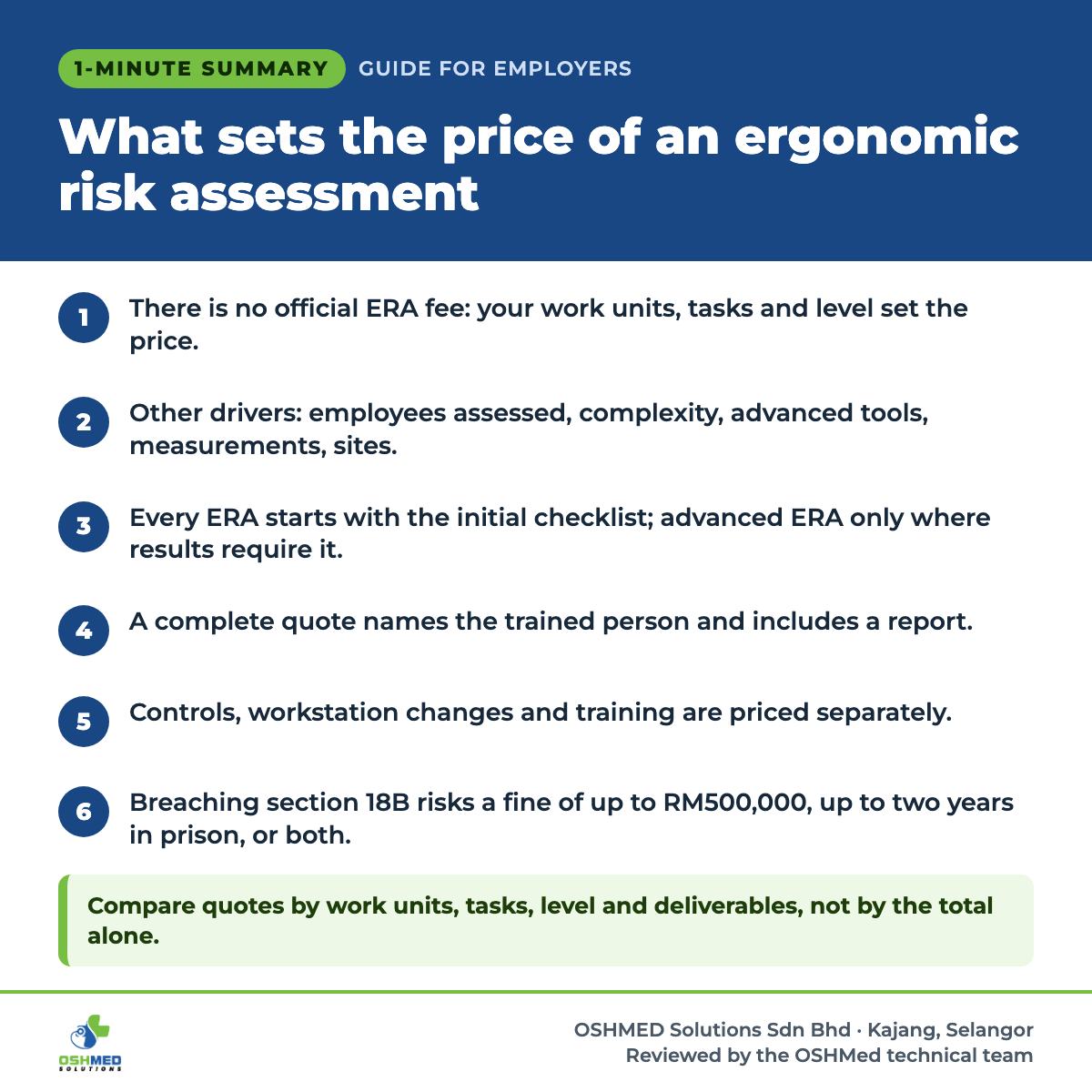
- There is no official ERA fee: your work units, tasks and level set the price.
- Other drivers: employees assessed, complexity, advanced tools, measurements, sites.
- Every ERA starts with the initial checklist; advanced ERA only where results require it.
- A complete quote names the trained person and includes a report.
- Controls, workstation changes and training are priced separately.
- Breaching section 18B risks a fine of up to RM500,000, up to two years in prison, or both.
Is there a fixed ergonomic risk assessment price in Malaysia?
No. The DOSH Guidelines on Ergonomics Risk Assessment at Workplace 2017 set out how an ergonomic risk assessment (ERA) is planned, carried out and reported, but do not set a fee. Each quote follows your scope: work units and tasks, employees involved, level of assessment and site visits.
Section 2.4.1 ties the duration, and so the cost, to the objective, the employees assessed, the complexity of the work and the scope. For the method itself, read our guide to initial and advanced ERA.
Which factors determine your ERA quote?
Nine factors set the workload, and each comes from the 2017 guidelines. Knowing them helps you give accurate details early, so the quote fits your site, and helps you spot a quote that leaves part of the required method out.
| Cost driver | Why it changes the quote | Basis |
|---|---|---|
| Work units and tasks | Every task in each unit is described and screened | Sections 2.4.1(c), 6.1(b) |
| Employees to assess | Headcount is a listed duration factor | Sections 2.4.1(b), 3.1 |
| Complexity and objective | A simple process takes 1 to 2 hours; a compensation claim changes the scope | Sections 2.4(a), 2.4.1 |
| Initial only, or advanced too | Advanced ERA adds methods such as RULA, REBA, MAC or ROSA | Sections 2.2, 4 |
| Environmental readings | Lux, heat stress or sound level meters where flagged | Section 3.2.6; Table 2.1 |
| Workstation redesign | Ideally assessed with an ergonomist | Section 4.4 |
| Sites and shifts | Each visit has a walkthrough and a closure meeting | Sections 2.4, 2.4.2 |
| Reports | An initial report every time; advanced reports add work and medical history | Section 6 |
| Training add-on | Awareness or ETP training, quoted separately | Section 9.2 |
ERA scope builder: prepare an accurate quote request
Answer nine quick questions. Your answers build a scope summary you can send to OSHMed on WhatsApp for a written quote, or print for internal approval. No personal or medical details are needed.
OSHMed uses these answers to prepare a written quote. This summary is not a price: the trained person confirms the work units, tasks and any need for an advanced ERA after the walkthrough (DOSH 2017 guidelines, sections 2.2 and 2.4.1). Planning to train your own staff instead? See the ETP course.
Initial or advanced ERA: how does the level change the price?
Every ERA starts with the initial checklist. An advanced ERA follows only for units whose scores reach the Table 3.15 minimums or where pain is reported, and its five steps and specialist methods cost more per unit. Approve the initial ERA for all units, with advanced work priced per unit as an option.
What should a complete ERA quote include?
A complete quote covers the briefing, walkthrough, musculoskeletal assessment, initial checklist for each task, photo or video records, closure meeting and report. It also names the trained person who will lead the work, since section 6.1 requires that name and their training certificate in the report.
- A briefing on the objective, units, tools and duration (section 2.3.3).
- A walkthrough and musculoskeletal assessment in each unit (sections 2.4, 3.1).
- The Appendix 6 checklist for each task, with postures filmed from the front, back and sides (section 3.2.1).
- A closure meeting, then a report that meets section 6.1 or 6.2 (sections 2.4.2, 6).
Need an ERA quote, or your own trained person?
Send us your work units, tasks, headcount and sites, and OSHMed will reply with a written quote that lists the units, the level of assessment and the deliverables: request an ERA quote. Would you rather run ERAs in-house? Train a staff member on our DOSH-registered ETP course.
What is not included in an ERA quote?
The ERA identifies risk and recommends controls; it does not deliver them. Engineering changes, workstation rebuilds, job rotation and employee training are separate. The employer is responsible for applying effective, timely controls and telling affected employees the results (section 8), so budget for them once the report arrives.
| Item | Who provides it | Reference |
|---|---|---|
| Mechanisation, jigs, lift-assist devices | A supplier or contractor | Part 5, engineering control |
| Workstation redesign | A supplier, with an ergonomist where needed | Sections 4.4, 5.4.4 |
| Job rotation, procedures, exercise programmes | The employer | Part 5, administrative control |
| Awareness training for employees | The employer or a trained person | Section 9.2.1 |
| Noise risk assessment | A DOSH-registered noise risk assessor | Section 3.2.6.4; Noise Exposure Regulations 2019, reg. 4 |
If the ERA flags noise, our noise risk assessment cost guide explains that quote. See also OSHMed’s ergonomic risk assessment service.
Train your own ETP or buy an external ERA: what does each cost?
An external ERA is priced per scope, and each review after a change or complaint is quoted again. Training an in-house Ergonomic Trained Person (ETP) costs a course fee and staff time up front; reviews then become internal work. The more often your processes change, the stronger the case for training.
| Cost item | Train an in-house ETP | Commission an external ERA |
|---|---|---|
| What you pay for | Course fee per participant, plus two days of staff time (OSHMed course) | A quote for your units, tasks, level and sites |
| First report | The course includes a workplace initial ERA report, due within 14 days | The external report |
| Advanced ERA | Advanced-level training, or a consultant (section 9.3) | Only if scoped |
| Reviews | In-house (section 7) | Quoted again each time |
Reviews have no fixed interval: section 7 triggers them after significant changes, complaints or a DOSH direction. For the full decision, with a self-check, read our ETP course buyer’s guide.
How do you compare ERA quotes, and what are the red flags?
Compare scope, not totals: the same work units, tasks, employees, level and deliverables, a named trained person and a sample report. A quote far below the others often reflects a smaller method, such as a checklist with no walkthrough, so ask what is missing before you sign.
- No named trained person or certificate (section 6.1). Check the name on DOSH’s Recognized List of Ergonomics Trained Persons.
- A “DOSH-registered ergonomic assessor”. No such scheme exists for ERA (see the objections below).
- Checklist only, with no walkthrough or musculoskeletal assessment (section 3.1).
- No report if advanced ERA is not needed. It is required either way (section 6).
- Advanced methods everywhere from day one, with no complaint or request behind it (section 2.2).
What does it cost to delay or skip an ERA?
More than the assessment. Section 18B of Act 514 requires every employer to conduct a risk assessment and apply the controls it shows are needed. A breach carries a fine of up to RM500,000, up to two years in prison, or both (section 19), and complaints can force the timing.
After an MSD complaint, or a request from an occupational health doctor (OHD), DOSH or SOCSO, an initial ERA should follow without assessing the claim first (section 2.1). The guidelines also list lower compensation, medical and absenteeism costs among the benefits of an ERA (section 1.2).
OSHMED Solutions Sdn Bhd in Kajang serves employers across Malaysia and quotes in writing. OSHMed carries out initial and advanced ERAs through our assessment services, each report naming the trained person and their certificate. It is also one of 13 organisations on DOSH’s ETP training provider list (16 October 2026), authorised for initial and advanced ERA (SL/22/22/181036, valid until 21 July 2028).
- Self-assessment forms show pain or discomfort in any unit.
- There is an MSD complaint, or an OHD, DOSH or SOCSO request.
- You are changing workstations, work rates or methods.
- Your last ERA report names no trained person.
Before you decide: three common objections
Three objections come up when employers review ERA quotes: waiting for a complaint, looking for a registered ergonomic assessor, and taking the lowest total. Each is checked below against the 2017 guidelines and Act 514, so the decision rests on the rules.
"We will wait until someone complains."
Section 18B applies either way, and the guidelines start ERAs proactively through self-assessment forms, walkthroughs and HIRARC reviews (section 2.1). A complaint sets the timetable for you.
"We need a DOSH-registered ergonomic assessor."
No such registration exists for ERA. The report names a trained person and their training certificate (section 6.1), and DOSH expects that training from a registered training provider.
"We will just take the lowest quote."
Compare first. A quote that drops the walkthrough, the musculoskeletal assessment or the report may need repeating.
Frequently asked questions
How much does an ergonomic risk assessment cost in Malaysia?
There is no official fee schedule. The DOSH 2017 guidelines set the method, not the price, so each quote follows your scope: work units and tasks, employees assessed, initial or advanced level, measurements and sites. OSHMed quotes in writing.
Who can carry out an ergonomic risk assessment in Malaysia?
A trained person who has completed ergonomics risk assessment training (section 1.4.7). DOSH states that trained persons attend its Ergonomic Management Course at a registered training provider. There is no registration scheme for ERA assessors, unlike noise and chemical assessments.
Is an ergonomic risk assessment mandatory?
Section 18B of Act 514 requires every employer to conduct a risk assessment and implement the controls it indicates; a breach carries a fine of up to RM500,000, up to two years in prison, or both. The 2017 guidelines show how to meet that duty for ergonomics.
How often do we need to pay for an ERA?
The guidelines set no fixed interval. Review the ERA after a significant change in the work, after symptoms or complaints, or when DOSH directs (section 7). Sites that change often can cut review costs by training an in-house Ergonomic Trained Person (ETP).
Does training an in-house ETP cost less than hiring a consultant?
It depends on how often ERAs recur. An external ERA is quoted per scope and per review; an in-house ETP costs a course fee and staff time up front, then handles reviews internally. For advanced methods or workstation redesign, the guidelines allow external consultants (sections 4.4, 9.3).
Your next step
Fill in the scope builder above, or send your work units, tasks, headcount and sites, and OSHMed will reply with a written ERA quote.
If ERAs will recur at your site, register a staff member for the Ergonomic Trained Person (ETP) course. Noise on the same floor? See our NRA cost guide and plan both in one visit.
Get a written ERA quote, or train your own ETP
Share your scope summary on WhatsApp or through the quote form. If ERAs will recur at your site, register a staff member for the ETP course instead.
Sources and references
Checked against the official documents listed below on 29 October 2026. Laws change: always confirm the current version on the DOSH (JKKP) website.
- Guidelines on Ergonomics Risk Assessment at Workplace 2017 (sections 1.2, 1.4.7, 2.1 to 2.4, 3.1, 3.2.6, 4, 6, 7, 8, 9; Tables 2.1 and 4.1), DOSH Malaysia
- Registered Training Provider Ergonomic Management Course (DOSH rule on ETP training), DOSH Malaysia
- List of registered training providers and authorised trainers for the Ergonomic Management Course for Ergonomic Trained Person (ETP), updated 16 October 2026, DOSH Malaysia
- Recognized List: Ergonomics Trained Person, Initial Ergonomic Risk Assessment, DOSH Malaysia
- Recognized List: Ergonomics Trained Person, Advance Ergonomic Risk Assessment, DOSH Malaysia
- Occupational Safety and Health Act 1994 (Act 514), reprint incorporating Act A1648 (sections 15, 18B, 19), DOSH Malaysia
- Occupational Safety and Health (Noise Exposure) Regulations 2019, P.U. (A) 60/2019 (regulation 4), Attorney General's Chambers, published by DOSH
Disclaimer: This article is general information for employers and is not legal advice. Requirements depend on your workplace, processes and the current law. For a decision on your premises, speak to a DOSH-registered competent person or contact DOSH (JKKP).