
Manual Handling Guidelines Malaysia: DOSH 2018 Weight Limits and Lifting Checker
The manual handling guidelines Malaysia’s DOSH publishes are the Guidelines for Manual Handling at Workplace 2018. Their risk filter gives a recommended lifting weight for each hand height, for men and women, from 25 kg down to 3 kg, reduced for frequent lifting and twisting. A task above the figure needs an advanced ergonomic risk assessment (ERA).
- MD (NNSMA, Rus)
- MScCH (Occ. Health, UKM)
- MBA (ARU, UK)
- OHD (NIOSH)
- MRO (AOEMM)
- TTT (HRDF)
- SSM 202001013523 (OSHMED Solutions Sdn Bhd)
- DOSH registered training provider SL/22/22/181036, valid to 21 July 2028
- MMC Full Registration 55275 (Dr. Wan Muhammad Zulhusni)
- DOSH Occupational Health Doctor HQ/16/DOC/00/454
- DMAC/EDTCmed 263
- OEUK OEUK/2024/3751
OSHMed Solutions Sdn Bhd is an occupational safety and health consultancy and DOSH-registered training provider (ergonomics) in Kajang, Selangor. We are not a clinic. Medical tests are arranged through approved centres.
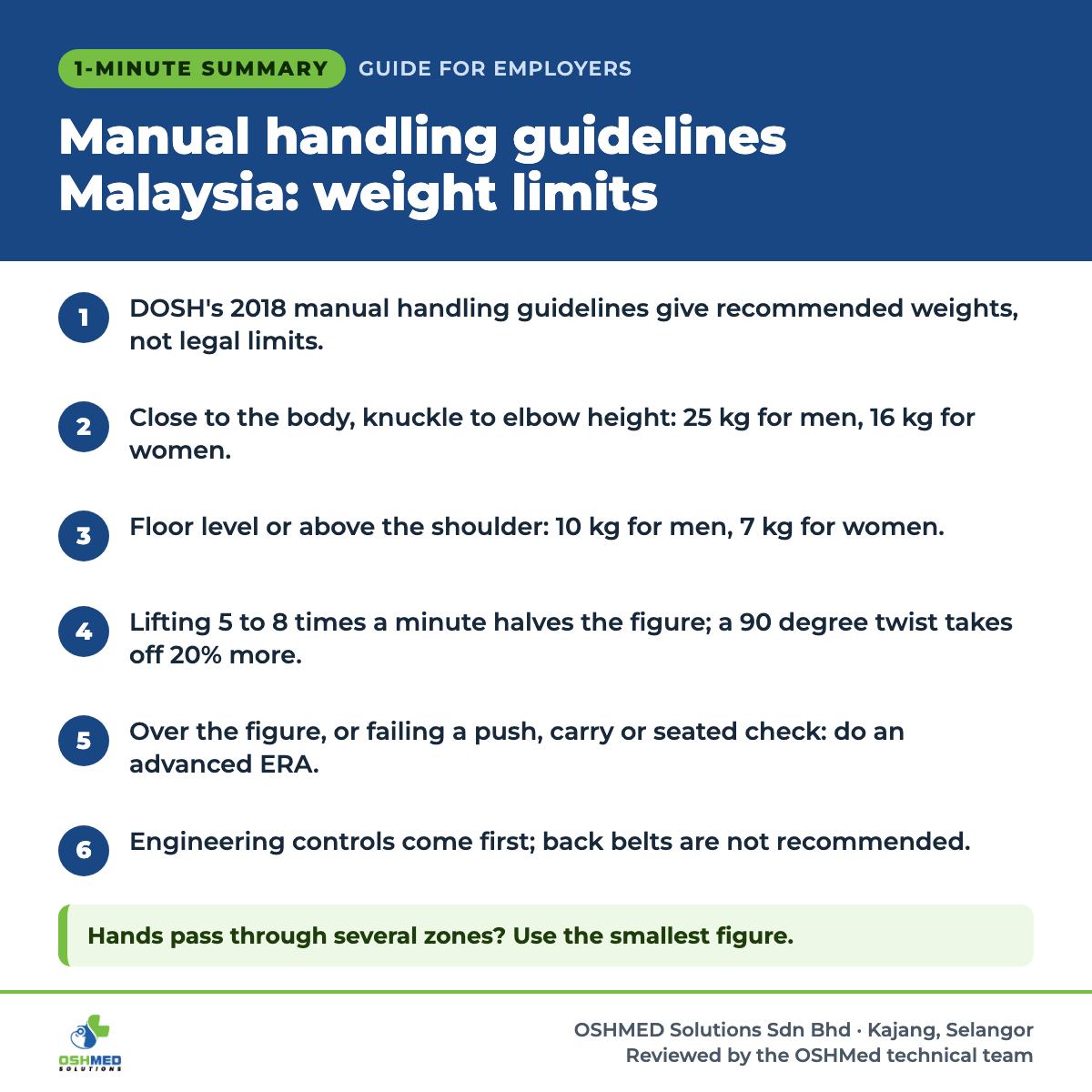
- DOSH's 2018 manual handling guidelines give recommended weights, not legal limits.
- Close to the body, knuckle to elbow height: 25 kg for men, 16 kg for women.
- Floor level or above the shoulder: 10 kg for men, 7 kg for women.
- Lifting 5 to 8 times a minute halves the figure; a 90 degree twist takes off 20% more.
- Over the figure, or failing a push, carry or seated check: do an advanced ERA.
- Engineering controls come first; back belts are not recommended.
Hands pass through several zones? Use the smallest figure.
What are the DOSH manual handling guidelines?
They are the Guidelines for Manual Handling at Workplace 2018, prepared by DOSH with NIOSH Malaysia. They cover risk factors and injuries, employer duties, an initial risk assessment based on the HSE UK method, and controls from engineering changes to personal protective equipment (PPE). They are guidance, not regulations.
Manual handling means using human force to lift, lower, push, pull, carry, hold or restrain a load (2.2); the guidelines link it to 40% of reported musculoskeletal disorder (MSD) cases in Malaysia.
What is the DOSH recommended weight limit for lifting?
Figure 5.2 gives a recommended weight for five hand-height zones, for men and women, close to the body or further away. The highest is 25 kg for men and 16 kg for women, between knuckle and elbow height, close to the body. If the hands pass through several zones, the smallest figure applies.
| Hand height | Men, close to the body | Men, further away | Women, close to the body | Women, further away |
|---|---|---|---|---|
| Above the shoulder | 10 kg | 5 kg | 7 kg | 3 kg |
| Elbow to shoulder | 20 kg | 10 kg | 13 kg | 7 kg |
| Knuckle to elbow | 25 kg | 15 kg | 16 kg | 10 kg |
| Mid-lower leg to knuckle | 20 kg | 10 kg | 13 kg | 7 kg |
| Floor to mid-lower leg | 10 kg | 5 kg | 7 kg | 3 kg |
The figures assume up to about 30 lifts an hour and protect around 95% of working men and women. They are not safe or maximum limits; a task more than about twice the figure may pose a serious risk of injury even for fit, well-trained people (5.3.1).
How do frequency and twisting reduce the weight limit?
Cut the Figure 5.2 value by 30% for lifting once or twice a minute, 50% for five to eight times and 80% for more than 12 times a minute (Table 5.2). Twisting 45 degrees cuts it by 10%, and 90 degrees by 20% (Table 5.3). When both apply, both cuts come off the original figure.
| Task | Reduction | Recommended weight |
|---|---|---|
| Man, occasional lift | None | 25 kg |
| Man, 7 to 8 lifts a minute | 50% | 12.5 kg |
| Man, twisting 45 degrees | 10% | 22.5 kg |
| Man, both of the above | 50% + 10% | 10 kg |
| Woman, both of the above (16 kg) | 50% + 10% | 6.4 kg |
Table 5.2 has no figure for three or four lifts a minute, or for nine to 12, so the checker below shows the range between the nearest bands for a trained person to judge.
Manual handling weight checker: the DOSH lifting and lowering filter
Choose who lifts, where the hands start and finish, how far the load is from the body, how often and how much twisting, then enter the weight. The checker applies Figure 5.2 and Tables 5.2 and 5.3 of the 2018 guidelines.
| Hand height | Close to the body | Further away |
|---|---|---|
| Above the shoulder | 10 kg | 5 kg |
| Elbow to shoulder | 20 kg | 10 kg |
| Knuckle to elbow | 25 kg | 15 kg |
| Mid-lower leg to knuckle | 20 kg | 10 kg |
| Floor to mid-lower leg | 10 kg | 5 kg |
This is a screening check of one lifting or lowering task, not an ergonomic risk assessment. It uses Figure 5.2 and Tables 5.2 and 5.3 of the Guidelines for Manual Handling at Workplace 2018 (the same figures as Figure 3.1 and Tables 3.4 and 3.5 of the ERA Guidelines 2017) and, as in the worked example in section 5.3.1.3, subtracts both reductions from the Figure 5.2 value. Where the hands cross several boxes, the smallest figure applies; near a boundary, a trained person may choose an intermediate weight. Nothing you enter is stored or sent unless you choose WhatsApp.
What are the limits for pushing, pulling, carrying and seated handling?
Table 5.4 allows a pushing or pulling force of 200 N for men and 150 N for women to start or stop a load, and 100 N and 70 N to keep it moving. Seated handling is limited to 5 kg for men and 3 kg for women. Carrying beyond 10 m needs an advanced ERA.
| Activity | Men | Women |
|---|---|---|
| Start or stop a load | 200 N, about 1,000 kg | 150 N, about 750 kg |
| Keep a load moving | 100 N, about 100 kg | 70 N, about 70 kg |
| Seated handling, within the box zone | 5 kg | 3 kg |
| Carrying distance | 2 to 10 m | 2 to 10 m |
The push and pull figures assume the hands are between knuckle and shoulder height, the distance is under 20 m, and the load is on wheels with a well-maintained handling aid. Carrying also needs an advanced ERA on poor or wet floors, in extreme conditions, or on routes with slopes, steps, closed doors or ladders.
What does the law require of employers for manual handling?
Section 15 of the Occupational Safety and Health Act 1994 requires every employer to ensure, so far as is practicable, the safety, health and welfare of employees at work, including safe handling of plant and substances (15(2)(b)) and the necessary training and supervision (15(2)(c)). There are no separate manual handling regulations.
- Section 18B requires every employer to assess risks and implement the controls needed (section 18B guide).
- Breaching section 15 or 18B can bring a fine of up to RM500,000, up to two years in prison, or both (section 19).
- Since Act A1648 took effect on 1 June 2024, the Act covers all places of work except domestic employment, the armed forces and ships (OSHA amendment guide).
The 2018 guidelines still quote section 12 of the Factories and Machinery Act 1967, which barred employing anyone to lift a load likely to injure them. That Act was repealed on 1 June 2024 (Act 835).
When does a manual handling task need an advanced ERA?
Whenever a row of the summary table, Table 5.6, is answered YES: the load is above the recommended weight, or a push, pull, seated or carrying check fails. Section 5.3.2 adds cases where the filter cannot be relied on, such as ill health or pregnancy, hands outside the boxes, or uneven floors.
- The load is hard to grasp with both hands, or the hands are outside the boxes.
- The person has reduced capacity, for example through ill health or pregnancy.
- Uneven floors, constricted spaces, or moving the load more than about 20 m without a break.
The advanced ERA follows the ERA Guidelines 2017, where a trained person picks a method such as the Manual Handling Assessment Chart (MAC), the Snook tables or the revised NIOSH lifting equation (Table 4.1). See our initial vs advanced ERA guide.
Is a task above the guideline figure?
A YES in Table 5.6 calls for an advanced ERA by a trained person. OSHMed can scope the ERA for your work units, or train your own staff as ergonomic trained persons: ask about the ETP course.
How do the 2018 guidelines relate to the ERA Guidelines 2017?
They share one weight filter. Section 3.2.3 of the ERA Guidelines 2017 contains the same Figure 3.1 and Tables 3.3 to 3.8, repeated in 2018 as Figure 5.2 and Tables 5.1 to 5.6. The 2018 text adds the 30-an-hour basis, the section 5.3.2 triggers and chapter 6 on controls.
We found no difference in any weight or percentage. A checker result answers the forceful exertion item of the initial ERA checklist: one YES calls for an advanced ERA.
Which controls do the guidelines recommend for manual handling?
Engineering comes first, to make the job fit the person: modified tools, workstation redesign, powered equipment and low-cost automation. Administrative steps follow, such as safe work practice, training, job rotation and work-rest breaks. PPE comes last, and back supports are not recommended as protection.
- Engineering (6.2): spring balancers, turntables, roller tracks, hydraulic lifters, hoists, vacuum lifters and AGVs.
- Administrative (6.3): safe procedures, team lifting, training, job rotation and work-rest cycles.
- PPE (6.4): well-fitting gloves, knee pads and anti-slip footwear; back belts are not PPE (6.4.5).
Keep assessment and investigation reports for at least 30 years and other records for five years (6.3.11), and log each task in your HIRARC form.
What manual handling training do employees and assessors need?
Employees need awareness training on risk factors, signs of MSDs, correct manual handling techniques, controls and the self-assessment form (ERA Guidelines 2017, 9.2.1). Whoever carries out an initial or advanced ERA must be a trained person who attended training for that level (9.2.2): the ETP course.
OSHMED Solutions Sdn Bhd in Kajang, Selangor, is a DOSH-registered Ergonomic Trained Person (ETP) training provider (SL/22/22/181036, valid until 21 July 2028) for initial and advanced ERA courses: see our ETP course page and ETP guide. We also carry out ERAs through our assessment services (ERA price guide).
- The checker shows a task above the guideline figure.
- Workers lift five or more times a minute, twist, or carry beyond 10 m.
- Staff report back, shoulder or wrist pain.
Before you decide: three common objections
Three objections come up when employers read the weight chart. Each is checked below against the 2018 guidelines, the ERA Guidelines 2017 and the Act, so the decision rests on the rules rather than on habit.
"25 kg is the legal limit, so 23 kg is fine."
No. 25 kg is a guideline figure for men lifting infrequently, close to the body, between knuckle and elbow. For women it is 16 kg, and frequent lifting halves it.
"A back belt and a lifting talk are enough."
The guidelines rank engineering ahead of training and PPE (6.1.3.2) and do not recommend back supports without a doctor’s advice (6.4.5).
"We only assess after someone complains."
Section 18B already requires a risk assessment; the filter finds high risk tasks before anyone is hurt.
Frequently asked questions
What is the maximum weight a person can lift at work in Malaysia?
There is no legal maximum. The DOSH guidelines recommend up to 25 kg for men and 16 kg for women, close to the body between knuckle and elbow, and less elsewhere.
Is the DOSH manual handling guideline mandatory?
It is guidance, not a regulation. The duties come from sections 15 and 18B of the Act; the guidelines give DOSH’s recommended method.
What is manual handling in Malay?
Pengendalian manual, the term DOSH uses in the Malay edition of its HIRARC guidelines. The 2018 guidelines are in English only.
What is the manual handling assessment chart (MAC)?
A UK Health and Safety Executive (HSE) tool that the ERA Guidelines 2017 list as an advanced ERA method for forceful exertion (Table 4.1).
What lifting techniques do the DOSH guidelines show?
Appendix 4 shows the basic diagonal, power, tripod, partial squat, golfer’s and overhead lifts, plus the pivot technique.
Your next step
Check your heaviest, fastest lifts with the checker above. Above the figure? Request an ERA quote or ask about the ETP course.
Then run the initial ERA checklist for each work unit; see our training page for in-house courses.
Check your lifting tasks with a trained person
Send your heaviest lifting tasks on WhatsApp, or ask about an ETP course for your team. We will tell you whether to assess externally, train in-house, or do both.
- Ergonomic risk assessment report: initial ERA format and a filled sample (DOSH 2017)
- Initial vs advanced ergonomic risk assessment (ERA): the DOSH 2017 guidelines
- Ergonomic Trained Person (ETP) course: DOSH rules and buyer’s guide
- Ergonomic risk assessment price in Malaysia: what sets your ERA quote
- Section 18B OSHA: the employer’s risk assessment duty
- HIRARC form (DOSH): template, examples and how to fill it in
- OSHMed ergonomic risk assessment service
Sources and references
Checked against the official documents listed below on 13 November 2026. Laws change: always confirm the current version on the DOSH (JKKP) website.
- Guidelines for Manual Handling at Workplace 2018 (sections 1.0 to 6.4, Figures 5.1 to 5.3, Tables 5.1 to 5.6 and 6.1, Appendices 1 to 5), DOSH Malaysia
- Guidelines on Ergonomics Risk Assessment at Workplace 2017 (sections 3.2.3, 4.3, 7.0, 9.2, 9.3 and 10.3, Figure 3.1, Tables 3.3 to 3.8 and 4.1), DOSH Malaysia
- DOSH ergonomics guidelines listing, DOSH Malaysia
- Occupational Safety and Health Act 1994 (Act 514), reprint incorporating Act A1648 (sections 1, 15, 18B, 19 and 24, First Schedule), DOSH Malaysia
- Factories and Machinery (Repeal) Act 2022 (Act 835), section 3, DOSH Malaysia
- Factories and Machinery (Repeal) Act 2022: Appointment of Date of Coming into Operation, P.U. (B) 127/2024, Attorney General's Chambers, published by DOSH
- Regulations under the Occupational Safety and Health Act 1994 (Act 514), DOSH Malaysia
Disclaimer: This article is general information for employers and is not legal advice. Requirements depend on your workplace, processes and the current law. For a decision on your premises, speak to a DOSH-registered competent person or contact DOSH (JKKP).