
USECHH 2000: A Plain Guide to All 30 Regulations and 3 Schedules
USECHH 2000 is the Occupational Safety and Health (Use and Standards of Exposure of Chemicals Hazardous to Health) Regulations 2000, P.U. (A) 131/2000, in force since 4 April 2000 under Act 514. Its 30 regulations in 12 parts require a chemical register, exposure limits, a CHRA by a DOSH-registered assessor, controls, labels, training, monitoring, health surveillance, warning signs and records.
- MD (NNSMA, Rus)
- MScCH (Occ. Health, UKM)
- MBA (ARU, UK)
- OHD (NIOSH)
- MRO (AOEMM)
- TTT (HRDF)
- SSM 202001013523 (OSHMED Solutions Sdn Bhd)
- DOSH registered training provider SL/22/22/181036, valid to 21 July 2028
- MMC Full Registration 55275 (Dr. Wan Muhammad Zulhusni)
- DOSH Occupational Health Doctor HQ/16/DOC/00/454
- DMAC/EDTCmed 263
- OEUK OEUK/2024/3751
OSHMed Solutions Sdn Bhd is an occupational safety and health consultancy and DOSH-registered training provider (ergonomics) in Kajang, Selangor. We are not a clinic. Medical tests are arranged through approved centres.
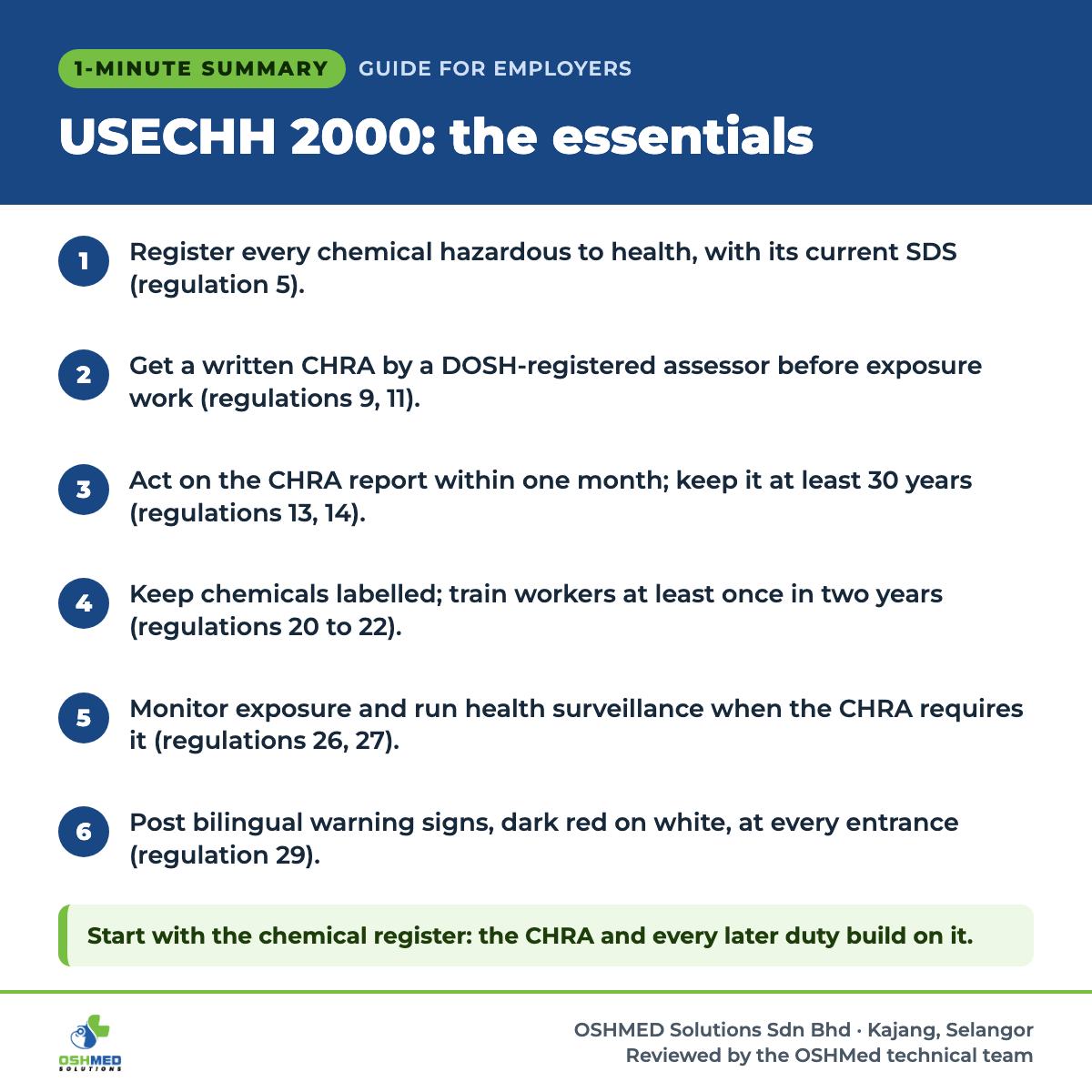
- Register every chemical hazardous to health, with its current SDS (regulation 5).
- Get a written CHRA by a DOSH-registered assessor before exposure work (regulations 9, 11).
- Act on the CHRA report within one month; keep it at least 30 years (regulations 13, 14).
- Keep chemicals labelled; train workers at least once in two years (regulations 20 to 22).
- Monitor exposure and run health surveillance when the CHRA requires it (regulations 26, 27).
- Post bilingual warning signs, dark red on white, at every entrance (regulation 29).
Start with the chemical register: the CHRA and every later duty build on it.
What is USECHH 2000, and who must comply?
USECHH stands for Use and Standards of Exposure of Chemicals Hazardous to Health. Made under section 66 of Act 514, the regulations apply to every place of work under the Act where chemicals hazardous to health are used (regulation 3). Employers carry the duties; self-employed persons do too, except monitoring and health surveillance (regulation 4).
Covered chemicals include those in Schedules I and II, pesticides, listed scheduled wastes and chemicals with the properties in Part B of Schedule I of the 1997 classification regulations (regulation 2). DOSH’s Chemical Management page states that chemicals classified as hazardous to health under CLASS 2013 are covered too. Excluded: radioactive materials, foodstuffs, pharmaceutical products, and chemicals hazardous only because they are explosive, flammable, hot, cold or under high pressure.
What does each part of USECHH 2000 require?
USECHH 2000 has 30 regulations in 12 parts, plus three Schedules. Parts I to III set the scope, register and exposure limits; Parts IV to VII cover assessment, control, labelling and training; Parts VIII to XII cover monitoring, health surveillance, medical removal, warning signs and records.
| Part | Regs | Core duty | More |
|---|---|---|---|
| I Preliminary | 1 to 4 | Scope, definitions, exclusions, who owes duties | Above |
| II Identification | 5 | Register of chemicals with current SDSs | Register guide |
| III Exposure limits | 6 to 8 | Stay within the Schedule I limits | Below |
| IV Assessment | 9 to 13 | Written CHRA by a registered assessor | CHRA guide |
| V Control | 14 to 19 | Act within one month; control measures; engineering control checks | Below |
| VI Labelling | 20, 21 | Labels intact; relabel decanted containers | Below |
| VII Information and training | 22 to 25 | Training, supervision, SDS at each place of use | Training |
| VIII Monitoring | 26 | Exposure monitoring when the CHRA requires it | CEM guide |
| IX Health surveillance | 27 | Programme when the CHRA requires it | Surveillance guide |
| X Medical removal | 28 | Remove workers on medical advice | Surveillance guide |
| XI Warning sign | 29 | Bilingual signs at every entrance | Below |
| XII Records | 30 | Records on transfer or closure | Below |
Full text: DOSH’s English PDF and Malay PDF. Schedule I in both is a scanned image, so a text search misses chemical names.
What do the exposure limits and Schedules I, II and III mean?
Schedule I lists each chemical’s permissible exposure limit: an eight-hour time-weighted average, a ceiling limit, or both. The maximum exposure limit is a 15-minute average at three times the eight-hour figure (regulation 2). Schedule II lists chemicals for which medical surveillance is appropriate; Schedule III lists pesticide information for the register.
| Schedule | Contents | Linked rules |
|---|---|---|
| I: permissible exposure limits | Chemical, CAS number, eight-hour average and/or ceiling limit (ppm or mg/m³); some entries marked “(skin)” | Reg. 6 to 8 |
| II: chemicals for medical surveillance | Includes lead, mercury, benzene, n-hexane, isocyanates, free crystalline silica, asbestos and pesticides | Reg. 26(2), 27(3) |
| III: information on pesticides | Ingredients and concentrations, toxicology, precautions, supplier and manufacturer | Reg. 5(2)(b) |
The ceiling applies at all times (regulation 6), the eight-hour average to every shift (regulation 7), and a respirator’s protection counts only while worn (regulation 8). Measuring exposure: our chemical exposure monitoring guide.
Schedule I sets how much exposure is allowed; Schedule II flags chemicals that need medical surveillance. Lead appears in both.
What does USECHH 2000 require for chemical health risk assessment (CHRA)?
Part IV bars any work that may expose employees to chemicals hazardous to health until a written assessment exists (regulation 9). A DOSH-registered assessor must carry it out (regulation 11) and report within one month (regulation 12). Review it after a significant change, after five years, or when DOSH directs, and keep each report at least 30 years.
The assessment covers ten items, from the hazard and degree of exposure to the need for monitoring, health surveillance and training (regulation 9(2)). It starts from your chemical register. When a CHRA is due: our CHRA guide. Checking an assessor and the cost: our CHRA assessor guide.
USECHH 2000 compliance checklist: 16 duties, regulation by regulation
Tick each duty already in place at your workplace. The regulation number is in brackets so you can check the text. Monitoring and health surveillance are required only where your CHRA calls for them, so tick any item that does not apply to you. Print the list or send your score to OSHMed on WhatsApp.
0 of 16 ready
How must employers control exposure under regulations 14 to 19?
Within one month of receiving the CHRA report, carry out the actions it requires, cutting exposure to the lowest practicable level and below any permissible limit (regulation 14). Regulation 15 lists the measures, from elimination and substitution to enclosure, engineering controls and safe work systems; approved PPE is used only where those fall short (regulation 16).
| Duty | Rule | Reg. |
|---|---|---|
| Safe work systems | Documented, implemented and reviewed after significant change | 15 |
| Approved PPE | Suitable, fitted, adequate supply; issue, maintenance, inspection and training procedures | 16 |
| Engineering control equipment | Employer inspects at least monthly; hygiene technician tests at least every 12 months | 17 |
| Local exhaust ventilation (LEV) | Designed to an approved standard and tested after installation by a registered professional engineer | 18 |
| Records | Design, testing, inspection and maintenance records, produced when DOSH directs | 19 |
That yearly equipment test is separate from exposure monitoring under regulation 26. For the monthly checks, the yearly test and the records, see our LEV inspection guide. Our services are on our assessments page.
Not sure which USECHH duties apply to your site?
Send us your chemical register, or a list of chemicals, work units and headcount. OSHMed will reply with a written CHRA quote. The CHRA is the step that decides whether monitoring, health surveillance and other follow-up duties apply: request a CHRA quote.
What do the labelling, SDS and training rules require (regulations 20 to 25)?
Every chemical hazardous to health must stay labelled, and decanted containers must be relabelled (regulations 20 and 21). Do not use a chemical without its label or data sheet (regulation 24), and keep the current sheet near each place of use (regulation 25). Train exposed workers, review the programme at least once in two years and document it (regulation 22).
- Relabelling. Decanted contents used within the shift need the chemical or trade name; longer storage needs a full label (regulation 21).
- Training. Include monitoring results and anonymised health surveillance results, and retrain when hazards, practices or tasks change (regulation 22).
- Supervision. Anyone doing USECHH work for you needs information, instruction and supervision (regulation 23).
USECHH still says “Chemical Safety Data Sheet” and cites 1997 labelling rules; CLASS 2013 revoked those (regulation 16) and now sets labels and the safety data sheet (SDS). See our register guide and training page.
When are monitoring, health surveillance and medical removal required?
When the CHRA says so. Exposure monitoring by a registered hygiene technician follows regulation 26, repeated at least every six months for Schedule II chemicals. A health surveillance programme follows regulation 27, with medical surveillance conducted by an occupational health doctor at least every 12 months for Schedule II chemicals. Regulation 28 covers removal from exposure.
Only a pre-entry gas and oxygen check in a confined space may skip the hygiene technician (regulation 26(3)). Under regulation 28, remove a worker an occupational health doctor finds at increased risk, and a pregnant or breastfeeding employee once notified, until a later finding clears them or the pregnancy or breastfeeding ends.
Details: our CEM guide and medical surveillance guide. OSHMed coordinates medical surveillance through our occupational health doctor service, with tests carried out and billed by our partner clinic; see also our workplace health services.
What does regulation 29 of USECHH 2000 require?
Regulation 29 requires warning signs. Where a chemical hazardous to health is used in a way hazardous to anyone in an area, post signs in a conspicuous place at every entrance and give other relevant information to people at risk. Signs must warn of the hazards, in Malay and English, printed dark red on white.
- Where: a conspicuous place at every entrance (29(1)(a)).
- Extra information: given to anyone who may be at risk (29(1)(b)).
- Upkeep: lit and cleaned so the wording stays readily visible (29(2)).
- Format: warns of the hazards, in Malay and English, dark red on white (29(3)).
Regulation 29 sets colour and language, not wording or size. Name the hazard, and sign the areas your CHRA identifies.
Which USECHH records must you keep, and for how long?
Keep CHRA reports at least 30 years (regulation 13), personal exposure monitoring records at least 30 years and other monitoring records at least five (regulation 26), and health surveillance records 30 years from the last entry (regulation 27). Engineering control and training records must be kept for inspection, with no fixed period stated (regulations 19 and 22).
If the business passes to a successor, the records go with it; if it closes with none, they go to DOSH. Give DOSH at least three months’ written notice before disposing of expired CHRA, monitoring or surveillance records (regulation 30).
What is the penalty for breaching USECHH 2000?
USECHH 2000 sets no penalty of its own, so the general penalty in section 51 of Act 514 applies: a fine of up to RM100,000, up to one year in prison, or both, plus up to RM2,000 a day for a continuing offence after conviction. Directors and managers can be charged with the company (section 52).
Doing a CHRA, exposure monitoring, medical surveillance or engineering control testing without DOSH registration is a separate offence: a fine of up to RM100,000 (section 31B).
OSHMED Solutions Sdn Bhd, based in Kajang, Selangor, serves employers across Malaysia and quotes in writing. Through our CHRA service, the assessment is carried out by a DOSH-registered assessor, as the law requires, and ends with a written report. Every report names the responsible registered assessor and their myKKP registration number, so you can verify it on the DOSH register.
- No CHRA on file for work with chemicals hazardous to health.
- Your last CHRA is over four years old, or the work has changed.
- A new chemical, process or control is coming in.
- DOSH has directed a review, or workers report symptoms.
Three common objections, checked against the text:
"We only use a few chemicals."
Regulation 3 sets no minimum quantity or workplace size.
"Our supplier's labels and SDSs cover us."
Regulation 9 still needs a written assessment of how your own workers use the chemical.
"We had a CHRA years ago."
Regulation 10 requires a review after five years, a significant change or a DOSH direction.
Frequently asked questions
What does USECHH stand for?
Use and Standards of Exposure of Chemicals Hazardous to Health. USECHH 2000 is P.U. (A) 131/2000, made under the Occupational Safety and Health Act 1994 (Act 514).
Where can I download the USECHH 2000 PDF?
DOSH publishes the English and Malay texts as PDFs, linked in the sources below. Check the DOSH website for the current file before relying on a saved copy.
What is Schedule 2 of USECHH 2000?
The list of chemicals for which medical surveillance is appropriate, such as lead, benzene, isocyanates and free crystalline silica. Required monitoring repeats at least six-monthly and medical surveillance at least yearly (regulations 26(2), 27(3)).
Does USECHH 2000 use the term SDS?
Not by that name. It says “Chemical Safety Data Sheet”, from the 1997 rules that CLASS 2013 revoked. Keep the current safety data sheet (SDS) in your register and near each place of use (regulations 5 and 25).
Is USECHH 2000 still in force?
Yes. It is on DOSH’s current list of regulations under Act 514, and DOSH applies it to chemicals classified as hazardous to health under CLASS 2013.
Your next step
Run the checklist, then fix your register and CHRA first: the other duties follow. Send OSHMed your register for a written CHRA quote.
Other chemical guides: our chemical register template, CEM guide and medical surveillance guide.
Start your USECHH compliance with a CHRA
Share your checklist score or chemical register on WhatsApp or through the quote form. We will reply in writing with the CHRA scope and what the assessor needs from you.
- LEV inspection in Malaysia: DOSH rules, frequency and records
- Respirator fit test in Malaysia: DOSH requirements, methods and frequency
- CHRA report: DOSH format, sample outline, validity and retention period
- Chemical health risk assessment (CHRA) under USECHH 2000: when it is required
- CHRA assessor in Malaysia: how to check one and what sets the cost
- Chemical register DOSH template: how to fill in the USECHH format
- Chemical exposure monitoring (CEM) in Malaysia: when, how often, who
- Medical surveillance Malaysia: how to set up a USECHH programme
- Section 18B OSHA 1994: risk assessment duty, HIRARC and specialists
Sources and references
Checked against the official documents listed below on 8 November 2026. Laws change: always confirm the current version on the DOSH (JKKP) website.
- Occupational Safety and Health (Use and Standards of Exposure of Chemicals Hazardous to Health) Regulations 2000, P.U. (A) 131/2000 (regulations 1 to 30; Schedules I, II and III), Attorney General's Chambers, published by DOSH
- Peraturan-Peraturan Keselamatan dan Kesihatan Pekerjaan (Penggunaan dan Standard Pendedahan Bahan Kimia Berbahaya kepada Kesihatan) 2000 (Malay text of the same regulations), Attorney General's Chambers, published by DOSH
- Occupational Safety and Health (Classification, Labelling and Safety Data Sheet of Hazardous Chemicals) Regulations 2013, P.U. (A) 310/2013 (regulation 16; Malay text), Attorney General's Chambers, published by DOSH
- Occupational Safety and Health Act 1994 (Act 514), reprint incorporating Act A1648 (sections 31B, 51, 52 and 66; Fifth Schedule), DOSH Malaysia
- Chemical Management: USECHH Regulations and CLASS scope note, DOSH Malaysia
- Regulations under Act 514 (current list), DOSH Malaysia
Disclaimer: This article is general information for employers and is not legal advice. Requirements depend on your workplace, processes and the current law. For a decision on your premises, speak to a DOSH-registered competent person or contact DOSH (JKKP).