
DOSH Noise Identification Checklist: 10 Questions, Examples and Next Steps
The noise identification checklist DOSH publishes as Appendix 1 of its 2019 noise ICOP has ten Yes or No questions, answered for each work area under regulation 3 of the Noise Exposure Regulations 2019. Any Yes means excessive noise is possible: appoint a DOSH-registered noise risk assessor within one month. All No: re-identify within a year. Fill it in below.
- MD (NNSMA, Rus)
- MScCH (Occ. Health, UKM)
- MBA (ARU, UK)
- OHD (NIOSH)
- MRO (AOEMM)
- TTT (HRDF)
- SSM 202001013523 (OSHMED Solutions Sdn Bhd)
- DOSH registered training provider SL/22/22/181036, valid to 21 July 2028
- MMC Full Registration 55275 (Dr. Wan Muhammad Zulhusni)
- DOSH Occupational Health Doctor HQ/16/DOC/00/454
- DMAC/EDTCmed 263
- OEUK OEUK/2024/3751
OSHMed Solutions Sdn Bhd is an occupational safety and health consultancy and DOSH-registered training provider (ergonomics) in Kajang, Selangor. We are not a clinic. Medical tests are arranged through approved centres.
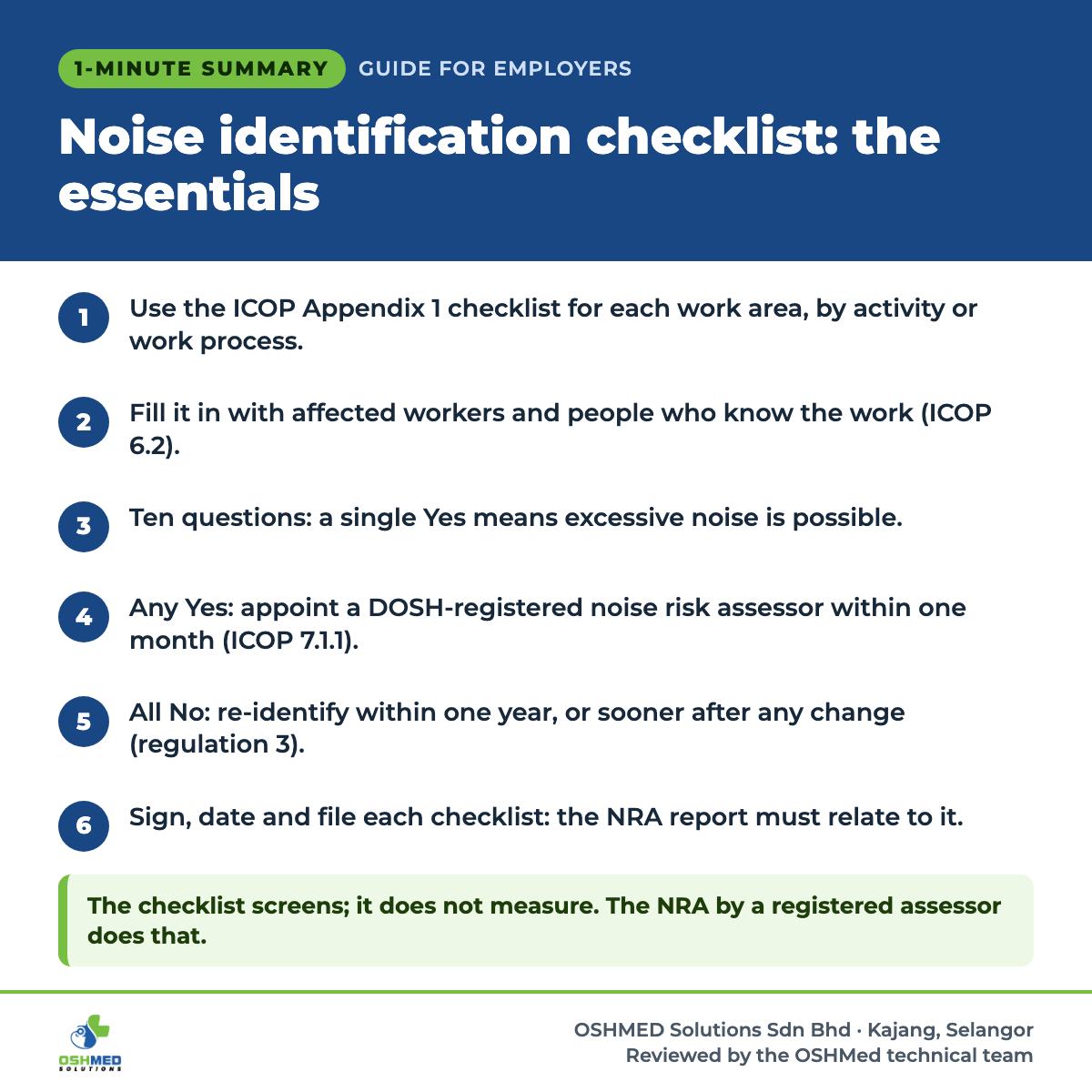
- Use the ICOP Appendix 1 checklist for each work area, by activity or work process.
- Fill it in with affected workers and people who know the work (ICOP 6.2).
- Ten questions: a single Yes means excessive noise is possible.
- Any Yes: appoint a DOSH-registered noise risk assessor within one month (ICOP 7.1.1).
- All No: re-identify within one year, or sooner after any change (regulation 3).
- Sign, date and file each checklist: the NRA report must relate to it.
What is the DOSH noise identification checklist?
It is the “Checklist for Identification of Excessive Noise” in Appendix 1 of the DOSH Industry Code of Practice (ICOP) on noise, 2019. Regulation 3 of the Noise Exposure Regulations 2019 requires every employer to identify whether workers may be exposed to excessive noise, and ICOP section 6.3 says to use this checklist.
Each checklist covers one work area: ten Yes or No questions, then who assessed it, who verified it, the date and the company stamp. No sound level meter is needed; measurement comes in the noise risk assessment (NRA) after a Yes. See our NRA guide and Regulations 2019 guide.
The ICOP is promulgated under section 37 of Act 514 and defines “shall” as mandatory. Section 6.3 uses “shall”.
Online noise identification checklist (ICOP 2019, Appendix 1)
Answer the ten questions for one work area, save it, then check the next area. The result follows the rule printed on the DOSH checklist. Print the set for signature, or send your results to OSHMed on WhatsApp.
"Yes" to any question indicates the possibility of excessive noise (ICOP Appendix 1).
1. Is a raised voice needed to communicate with someone about one metre away?
2. Do your employees notice a reduction in hearing over the course of the day?Example: needing to turn up the radio on the way home.
3. Are your employees using noisy powered tools or machinery?Example: drills, air compressors and other noisy power tools or machinery.
4. Are there noises due to impacts or explosive sources?Example: impact noise from hammers or pneumatic impact tools; explosive sources such as explosive-powered tools or detonators.
5. Are personal hearing protectors (PHP) used for some work?
6. Do your workers complain that there is too much noise, or that they cannot clearly hear instructions or warning signals?
7. Do your workers experience ringing in the ears, or sound heard differently in each ear?
8. Has any employee started experiencing difficulties in hearing after working here?
9. Does any equipment have manufacturer's information (including labels) indicating noise levels greater than any of the following: (a) a peak sound pressure level of 140 dB(C); (b) a sound pressure level of 82 dB(A)?Check machine labels, manuals and supplier data sheets.
10. Does the latest noise risk assessment indicate exposure to the noise exposure limit (NEL)?No NRA done yet? This question cannot be Yes, so mark No.
| Work area | "Yes" answers | Result |
|---|
No work areas saved yet. Answer the ten questions for one area, then save it.
Questions follow the Checklist for Identification of Excessive Noise in Appendix 1 of the DOSH ICOP 2019. This is a screening record, not a noise measurement. Your answers stay in this browser and leave it only if you send them on WhatsApp. Add the company stamp to the printed copy.
Who should fill in the checklist, and for which areas?
The employer is responsible, but ICOP section 6.2 says identification shall involve the affected employees and people who understand the work, operations or processes. Section 6.3 requires a checklist for each area of the workplace, by the nature of the activities or work process, not one form for the whole site.
In practice, involve the area supervisor, a worker from each shift and whoever coordinates safety, such as the safety and health officer or the hearing conservation administrator. The employer verifies and signs. Typical areas:
- Each process line or machine bay, such as pressing or grinding.
- Plant rooms with compressors, generators or pumps.
- Workshops that use power or impact tools.
- Offices and stores next to noisy areas.
What do the 10 questions ask, and what counts as a Yes?
Questions 1 to 4 look at the work: raised voices, hearing that fades during the day, noisy powered machinery, and impact or explosive noise. Questions 5 to 8 look at people: hearing protectors, complaints, ringing ears and new hearing difficulty. Questions 9 and 10 check equipment noise data and the latest NRA.
| No. | The question asks about | Signs of a Yes |
|---|---|---|
| 1 | A raised voice at about one metre | Workers shout beside a running machine |
| 2 | Hearing that fades over the day | Radio or phone turned up after a shift |
| 3 | Noisy powered tools or machinery | Drills, compressors, grinders, presses, generators |
| 4 | Impact or explosive noise | Hammering, pneumatic tools, explosive-powered tools |
| 5 | Hearing protectors used for some work | Earplugs or earmuffs worn for any task |
| 6 | Complaints; instructions or alarms hard to hear | Missed instructions, horns or warning signals |
| 7 | Ringing ears, or each ear hearing differently | Ringing after work, or one ear sounding duller |
| 8 | New hearing difficulty since joining | A worker hears less well than before |
| 9 | Manufacturer data above a 140 dB(C) peak or 82 dB(A) | A label, manual or data sheet states more |
| 10 | Latest NRA shows exposure to the noise exposure limit | Exposure reaching the regulation 6 limit |
- Question 5: a marked hearing protection zone is a Yes: regulation 8 requires everyone inside to use protectors.
- Question 9: no figure on the nameplate or manual? Ask the supplier, who must obtain noise information from the manufacturer (ICOP 15.3).
- Question 10: with no NRA done yet, this cannot be Yes; mark No.
What does a "Yes" answer mean, and how fast must you act?
“Yes” to any question indicates the possibility of excessive noise in that area; it does not prove a breach. Under regulation 4, the employer must then appoint a noise risk assessor registered with DOSH, and ICOP section 7.1.1 sets the deadline: within one month of the identification of excessive noise.
Only measurement shows whether exposure is above 82 dB(A), and the NRA provides that measurement: see what it involves and what sets its cost. Through our NRA service, the assessment is carried out by a DOSH-registered noise risk assessor, as the law requires, and ends with a written report.
Count the one-month period from the date on the checklist, not from the day a quote is approved.
Got a "Yes" on the checklist?
The one-month window to appoint a registered assessor has started. Send us your Yes results per area, headcount and shifts, and OSHMed will reply with a scoped proposal: request an NRA quote.
What if every answer is "No"?
Ten “No” answers mean there is no indication of excessive noise in that area for now. Keep the signed checklist and repeat the identification not more than one year after its date (regulation 3(2)(b); ICOP 6.7), or sooner if something changes or DOSH directs you to.
Re-identify after any of these changes (regulation 3(2); ICOP 6.5 and 6.6). A new Yes leads to the NRA.
- Machinery is installed, modified or removed.
- Workload or operating conditions change enough to shift noise levels.
- The building structure changes in a way likely to affect noise.
- Working arrangements lengthen time spent in noisy areas.
- Any other change in equipment, process, work, controls or operation.
An existing NRA does not replace yearly identification. The NRA has its own review of not more than five years (regulation 4(8)).
How should you keep the checklist record?
Sign, date and stamp each area’s checklist and file it where your safety committee and assessor can find it. Regulation 11 sets retention periods only for NRA and audiometric reports, but the checklist is your evidence that regulation 3 was followed, and its date sets the deadline for the next identification.
ICOP Appendix 2, the DOSH guideline on NRA report writing, says the purpose of the assessment must relate to the excessive noise identification results, so the assessor will ask for your checklists.
- Complete all four header fields, including the work area.
- Record who assessed it (name and designation) and who verified it for the employer.
- Note the question numbers answered Yes and the date the assessor was appointed.
What does a completed checklist look like?
A completed set has one checklist per work area, each with a clear result. The illustration below shows how one site might come out: two areas with “Yes” answers that go to a noise risk assessment, and one area with all “No” answers that is filed and checked again within a year.
| Work area | "Yes" answers | Result and next step |
|---|---|---|
| Cutting and grinding bay | Q1, Q3, Q4, Q5 | Possible excessive noise: appoint an assessor within one month |
| Compressor room (maintenance access) | Q3, Q9(b) | Possible excessive noise: include it in the same NRA |
| Office and store | None | No indication: file it; re-identify within a year |
Common mistakes
- One form for the whole site instead of one per area (ICOP 6.3).
- Filled in at a desk without the workers (ICOP 6.2), so questions 2, 6, 7 and 8 become guesses.
- No to question 5 because protectors are provided: protector use is a Yes.
- No date or signature, so you cannot show when the deadlines started.
What does skipping or delaying the identification cost?
A breach of regulation 3, including a missed re-identification, can bring a fine of up to RM10,000, up to one year in prison, or both (regulation 3(3)). Failing to appoint a noise risk assessor after a Yes carries the same maximum (regulation 4(9)), and directors and managers can be charged with the company (Act 514, section 52).
Other duties and penalties: see our Regulations 2019 guide. OSHMED Solutions Sdn Bhd in Kajang, Selangor, prepares written NRA quotes for employers across Malaysia. See our assessments page.
- Any area has a Yes and no assessor has been appointed yet.
- Machinery was installed, moved or modified since the last checklist.
- Your last identification record or NRA report is missing.
- Workers report ringing ears or new hearing difficulty.
Before you decide: three common objections
Three objections come up when employers see a “Yes”: the checklist is only paperwork, earplugs already solve the problem, and an in-house meter reading is enough. Each one is checked below against the Noise Exposure Regulations 2019 and the ICOP, so your decision rests on the rules.
"We know it is noisy; the checklist is just paperwork."
Then the answer is Yes, and the signed checklist starts the one-month window to appoint the assessor (ICOP 7.1.1).
"Our workers wear earplugs, so we are covered."
Protector use is itself a Yes (question 5). Under regulation 6(4), protectors come after engineering and administrative controls, which are based on the NRA report.
"We will measure it ourselves with a sound level meter."
A reading can inform your answers, but it is not an NRA: regulation 4 requires a DOSH-registered assessor with a valid certificate and IEC-compliant equipment.
Frequently asked questions
Where can I get the DOSH noise identification checklist?
It is Appendix 1 of the DOSH ICOP on occupational noise exposure and hearing conservation, 2019 (Lampiran 1 in the Malay edition). You can also complete it on this page and print the result.
Is the noise identification checklist mandatory?
Identification is mandatory under regulation 3 of the Noise Exposure Regulations 2019, and ICOP section 6.3 says the employer shall use the Appendix 1 checklist for each work area.
Who can fill in the noise identification checklist?
The employer, with affected employees and people who understand the work (ICOP 6.2). The Regulations require DOSH registration for the noise risk assessment that follows a Yes, not for the identification.
How often must noise identification be done?
Not more than one year after the previous identification, and earlier after a change in machinery, equipment, process, work, controls or operation, or when DOSH directs (regulation 3(2)).
What happens after a Yes on the checklist?
Appoint a DOSH-registered noise risk assessor within one month (ICOP 7.1.1). The assessor measures exposure and reports within one month of completing the assessment (regulation 4(4)).
Your next step
Complete the checklist above for each work area and print the set for signature. Any Yes answers? Request an NRA quote within the month, or send your results via WhatsApp.
Planning what follows? See our hearing conservation programme guide and yearly hearing conservation training.
Turn your checklist results into an NRA plan
Share your saved areas on WhatsApp or through the quote form. We will tell you what the assessor needs from you before the site visit.
- ICOP noise 2019: summary of all 15 sections and 9 appendices (DOSH)
- Noise dose calculator: how to calculate LEX,8h and daily noise dose in Malaysia
- Hearing protection zone: DOSH signage rules and a printable sign
- Noise risk assessment (NRA) in Malaysia: when you need one
- Noise Exposure Regulations 2019: employer duties, limits and deadlines
- Noise risk assessment cost in Malaysia: what sets your NRA quote
- OSHMed noise risk assessment service
Sources and references
Checked against the official documents listed below on 5 November 2026. Laws change: always confirm the current version on the DOSH (JKKP) website.
- Occupational Safety and Health (Noise Exposure) Regulations 2019, P.U. (A) 60/2019 (regulations 2, 3, 4, 6, 8 and 11), Attorney General's Chambers, published by DOSH
- Industry Code of Practice for Management of Occupational Noise Exposure and Hearing Conservation 2019 (Foreword, sections 3, 6, 7.1 and 15.3, Appendix 1 and Appendix 2), DOSH Malaysia
- Tataamalan Industri bagi Pengurusan Pendedahan Bising Pekerjaan dan Pemuliharaan Pendengaran 2019, Malay edition (section 6, Lampiran 1), DOSH Malaysia
- Occupational Safety and Health Act 1994 (Act 514), reprint incorporating Act A1648 (sections 37 and 52), DOSH Malaysia
- Regulations under the Occupational Safety and Health Act 1994 (Act 514), DOSH Malaysia
Disclaimer: This article is general information for employers and is not legal advice. Requirements depend on your workplace, processes and the current law. For a decision on your premises, speak to a DOSH-registered competent person or contact DOSH (JKKP).