
Chemical Register DOSH Template: How to Fill In the USECHH Format
A chemical register is the employer’s record of every chemical hazardous to health used at the workplace (USECHH 2000, regulation 5), with each one’s current safety data sheet (SDS), average quantity, process, work area and supplier. Keep it in the chemical register DOSH format, up to date and open to exposed workers. Every CHRA starts from it.
- MD (NNSMA, Rus)
- MScCH (Occ. Health, UKM)
- MBA (ARU, UK)
- OHD (NIOSH)
- MRO (AOEMM)
- TTT (HRDF)
- SSM 202001013523 (OSHMED Solutions Sdn Bhd)
- DOSH registered training provider SL/22/22/181036, valid to 21 July 2028
- MMC Full Registration 55275 (Dr. Wan Muhammad Zulhusni)
- DOSH Occupational Health Doctor HQ/16/DOC/00/454
- DMAC/EDTCmed 263
- OEUK OEUK/2024/3751
OSHMed Solutions Sdn Bhd is an occupational safety and health consultancy and DOSH-registered training provider (ergonomics) in Kajang, Selangor. We are not a clinic. Medical tests are arranged through approved centres.
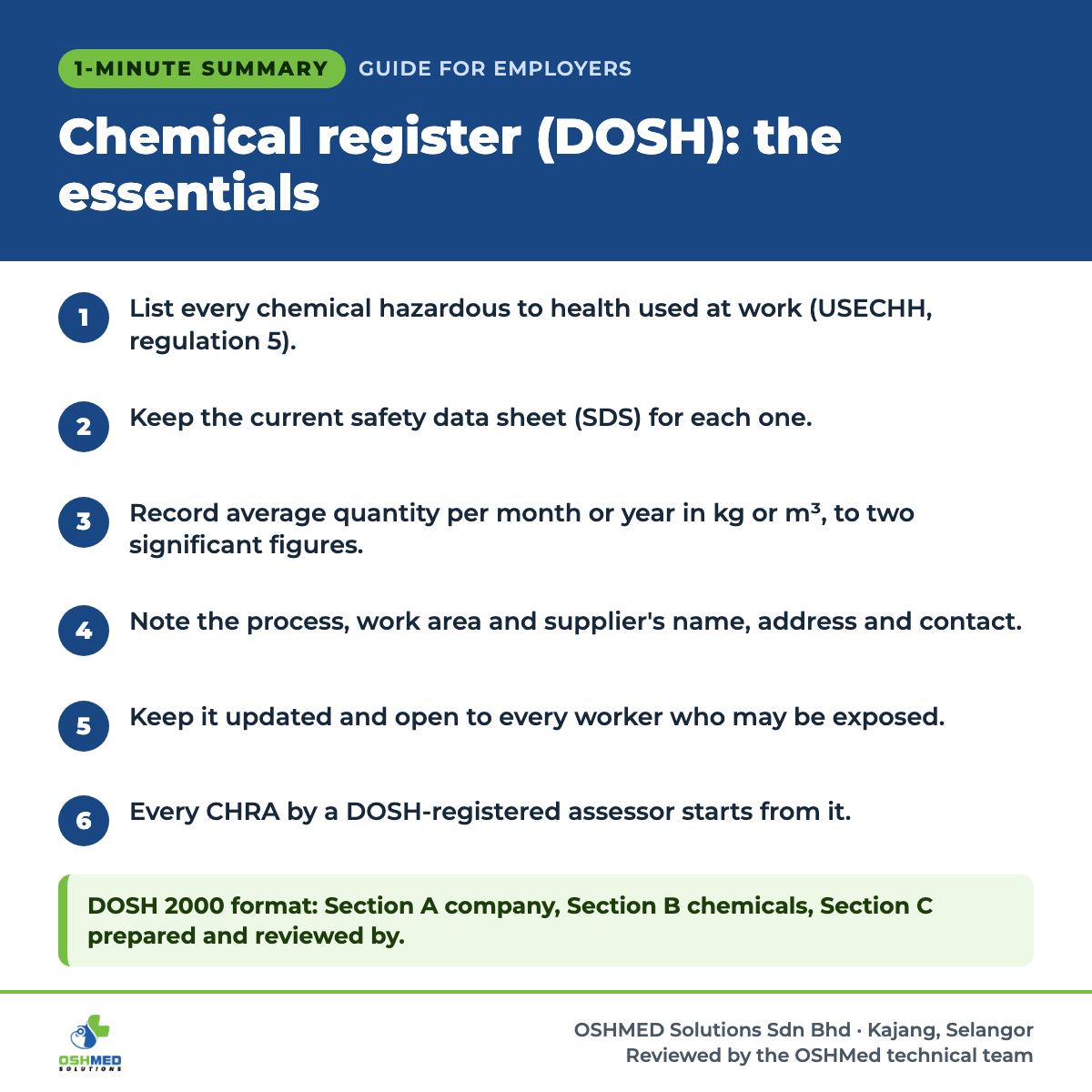
- List every chemical hazardous to health used at work (USECHH, regulation 5).
- Keep the current safety data sheet (SDS) for each one.
- Record average quantity per month or year in kg or m³, to two significant figures.
- Note the process, work area and supplier's name, address and contact.
- Keep it updated and open to every worker who may be exposed.
- Every CHRA by a DOSH-registered assessor starts from it.
What is a chemical register under USECHH 2000?
It is the written record, required by regulation 5 of USECHH 2000, of every chemical hazardous to health used at your workplace. The regulation sets five items of content, and the register must be kept in good order, updated from time to time and accessible to exposed employees.
- (a) A list of all chemicals hazardous to health used.
- (b) The current safety data sheet for each one; for pesticides, the information in Schedule III.
- (c) The average quantity used, produced or stored per month or per year.
- (d) The process and work area where each chemical is used.
- (e) The name and address of the supplier of each chemical.
DOSH’s 2000 guideline adds its purpose: a reference for employees, for staff training, and for the assessor, safety and health officer, firefighters and rescuers. Scope and exclusions: our CHRA guide. Courses: our training page.
Who must prepare a chemical register?
Every employer whose workplace uses chemicals hazardous to health, and self-employed persons too (regulations 4(2) and 5(1)). The DOSH guideline names formulators, manufacturers, importers, distributors and users. “Use” includes production, processing, handling, storage, transport and disposal (regulation 2), so stores and waste areas count.
Regulation 5(4) gives one narrow exemption, linked to regulations 9 and 11(1) of the Environmental Quality (Scheduled Wastes) Regulations 1989 (the guideline adds the Pesticides Act 1974). Confirm with DOSH in writing before relying on it.
What is the DOSH recommended format for a chemical register?
DOSH’s Guidelines for the Preparation of a Chemical Register 2000 (JKKP GP(I)/4/2000) split the form into three parts: Section A, company information; Section B, the chemicals at each process or location; Section C, who prepared and reviewed it. Employers may modify the format.
| Section | What it records | Notes |
|---|---|---|
| A: Company | Workplace name and address, DOSH registration number, industry code, ILO class, and your role: importer, manufacturer, distributor, formulator or end user | Codes in Appendices 2 and 3 |
| B: Chemicals | Location or process, number of hazardous chemicals, male and female workers, then one line per chemical | Two layouts: by process or by location |
| C: Prepared and reviewed by | Name, title, signature and date | Our builder puts these at the top of the CSV |
The industry code follows the 2000 version of the First Schedule of Act 514. Since 1 June 2024 (Act A1648), that schedule lists only excluded work, so our builder omits both industry codes.
How do you fill in the chemical register, field by field?
Write one line per chemical for each process or location. Copy the product name, chemical name and CAS number from the safety data sheet, choose the codes for physical form, usage, controls and PPE, and enter the average monthly or yearly quantity to two significant figures.
| Field | What to enter | Codes or example |
|---|---|---|
| Location, process | Where it is used or produced | Layout plan names |
| Product, chemical, CAS no. | Trade name, recognised chemical name, hazardous ingredients, CAS number | Copy from the SDS |
| Physical form | Form as used | A aerosol, F fibre, G gas, L liquid, N granule, P paste, PE pellet, PW powder, SL slurry, S solid |
| Workers exposed | Number exposed | A number |
| Engineering controls | Controls in place | E enclosure, I isolation, LEV local exhaust ventilation, GV general ventilation, W water spray |
| PPE | Equipment worn | C protective clothing, E eye protection, M dust mask, R chemical cartridge respirator, O others |
| Usage | Role at that point | B by-product, I intermediate product, P product, R raw material, S stored, W waste; or C cleaning, D degreasing, O other |
| Quantity | Per year or month, kg or m³ | 185 becomes 200; 2,550 becomes 2,600 |
| SDS, label | Yes or No | CPL 1997 class column now historical |
| Supplier | Name, address, phone or e-mail | DOSH may contact them |
Example (illustration only): “Paint shop”, “Spray painting”, a thinner, L, R, 185 kg a month entered as 200 kg per month, 4 workers, LEV, PPE C, E and R, SDS Yes, label Yes.
Watch the letters: E is enclosure under controls but eye protection under PPE; S is solid as a form but stored as a usage. The builder below spells them out.
Chemical register builder (DOSH format, opens in Excel)
Fill in the Section A and C boxes first: they become header lines at the top of the file. Then add one row per chemical for each location or process, following Section B of the DOSH 2000 format, with the current SDS in place of the old CSDS. Download the register as a CSV file for Excel, or send OSHMed the row count on WhatsApp for a CHRA quote.
| Location | Process | Product name | Chemical name | CAS no. | Physical form | Usage | Avg quantity (e.g. 200 kg/month) | Workers exposed | Engineering controls (E, I, LEV, GV, W) | PPE (C, E, M, R, O) | SDS on file | SDS date | Labelled | Supplier name, address, phone or e-mail |
|---|
The chemical details you enter stay in this browser only (localStorage) until you clear them. The Section A and C boxes are not saved, so complete them before you download. The CSV opens in Excel and other spreadsheet programmes. The columns follow the DOSH 2000 recommended format; the safety data sheet (SDS) replaces the old CSDS, and hazard classification now falls under CLASS 2013, so the 2000 column for the CPL 1997 class is left out. Codes are explained in the field table above.
Is CSDS still the right term, and what replaced CPL 1997?
No. The 2000 guideline asks for a Chemical Safety Data Sheet (CSDS) and the class under the CPL Regulations 1997. The CLASS Regulations 2013 revoked CPL 1997 (regulation 16) and use the term safety data sheet (SDS). Record the current SDS and its date; its hazard classification replaces the CPL class.
Under CLASS 2013 regulation 13, suppliers must give an SDS for every hazardous chemical supplied, in Bahasa Malaysia and English, and review it on new information, after five years, or when an officer directs. Breach: a fine of up to RM10,000, up to one year in prison, or both.
USECHH regulation 24 bars use of an unlabelled chemical, or one without its data sheet, until the supplier provides the information; regulation 25 wants a copy of the current sheet near each place of use.
How does the chemical register feed your CHRA?
It is where every CHRA starts. The DOSH guideline says the register helps the assessor gather information, and regulation 9(2) requires the assessment to cover the hazard, methods of use, degree of exposure and controls. Each register column feeds one of those inputs.
| Register column | CHRA input | USECHH 9(2) |
|---|---|---|
| Chemical name, CAS no., SDS | Nature of the hazard to health | (c) |
| Location, process, usage | Methods of use; release from work processes | (b), (e) |
| Quantity, physical form, workers exposed | Degree of exposure | (d) |
| Engineering controls, PPE | Measures to control exposure | (f) |
Only a DOSH-registered assessor may carry out the CHRA (regulation 11): see our CHRA assessor and cost guide. Our CHRA guide covers when it is due and has a register readiness checklist.
OSHMED Solutions Sdn Bhd, based in Kajang, Selangor, serves employers across Malaysia. Through our chemical health risk assessment service, the assessment is carried out by a DOSH-registered CHRA assessor, as the law requires, and ends with a written report. Other site assessments are on our assessments page.
Register done? Get your CHRA scoped from it
Send us your chemical register (the CSV from the builder works). OSHMed will reply with a written CHRA quote based on your chemicals, processes, work areas and workers: request a CHRA quote.
What are the common chemical register mistakes?
Check six gaps before the assessor arrives: chemicals left out because they were not bought, old safety data sheets, missing quantities or supplier details, a register workers cannot reach, confusion with the CLASS inventory, and no record of review. Each weakens the register as a legal record and as CHRA input.
- Only purchased chemicals. By-products, intermediates, stored stock and waste are Section B usage types.
- Old SDSs. The register needs the current one (regulation 5(2)(b)).
- No quantity or supplier address. Both are required (regulation 5(2)(c) and (e)).
- Locked away. Exposed employees must be able to access it (regulation 5(3)).
- CLASS inventory mix-up. Importers and manufacturers of one tonne or more a year file a separate inventory with DOSH by 31 March (CLASS 2013, regulation 14). It does not replace the register.
- Never reviewed. Complete Section C and update the register after any change.
What happens if you do not keep a chemical register?
USECHH 2000 sets no penalty of its own, so the general penalty in section 51 of Act 514 applies: a fine of up to RM100,000, up to one year in prison, or both, plus up to RM2,000 a day for a continuing offence. Directors and managers can be charged with the company (section 52).
- Your register is complete but you have no CHRA yet.
- You added a chemical or changed a process since the last CHRA.
- Your last CHRA is nearly five years old, or missing.
- Workers report symptoms they link to chemicals.
Before you decide: three common objections
Three objections come up: small users are exempt, the purchasing list is enough, and the register can wait for the CHRA. Each is checked below against USECHH 2000 and the DOSH guideline, so the decision rests on the rules.
"We only use a few chemicals."
Regulation 5 covers all chemicals hazardous to health used, with no minimum quantity. The one-tonne threshold belongs to the CLASS inventory.
"Our purchasing system already lists them."
A purchase list shows what was bought, not where and how it is used. Regulation 5(2)(d) requires the process and work area.
"The assessor can build it during the CHRA."
The register is the employer’s duty (regulation 5(1)), and a complete one gives an accurate CHRA scope.
Frequently asked questions
What is the DOSH format for a chemical register?
DOSH’s 2000 guideline uses three sections: A for company information, B for the chemicals per process or location, and C for who prepared and reviewed it. Employers may modify the format.
Is there a chemical register template in Excel?
DOSH publishes the format in a PDF guideline. The builder on this page follows the same columns and downloads a CSV file that opens in Excel.
Do we need a safety data sheet for every chemical in the register?
Yes, the current one (regulation 5(2)(b)); pesticides need the Schedule III information instead. Under CLASS 2013, the supplier must provide it.
How often should the chemical register be updated?
Regulation 5(2) says “from time to time”, with no fixed interval. Update it after any change in chemicals, processes or SDSs, and record the review in Section C.
Is the chemical register the same as a CHRA?
No. The register lists your chemicals. The CHRA is the written assessment of the health risk they create, carried out by a DOSH-registered assessor (regulations 9 and 11). The register is its main input.
Your next step
Build your register above, download the CSV and have the reviewer sign Section C. Then send it to OSHMed for a written CHRA quote.
What can follow a CHRA: our CEM guide and medical surveillance guide.
Turn your chemical register into a CHRA quote
Share the register on WhatsApp or through the quote form. We will tell you what else the registered assessor needs before the site visit.
- USECHH 2000: A plain guide to all 30 regulations and 3 schedules
- CLASS 2013 regulation in Malaysia: chemical labels, SDS and warning signs
- CHRA assessor in Malaysia: how to check one and what sets the cost
- Chemical health risk assessment (CHRA) under USECHH 2000: when it is required
- Chemical exposure monitoring (CEM) in Malaysia: when, how often, who
- Medical surveillance Malaysia: how to set up a USECHH programme
Sources and references
Checked against the official documents listed below on 5 November 2026. The 2000 guideline predates CLASS 2013, so its CSDS and CPL references are shown as historical. Laws change: always confirm the current version on the DOSH (JKKP) website.
- Occupational Safety and Health (Use and Standards of Exposure of Chemicals Hazardous to Health) Regulations 2000, P.U. (A) 131/2000 (regulations 2, 4, 5, 9, 11, 24, 25 and 30), Attorney General's Chambers, published by DOSH
- Guidelines for the Preparation of a Chemical Register 2000, JKKP GP(I)/4/2000 (preface, glossary, purpose, application, content, accessibility, record keeping, exemption, recommended format, Appendix 1), DOSH Malaysia
- Occupational Safety and Health (Classification, Labelling and Safety Data Sheet of Hazardous Chemicals) Regulations 2013, P.U. (A) 310/2013 (regulations 3, 13, 14 and 16; Malay text), Attorney General's Chambers, published by DOSH
- Occupational Safety and Health Act 1994 (Act 514), reprint incorporating Act A1648 (sections 1, 51 and 52; First Schedule), DOSH Malaysia
- Chemical Management guidelines (current list on the DOSH website), DOSH Malaysia
Disclaimer: This article is general information for employers and is not legal advice. Requirements depend on your workplace, processes and the current law. For a decision on your premises, speak to a DOSH-registered competent person or contact DOSH (JKKP).