
Section 18B OSHA 1994: Risk Assessment Duty, HIRARC and Specialists
Section 18B OSHA 1994 requires every employer, self-employed person and principal to assess the safety and health risks their work poses to anyone who may be affected, and to implement the controls the assessment shows are needed. It has applied since 1 June 2024. HIRARC is the general DOSH method; noise, chemicals, ergonomics and psychosocial risks have their own DOSH assessments.
- MD (NNSMA, Rus)
- MScCH (Occ. Health, UKM)
- MBA (ARU, UK)
- OHD (NIOSH)
- MRO (AOEMM)
- TTT (HRDF)
- SSM 202001013523 (OSHMED Solutions Sdn Bhd)
- DOSH registered training provider SL/22/22/181036, valid to 21 July 2028
- MMC Full Registration 55275 (Dr. Wan Muhammad Zulhusni)
- DOSH Occupational Health Doctor HQ/16/DOC/00/454
- DMAC/EDTCmed 263
- OEUK OEUK/2024/3751
OSHMed Solutions Sdn Bhd is an occupational safety and health consultancy and DOSH-registered training provider (ergonomics) in Kajang, Selangor. We are not a clinic. Medical tests are arranged through approved centres.
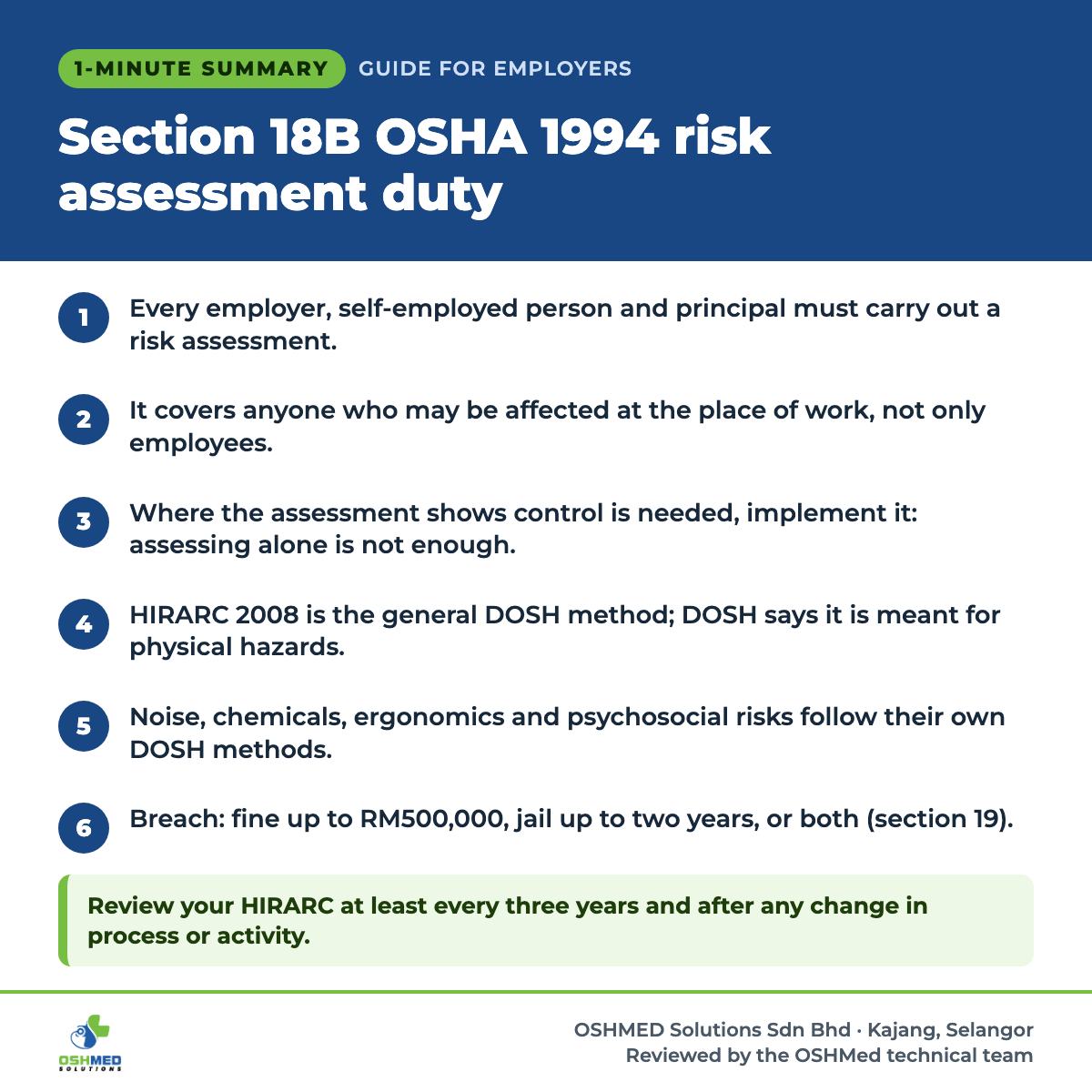
- Every employer, self-employed person and principal must carry out a risk assessment.
- It covers anyone who may be affected at the place of work, not only employees.
- Where the assessment shows control is needed, implement it: assessing alone is not enough.
- HIRARC 2008 is the general DOSH method; DOSH says it is meant for physical hazards.
- Noise, chemicals, ergonomics and psychosocial risks follow their own DOSH methods.
- Breach: fine up to RM500,000, jail up to two years, or both (section 19).
What does section 18B OSHA 1994 require?
Two things. Section 18B(1) requires a risk assessment of the safety and health risks your undertaking poses to anyone who may be affected at the place of work. Section 18B(2) requires you to implement the controls the assessment shows are needed to eliminate or reduce those risks.
Section 18B(3) defines risk assessment as “the process of evaluating the risks to safety and health arising from hazards at work and determining the appropriate measures for risk control”. Section 15 still requires every employer to ensure, so far as is practicable, the safety, health and welfare of employees.
In one line: section 18B means assess, then act. The Act names no method, so keep records that show both.
Who must comply with section 18B, and since when?
Every employer, self-employed person and principal, with no minimum headcount. Act A1648 added section 18B, in force since 1 June 2024 under P.U. (B) 128/2024. The Act covers all places of work in Malaysia, including the public services and statutory authorities.
Only First Schedule work is excluded: domestic employment, the armed forces and work on board ships under the Merchant Shipping Ordinances. The five-employee threshold belongs to the OSH coordinator duty in section 29A; see our OSH coordinator guide.
Self-check: which specialist assessments does your section 18B risk assessment need?
Answer seven quick questions about your workplace. Each Yes points to a hazard that DOSH handles with its own method, beyond the general HIRARC. This is a screening aid, not an assessment, and it needs no personal or medical details.
1. Noise: do people need to raise their voices to talk at arm's length, or do you run presses, grinders, compressors or similar machines?
2. Chemicals: do workers use, mix, spray or clean with products that carry a hazard label or come with a safety data sheet?
3. Chemicals: has a chemical health risk assessment (CHRA) recommended exposure monitoring, or is your CHRA more than five years old?
4. Ergonomics: do tasks involve repeated lifting, awkward postures, repetitive motion, vibrating tools, or long periods of sitting or standing?
5. Ergonomics: have workers reported aches or pains that they link to their tasks?
6. Psychosocial: are there signs of work-related stress, such as heavy workloads, long hours, conflict or bullying complaints?
7. General: is your written HIRARC more than three years old, out of date after a process change, or not done yet?
How do you carry out a section 18B risk assessment with HIRARC?
Follow the DOSH Guidelines for HIRARC 2008, the general method listed on the DOSH risk assessment page. The employer assigns a trained person to lead a team that knows the process, and the team works through the four steps below.
- Classify work activities by area, process stage or task (HIRARC 4.3.1).
- Identify hazards in routine and non-routine work, using inspections, incident records and worker complaints (4.3.2).
- Estimate the risk: likelihood (1 to 5) times severity (1 to 5), allowing for existing controls (4.3.3).
- Control it: eliminate or substitute first, then engineering and administrative controls, with PPE last (section 5).
| Score (L x S) | Level | Action |
|---|---|---|
| 15 to 25 | High | Act immediately; record actions and completion dates |
| 5 to 12 | Medium | Plan controls, with temporary measures if needed |
| 1 to 4 | Low | May be acceptable; fix it if quick and easy |
The DOSH FAQ describes the same sequence, and the DOSH Guidelines for HIRARC 2008 include the form and worked examples.
When is HIRARC not enough for section 18B?
When the hazard is a health hazard. DOSH states that the HIRARC 2008 method is intended for physical hazards, and that health hazards need guidelines designed for them. Noise and chemicals also carry their own legal assessment duties, so your HIRARC should lead to those assessments, not replace them.
| Hazard | Specialist assessment | Who | Basis | Guide |
|---|---|---|---|---|
| Noise | Employer’s noise identification, then a noise risk assessment (NRA) if needed | DOSH-registered noise risk assessor | Noise Exposure Regulations 2019, regs 3 and 4 | Noise regulations; NRA |
| Chemicals hazardous to health | Chemical health risk assessment (CHRA) before the work; chemical exposure monitoring (CEM) if the CHRA requires it | DOSH-registered assessor; registered hygiene technician for CEM | USECHH 2000, regs 9, 11 and 26 | CHRA; CEM |
| Ergonomic risk factors | Initial ergonomic risk assessment (ERA), then advanced ERA if needed | Trained person (ETP) | DOSH ERA Guidelines 2017, 2.2 | ERA; ERA cost |
| Psychosocial risk | PRisMA psychosocial risk assessment | Psychosocial Trained Person (PTP) | DOSH PRisMA 2024, 08.1 and 09 | PRisMA |
These regulations, made under section 66 of Act 514, carry their own penalties: failing to identify excessive noise carries a fine of up to RM10,000, up to a year in prison, or both (regulation 3(3)). CHRA and exposure monitoring are Fifth Schedule activities reserved for registered competent persons (section 31B).
Your own staff can run an initial ERA after the Ergonomic Trained Person course. PRisMA asks employers to appoint a Psychosocial Trained Person; the guideline calls for appropriate training, not registration.
Not sure which assessments your section 18B file needs?
Send us your current HIRARC, or a list of your processes, chemicals and noisy areas. OSHMed will suggest which specialist assessments may apply and how to scope them together.
How should you document and review a section 18B risk assessment?
Section 18B lists no documents or review interval, so follow DOSH guidance. HIRARC 2008 says each assessment must be fully documented, signed by the person in charge of the area, endorsed by management, shared with employees and reviewed every three years or when processes change.
| Item | Review or repeat | Keep the report | Source |
|---|---|---|---|
| HIRARC | Every three years, or when processes or activities change | At least three years | HIRARC 2008, 6.1 and 6.2 |
| Noise risk assessment | Within five years, or earlier if DOSH directs | 30 years | Noise Regulations 2019, regs 4(8) and 11 |
| CHRA | After a significant change, after five years, or when DOSH directs | 30 years | USECHH 2000, regs 10 and 13 |
| CEM for Schedule II chemicals | At intervals of not more than six months | 30 years for personal exposure records | USECHH 2000, reg 26 |
| PRisMA | After 12 months if high risk; otherwise after two years | Seven years, kept confidential | PRisMA 2024 |
Keep one file per site: the HIRARC, specialist reports, an action plan with owners and dates, and proof that controls were carried out. It shows what you found and what you did, the substance of section 18B(1) and (2).
What is the penalty for breaching section 18B?
Under section 19, a fine of up to RM500,000, imprisonment of up to two years, or both. Act A1648 raised the maximum fine from RM50,000. Directors and managers can be charged together with the company under section 52 unless they can prove a defence. For a specific case, consult the Act or DOSH.
How do you choose who carries out the specialist assessments?
Check four things: the person’s DOSH registration for the activity, the scope against your HIRARC, the deliverables, and whether related work can share site visits. For CHRA and exposure monitoring, registration is a legal requirement under section 31B.
- Registration: the name and myKKP number of the person who signs the report, checked on the DOSH register.
- Scope: the areas, processes and hazards from your HIRARC, not a generic package.
- Deliverables: a written report with findings, recommendations and the follow-up the regulation requires.
- Sequencing: noise, chemical and ergonomic work at one site, planned together to cut repeat visits.
OSHMED Solutions Sdn Bhd in Kajang, Selangor, serves employers across Malaysia. OSHMed scopes and coordinates NRA, CHRA, CEM and ERA, carried out by a DOSH-registered assessor where the law requires one; every report names the assessor and their myKKP number. OSHMed also runs the DOSH-registered ETP course (SL/22/22/181036) and psychosocial risk assessment training for HR and OSH teams. See our assessments and training.
- Your HIRARC lists noise, chemical, ergonomic or stress hazards but no specialist assessment.
- You use chemicals with a safety data sheet and have no CHRA, or it is over five years old.
- A process, machine or layout has changed since your last assessment.
- Contractors work on site but are missing from your assessment.
Before you decide: three common objections
Three objections come up when employers plan section 18B work: we already have a HIRARC, we are too small or just an office, and our safety officer can do it all. Each is checked below against the Act, the HIRARC guideline and the regulations.
"We already have a HIRARC, so we are covered."
Only for physical hazards, which is what DOSH says the method is for. Noise, chemical, ergonomic and psychosocial risks need their own assessments, and section 18B(2) requires controls to be implemented, not only listed.
"We are a small company, or just an office."
Section 18B has no headcount threshold. An office may have fewer hazards, but sitting work, workstation design and workload still belong in the assessment.
"Our safety and health officer can do it all in-house."
Your officer can lead the HIRARC. CHRA and exposure monitoring need a person registered for that activity (section 31B), and DOSH guidance expects trained people for ERA and PRisMA.
Frequently asked questions
What is section 18B of OSHA 1994?
Section 18B of the Occupational Safety and Health Act 1994 (Act 514) is the duty to conduct and implement risk assessment: assess the risks your undertaking poses to anyone affected, then implement the controls needed. It took effect on 1 June 2024.
Is HIRARC mandatory in Malaysia?
The Act requires a risk assessment but names no method. HIRARC 2008 is the general DOSH guideline, and the DOSH FAQ describes it as how employers can manage workplace risk. Noise and chemicals have their own methods under specific regulations. For your case, consult DOSH.
Does section 18B apply to small companies?
Yes. It applies to every employer, self-employed person and principal, with no minimum number of employees. The five-employee threshold belongs to the OSH coordinator duty in section 29A.
Does section 18B cover contractors and visitors?
Section 18B(1) covers any person who may be affected by your undertaking at the place of work, not only your employees. Principals also have a separate duty under section 18A towards contractors who work under their direction.
How often must a HIRARC be reviewed?
HIRARC 2008 says every three years or whenever processes or activities change, with records kept for at least three years. Noise risk assessments and CHRAs are reviewed within five years.
Your next step
Run the self-check above against your HIRARC. Every hazard that needs its own DOSH method should get a specialist assessment, an owner and a date.
Then send OSHMed your HIRARC, chemical register or site layout on WhatsApp for one combined scope. If chemicals are on your list, start with our CHRA guide.
Plan your specialist assessments as one scope
Share your HIRARC, chemical register and site layout on WhatsApp or through the form. We will suggest which assessments apply, who must carry them out and the order to do them in.
Sources and references
Checked against the official documents listed below on 29 October 2026. Laws change: always confirm the current version on the DOSH (JKKP) website.
- Occupational Safety and Health Act 1994 (Act 514), reprint incorporating Act A1648 (sections 1, 3, 15, 18A, 18B, 19, 31B, 52, 66, First and Fifth Schedules), DOSH Malaysia
- Occupational Safety and Health (Amendment) Act 2022 [Act A1648]: Appointment of Date of Coming into Operation, P.U. (B) 128/2024, Attorney General's Chambers, published by DOSH
- Guidelines for Hazard Identification, Risk Assessment and Risk Control (HIRARC) 2008 (Preface, sections 4 to 6), DOSH Malaysia
- Guidelines: Risk Assessment (DOSH list of risk assessment guidelines), DOSH Malaysia
- Frequently Asked Questions (answer on managing workplace safety and health through HIRARC), DOSH Malaysia
- Occupational Safety and Health (Noise Exposure) Regulations 2019, P.U. (A) 60/2019 (regulations 3, 4 and 11), Attorney General's Chambers, published by DOSH
- Occupational Safety and Health (Use and Standards of Exposure of Chemicals Hazardous to Health) Regulations 2000, P.U. (A) 131/2000 (regulations 9 to 13 and 26), Attorney General's Chambers, published by DOSH
- Guidelines on Ergonomics Risk Assessment at Workplace 2017 (sections 1.4.7 and 2.2), DOSH Malaysia
- Guidelines on Psychosocial Risk Assessment and Management at the Workplace (PRisMA) 2024 (sections 08.1, 09.2 and 09.4; reassessment and recordkeeping), DOSH Malaysia
Disclaimer: This article is general information for employers and is not legal advice. Requirements depend on your workplace, processes and the current law. For a decision on your premises, speak to a DOSH-registered competent person or contact DOSH (JKKP).