
Medical Surveillance Malaysia: How to Set Up a USECHH Programme
The medical surveillance Malaysia employers must provide starts with the chemical health risk assessment (CHRA). When it shows health surveillance is necessary for exposed workers, regulation 27 of USECHH 2000 requires a programme, with the medical part done by a DOSH-registered occupational health doctor (OHD). For Schedule II chemicals, examinations are at intervals of not more than 12 months.
- MD (NNSMA, Rus)
- MScCH (Occ. Health, UKM)
- MBA (ARU, UK)
- OHD (NIOSH)
- MRO (AOEMM)
- TTT (HRDF)
- SSM 202001013523 (OSHMED Solutions Sdn Bhd)
- DOSH registered training provider SL/22/22/181036, valid to 21 July 2028
- MMC Full Registration 55275 (Dr. Wan Muhammad Zulhusni)
- DOSH Occupational Health Doctor HQ/16/DOC/00/454
- DMAC/EDTCmed 263
- OEUK OEUK/2024/3751
OSHMed Solutions Sdn Bhd is an occupational safety and health consultancy and DOSH-registered training provider (ergonomics) in Kajang, Selangor. We are not a clinic. Medical tests are arranged through approved centres.
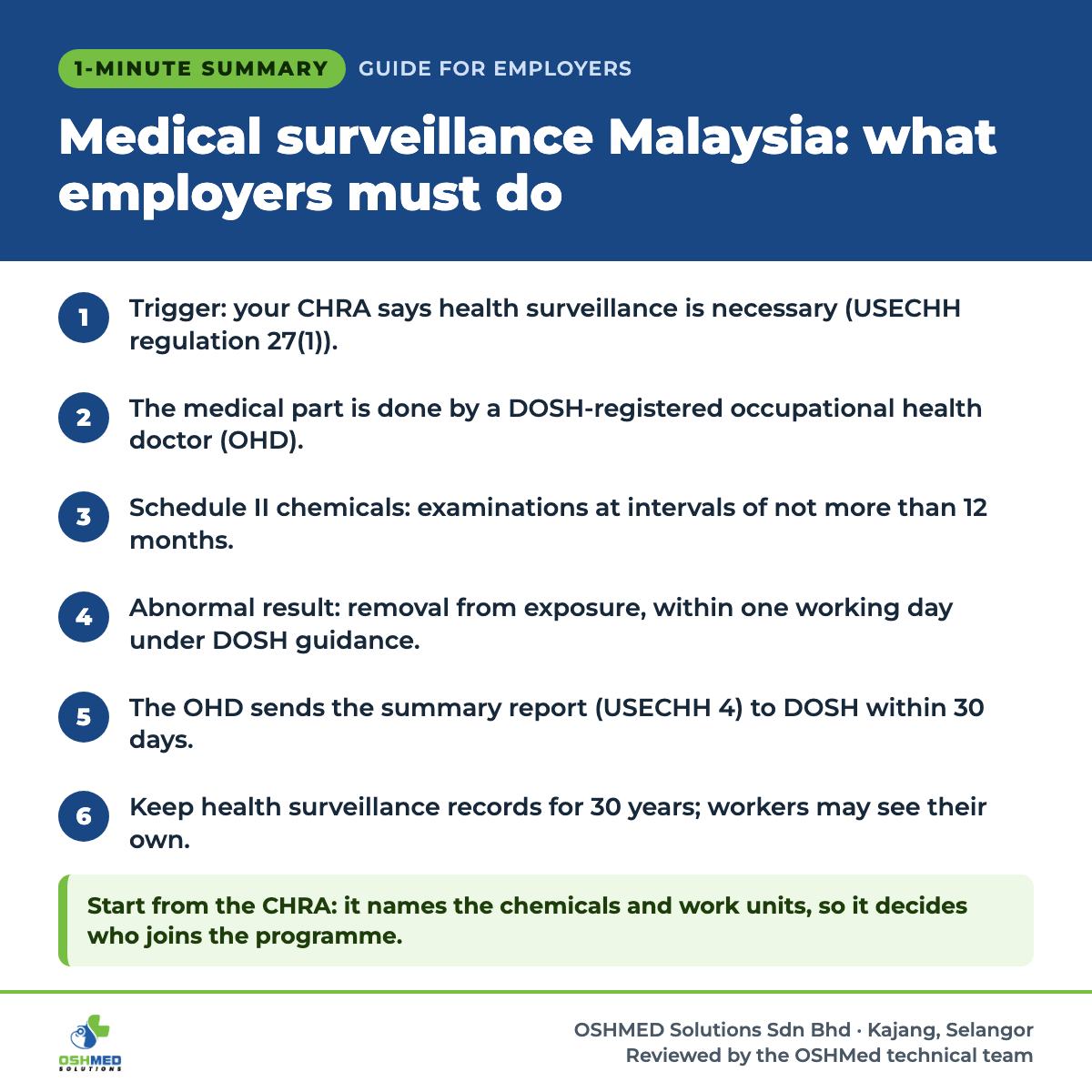
- Trigger: your CHRA says health surveillance is necessary (USECHH regulation 27(1)).
- The medical part is done by a DOSH-registered occupational health doctor (OHD).
- Schedule II chemicals: examinations at intervals of not more than 12 months.
- Abnormal result: removal from exposure, within one working day under DOSH guidance.
- The OHD sends the summary report (USECHH 4) to DOSH within 30 days.
- Keep health surveillance records for 30 years; workers may see their own.
What is medical surveillance, and what is a medical surveillance exam?
Medical surveillance is the monitoring of a worker to identify changes in health caused by exposure to chemicals hazardous to health at work (USECHH 2000, regulation 2). The exam is a clinical examination by a DOSH-registered occupational health doctor (OHD): history, physical examination and tests of the organs the chemical can affect.
When does your workplace need a medical surveillance programme?
When your chemical health risk assessment (CHRA) shows that health surveillance is necessary for employees exposed, or likely to be exposed, to chemicals hazardous to health (regulations 9(2)(i) and 27(1)). For Schedule II chemicals, the programme includes medical surveillance at intervals of not more than 12 months (regulation 27(3)).
Section 3.1.6 of the DOSH Guidelines on Medical Surveillance Programme at The Workplace 2023 lists the usual reasons:
- Air monitoring at or above half the 8-hour limit, or above a ceiling, maximum exposure or short-term limit.
- A chemical with a “skin” notation in USECHH Schedule I, with likely skin contact.
- Biological monitoring above the biological exposure limit (BEL).
- Health complaints that match the chemical’s known effects, where a valid test exists.
Schedule II lists 34 entries, including lead, mercury, cadmium, benzene, n-hexane, isocyanates, free crystalline silica, chromium compounds and pesticides. If your CHRA names one for a work unit, check its recommendation.
What is changing. From 15 October 2027, P.U. (A) 359/2026 prohibits benzene, carbon disulphide, carbon tetrachloride and n-hexane above set concentrations for cleaning and degreasing. Substitution can end a programme (Guidelines, 7.6), so plan any switch with your OHD.
In one line: the CHRA decides whether medical surveillance is needed; the OHD decides how.
Does your workplace need a medical surveillance programme?
Answer eight questions about your chemicals and your CHRA. They follow regulation 27 of USECHH 2000 and section 3.1.6 of the DOSH 2023 Guidelines. This is a planning aid, not medical advice: only a DOSH-registered occupational health doctor can design the programme. No personal data is collected; your answers stay in your browser.
1. Does your CHRA report say that health surveillance or medical surveillance is necessary for any work unit?
2. Are workers exposed, or likely to be exposed, to a chemical in USECHH Schedule II (for example lead, mercury, benzene, n-hexane, isocyanates, free crystalline silica, chromium compounds or pesticides)?
3. Have air monitoring results reached half of the 8-hour limit, or exceeded a ceiling, maximum exposure or short-term limit?
4. Do workers handle a chemical with a "skin" notation in USECHH Schedule I, in tasks where skin contact is likely?
5. Has any biological monitoring result been above the biological exposure limit (BEL)?
6. Have workers reported symptoms that they link to chemicals at work?
7. Has DOSH directed you to carry out medical surveillance?
8. Do you have a CHRA for every work unit that uses chemicals, done or reviewed in the last five years with no significant change since?
What happens in a programme, and how often are workers examined?
The OHD reviews your CHRA and monitoring reports, then examines each worker in scope: a baseline before exposure, periodic examinations at least once in 12 months, a return-to-work check after any removal, and an exit examination. Three-monthly or six-monthly rounds are recommended when there are removals or health concerns.
| Examination | When |
|---|---|
| Pre-placement | Before work in a new work unit, or when a new chemical is introduced; this is the baseline |
| Periodic | At least once in 12 months, or earlier if the OHD recommends |
| Return-to-work | Before a removal from exposure ends |
| Exit | When the worker leaves the at-risk unit, preferably within the six months before |
Each examination covers history, a physical examination, target organ tests such as blood tests or spirometry where relevant, and fitness to wear a respirator. The OHD certifies each worker fit or not fit for that chemical (form USECHH 3). Samples go to a laboratory accredited by Standards Malaysia.
Some chemicals have their own timetable: for inorganic lead, the next blood lead test ranges from six months to six weeks, depending on the last result. A programme ends only on the OHD’s written justification.
Need a medical surveillance programme planned from your CHRA?
Send us your CHRA report and the number of exposed workers in each work unit. OSHMed will propose a programme plan: who is in scope, how often they are examined, and how records and follow-up will run.
Who does what in a medical surveillance programme?
The employer owns and pays for the programme. A DOSH-registered CHRA assessor decides whether it is needed, a registered hygiene technician measures exposure and a DOSH-registered OHD does the medical part. In an OSHMed programme, our partner clinic carries out the examinations and tests, samples go to an accredited laboratory, and we coordinate.
| Role | Responsibility |
|---|---|
| Employer | Appoints the OHD, removes workers when advised, keeps the records (regulations 27, 28) |
| Occupational health doctor | Examinations, fitness certificates, removal advice, reports to DOSH |
| Nova Care Sdn Bhd (partner clinic) | Carries out and bills the examinations and tests |
| OSHMed | Plans and coordinates: worker list, schedule, records, follow-up |
OSHMed Solutions Sdn Bhd (SSM 202001013523) is an occupational safety and health consultancy in Kajang, Selangor, serving employers nationwide. OSHMed is not a clinic and does not examine workers or run a laboratory. We build the worker list from your CHRA, schedule rounds around your shifts, keep the records and follow up retests. The medical part is done by a DOSH-registered occupational health doctor; examinations and tests are carried out and billed by our partner clinic, Nova Care Sdn Bhd, No. 32 Jalan Reko Sentral 4, Kajang. For noise-exposed workers, Nova Care is also a DOSH-approved audiometric testing centre (JKKP/2025/11-02/00027, valid until 11 February 2028). See our hearing conservation guide, the hearing conservation programme page and our services.
What happens when a worker's result is abnormal?
The OHD may recommend medical removal protection: the worker is moved away from the chemical while the cause is checked and controls improve. Regulation 28 makes removal the employer’s duty; the DOSH 2023 Guidelines say within one working day. The worker returns when a later examination is clear.
- Pregnant or breastfeeding employees must be kept from exposure once the OHD notifies you (regulation 28(2)).
- The OHD reports removals and abnormal results to DOSH on forms USECHH 5i and 5ii.
- Occupational poisoning or disease is reported to the nearest DOSH office within seven days (2004 notification regulations, regulation 7).
- A worker who becomes unwell after a chemical exposure needs medical help urgently; call 999 in an emergency.
Which forms and records does the law require?
The employer keeps each health surveillance record for 30 years from the last entry (regulation 27(4)), lets each worker see their own record after reasonable notice (regulation 27(6)) and shares anonymous collective results in training (regulation 22(2)(b)). The OHD records results on forms USECHH 1 to 5 and sends the summary to DOSH within 30 days.
| Form | Content | Employer keeps | Sent to DOSH |
|---|---|---|---|
| USECHH 1 | Examination findings | No (the OHD keeps it; the worker gets a copy) | No |
| USECHH 2 | Each worker’s results over time | 30 years | No |
| USECHH 3 | Certificate of fitness | 30 years | No |
| USECHH 4 | Work unit summary with recommendations | 30 years | Yes, within 30 days |
| USECHH 5ii and 5i | Abnormal results; medical removal | 30 years | Yes, with USECHH 4 |
How do you compare medical surveillance providers?
Compare quotes on the same scope. Ask each provider to name the OHD and registration number, list the chemicals and work units from your CHRA, state the tests per chemical under the DOSH 2023 Guidelines, name the accredited laboratory and confirm who sends the forms to DOSH.
- Registration: check the OHD in the myKKP competent person lookup and note the validity date. Medical surveillance by an unregistered person is an offence under section 31B of Act 514, with a fine of up to RM100,000.
- Scope and tests: exposed workers per work unit, the chemicals, and the tests each needs, which drive the cost.
- Follow-up: who sends USECHH 4 and 5, when you receive USECHH 2 and 3, and how removals and retests run.
Price follows scope: workers, chemicals, tests, frequency and follow-up. We prepare a written proposal for each programme; there is no public price list.
- Your CHRA says health surveillance is necessary, but no examinations are booked.
- Workers handle a Schedule II chemical such as lead, benzene, isocyanates or silica.
- The last examination round was more than 12 months ago.
- Biological monitoring was above the limit, or workers report symptoms.
Before you decide: three common objections
Three objections often delay medical surveillance: the yearly check-up already covers it, protective equipment keeps exposure low, and nothing is needed until DOSH inspects. Each is checked below against USECHH 2000, Act 514 and the DOSH 2023 Guidelines.
"Our annual medical check-up already covers this."
A general check-up is not chemical-specific. Medical surveillance follows your CHRA, uses tests chosen for each chemical, is done by a DOSH-registered OHD and goes on the USECHH forms.
"Our workers wear protective equipment, so exposure is low."
Protective equipment is one control, and the OHD checks fitness to wear a respirator. The Guidelines say a programme should never stop where skin protection alone keeps the chemical from being absorbed.
"We will act when DOSH inspects."
USECHH has no penalty of its own, so section 51 of Act 514 applies: a fine of up to RM100,000, up to one year in prison or both, plus a fine of up to RM2,000 a day if the offence continues. Directors can be charged too (section 52).
Frequently asked questions
What is a medical surveillance exam?
A clinical examination by a DOSH-registered occupational health doctor for workers exposed to chemicals hazardous to health. It covers history, a physical examination and tests of the organs the chemical can affect, sometimes with biological monitoring, and ends with a fit or not fit certificate.
Is medical surveillance mandatory in Malaysia?
Yes, when your CHRA shows that health surveillance is necessary (USECHH 2000, regulation 27(1)). For chemicals listed in Schedule II, it must include medical surveillance at intervals of not more than 12 months, carried out by a DOSH-registered occupational health doctor.
What are the DOSH 2023 medical surveillance guidelines?
The Guidelines on Medical Surveillance Programme at The Workplace 2023, published by DOSH. They replaced the 2001 guideline and explain how occupational health doctors run programmes under regulation 27 of USECHH 2000, from examinations to forms and records.
Who pays for medical surveillance?
The employer. Section 26 of Act 514 says no employer shall charge employees for anything done or provided under the Act or its regulations. Workers may see their own health surveillance record after giving reasonable notice (regulation 27(6)).
Does OSHMed carry out the examinations?
No. OSHMed is a consultancy, not a clinic, and plans and coordinates the programme. A DOSH-registered occupational health doctor does the medical part, and examinations and tests are carried out and billed by our partner clinic, Nova Care Sdn Bhd in Kajang.
Your next step
Take your latest CHRA report, list the exposed workers per work unit, run the self-check above, then ask us for a written plan.
If the same workers face noise, plan audiometric testing alongside; see our hearing conservation guide.
Put your medical surveillance programme on a schedule
OSHMed plans and coordinates. A DOSH-registered occupational health doctor does the medical part, and examinations and tests are carried out and billed by our partner clinic, Nova Care Sdn Bhd.
Sources and references
Checked against the official documents listed below on 28 October 2026. Laws change: always confirm the current version on the DOSH (JKKP) website.
- Occupational Safety and Health (Use and Standards of Exposure of Chemicals Hazardous to Health) Regulations 2000, P.U. (A) 131/2000 (regulations 2, 4, 9, 22, 26 to 30, Schedule II), Attorney General's Chambers, published by DOSH
- Guidelines on Medical Surveillance Programme at The Workplace 2023 (sections 1.4, 1.5, 3.1.6, 6.1.2, 7.2 to 7.6, 9 and Table 26; Part B, inorganic lead), DOSH Malaysia
- Occupational Safety and Health Act 1994 (Act 514), reprint incorporating Act A1648 (sections 26, 31B, 51, 52, Fifth Schedule), DOSH Malaysia
- Occupational Safety and Health (Prohibition of Use of Substance) Order 2026, P.U. (A) 359/2026, Attorney General's Chambers, published by DOSH
- Occupational Safety and Health (Notification of Accident, Dangerous Occurrence, Occupational Poisoning and Occupational Disease) Regulations 2004, P.U. (A) 128/2004 (regulation 7), Attorney General's Chambers, published by DOSH
- Occupational Health Doctor: role, qualifications and registration, DOSH Malaysia
- List of approved audiometric testing centres (Pusat Ujian Audiometrik), entry for Nova Care Sdn. Bhd., DOSH Malaysia
Disclaimer: This article is general information for employers and is not legal advice. Requirements depend on your workplace, processes and the current law. For a decision on your premises, speak to a DOSH-registered competent person or contact DOSH (JKKP).