
First Aid Box DOSH Checklist: Contents, Checks and Type A, B, C
The first aid box DOSH recommends in its Guidelines on First-Aid in the Workplace (2nd Edition, 2004) holds the 25 items in Appendix 4, from triangular bandages and sterile gauze to gloves and a CPR barrier device. Check each box against the 16 questions in Appendix 6. Box A, B and C come from the repealed 1970 factory regulations.
- MD (NNSMA, Rus)
- MScCH (Occ. Health, UKM)
- MBA (ARU, UK)
- OHD (NIOSH)
- MRO (AOEMM)
- TTT (HRDF)
- SSM 202001013523 (OSHMED Solutions Sdn Bhd)
- DOSH registered training provider SL/22/22/181036, valid to 21 July 2028
- MMC Full Registration 55275 (Dr. Wan Muhammad Zulhusni)
- DOSH Occupational Health Doctor HQ/16/DOC/00/454
- DMAC/EDTCmed 263
- OEUK OEUK/2024/3751
OSHMed Solutions Sdn Bhd is an occupational safety and health consultancy and DOSH-registered training provider (ergonomics) in Kajang, Selangor. We are not a clinic. Medical tests are arranged through approved centres.
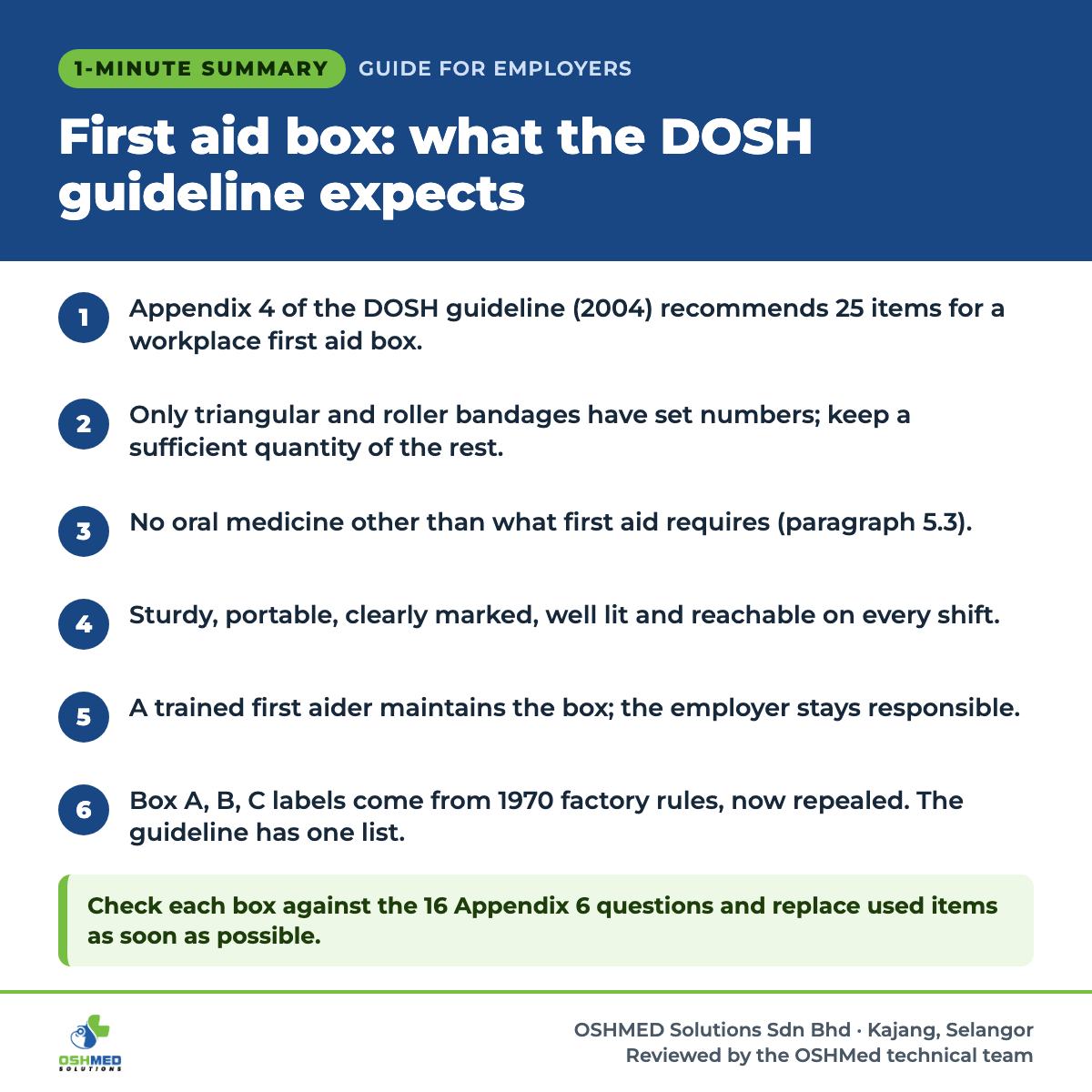
- Appendix 4 of the DOSH guideline (2004) recommends 25 items for a workplace first aid box.
- Only triangular and roller bandages have set numbers; keep a sufficient quantity of the rest.
- No oral medicine other than what first aid requires (paragraph 5.3).
- Sturdy, portable, clearly marked, well lit and reachable on every shift.
- A trained first aider maintains the box; the employer stays responsible.
- Box A, B, C labels come from 1970 factory rules, now repealed. The guideline has one list.
What should a first aid box contain under the DOSH guideline?
Appendix 4 of the DOSH guideline recommends 25 items, including bandages, sterile eye pads and gauze, a burn dressing, gloves, scissors, a CPR barrier device, a thermometer, a first aid manual and an inventory checklist. Only the triangular and roller bandages carry set numbers; everything else should be in sufficient quantity.
The set numbers are five triangular bandages (130 x 90 x 90 cm) and four roller bandages each of 7.5 cm, 3 cm and 2.5 cm. The other 21 items, from sterile gauze pads and a multi-trauma dressing to safety pins, Cetavlon and a waterproof waste bag, appear in the checker below.
Paragraph 5.3 of the DOSH Guidelines on First-Aid in the Workplace (2nd Edition, 2004) adds two rules: a sufficient quantity of suitable first aid materials, and no oral medication of any kind other than what first aid requires. Appendix 6 also asks whether the contents suit your likely injuries and illnesses; your section 18B risk assessment shows what those are.
How do you check a first aid box with the DOSH checklist?
Use Appendix 6 of the guideline: 16 yes or no questions in six areas, covering location, identifiability, contents, information, training and a responsible person. Each “no” means further action may be needed. Paragraph 5.3 asks for frequent checks, so that the box stays fully equipped and every item is usable.
- Tick each item against the inventory and Appendix 4. Replace anything used, past its use-by date, unlabelled or poorly stored (questions 3d to 3f).
- Check the displays: a contents list, emergency telephone numbers, and the nearest first aider’s name, location and extension (questions 4a to 4c).
- Where chemicals hazardous to health are used, keep the current chemical safety data sheet (CSDS) near each point of use (paragraph 7.2). See our CHRA guide.
- Date and sign the checklist, and pass the restock list to the person responsible.
Tape the printed checklist inside the lid and date each check, so anyone can see when the box was last restocked.
First aid box checker: DOSH Appendix 4 and Appendix 6
Tick each item that is in the box and usable, then tick each of the 16 Appendix 6 checks that is a yes. The checker lists what is missing, so you can print a restock list, or send the result to OSHMed on WhatsApp if you also need first aiders trained. Repeat it for each box.
0 of 41
Missing or to fix: Tick the items in the box to build your restock list.
Based on Appendices 4 and 6 of the DOSH Guidelines on First-Aid in the Workplace (2nd Edition, 2004), which are guidance, not a regulation. DOSH sets no quantity for 20 of the 25 items: paragraph 5.3 asks for a sufficient quantity of suitable first aid materials and no oral medication other than what first aid requires. The item list and box details stay in your browser unless you press the WhatsApp button. Print one copy per box and repeat the check regularly, for example once a month.
What does first aid box Type C (Box A, B or C) mean?
The labels come from the Fourth Schedule of the Factories and Machinery (Safety, Health and Welfare) Regulations 1970. It sized a factory first aid box by the number of persons employed at one time: column A for 10 or fewer, B for 11 to 50, and C for 50 and above. DOSH now lists these regulations as repealed.
| Point | 1970 Fourth Schedule (Box A, B, C) | DOSH guideline 2004, Appendix 4 |
|---|---|---|
| Status | Repealed (on DOSH list of repealed regulations) | Guidance still published by DOSH |
| Sizing | Three columns by persons employed at one time | One list; a “sufficient quantity” (5.3) |
| Items | 16 numbered items, quantities per column | 25 items, set numbers for triangular and roller bandages only |
| Upkeep | A responsible person, trained in first aid above 20 persons | A trained first aider |
| Item (1970 wording, translated) | A: 10 or fewer | B: 11 to 50 | C: 50 and above |
|---|---|---|---|
| Small sterile dressings for fingers | 6 | 12 | 24 |
| Medium (hands and feet) and large sterile dressings | 3 of each | 6 of each | 12 of each |
| Small or large adhesive wound dressings | 12 | 24 | 36 |
| Triangular bandages | 2 | 4 | 8 |
| Roller bandages, 1 inch and 2 inch | 6 of each | 9 of each | 12 of each |
| Sterile eye pads | 2 | 4 | 8 |
| Safety pins | 12 | 24 | 36 |
| Adhesive plaster, splints and padding | Sufficient | Sufficient | Sufficient |
Box A, B and C sized a factory box by headcount under a schedule DOSH now lists as repealed. The 2004 guideline has one 25-item list and asks for a sufficient quantity, so judge a “Type C” kit against Appendix 4, not its label.
Is a first aid box a legal requirement in Malaysia?
In practice, yes. Section 15 of the Occupational Safety and Health Act 1994 requires employers to ensure, so far as is practicable, the safety, health and welfare of employees, including adequate welfare facilities. The DOSH guideline states that providing first aid facilities and first aiders meets this welfare duty. The box contents come from that guidance.
Breaching the section 15 duty is an offence under section 19, with a fine of up to RM500,000, imprisonment of up to two years, or both.
Regulation 38 of the 1970 factory regulations once required each factory box to follow the Fourth Schedule, carry a red cross on white, remain locked with a responsible key holder, and be kept by someone trained in first aid where more than 20 persons worked. DOSH lists those regulations as repealed since the Factories and Machinery Act 1967 was repealed on 1 June 2024.
Who looks after your first aid box on every shift?
The DOSH guideline gives box upkeep to a trained first aider. OSHMed runs in-house Basic Occupational First Aid (BOFA) training at your premises: request a BOFA quote.
Where should first aid boxes go, and how many do you need?
Place each box in a clearly identifiable, well-lit and accessible spot, and tell employees where every box is (paragraph 5.2). The guideline sets no box-per-worker ratio: where a workplace covers a large area, provide an adequate number of boxes so that every employee can reach one on every shift.
- Design. Sturdy, portable enough to carry to an incident, and clearly marked (paragraph 5.1).
- Sizing factors. Type of industry, number of workers and shifts, and distance to the nearest clinic or hospital (paragraph 3.2).
- Locking. Paragraph 5.2 still advises a locked box with a key holder available in working hours, citing the repealed regulation 38. If you lock it, keep a key holder on every shift.
- First aid room. Above 150 employees, the guideline recommends a first aid room with a first aid box and a cupboard of the same items for top-ups (Appendix 8).
Who is responsible for maintaining the first aid box?
The trained first aider. Paragraph 4.5.3 makes the first aider responsible for keeping only first aid material in the box, checking it periodically and restocking it. The employer keeps absolute responsibility and must ensure the first aider does this. Where a registered nurse or medical assistant is employed, they supervise the first aider.
Each shift also needs a first aider to look after the boxes: size that with the planner in our first aider guide, and display a notice naming your first aiders and where they are (paragraph 4.2).
OSHMED Solutions Sdn Bhd, an occupational safety and health consultancy in Kajang, Selangor, runs in-house Basic Occupational First Aid (BOFA) training across Malaysia, covering CPR and AED use, cuts, burns, fractures, sprains, workplace injuries, choking and poisoning. Its DOSH training provider registration covers the Ergonomic Trained Person (ETP) course; for BOFA, ask for the outline, assessment and certificate details with your quote. See our training services.
- A shift has no trained first aider responsible for its boxes.
- Your site uses chemicals hazardous to health, so first aiders need decontamination training (paragraph 7.2).
- You have more than 150 employees and no first aid room.
- Contractors share your site without a written first aid agreement (paragraph 4.1.3).
Before you decide: three common objections
Three objections come up when employers review first aid boxes: a kit labelled Type C must already comply, anyone can restock it, and one box covers the whole site. Each is checked below against the DOSH guideline, using its own paragraph numbers.
"We bought a Type C kit, so we comply."
The label refers to a repealed 1970 schedule. Check the kit against Appendix 4, and ask whether it suits the likely injuries at your site (Appendix 6, question 3a).
"Anyone can restock the box."
The guideline gives upkeep to a trained first aider (paragraph 4.5.3), and Appendix 6 asks whether selected employees are trained to use and maintain the box.
"One box is enough for the whole building."
Not if the area is large or some employees cannot reach it on every shift. Paragraph 5.2 asks for an adequate number of boxes.
Frequently asked questions
What is the DOSH first aid box guideline?
It is the Guidelines on First-Aid in the Workplace (2nd Edition) 2004, JKKP GP(I) 06/2004. Section 5 covers the box, Appendix 4 lists 25 recommended items and Appendix 6 gives a 16-question checklist. DOSH still publishes it as guidance, not as a regulation.
What is a Type C first aid box in Malaysia?
Column C of the Fourth Schedule of the 1970 factory regulations: box contents for factories with 50 and above persons employed at one time. DOSH lists those regulations as repealed; its current guideline has one 25-item list with no A, B or C sizes.
Can we keep medicine in a first aid box?
Paragraph 5.3 of the DOSH guideline says a first aid box should not contain oral medication of any kind other than what first aid requires. The first aider should keep only first aid material inside the box (paragraph 4.5.3).
How often should a first aid box be checked?
The guideline asks for frequent checks so the box stays fully equipped and usable, with used items replaced as soon as possible. It sets no interval; a monthly Appendix 6 check, plus a check after each use, makes this routine.
Is there a first aid kit checklist for the workplace?
Yes. Appendix 6 of the DOSH guideline is a 16-question first aid box checklist, and Appendix 4 lists the 25 recommended contents. The checker on this page combines both into a restock list you can print for each box.
Your next step
Run the checker for each box, restock what is missing, and file the printouts with your first aid records.
Then make sure every shift has a trained first aider to maintain the boxes: use the planner in our first aider guide and see the BOFA course page. More guides are in our resources.
Train the first aiders who keep your boxes ready
Send us your headcount, shifts and number of boxes on WhatsApp, or use the quote form. We will reply with an in-house BOFA proposal for your site.
Sources and references
Checked against the official documents listed below on 5 November 2026. Laws change: always confirm the current version on the DOSH (JKKP) website.
- Guidelines on First-Aid in the Workplace (2nd Edition) 2004, JKKP GP(I) 06/2004 (paragraphs 1.2, 2.2, 3.2, 4.1.3, 4.2, 4.5.3, 5, 6.1 and 7.2; Appendices 4, 5, 6 and 8), DOSH Malaysia
- Factories and Machinery (Safety, Health and Welfare) Regulations 1970 (revised 1983), P.U. (A) 114/83, regulation 38 and Fourth Schedule (repealed; historical reference only), DOSH Malaysia
- Occupational Safety and Health Act 1994 (Act 514), reprint incorporating Act A1648 (sections 15 and 19), DOSH Malaysia
- Factories and Machinery (Repeal) Act 2022 (Act 835), Attorney General's Chambers, published by DOSH
- Appointment of date of coming into operation, Factories and Machinery (Repeal) Act 2022, P.U. (B) 127/2024, Attorney General's Chambers, published by DOSH
- Regulations that have been repealed (Peraturan Yang Telah Dimansuhkan), regulations under Act 139, DOSH Malaysia
- Regulations under Act 514 (current list), DOSH Malaysia
Disclaimer: This article is general information for employers and is not legal advice. Requirements depend on your workplace, processes and the current law. For a decision on your premises, speak to a DOSH-registered competent person or contact DOSH (JKKP).