
Spirometry Test for Workers in Malaysia: DOSH Guidance, Results and Frequency
A spirometry test measures how much air a worker can blow out after a full breath, and how fast: FEV1, FVC and the FEV1/FVC ratio. In Malaysia, it is part of USECHH 2000 medical surveillance when the CHRA calls for surveillance and the occupational health doctor includes it, following DOSH’s 2026 spirometry guidance.
- MD (NNSMA, Rus)
- MScCH (Occ. Health, UKM)
- MBA (ARU, UK)
- OHD (NIOSH)
- MRO (AOEMM)
- TTT (HRDF)
- SSM 202001013523 (OSHMED Solutions Sdn Bhd)
- DOSH registered training provider SL/22/22/181036, valid to 21 July 2028
- MMC Full Registration 55275 (Dr. Wan Muhammad Zulhusni)
- DOSH Occupational Health Doctor HQ/16/DOC/00/454
- DMAC/EDTCmed 263
- OEUK OEUK/2024/3751
OSHMed Solutions Sdn Bhd is an occupational safety and health consultancy and DOSH-registered training provider (ergonomics) in Kajang, Selangor. We are not a clinic. Medical tests are arranged through approved centres.
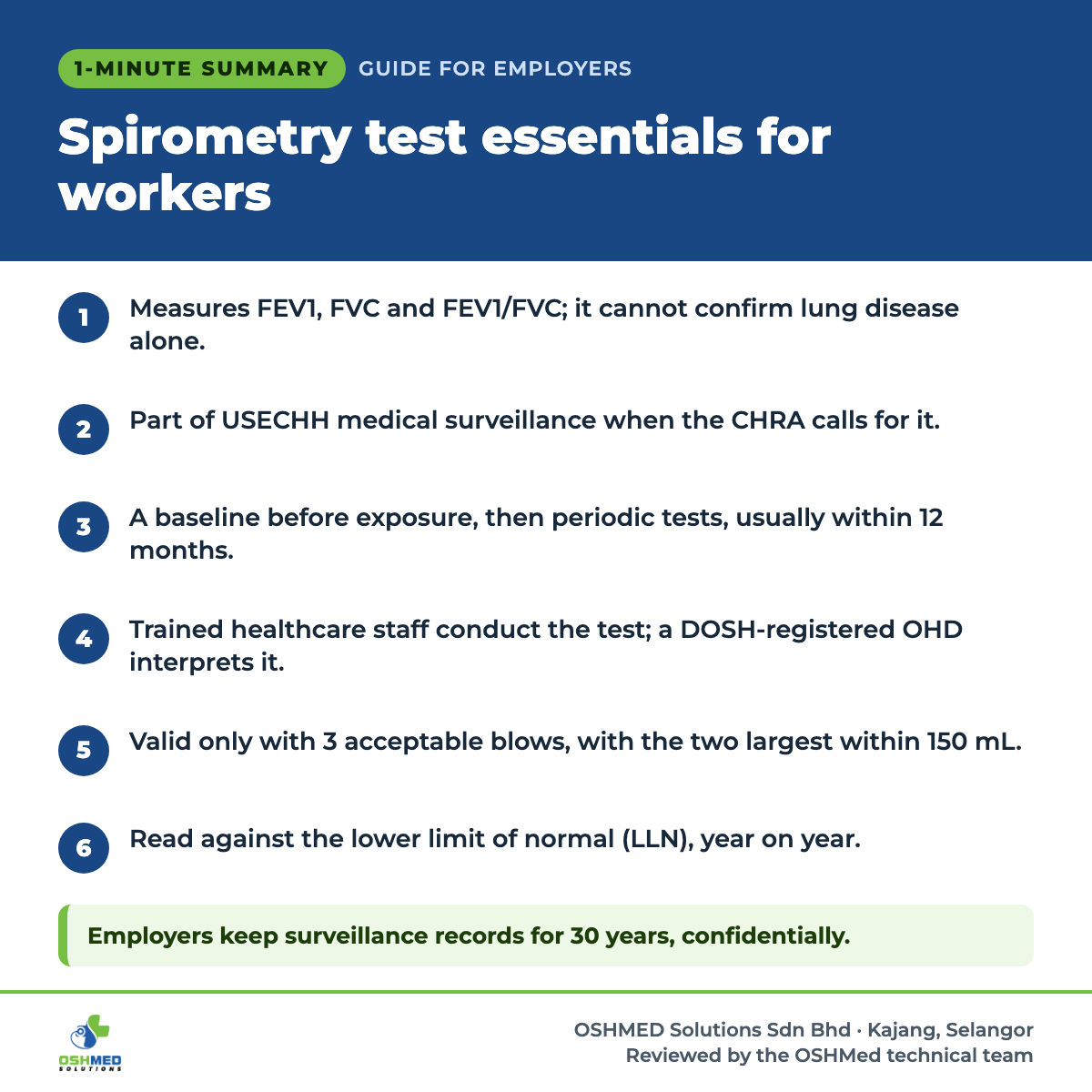
- Measures FEV1, FVC and FEV1/FVC; it cannot confirm lung disease alone.
- Part of USECHH medical surveillance when the CHRA calls for it.
- A baseline before exposure, then periodic tests, usually within 12 months.
- Trained healthcare staff conduct the test; a DOSH-registered OHD interprets it.
- Valid only with 3 acceptable blows, with the two largest within 150 mL.
- Read against the lower limit of normal (LLN), year on year.
Employers keep surveillance records for 30 years, confidentially.
What is a spirometry test?
A spirometry test measures how much air a person can breathe out after a full breath, and how fast. FEV1 is the air blown out in the first second, FVC is the total, and the FEV1/FVC ratio compares them. DOSH calls it an essential tool for the surveillance of workers exposed to dust, fumes and chemicals (2026 guidance, 5.1 and 6.1).
It must not be used on its own to conclude that a worker has lung disease (6.1). Between 2011 and 2024, 870 respiratory disease cases were reported to DOSH (3.1.2).
When is a spirometry test required for workers in Malaysia?
No regulation names spirometry. USECHH 2000 requires health surveillance when an assessment shows it is necessary, with the medical part done by an occupational health doctor (regulation 27). The DOSH 2023 Guidelines list spirometry as a target organ test “as necessary”; the 2026 guidance sets the method.
| Requirement | Source | Status |
|---|---|---|
| Health surveillance when the CHRA says it is necessary | USECHH reg. 27(1) | Regulation |
| Medical surveillance by a registered occupational health doctor | USECHH reg. 27(2); Act 514, s.31B | Regulation and Act |
| Schedule II chemicals: medical surveillance at least every 12 months | USECHH reg. 27(3) | Regulation |
| Spirometry as a target organ test | DOSH 2023 Guidelines, 7.3.1 | Guideline: “as necessary” |
| Test method and interpretation | DOSH 2026 spirometry guidance | Guideline; some steps use “must” |
Check that the doctor is registered using our DOSH competent person list guide, and plan the programme with our medical surveillance guide.
Which workers need a spirometry test?
Workers whose exposure poses a respiratory risk. The 2026 guidance lists four uses: a baseline before exposure, annual medical surveillance including fitness to wear a respirator, checking breathing symptoms, and fitness to work for DOSH competent persons in confined or oxygen-limited spaces (6.1).
Examples where the DOSH 2023 Guidelines name spirometry or lung function tests (Part B, 4.2 of each chemical):
- Isocyanates, free crystalline silica and asbestos
- Hexavalent chromium compounds; mercury as a baseline only
- Formaldehyde and chlorine, at the levels each chapter sets
- Welding fumes, “when indicated” (Part A, section 8)
The CHRA decides whether surveillance is needed; the OHD picks the tests. Try the self-check below.
Self-check: do your workers need a spirometry test?
Answer eight questions about your workplace. Each Yes points to a rule or a DOSH recommendation, listed in the result with its source. This is a planning aid, not medical or legal advice: the CHRA and the occupational health doctor decide. No personal data is collected, and your answers stay in your browser unless you choose WhatsApp.
1. Does your CHRA recommend health surveillance for any work unit?
2. Do workers handle isocyanates, free crystalline silica, asbestos, chromium compounds or other Schedule II chemicals?
3. Are workers exposed to welding fumes, formaldehyde or chlorine?
4. Do workers wear respirators to control chemical exposure?
5. Will new hires or transfers start work in a unit with chemical or respiratory hazards?
6. Do workers report cough, wheeze or breathlessness that seems linked to work?
7. Do authorised entrants or other competent persons work in confined spaces?
8. Was your last medical surveillance round more than 12 months ago?
- 1: run health surveillance (USECHH reg. 27(1)); the OHD chooses the tests. See our medical surveillance guide.
- 2: with surveillance in place, Schedule II chemicals need medical surveillance at least every 12 months (reg. 27(3)); the DOSH 2023 Guidelines list spirometry or lung function tests for these.
- 3: the DOSH 2023 Guidelines include spirometry or lung function tests for these exposures when the CHRA finds significant exposure.
- 4: fitness to wear a respirator is assessed in medical surveillance (Guidelines 7.3.12); see our respirator fit test guide.
- 5: a baseline test before exposure (2026 spirometry guidance, 6.1).
- 6: breathing symptoms are an indication for spirometry (6.1); ask the worker to see a doctor promptly.
- 7: an OHD fitness certificate for confined space entrants, valid for two years (ICOP 2010, 11.2 and 11.3).
- 8: the next round may be due (reg. 27(3)).
Who can perform and interpret a spirometry test?
Trained and competent healthcare personnel, such as occupational health doctors, nurses and medical assistants (2026 guidance, 5.3.1); DOSH strongly recommends a DOSH-recognised spirometry course. A spirometry technician runs the test; the OHD interprets the results, links them to the worker’s exposure and prepares the report (5.3.3, 9.0).
The spirometer should meet ISO 26782 and be registered with the Medical Device Authority (5.2.2). Ask for the daily calibration log: testing must not go ahead if the calibration check fails (6.3.1.2, 6.3.3).
How is a spirometry test done, and how should workers prepare?
The worker sits upright with a nose clip, breathes in fully, seals their lips around a clean mouthpiece and blows out as hard and fast as possible for at least six seconds. This is repeated at least three times and up to eight, with short rests (2026 guidance, 7.1).
Workers should tell the tester about any relative contraindication (6.2). Testing may be postponed rather than cancelled, for example in the case of:
- A heart attack or eye surgery in the past week
- Chest, abdominal or brain surgery in the past four weeks
- Late-term pregnancy
- A chest infection or its symptoms, including suspected tuberculosis (6.3.5.4)
Smoking history (including e-cigarettes), height and weight go on the report (9.1). For a bronchodilator test, the testing team will say which inhaler to withhold and for how long (7.4).
Need spirometry for exposed workers?
Send your latest CHRA, the work units and chemicals, your headcount and shifts. OSHMed will reply with a written proposal to arrange medical surveillance with spirometry, interpreted by a DOSH-registered occupational health doctor.
When is a spirometry result acceptable and repeatable?
A blow is acceptable when it starts without hesitation, has no cough in the first second, no leak or blockage, and ends properly. The test is repeatable when the two largest FEV1 and FVC values from at least three acceptable blows are within 150 mL. Otherwise, the results should not be interpreted (7.3, 8.2).
| Check | Criterion |
|---|---|
| Start | Back-extrapolated volume no more than 5% of FVC or 0.100 L, whichever is greater |
| During the blow | No cough in the first second, glottic closure, leak or blocked mouthpiece |
| End | Under 0.025 L in the last second, 15 seconds of blowing, or FVC repeatable within 0.150 L |
| Rest | At least 30 seconds between blows |
How are spirometry test results interpreted?
The OHD compares each value with the lower limit of normal (LLN) for the worker’s sex, age, height and ethnicity, using GLI equations. A low FEV1/FVC ratio suggests an obstructive pattern; a normal ratio with a low FVC suggests a possible restrictive pattern, confirmed only by a full lung function test (8.1, 8.2).
Older fixed cut-offs (below 80% of predicted, or a ratio below 70) may miss obstruction in younger people and overstate it in older people (8.1).
| FEV1/FVC | FVC | Pattern |
|---|---|---|
| At or above LLN | At or above LLN | Normal |
| Below LLN | At or above LLN | Obstructive |
| At or above LLN | Below LLN | Possible restrictive |
| Below LLN | Below LLN | Mixed |
Trends matter too: in non-smokers, FEV1 falls by about 30 mL a year, and a fall of more than 10% from baseline within a year is significant. Workers must be referred to a physician for a restrictive or mixed pattern, a yearly fall of 10% or more, abnormal results, or symptoms when an acceptable test is not possible (8.3).
How often do workers need a spirometry test?
As often as the medical surveillance programme it belongs to. For Schedule II chemicals, USECHH 2000 sets intervals of not more than 12 months, or shorter if the OHD decides (regulation 27(3)). The DOSH 2023 Guidelines add baseline and exit examinations, and three- or six-monthly rounds when there is concern (7.5).
- Baseline: before work in a new unit or with a new chemical (7.2.1).
- Periodic: at least once every 12 months (7.2.2).
- Exit: preferably within six months before leaving the at-risk unit (7.2.4).
- Mercury: lung function as a baseline test only, unless indicated (Part B).
What does the employer receive after a spirometry test?
The OHD’s medical surveillance report, not the full clinical record: the work unit summary (USECHH 4), abnormal results with recommendations (USECHH 5ii), medical removals (USECHH 5i) and each worker’s fit or not fit certificate (USECHH 3), presented within one month of completion (DOSH 2023 Guidelines, 1.4 and 9.1).
The examination form that records spirometry results (USECHH 1) is confidential: the OHD keeps it and the worker keeps a copy (Table 26). The employer keeps surveillance records confidentially for 30 years from the last entry and lets each worker see their own (regulation 27(4) and (6); Guidelines 9.2).
The OHD’s spirometry report should list the readings, an LLN-based interpretation and the names of the technician and reporting OHD (2026 guidance, 9.1). Compare results each year: a falling trend can still sit within the normal range (Guidelines 9.2).
OSHMED Solutions Sdn Bhd in Kajang, Selangor, is not a clinic and serves employers across Malaysia, including Sabah and Sarawak. OSHMed arranges spirometry for workers as part of medical surveillance through our occupational health doctor service: a DOSH-registered occupational health doctor interprets the results, and our partner clinic carries out and bills for the tests. See our workplace health services.
- Your CHRA recommends health surveillance, but nothing is booked.
- Workers handle isocyanates, silica or welding fumes without a baseline test.
- The last surveillance round was over 12 months ago.
Before you decide: three common objections
Three objections delay spirometry: the yearly check-up covers it, workers wear respirators, and nobody has symptoms. Each is checked below against USECHH 2000 and the DOSH 2023 and 2026 guidance, so your decision rests on what DOSH has published.
"Our annual check-up already includes lung tests."
A general check-up is not medical surveillance, which is done by a DOSH-registered OHD and recorded on USECHH forms (regulation 27).
"Our workers wear respirators."
They still need an assessment of fitness to wear one in medical surveillance (Guidelines 7.3.12); see our respirator fit test guide.
"Nobody has symptoms, so we can wait."
Spirometry aims to find a decline before symptoms appear, and a baseline makes later change visible (2026 guidance, 3.3).
Frequently asked questions
Is spirometry the same as a lung function test?
Spirometry is one type of lung function test. It measures airflow; confirming a restrictive pattern needs a test of total lung capacity (2026 guidance, 5.1 and 8.2).
Is a spirometry test compulsory for all workers?
No. It is needed where the CHRA calls for health surveillance and the OHD includes spirometry (USECHH regulation 27). Confined space entrants need an OHD fitness certificate, which may include it.
Does a spirometry test confirm asthma or occupational lung disease?
Spirometry does not diagnose lung disease on its own. The OHD interprets it alongside symptoms, exposure and history, and refers the worker to a physician when the guidance criteria are met (6.1, 8.3).
How long does a spirometry test take?
No total time is set. Each blow lasts at least six seconds and up to 15, with at least 30 seconds of rest, over three to eight attempts (7.1, 7.3).
How much does a spirometry test cost for workers?
Cost depends on the scope: the number of workers, sites and shifts, other tests in the programme and follow-up. OSHMed quotes each programme in writing; there is no public price list.
Does OSHMed cover Sabah and Sarawak?
Yes. OSHMed serves employers across Malaysia, including Sabah and Sarawak.
Your next step
Run the self-check, then match each Yes to your CHRA. If surveillance is due, request a medical surveillance quote that includes spirometry.
No CHRA yet? Start with our chemical health risk assessment services or a CHRA quote. See also our workplace assessments.
Not sure which workers need spirometry?
Share your self-check result on WhatsApp or through the quote form. If no CHRA covers your chemicals yet, start with a CHRA quote.
- Medical surveillance Malaysia: how to set up a USECHH programme
- Pre-employment medical check-up in Malaysia: when is it required by law?
- Respirator fit test in Malaysia: DOSH requirements, methods and frequency
- USECHH 2000: a plain guide to all 30 regulations and 3 schedules
- Chemical health risk assessment (CHRA) under USECHH 2000
- Chemical exposure monitoring (CEM) in Malaysia: when, how often, who
- DOSH competent person list: categories, duties and how to check
- OSHMed occupational health doctor services
Sources and references
Checked against the official documents listed below on 23 November 2026. Laws change: always confirm the current version on the DOSH (JKKP) website.
- Guidance on Spirometry Procedure for Occupational Health Practice 2026 (sections 3.1.2, 3.3, 5.1 to 5.3, 6.1 to 6.3, 7.1, 7.3, 7.4, 8.1 to 8.3, 9.0 and 9.1), DOSH Malaysia
- Guidelines on Medical Surveillance Programme at The Workplace 2023 (sections 1.4, 1.5, 7.2, 7.3, 7.5, 8, 9.1, 9.2, Table 26, Part B section 4.2 for each chemical, Appendices 2 and 7), DOSH Malaysia
- Occupational Safety and Health (Use and Standards of Exposure of Chemicals Hazardous to Health) Regulations 2000, P.U. (A) 131/2000 (regulations 2 and 27; Schedule II), Attorney General's Chambers, published by DOSH
- Occupational Safety and Health Act 1994 (Act 514), reprint as at 1 June 2024 (section 31B and the Fifth Schedule), DOSH Malaysia
- Industry Code of Practice for Safe Working in a Confined Space 2010 (paragraphs 11.2 and 11.3), DOSH Malaysia
- Occupational health guidelines page, listing the 2026 spirometry guidance, checked 23 November 2026, DOSH Malaysia
Disclaimer: This article is general information for employers and is not legal advice. Requirements depend on your workplace, processes and the current law. For a decision on your premises, speak to a DOSH-registered competent person or contact DOSH (JKKP).