
Noise Risk Assessment (NRA) Services in Malaysia
OSHMed scopes and coordinates noise risk assessments for workplaces across Malaysia under the Noise Exposure Regulations 2019. The assessment is carried out by a DOSH-registered noise risk assessor, whose name and registration number appear in your report. You receive a noise map, full-shift personal dosimetry results and recommended controls.
At a glance
- Regulation
- Noise Exposure Regulations 2019 (P.U. (A) 60/2019)
- Carried out by
- A DOSH-registered noise risk assessor, named in the report with their registration number
- Method
- Area noise mapping and full-shift personal dosimetry (ICOP 2019, section 7.3)
- Report
- Within one month of completing the assessment (regulation 4(4))
- Review
- At least every five years, or sooner after changes
Does any of these apply to your workplace?
Noise may be above 82 dB(A)
Your excessive noise identification shows, or cannot rule out, a daily level above 82 dB(A) (regulation 2).
New or moved machinery
Machinery, processes, work or controls have changed since your last identification (regulation 3).
Five-year review due
Your last NRA is close to five years old, or DOSH has directed a review (regulation 4(8)).
Workers report ringing ears
Complaints of ringing ears or hearing difficulty after a shift are a reason to check exposure now.
What the assessment includes
- Walkthrough of the layout, machines, shifts, headcount and existing controls
- Area noise mapping, shown as a colour-coded noise map
- At least three spot readings per noise source, with peak checks for impact noise
- Full-shift personal dosimetry for each similar exposure group
- IEC-compliant instruments, verified within the last 12 months
- Results compared with the 82 dB(A) and 85 dB(A) levels in the 2019 Regulations
- Recommended controls, hearing protection zones and hearing protectors
- The 14-day notice to DOSH before site work and the summary report to DOSH
The registered assessor confirms the exposure groups and the number of workers sampled after reviewing your site (ICOP 2019, section 7.3.3).
Typical workplaces
- Metal fabrication, stamping and machining
- Plastic injection, woodworking and printing
- Food processing with compressors and chillers
- Utility plant rooms, generators and boiler houses
What matters legally is your own written identification for each work area, not the type of industry.
One visit for several assessments
Many sites also need a noise, chemical or ergonomic assessment. We can scope them together so you plan one series of site visits. Each keeps its own registered assessor and report.
What the NRA report contains
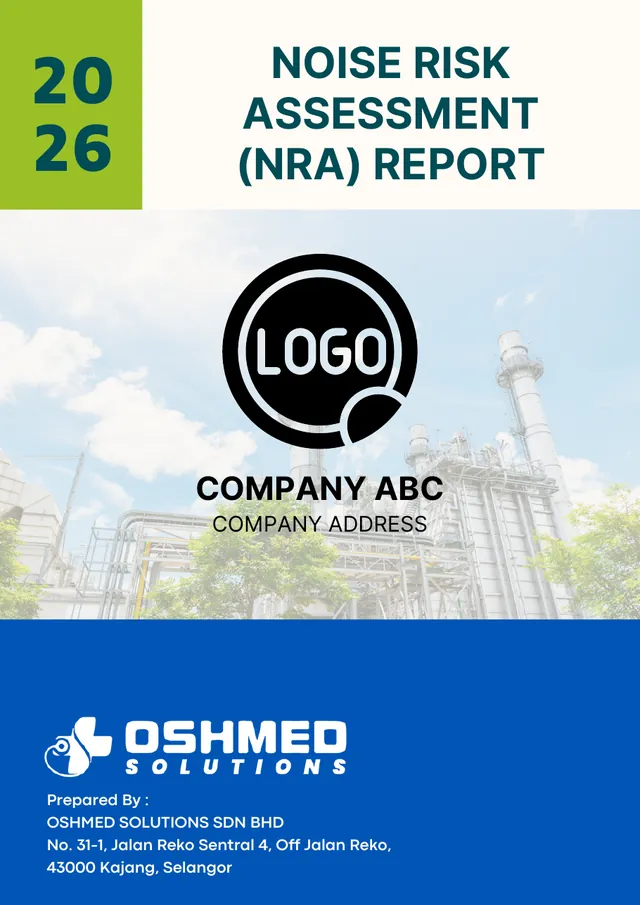
Prepared for your workplace, with your company name on the cover, following section 7.5 and Appendix 2 of the DOSH ICOP on noise (2019).
- Introduction, objective and process description
- Instruments used, with the latest calibration certificate
- Methodology, noise map and personal dosimetry results by exposure group
- Discussion, recommendations per group and conclusion
- The assessor’s name and DOSH registration number
| Action | Deadline | Regulation |
|---|---|---|
| Tell exposed workers the findings and recommendations | Within 14 days | 4(6) |
| Carry out the recommended actions | Within 30 days | 4(7) |
| Information and training for exposed workers | At least once a year | 5 |
| Audiometric testing for workers above the limit | Every year | 9 |
| Keep the NRA report | At least 30 years | 11(1)(a) |
Prepare before the site visit
- Floor plan with work areas marked, and photos of the main noise sources
- Machine and equipment list, with operating hours
- Shift roster, overtime patterns and time spent in each area
- Previous excessive noise identification and any earlier NRA
- Hearing protectors issued, with model names
Four steps from enquiry to report
- Send your detailsWhatsApp us your noisy areas, machine list, headcount per area and shifts, or your floor plan.
- Scope and written quoteWe reply with a written quote that lists the areas, exposure groups, personal samples and deliverables.
- DOSH notice and site workThe assessor notifies DOSH at least 14 days ahead, then maps the noise and runs full-shift dosimetry during normal work.
- Report and findingsYou receive the written report within one month of the assessment, and the findings are presented to your team.
Why employers need it
Questions employers ask before booking
Is a noise risk assessment mandatory in Malaysia?
Yes, when your identification under regulation 3 of the Noise Exposure Regulations 2019 shows that employees may be exposed to excessive noise. You must then appoint a DOSH-registered noise risk assessor under regulation 4. Section 18B of Act 514 also requires every employer to carry out risk assessments for workplace hazards.
Who can carry out a noise risk assessment?
Only a noise risk assessor registered with DOSH and holding a valid certificate (regulation 4(2)). OSHMed scopes and coordinates the assessment, and a DOSH-registered noise risk assessor carries it out. Ask for the name and registration number, and check them on the myKKP competent person lookup.
How long does a noise risk assessment take?
Allow several weeks. The assessor notifies DOSH at least 14 days before site work, measures full shifts, and must deliver the report within one month of completing the assessment (regulation 4(4)).
How much does a noise risk assessment cost?
There is no official fee schedule. DOSH sets the method, not the price, so each quote follows your scope: noisy areas and machines, exposure groups, workers needing full-shift dosimetry, shift length and sites. OSHMed quotes in writing.
How often must the NRA be reviewed?
Not more than five years from the previous noise risk assessment, or earlier when directed by DOSH (regulation 4(8)). Changes to machinery, processes, work or controls require a new identification under regulation 3, which can bring the next NRA forward.
Is audiometric testing included?
No. Audiometric testing is a separate service by a DOSH-approved audiometric testing centre, yearly for workers above the exposure limit, at no cost to the worker (regulations 9 and 10). OSHMed arranges it through our partner clinic, Nova Care Sdn Bhd, a DOSH-approved centre (PUA JKKP/2025/11-02/00027). Yearly noise training is also separate.
Need a noise risk assessment?
Send us your floor plan, machine list and shifts. We will reply with a written quote and what the assessor needs from you.