
Noise Risk Assessment Cost in Malaysia: What Sets Your NRA Quote
There is no official noise risk assessment price Malaysia-wide: DOSH sets the method, not the fee. Your quote depends on the number of noisy areas and machines, how many similar exposure groups need full-shift dosimetry, your shift pattern and the number of sites. Compare quotes on scope, assessor registration and deliverables, not on the total alone.
- MD (NNSMA, Rus)
- MScCH (Occ. Health, UKM)
- MBA (ARU, UK)
- OHD (NIOSH)
- MRO (AOEMM)
- TTT (HRDF)
- SSM 202001013523 (OSHMED Solutions Sdn Bhd)
- DOSH registered training provider SL/22/22/181036, valid to 21 July 2028
- MMC Full Registration 55275 (Dr. Wan Muhammad Zulhusni)
- DOSH Occupational Health Doctor HQ/16/DOC/00/454
- DMAC/EDTCmed 263
- OEUK OEUK/2024/3751
OSHMed Solutions Sdn Bhd is an occupational safety and health consultancy and DOSH-registered training provider (ergonomics) in Kajang, Selangor. We are not a clinic. Medical tests are arranged through approved centres.
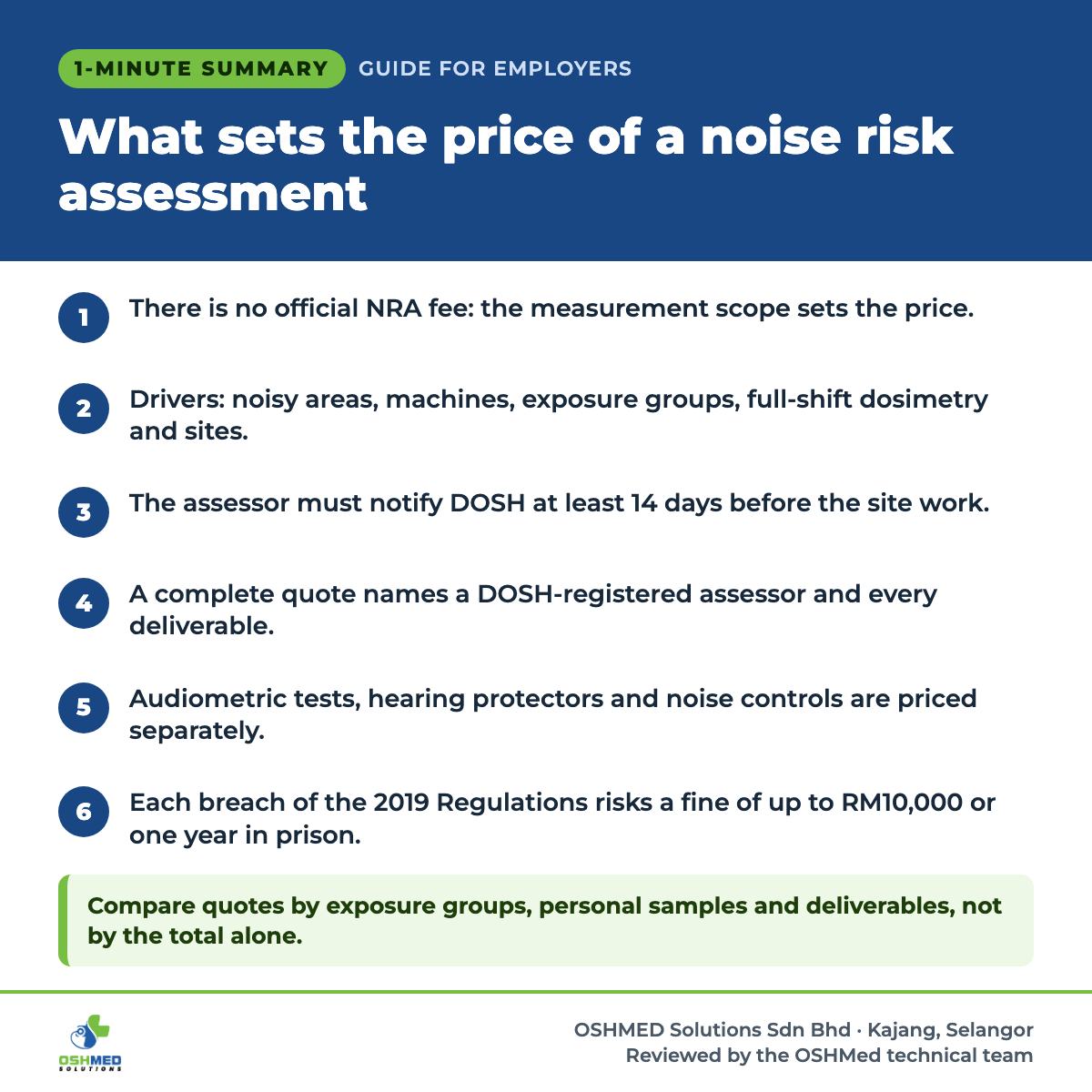
- There is no official NRA fee: the measurement scope sets the price.
- Drivers: noisy areas, machines, exposure groups, full-shift dosimetry and sites.
- The assessor must notify DOSH at least 14 days before the site work.
- A complete quote names a DOSH-registered assessor and every deliverable.
- Audiometric tests, hearing protectors and noise controls are priced separately.
- Each breach of the 2019 Regulations risks a fine of up to RM10,000 or one year in prison.
What sets the price of a noise risk assessment?
The scope of measurement. A noise risk assessment (NRA) under the Noise Exposure Regulations 2019 combines area and personal monitoring (ICOP 7.3.1). The more noisy areas, machines, exposure groups and shift hours there are to measure, the more field time, equipment and reporting the assessor needs, and the higher the quote.
DOSH publishes no NRA fee schedule. The 2019 Industry Code of Practice on noise (the ICOP) sets the method, and the price follows it. For the basics, read what an NRA is and when you need one.
Which factors change the size of your NRA quote?
Eight factors set the workload. Each comes from an ICOP requirement, so a registered assessor cannot drop one to lower the price. Knowing them helps you give accurate details early and spot a quote that leaves part of the method out.
| Cost driver | Why it changes the quote | Basis |
|---|---|---|
| Noisy work areas | Each area is measured and drawn on a colour-coded noise map | ICOP 7.3.2(b) |
| Machines and noise sources | At least three spot readings per source | ICOP Table 7.1 |
| Type of noise | Impact or impulse noise needs peak checks against 140 dB(C) | ICOP 7.3.3(g), (i) |
| Similar exposure groups (SEGs) | Each group needs personal monitoring and a written justification | ICOP 7.3.3(b) to (d) |
| Workers sampled per group | Those with the highest likely exposure wear a dosimeter; the number must be justified | ICOP 7.3.3(e), (f) |
| Shift length and number of shifts | Dosimetry covers the full working shift, with the worker observed | ICOP 7.3.3(j), (k) |
| Instruments | IEC-compliant, verified every 12 months; drift above 0.5 dB means measuring again | Reg. 4(3); ICOP 7.2 |
| Sites and reporting | Each site is assessed and reported, plus a summary report to DOSH | Reg. 4(4); ICOP 15.4.1 |
NRA scope builder: prepare an accurate quote request
Answer eight quick questions. Your answers build a scope summary you can send to OSHMed on WhatsApp for a written quote, or print for internal approval. No personal or medical details are needed.
OSHMed uses these answers to prepare a written quote. This summary is not a price: the registered noise risk assessor confirms the similar exposure groups and the number of personal samples after reviewing your site (ICOP 2019, section 7.3.3).
How many workers will wear a noise dosimeter?
It depends on your exposure groups, not on a fixed ratio. The assessor groups workers with similar exposure, then monitors those with the highest likely exposure in each group over a full shift. The report must state how many were monitored and why (ICOP 7.3.3 and Appendix 2).
What should a complete NRA quote include?
A complete quote names the registered assessor and covers area and personal monitoring, calibrated IEC equipment, the full report, the employer confirmation form, a presentation of findings and the summary report to DOSH. Regulation 4 and the ICOP require these, so they belong in the scope.
- The assessor’s name and valid DOSH registration (regulation 4(2)).
- A noise map plus full-shift dosimetry for each exposure group (ICOP 7.3).
- An Appendix 2 report with recommendations per group, within one month (regulation 4(4)).
- The 14-day DOSH notice and the summary report to DOSH (ICOP 15.4.1).
Want an NRA quote you can compare line by line?
Send us your noisy areas, headcount, shifts and sites, or your layout plan. OSHMed will reply with a written quote that lists the areas, exposure groups, personal samples and deliverables.
What is not included in an NRA quote?
The NRA measures and recommends; it does not deliver the follow-up. Audiometric testing, approved hearing protectors, warning signs, yearly training, the noise control practicability report and engineering works are separate items. Budget for them once the report shows who is above the exposure limit.
| Item | Who provides it | Rule |
|---|---|---|
| Audiometric testing for workers above the limit | A DOSH-approved audiometric testing centre | Reg. 9 and 10 |
| Hearing protectors | A supplier; models approved by the Director General | Reg. 7 |
| Hearing protection zone signs | The employer | Reg. 8 |
| Yearly noise and hearing protector training | The employer arranges it | Reg. 5 |
| Noise control practicability report | The employer, with an acoustic consultant if needed | Reg. 6(3) to (5); DOSH guidance 2024 |
| Engineering noise controls | An acoustic consultant or noise control supplier | Reg. 6(4); ICOP 8.2.2 |
These sit within the hearing conservation programme, which is costed separately from the NRA. See also OSHMed’s hearing conservation programme.
How do you compare NRA quotes, and what are the red flags?
Compare scope, not totals: the same areas, exposure groups and personal samples, full-shift sampling, a named registered assessor and the same deliverables. A quote far below the others often reflects a smaller method or fewer deliverables, so ask what is missing before you sign.
- No personal dosimetry. Sound level meter readings alone do not meet ICOP 7.3.1.
- No named assessor. Ask for the name, registration number and certificate, and check them on the myKKP competent person lookup that DOSH provides. Registration is valid for up to three years (regulation 4(2); ICOP 14.1.3.1).
- Site work within 14 days and no DOSH notice. ICOP 15.4.1(c) requires at least 14 days’ notice.
- Short sampling as standard. Personal monitoring covers the full working shift (ICOP 7.3.3(j)).
- No calibration evidence. The report must attach the latest calibration certificate (ICOP Appendix 2).
- Earplugs as the only recommendation. Regulation 6 puts engineering and administrative control first.
How long does an NRA take, and when do you pay again?
Allow several weeks. The assessor notifies DOSH at least 14 days before site work, measures full shifts and must deliver the report within one month of finishing. The next NRA is due within five years, or sooner after changes in machines, processes or controls (regulations 3(2) and 4(8)).
Appoint the assessor within one month of identifying excessive noise (ICOP 7.1.1). After the report, you have 14 days to inform exposed workers and 30 days to act on the recommendations (regulations 4(6), 4(7)), so approve that budget with the NRA.
What does it cost to delay or skip the NRA?
More than the assessment. Each breach of regulations 3 to 9 and 11 of the 2019 Regulations can bring a fine of up to RM10,000, up to one year in prison, or both. Under Act 514, failing to implement risk controls or ignoring a DOSH notice carries much higher penalties.
Breaching section 18B (risk assessment and controls) carries a fine of up to RM500,000, up to two years in prison, or both (section 19). Ignoring an improvement or prohibition notice carries the same maximum plus a further fine of up to RM2,000 per day (section 49). Directors and managers can be charged with the company (section 52).
OSHMED Solutions Sdn Bhd, based in Kajang, serves employers across Malaysia and quotes in writing. OSHMed scopes and coordinates the noise risk assessment; it is carried out by a DOSH-registered noise risk assessor whose name and registration number appear in the report. Where needed, audiometric testing is carried out and billed by our partner Nova Care Sdn Bhd, a DOSH-approved audiometric testing centre (JKKP/2025/11-02/00027, valid until 11 February 2028). See our assessment services.
- Your noise identification flags any area above 82 dB(A), or you cannot rule it out.
- You are adding, moving or modifying noisy machinery.
- Your last NRA is over four and a half years old, or DOSH has directed a review.
- Workers report ringing ears after a shift.
Before you decide: three common objections
Three objections come up when employers review NRA quotes: using their own meter, using the in-house safety and health officer, and taking the lowest total. Each is checked below against the 2019 Regulations, the ICOP and Act 514, so the decision rests on the rules.
"We can buy a sound level meter and do it ourselves."
Identification can be done in-house, but the NRA needs a registered assessor, IEC-compliant equipment and personal monitoring (regulation 4(2) and (3); ICOP 7.3.1). Noise monitoring without registration risks a fine of up to RM100,000 (Act 514, section 31B).
"Our safety and health officer can handle it."
Only if the officer is also a registered noise risk assessor with a valid DOSH certificate. That registration has its own qualification, examination and experience rules (ICOP 14.1).
"We will just take the lowest quote."
Compare first. A total that drops dosimetry, shortens sampling or skips the DOSH summary may need repeating, and your 30-day action plan rests on its recommendations.
Frequently asked questions
How much does a noise risk assessment cost in Malaysia?
There is no official fee schedule. DOSH sets the method, not the price, so each quote is built from your scope: noisy areas and machines, exposure groups, workers needing full-shift dosimetry, shift length and sites. OSHMed then prepares a written quote.
How long is a noise risk assessment valid?
Review it within five years of the previous NRA, or earlier if DOSH directs (regulation 4(8)). Changes in machinery, process, work or controls trigger a new identification (regulation 3(2)), which can bring the next NRA forward.
How can I check that a noise risk assessor is registered?
Ask for the assessor’s name, registration number and certificate, and check them on the myKKP competent person lookup that DOSH provides. Registration is valid for up to three years (ICOP 14.1.3.1), so confirm it covers the fieldwork date.
Can we use the DOSH noise checklist instead of paying for an NRA?
Partly. The Appendix 1 checklist is your own identification step under regulation 3 and needs no registered assessor. If any area may have excessive noise, regulation 4(1) requires a registered noise risk assessor, and the ICOP asks you to appoint one within one month.
Is audiometric testing included in the NRA price?
Not within the NRA itself. It is a separate service by a DOSH-approved audiometric testing centre, with an occupational health doctor interpreting results (regulation 9). It covers workers above the exposure limit, every year, at no cost to the worker (regulation 10).
Your next step
Fill in the scope builder above, or send your layout plan, machine list, headcount per area and shifts. OSHMed will reply with a written quote you can compare line by line.
Chemical risks too? OSHMed can plan them with the NRA in one round of site visits. See our chemical health risk assessment guide.
Get a written NRA quote for your site
Share your scope summary on WhatsApp or through the quote form. We will confirm what the registered assessor needs so the 14-day DOSH notice can start on time.
Sources and references
Checked against the official documents listed below on 28 October 2026. Laws change: always confirm the current version on the DOSH (JKKP) website.
- Occupational Safety and Health (Noise Exposure) Regulations 2019, P.U. (A) 60/2019 (regulations 3 to 11), Attorney General's Chambers, published by DOSH
- Industry Code of Practice for Management of Occupational Noise Exposure and Hearing Conservation 2019 (sections 7, 14 and 15, Appendix 2), DOSH Malaysia
- Occupational Safety and Health Act 1994 (Act 514), reprint incorporating Act A1648 (sections 18B, 19, 31B, 49, 52, Fifth Schedule), DOSH Malaysia
- Panduan Mengenai Kawalan Kebisingan di Tempat Kerja 2024 (section 4.3, noise control practicability assessment), DOSH Malaysia
- Noise Risk Assessor (Penaksir Risiko Bising): duties and registration, DOSH Malaysia
- List of approvals (Senarai Kelulusan / Kebenaran), including the myKKP competent person lookup and approved audiometric testing centres, DOSH Malaysia
- List of approved audiometric testing centres (Pusat Ujian Audiometrik), entry for Nova Care Sdn. Bhd., DOSH Malaysia
Disclaimer: This article is general information for employers and is not legal advice. Requirements depend on your workplace, processes and the current law. For a decision on your premises, speak to a DOSH-registered competent person or contact DOSH (JKKP).