
Initial vs Advanced Ergonomic Risk Assessment (ERA): The DOSH 2017 Guidelines Explained
The DOSH Guidelines on Ergonomics Risk Assessment at Workplace 2017 set out two levels. An initial ergonomic risk assessment (ERA) is a checklist screening of risk factors such as posture, force, repetition and vibration. If scores exceed the minimum in Table 3.15, or pain is reported, an advanced ERA follows using tools such as RULA, REBA or MAC. Both are done by a trained person.
- MD (NNSMA, Rus)
- MScCH (Occ. Health, UKM)
- MBA (ARU, UK)
- OHD (NIOSH)
- MRO (AOEMM)
- TTT (HRDF)
- SSM 202001013523 (OSHMED Solutions Sdn Bhd)
- DOSH registered training provider SL/22/22/181036, valid to 21 July 2028
- MMC Full Registration 55275 (Dr. Wan Muhammad Zulhusni)
- DOSH Occupational Health Doctor HQ/16/DOC/00/454
- DMAC/EDTCmed 263
- OEUK OEUK/2024/3751
OSHMed Solutions Sdn Bhd is an occupational safety and health consultancy and DOSH-registered training provider (ergonomics) in Kajang, Selangor. We are not a clinic. Medical tests are arranged through approved centres.
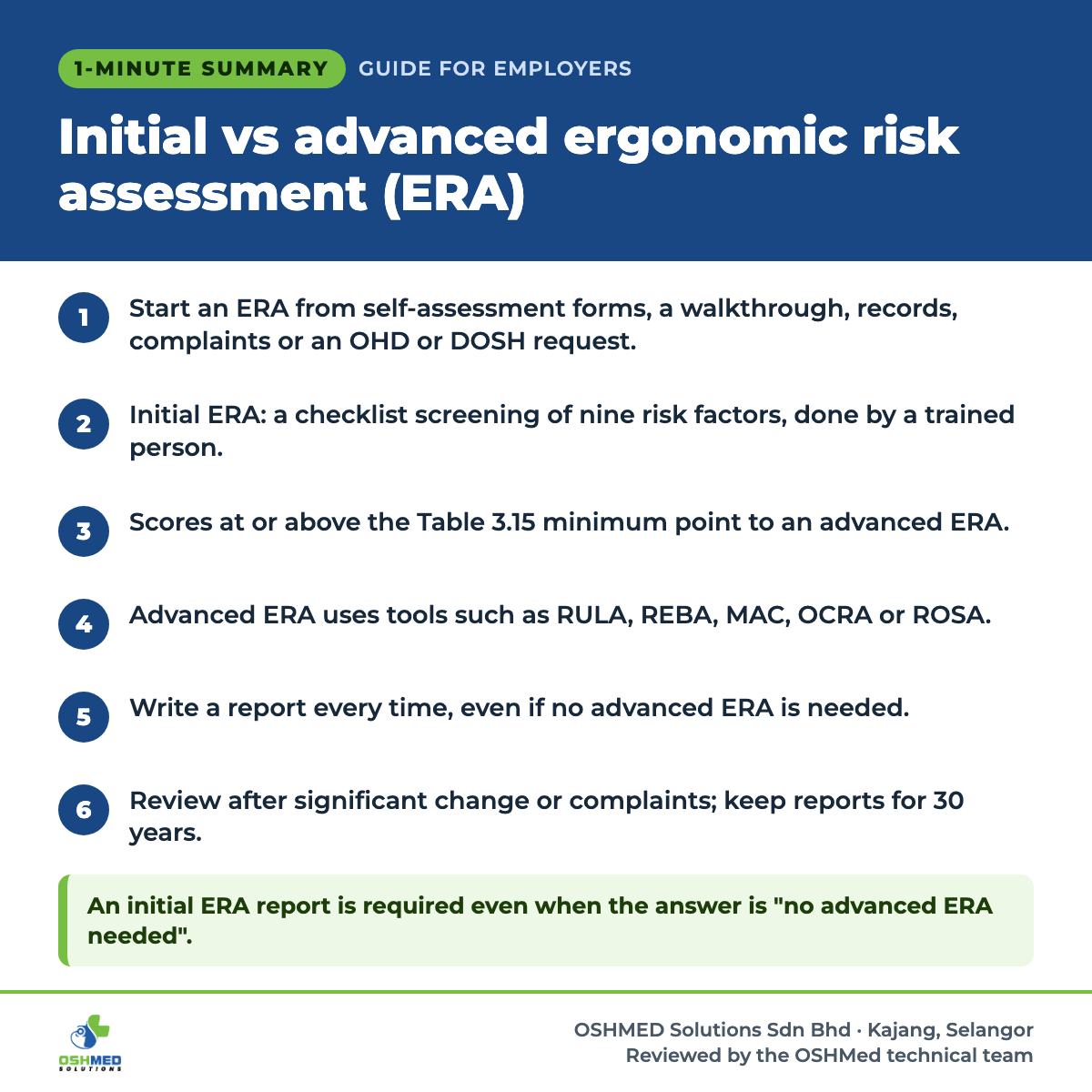
- Start an ERA from self-assessment forms, a walkthrough, records, complaints or an OHD or DOSH request.
- Initial ERA: a checklist screening of nine risk factors, done by a trained person.
- Scores at or above the Table 3.15 minimum point to an advanced ERA.
- Advanced ERA uses tools such as RULA, REBA, MAC, OCRA or ROSA.
- Write a report every time, even if no advanced ERA is needed.
- Review after a significant change or complaint; keep reports for 30 years.
What is an ergonomic risk assessment (ERA)?
An ergonomic risk assessment is a systematic way to identify, assess and control ergonomic risk factors linked to work tasks, as set out in the DOSH Guidelines on Ergonomics Risk Assessment at Workplace 2017. It covers physical ergonomics: posture, force, repetition, static work, vibration and environmental factors such as lighting and temperature.
The guidelines aim to identify risk factors that may harm employees, judge the likelihood of harm and recommend controls. They support the employer’s general duty under section 15 of the Occupational Safety and Health Act 1994 (Act 514) and the duty to conduct a risk assessment under section 18B, which took effect on 1 June 2024 under Act A1648.
When should you start an ergonomic risk assessment?
The guidelines give proactive and reactive routes. Proactive: employee self-assessment, a walkthrough by a trained person, or a review of records such as HIRARC. Reactive: musculoskeletal complaints, or a request from an occupational health doctor (OHD) or authorities such as DOSH and SOCSO.
- Initial ERA is required when pain or discomfort is identified on the self-assessment form, or when the trained person judges there is probable risk.
- Initial ERA is not required when no pain or discomfort is reported and the trained person judges there is no probable risk.
- Complaints, or OHD or authority requests, lead to an initial ERA without first assessing the claim.
Initial vs advanced ERA: what is the difference?
An initial ERA (Level 1) is a structured checklist that screens and scores each risk factor. An advanced ERA (Level 2) is a deeper study of the work units flagged by the initial ERA. It uses established assessment tools and extra information, such as a history of musculoskeletal disorders, to set priorities for improvement.
| Initial ERA (Level 1) | Advanced ERA (Level 2) | |
|---|---|---|
| Purpose | Screen for ergonomic risk factors | Measure risk level and design improvements |
| Method | Musculoskeletal assessment plus the Appendix 6 checklist | Five steps: review initial ERA, gather data, assess risk level or workstation, summarise, set priorities |
| Tools | Checklist questions on nine risk factors | For example RULA, REBA, OWAS, MAC, Snook tables, revised NIOSH lifting equation, ART, OCRA, ROSA |
| Trigger | Self-assessment, walkthrough, records, complaints or requests | Initial ERA result meets the minimum requirement, or pain is found |
| Who | Trained person | Trained person, with an ergonomist or consultant where needed |
| Report | Required whether or not advanced ERA is needed (section 6.1) | Required, including occupational and medical history (section 6.2) |
How is the initial ERA scored?
Each risk factor in the initial checklist has a total score. Table 3.15 of the guidelines sets a minimum score for an advanced assessment for each factor. The checklist also asks whether the musculoskeletal assessment found pain or discomfort, and which body parts are affected, before deciding whether an advanced ERA is needed.
| Risk factor | Total score | Minimum for advanced assessment |
|---|---|---|
| Awkward posture | 13 | 6 or more |
| Static and sustained work posture | 3 | 1 or more |
| Forceful exertion | 1 | 1 |
| Repetitive motion | 5 | 1 or more |
| Vibration | 4 | 1 or more |
| Lighting | 1 | 1 |
| Temperature | 1 | 1 |
| Ventilation | 1 | 1 |
| Noise | 2 | 1 or more |
Initial ERA readiness checklist
Tick what is already in place before an initial ergonomic risk assessment. Items follow sections 2 and 3 of the DOSH 2017 guidelines. Print it for your safety committee or send your score to us.
0 of 10 ready
What must the ERA report contain?
Section 6 says an initial ERA report must be produced whether or not it shows the need for an advanced ERA. Both reports name the workplace, describe tasks per work unit, give the risk evaluation and recommendations, and name the trained person with their training certificate. The advanced report adds occupational and medical history and methods used.
- Name and address of the workplace, and description of tasks in each work unit.
- Initial ERA: the completed checklist, the scores and the need for advanced ERA, if any.
- Advanced ERA: occupational and medical history of employees involved, and the methods used.
- Risk evaluation, conclusion and recommendations for ergonomic improvement.
- Name of the trained person and the relevant training certificate.
Medical history in an advanced ERA is confidential information. It should come from employees or the occupational health doctor with proper consent; the ergonomic assessor does not diagnose.
Need an initial ERA, or want your own team trained?
OSHMed can scope an ergonomic risk assessment for your work units, or train your staff as ergonomic trained persons through our DOSH-registered ETP course.
When must an ERA be reviewed, and how long are records kept?
Section 7 says review the ERA when there is a significant change in the work, such as a new employee with very different body size, a change in methods or work rate, or weaker controls; when symptoms or complaints arise; or when DOSH directs. Assessment and investigation reports are kept for at least 30 years.
Other records under the guidelines, such as self-assessment forms, complaint records, walkthrough notes, corrective action reports and training records, are kept for at least five years (section 10.3). Keep them in print or electronic form, available to employees and DOSH.
Who can carry out an ERA?
A trained person, defined in section 1.4.7 as someone who has undergone ergonomics risk assessment training and can conduct the assessment and in-house training. Section 9.2.2 sets separate minimum training content for initial and advanced ERA, and DOSH publishes a list of registered training providers for the Ergonomics Management Course.
OSHMed Solutions Sdn Bhd in Kajang, Selangor, is listed by DOSH as a registered training provider for the Ergonomics Management Course for Ergonomic Trained Person (ETP), Initial and Advanced (RULA, REBA, MAC, RAPP, ART, ROSA), MyKKP registration SL/22/22/181036 (valid from 22 July 2025 to 21 July 2028). Details are on our ETP course page and training page.
If you prefer an external assessment, OSHMed can scope an initial or advanced ERA for your work units through our workplace assessments, carried out by a trained person or assessor who is named in the report. Read more on our existing ergonomic risk assessment service.
Training your own staff as ETPs builds internal capability for reviews and complaints; an external assessment gives you a fast initial baseline. Some sites do both.
- Self-assessment forms show pain or discomfort in any work unit.
- You have received musculoskeletal complaints, or an OHD, DOSH or SOCSO request.
- You are changing workstations, work rate or methods.
- Your last ERA report is missing the trained person’s name and certificate.
Before you decide: three common objections
Three objections come up often: offices are exempt, the guidelines are only advice, and a quick checklist is enough. Each is answered below against what the DOSH 2017 guidelines and Act 514 actually say, so you can weigh the decision on facts rather than assumptions.
"We are an office, so ergonomics does not apply."
The guidelines cover physical ergonomics at any workplace and list ROSA specifically for office workstation design. Prolonged sitting is one of the static posture examples.
"Guidelines are not law."
The guidelines are DOSH guidance, but section 18B of Act 514 requires every employer to conduct a risk assessment and implement controls. Following the guidelines is a clear way to show how you have met that duty.
"We just need the checklist filled in."
The checklist is part of the initial ERA. The guidelines also expect a musculoskeletal assessment, a report, communication to employees and record keeping.
Frequently asked questions
What is the difference between an initial and an advanced ergonomic risk assessment?
An initial ERA is a checklist screening of risk factors such as posture, force, repetition and vibration. If a factor meets the minimum score in Table 3.15 of the DOSH 2017 guidelines, or pain is found, an advanced ERA is done with tools such as RULA, REBA or MAC.
Who can conduct an initial ERA?
A trained person who has undergone ergonomics risk assessment training, as defined in section 1.4.7 of the DOSH guidelines. DOSH lists registered training providers for the Ergonomics Management Course; OSHMed is listed under MyKKP SL/22/22/181036.
Do we need a report if the initial ERA finds no high risk?
Yes. Section 6 states that an initial ERA report must be produced whether or not the assessment shows the need for an advanced ERA. It includes the checklist, scores, recommendations and the trained person’s name and training certificate.
How often should an ergonomic risk assessment be reviewed?
The guidelines do not set a fixed calendar interval. Review is required after a significant change in the work, when symptoms or complaints arise, or when directed by DOSH. You may also choose to review it when you update your HIRARC.
How long must ERA records be kept?
Assessment reports and investigation reports for at least 30 years. Other records, such as self-assessment forms, complaints, walkthrough findings, corrective actions and training records, for at least five years (section 10.3 of the guidelines).
Your next step
Collect self-assessment forms from your work units and appoint a trained person. That gives you the trigger and the lead for a defensible initial ERA.
If the same site has noise or chemical exposure, plan the ERA together with a noise risk assessment and a chemical health risk assessment.
Start with an initial ERA you can defend
Tell us your work units, headcount and any complaints. We will suggest whether to assess externally, train in-house, or do both.
Sources and references
Checked against the official documents listed below on 21 October 2026. Laws change: always confirm the current version on the DOSH (JKKP) website.
- Guidelines on Ergonomics Risk Assessment at Workplace 2017 (sections 1.4.7, 2.1, 2.2, 3.3, 4, 6, 7, 9, 10), DOSH Malaysia
- DOSH ergonomics guidelines listing, DOSH Malaysia
- List of registered training providers and trainers for the Ergonomics Management Course (ETP), updated 16 October 2026, DOSH Malaysia, Industrial Hygiene and Ergonomics Division
- Occupational Safety and Health Act 1994 (Act 514), reprint incorporating Act A1648 (sections 15, 18B, 31B), DOSH Malaysia
Disclaimer: This article is general information for employers and is not legal advice. Requirements depend on your workplace, processes and the current law. For a decision on your premises, speak to a DOSH-registered competent person or contact DOSH (JKKP).