
Noise Risk Assessment (NRA) in Malaysia: When You Need One and What the Report Covers
Under the Occupational Safety and Health (Noise Exposure) Regulations 2019, every employer must first identify whether workers may be exposed to excessive noise. If they may be, the employer must appoint a DOSH-registered noise risk assessor to carry out a noise risk assessment (NRA), act on the recommendations within 30 days, and review the NRA at least every five years.
- MD (NNSMA, Rus)
- MScCH (Occ. Health, UKM)
- MBA (ARU, UK)
- OHD (NIOSH)
- MRO (AOEMM)
- TTT (HRDF)
- SSM 202001013523 (OSHMED Solutions Sdn Bhd)
- DOSH registered training provider SL/22/22/181036, valid to 21 July 2028
- MMC Full Registration 55275 (Dr. Wan Muhammad Zulhusni)
- DOSH Occupational Health Doctor HQ/16/DOC/00/454
- DMAC/EDTCmed 263
- OEUK OEUK/2024/3751
OSHMed Solutions Sdn Bhd is an occupational safety and health consultancy and DOSH-registered training provider (ergonomics) in Kajang, Selangor. We are not a clinic. Medical tests are arranged through approved centres.
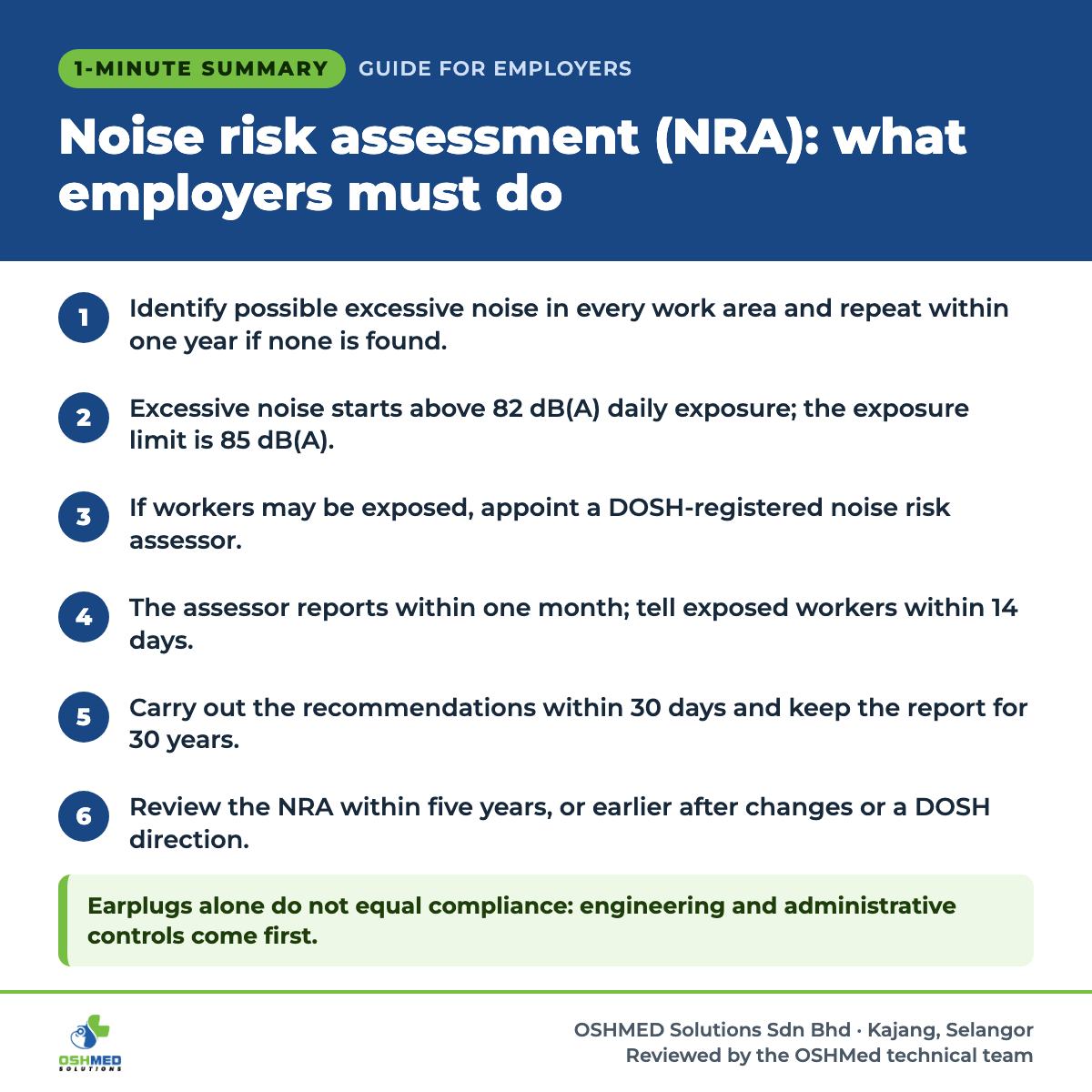
- Identify possible excessive noise in every work area and repeat within one year if none is found.
- Excessive noise starts above 82 dB(A) daily exposure; the exposure limit is 85 dB(A).
- If workers may be exposed, appoint a DOSH-registered noise risk assessor.
- The assessor reports within one month; tell exposed workers within 14 days.
- Carry out the recommendations within 30 days and keep the report for 30 years.
- Review the NRA within five years, or earlier after changes or a DOSH direction.
What is a noise risk assessment (NRA)?
A noise risk assessment is a structured measurement and evaluation of workplace noise, carried out by a noise risk assessor registered with DOSH. It identifies who is exposed to excessive noise, checks existing controls, and recommends noise reduction, hearing protection zones and whether a hearing conservation programme is needed.
The legal basis is regulation 4 of the Occupational Safety and Health (Noise Exposure) Regulations 2019 (P.U. (A) 60/2019), in force since 1 June 2019. These Regulations replaced the Factories and Machinery (Noise Exposure) Regulations 1989. DOSH also published an Industry Code of Practice (ICOP) on noise exposure and hearing conservation in 2019 that explains how to comply.
In one line: identification is the employer’s screening step; the noise risk assessment is the measured, registered step that follows when excessive noise may be present.
Who needs a noise risk assessment in Malaysia?
Any employer whose written identification shows that employees may be exposed to excessive noise. Under regulation 2, excessive noise means a daily noise exposure level above 82 dB(A), a daily personal noise dose above 50%, a maximum sound pressure level above 115 dB(A) at any time, or a peak above 140 dB(C).
Regulation 3 makes the first step every employer’s job: identify whether workers may be exposed to excessive noise, in the manner set by the Director General. You must repeat that identification when machinery, equipment, processes, work, controls or operations change, when directed by DOSH, and not more than one year after the previous identification.
| Measure | Excessive noise (triggers action, reg. 2) | Exposure limit (must not be exceeded, reg. 6) |
|---|---|---|
| Daily noise exposure level (8-hour) | Above 82 dB(A) | Above 85 dB(A) |
| Daily personal noise dose | Above 50% | Above 100% |
| Maximum sound pressure level | Above 115 dB(A) at any time | Above 115 dB(A) at any time |
| Peak sound pressure level | Above 140 dB(C) | Above 140 dB(C) |
Typical candidates include metal fabrication, stamping, plastic injection, woodworking, printing, food processing with compressors and utility plant rooms. What matters legally is your own identification record.
Self-check: do you need a noise risk assessment?
Answer seven quick questions about your workplace. This is a screening aid based on the 2019 Regulations, not a measurement. Only a registered noise risk assessor can confirm exposure levels.
1. Do any machines, tools or processes run loud enough that people need to raise their voice to talk at close range?
2. Do workers use impact tools, presses, grinders, compressors, generators or similar equipment?
3. Have you added, moved or modified machinery, or changed shifts or work methods, since your last noise identification?
4. Has any worker complained of ringing ears or difficulty hearing after a shift?
5. Is your last noise risk assessment older than about four and a half years, or do you not have one?
6. Has DOSH directed you to carry out or review a noise risk assessment?
7. Do you have a written record of your excessive noise identification for each work area?
What happens during an NRA?
The registered noise risk assessor plans the survey with you, measures noise sources and area levels, carries out personal dosimetry for each group of similarly exposed workers, and then analyses the results against the 2019 limits. The written report must reach you within one month of completing the assessment (regulation 4(4)).
- Appoint the assessor. The ICOP asks employers to appoint a registered noise risk assessor within one month of identifying excessive noise.
- Walkthrough. Layout, machines, shifts, headcount and existing controls.
- Area monitoring. Noise sources and levels across work areas, often shown as a noise map.
- Personal monitoring. Dosimeters worn by representative workers during normal work, using IEC-compliant equipment.
- Analysis and report. Findings, recommendations, hearing protection zones and the need for a hearing conservation programme.
What does the noise risk assessment report contain?
The ICOP (section 7.5) states that the report shall include an introduction, objective, process description, instrumentation, methodology, results, discussion, recommendations and conclusion. Regulation 4(5) requires findings and recommendations. The report must be kept at or near the premises and made available to management, the safety and health committee and the authorities.
The report also starts several legal clocks:
| Action | Deadline | Regulation |
|---|---|---|
| Tell employees exposed to excessive noise about the findings and recommendations | Within 14 days of receiving the report | 4(6) |
| Carry out the recommended actions | Within 30 days of receiving the report | 4(7) |
| Information, instruction and training on hearing protection for exposed employees | At least once a year | 5 |
| Reduce noise above the limit: engineering control first, then administrative control, then hearing protectors | As assessed | 6 |
| Mark hearing protection zones and enforce hearing protector use | Where the limit is exceeded | 8 |
| Annual audiometric testing through a DOSH-approved audiometric testing centre | Annually, for employees above the limit | 9 |
| Keep the NRA report | Not less than 30 years | 11(1)(a) |
Need a noise risk assessment scoped for your site?
Tell us your processes, shifts and headcount per area. OSHMed will propose a scope for the noise risk assessment and, if needed, your hearing conservation programme.
How often must a noise risk assessment be reviewed?
Regulation 4(8) requires the employer to review the noise risk assessment not more than five years from the date of the previous one, or earlier if DOSH directs. Separately, any change in machinery, process, work or controls triggers a new identification under regulation 3, which can lead to a fresh NRA before the five years are up.
Put the five-year review date in your compliance calendar the day the report arrives, plus a yearly reminder for the noise identification. Planning a new line? Make the identification part of the project, not an afterthought.
What should you prepare before the assessor arrives?
Prepare a layout plan, machine list, shift patterns, headcount per area and job, your last identification and NRA, the hearing protectors in use and any planned changes. Good preparation shortens the site visit and makes the report specific to your operations.
- Floor plan with work areas marked, and photos of the main noise sources.
- Machine and equipment list, including operating hours and maintenance status.
- Shift roster, overtime patterns and typical time spent in each area.
- Previous excessive noise identification and any earlier noise survey or NRA.
- Types of hearing protectors issued, with model names.
- Any complaints, aggregate audiometric summaries and planned changes in the next 12 months.
Who can carry out an NRA, and how does OSHMed help?
Only a noise risk assessor registered with the Director General and holding a valid DOSH certificate (regulation 4(2)). Act 514 section 31B and the Fifth Schedule also require noise monitoring to be done by a registered competent person. Check the assessor’s registration in the DOSH myKKP register before you sign.
OSHMed, an occupational safety and health consultancy in Kajang, Selangor, scopes and coordinates noise risk assessments for employers across Malaysia. The assessment is carried out by a DOSH-registered noise risk assessor, whose name and registration number appear in the report. If the report shows exposure above the limit, we can help you set up the hearing conservation programme, while annual audiometric testing is arranged through a DOSH-approved audiometric testing centre. See our workplace assessments and OSH training pages.
- Your identification shows any area may exceed 82 dB(A), or you cannot rule it out.
- You are installing, moving or modifying noisy machinery.
- Workers report ringing ears or hearing difficulty after shifts.
- Your last NRA is more than four and a half years old, or DOSH has directed a review.
Before you decide: three common objections
Many delays come from three assumptions: an old report is still enough, noise is limited to one machine, and earplugs settle the matter. Each one is tested against the 2019 Regulations below, so you can decide with the actual rules in front of you.
"We already have a noise report from a few years ago."
That may be fine if it is a noise risk assessment by a registered assessor, done under the 2019 Regulations, less than five years old, and nothing has changed since. Older surveys under the repealed 1989 regulations, or reports done before a layout change, should be reviewed.
"Only one machine is loud."
Then the assessment can be scoped to the affected areas and groups. The assessor still needs to confirm who else is exposed, including workers who pass through or work nearby for part of a shift.
"We give everyone earplugs, so we are covered."
Regulation 6 requires engineering control first and administrative control next. Hearing protectors are the last layer, and regulation 7 requires them to be suitable, maintained and approved by the Director General.
Frequently asked questions
Is a noise risk assessment mandatory in Malaysia?
Yes, when your identification under regulation 3 of the Noise Exposure Regulations 2019 shows that employees may be exposed to excessive noise. You must then appoint a DOSH-registered noise risk assessor under regulation 4. Section 18B of Act 514 also requires every employer to carry out risk assessments for workplace hazards.
How often must a noise risk assessment be reviewed?
Not more than five years from the previous noise risk assessment, or earlier when directed by DOSH (regulation 4(8)). Changes to machinery, processes, work or controls require a new identification under regulation 3, which can lead to an earlier NRA.
What is the difference between 82 dB(A) and 85 dB(A)?
A daily exposure above 82 dB(A) counts as excessive noise and triggers the noise risk assessment and training duties. The daily exposure limit that must not be exceeded is 85 dB(A); above it, noise reduction, hearing protection zones and annual audiometric testing apply.
Do the Factories and Machinery noise regulations of 1989 still apply?
No. The Occupational Safety and Health (Noise Exposure) Regulations 2019 replaced the Factories and Machinery (Noise Exposure) Regulations 1989 from 1 June 2019. Older noise surveys done under the 1989 rules should be reviewed against the 2019 requirements.
How long must we keep the noise risk assessment report?
Not less than 30 years (regulation 11(1)(a)). Audiometric test reports must be kept for as long as the employee works for you and five more years after they leave. If the business is taken over, the records pass to the new owner.
Your next step
Start with a written excessive noise identification for each work area. If any area may be above 82 dB(A), appoint a registered noise risk assessor and plan the 14-day and 30-day follow-up before the report arrives.
OSHMed in Kajang can scope the NRA together with a chemical health risk assessment or an ergonomic risk assessment so you plan one site visit for several assessments.
Plan your NRA before the next change or deadline
Send us your floor plan and machine list. We will reply with the next steps and what the registered assessor needs from you.
Sources and references
Checked against the official documents listed below on 21 October 2026. Laws change: always confirm the current version on the DOSH (JKKP) website.
- Occupational Safety and Health (Noise Exposure) Regulations 2019, P.U. (A) 60/2019 (regulations 2 to 11), Attorney General's Chambers, published by DOSH
- Industry Code of Practice for Management of Occupational Noise Exposure and Hearing Conservation 2019 (sections 5 to 7), DOSH Malaysia
- Occupational Safety and Health Act 1994 (Act 514), reprint incorporating Act A1648 (sections 18B, 31B, Fifth Schedule), DOSH Malaysia
Disclaimer: This article is general information for employers and is not legal advice. Requirements depend on your workplace, processes and the current law. For a decision on your premises, speak to a DOSH-registered competent person or contact DOSH (JKKP).