
Indoor Air Quality Assessment in Malaysia (IAQ): What the ICOP 2010 Requires
Under the Industry Code of Practice on Indoor Air Quality 2010, building owners or management must establish a complaint procedure and investigate indoor air quality concerns. If the cause cannot be found or fixed after a walkthrough, an indoor air quality assessment by a DOSH-registered IAQ assessor is required. It measures set physical parameters and contaminants and produces a report within one month.
- MD (NNSMA, Rus)
- MScCH (Occ. Health, UKM)
- MBA (ARU, UK)
- OHD (NIOSH)
- MRO (AOEMM)
- TTT (HRDF)
- SSM 202001013523 (OSHMED Solutions Sdn Bhd)
- DOSH registered training provider SL/22/22/181036, valid to 21 July 2028
- MMC Full Registration 55275 (Dr. Wan Muhammad Zulhusni)
- DOSH Occupational Health Doctor HQ/16/DOC/00/454
- DMAC/EDTCmed 263
- OEUK OEUK/2024/3751
OSHMed Solutions Sdn Bhd is an occupational safety and health consultancy and DOSH-registered training provider (ergonomics) in Kajang, Selangor. We are not a clinic. Medical tests are arranged through approved centres.
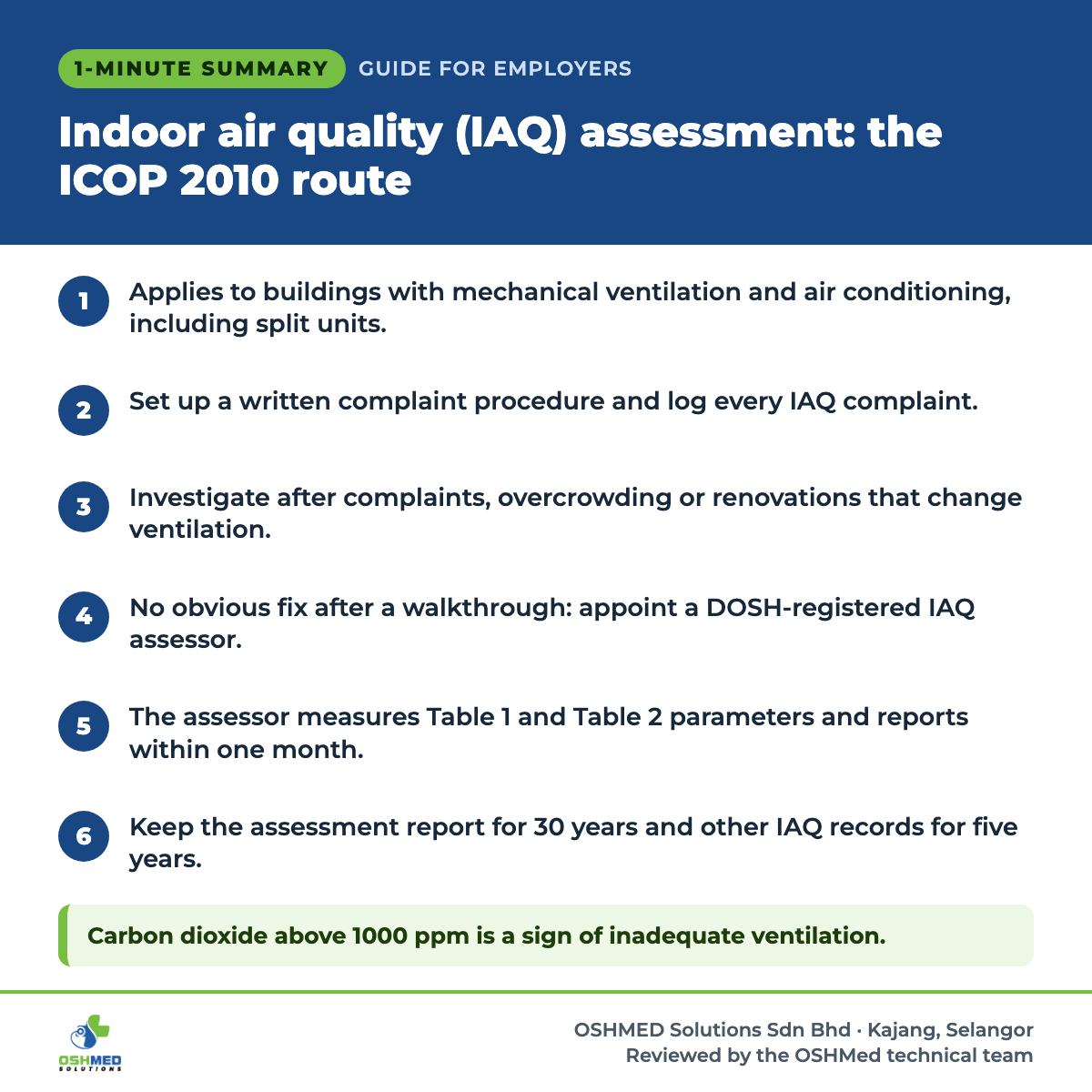
- Applies to buildings with mechanical ventilation and air conditioning, including split units.
- Set up a written complaint procedure and log every IAQ complaint.
- Investigate after complaints, overcrowding or renovations that change ventilation.
- No obvious fix after a walkthrough: appoint a DOSH-registered IAQ assessor.
- The assessor measures Table 1 and Table 2 parameters and reports within one month.
- Keep the assessment report for 30 years and other IAQ records for five years.
What is an indoor air quality (IAQ) assessment?
An IAQ assessment is a structured evaluation of the air inside a building by an indoor air quality assessor registered with DOSH. Under the Industry Code of Practice on Indoor Air Quality 2010, it combines a walkthrough inspection, a symptom survey and measurements of physical parameters and contaminants, then recommends improvements.
The ICOP was approved by the Minister on 30 August 2010 and replaced the earlier code on indoor air quality. It sets minimum standards for selected parameters and explains how to identify, evaluate and control indoor air contaminants. It links to the general duties of employers and occupiers under the Occupational Safety and Health Act 1994 (Act 514). In addition, the Fifth Schedule of Act 514 lists indoor air quality assessment as an activity for registered competent persons.
Which buildings does the IAQ code cover?
Section 1.2.2 says the code applies to buildings, or parts of buildings, served by a mechanical ventilating and air conditioning (MVAC) system, including air-cooled split units, where people work. It excludes domestic buildings, areas used for domestic or industrial purposes, laboratories using chemicals for analysis or research, and asbestos removal work.
In practice, that means offices, call centres, banks, hospitals and clinics, schools, hotels, malls and air-conditioned admin areas inside factories. The production floor itself, where materials are manufactured or transformed, falls outside this code; chemical exposure there is handled under the USECHH Regulations and CHRA.
When is an IAQ assessment needed?
Section 2.3 makes the building owner or building management responsible for investigating indoor air quality concerns when complaints are received, when occupancy exceeds the original design, or after renovations that significantly change ventilation. If the walkthrough finds no obvious cause or fix, an assessment by a registered IAQ assessor shall be conducted (section 2.4.2.2).
- Complaint received and logged. The complaint procedure records the date and time, location and symptoms.
- Walkthrough inspection. Building and ventilation history, previous complaints, occupants, and likely sources.
- Initial findings. If there is an obvious solution, fix it straight away.
- IAQ assessment. If the cause cannot be identified or resolved, a registered IAQ assessor measures and reports.
- Follow-up. Communicate remedial action to the complainant and check it has worked.
The code does not set a fixed calendar frequency for assessments in the sections we reviewed. Assessments are triggered by complaints, occupancy changes and ventilation adjustments. Some organisations also schedule periodic assessments as part of their own risk assessment under section 18B of Act 514.
IAQ complaint log template
Record each indoor air complaint as it comes in. Section 2.2 of the ICOP asks for the date and time, the location of the suspected source, and the signs and symptoms reported. Entries stay in this browser only. Download them as a CSV file for your records, or send the count to us.
| Date | Time | Location or floor | Complaint type | Number of people affected | Description | Reported by (role or initials) | Action taken |
|---|
Do not record names or medical details here. If someone has significant symptoms, the ICOP states that the employer should arrange a medical examination with a doctor.
What parameters does an IAQ assessment measure?
Table 1 of the ICOP sets acceptable ranges for air temperature, relative humidity and air movement. Table 2 sets acceptable limits for chemical contaminants, biological contaminants and carbon dioxide as a ventilation indicator. Chemical limits are eight-hour time-weighted averages, and carbon dioxide has a ceiling of 1000 ppm.
| Parameter | Acceptable range |
|---|---|
| Air temperature | 23 to 26 °C |
| Relative humidity | 40 to 70% |
| Air movement | 0.15 to 0.50 m/s |
| Contaminant | Acceptable limit |
|---|---|
| Carbon monoxide | 10 ppm |
| Formaldehyde | 0.1 ppm |
| Ozone | 0.05 ppm |
| Respirable particulates | 0.15 mg/m³ |
| Total volatile organic compounds (TVOC) | 3 ppm |
| Total bacterial counts | 500 cfu/m³ (indicator for further investigation) |
| Total fungal counts | 1000 cfu/m³ (indicator for further investigation) |
| Carbon dioxide (ventilation indicator) | 1000 ppm ceiling; above this indicates inadequate ventilation |
In one line: carbon dioxide indicates ventilation rather than toxicity; above 1000 ppm, the code treats it as inadequate ventilation.
The code notes that bacterial counts above the limit do not necessarily mean a health risk; they are an indicator for further investigation. The assessment is carried out during normal business activity so the results reflect real conditions.
Complaints about stuffy air or odours?
Send us your complaint log and a short description of the building and air conditioning. OSHMed will suggest whether an initial investigation or a full IAQ assessment fits.
What does the IAQ assessment report contain?
Section 2.5 lists the minimum contents: the assessment and sampling methods, potential sources of indoor air problems, measurement results for Table 1 and Table 2, the condition of the ventilation system including air changes and fresh air rate, health complaints and symptoms, the conclusion, and recommendations to improve indoor air quality.
The assessor presents and submits the report to the building owner or building management within one month of completing the assessment (section 2.4.3.5). Under section 5, assessment reports are kept for at least 30 years, and other records, such as complaint records, investigation reports and training records, for at least five years.
Who can carry out an IAQ assessment?
An indoor air quality assessor registered with the Director General of Occupational Safety and Health. Section 6 of the ICOP sets the qualifications, such as a science diploma with occupational hygiene experience plus recognised IAQ training and a NIOSH examination, and registration lasts up to three years before renewal.
OSHMed, an occupational safety and health consultancy in Kajang, Selangor, helps building managers and employers organise the complaint procedure, prepare for the walkthrough and scope the IAQ assessment. The assessment itself is carried out by a DOSH-registered IAQ assessor, whose name and registration number appear in the report. See our workplace assessments and resources.
Before the assessor visits, collect the MVAC maintenance records, filter change dates, floor plans with headcount, and your complaint log. These shorten the walkthrough and make the recommendations more specific.
- Complaints continue after the obvious fixes, such as cleaning filters or adjusting thermostats.
- Several people in one area report headaches, eye irritation or stuffiness.
- Occupancy is now higher than the space was designed for.
- A renovation has changed supply or return air to a room.
Before you decide: three common objections
Three objections come up when IAQ complaints appear: the landlord is responsible, the air conditioning was just serviced, and one carbon dioxide reading is enough. Each is set against what the ICOP 2010 actually says below, so you know where your own duties as employer or tenant begin.
"The building management handles this, not us."
The ICOP places the complaint procedure and investigation on the building owner or management. As an employer, you still have general duties to your employees under Act 514, so log complaints and pass them on in writing.
"Our air conditioning was just serviced."
Servicing helps, but the code looks at the whole picture: occupancy, sources such as renovation materials or printers, fresh air rate and symptoms. A walkthrough checks all of these.
"A basic CO2 meter will tell us enough."
A carbon dioxide reading is a useful early sign of poor ventilation. A formal assessment under the code covers the full list in Tables 1 and 2, a symptom survey and a written report by a registered assessor.
Frequently asked questions
Is an IAQ assessment mandatory for our office?
The ICOP 2010 requires the building owner or management to investigate IAQ complaints. If the cause cannot be identified or resolved, an assessment by a DOSH-registered IAQ assessor shall be conducted. The code does not set a fixed calendar frequency in the sections we reviewed.
What are the acceptable indoor air quality limits in Malaysia?
Table 1 of the ICOP sets temperature at 23 to 26 °C, relative humidity at 40 to 70% and air movement at 0.15 to 0.50 m/s. Table 2 includes carbon monoxide 10 ppm, formaldehyde 0.1 ppm, ozone 0.05 ppm, respirable particulates 0.15 mg/m³, TVOC 3 ppm and a carbon dioxide ceiling of 1000 ppm.
Who can carry out an IAQ assessment?
Only an indoor air quality assessor registered with the Director General of Occupational Safety and Health. Section 6 of the ICOP sets qualifications and training, and Act 514 lists indoor air quality assessment as an activity for registered competent persons.
How long does it take to get the IAQ report?
The assessor must present and submit the report to the building owner or building management within one month of completing the assessment (section 2.4.3.5 of the ICOP).
Does the IAQ code apply to factories?
The code applies to MVAC-served areas where people work, but excludes areas used for industrial purposes such as manufacturing. Air-conditioned offices inside a factory are covered; production areas are handled under other rules such as USECHH 2000.
Your next step
Set up the complaint log above today and agree the complaint procedure with your building management. If complaints continue after the obvious fixes, appoint a registered IAQ assessor.
If your workplace also uses chemicals or has noisy plant rooms, see our guides on CHRA and noise risk assessment.
Get your IAQ complaints investigated properly
Start with the complaint log, then let a registered IAQ assessor measure what matters.
Sources and references
Checked against the official documents listed below on 21 October 2026. Laws change: always confirm the current version on the DOSH (JKKP) website.
- Industry Code of Practice on Indoor Air Quality 2010 (sections 1.2, 2.1 to 2.5, 5, 6; Tables 1 and 2). Text copy hosted by Universiti Malaya OSHE resources; official listing on dosh.gov.my, DOSH Malaysia
- Occupational Safety and Health Act 1994 (Act 514), reprint incorporating Act A1648 (sections 15, 18B, 31B, Fifth Schedule), DOSH Malaysia
Disclaimer: This article is general information for employers and is not legal advice. Requirements depend on your workplace, processes and the current law. For a decision on your premises, speak to a DOSH-registered competent person or contact DOSH (JKKP).