
Chemical Exposure Monitoring (CEM) in Malaysia: When, How Often, Who
Chemical exposure monitoring (CEM) measures how much of a chemical hazardous to health your workers breathe in. Under regulation 26 of USECHH 2000, it is required when your chemical health risk assessment (CHRA) says so, is done by a DOSH-registered hygiene technician, and is repeated at intervals of not more than six months for Schedule II chemicals.
- MD (NNSMA, Rus)
- MScCH (Occ. Health, UKM)
- MBA (ARU, UK)
- OHD (NIOSH)
- MRO (AOEMM)
- TTT (HRDF)
- SSM 202001013523 (OSHMED Solutions Sdn Bhd)
- DOSH registered training provider SL/22/22/181036, valid to 21 July 2028
- MMC Full Registration 55275 (Dr. Wan Muhammad Zulhusni)
- DOSH Occupational Health Doctor HQ/16/DOC/00/454
- DMAC/EDTCmed 263
- OEUK OEUK/2024/3751
OSHMed Solutions Sdn Bhd is an occupational safety and health consultancy and DOSH-registered training provider (ergonomics) in Kajang, Selangor. We are not a clinic. Medical tests are arranged through approved centres.
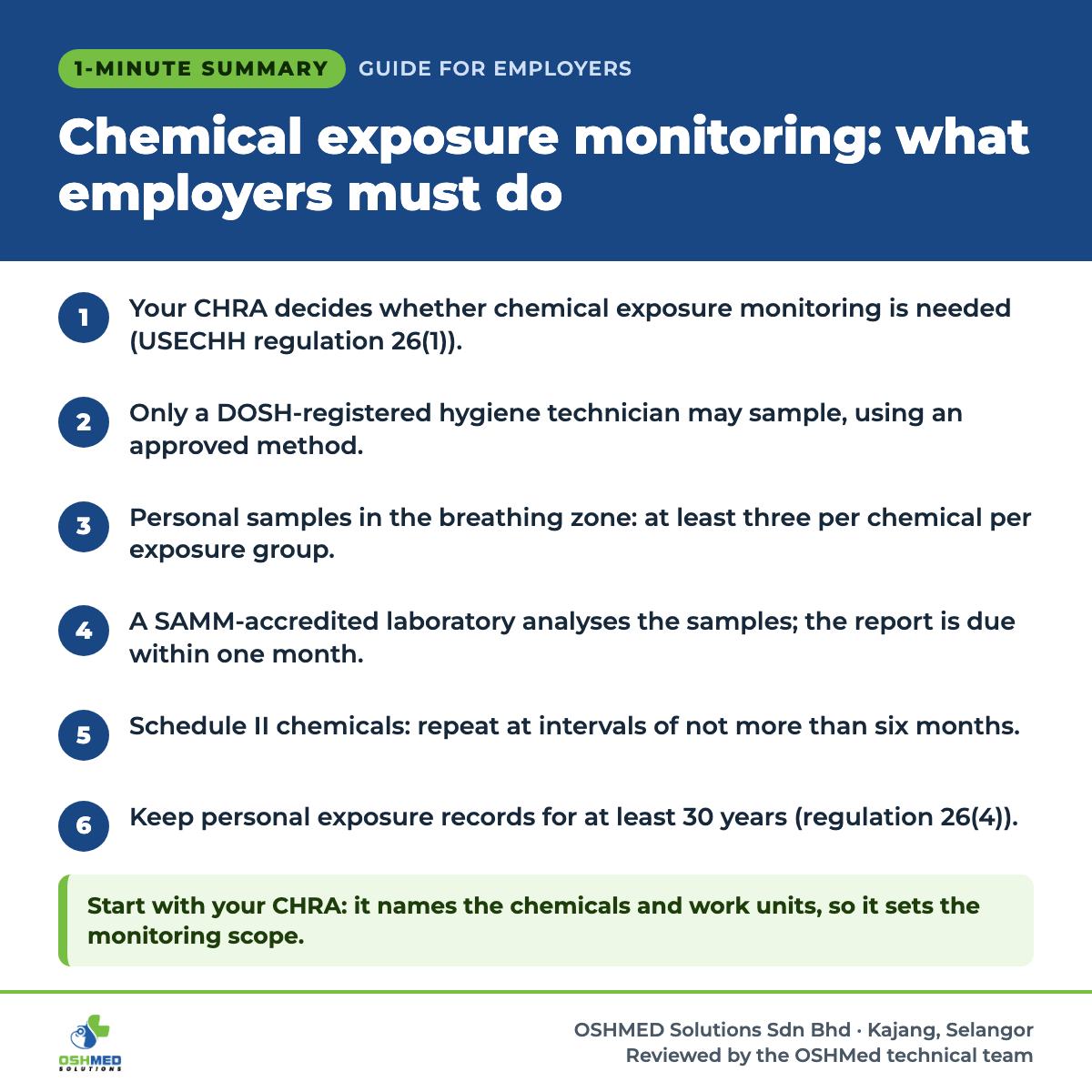
- Your CHRA decides whether chemical exposure monitoring is needed (USECHH regulation 26(1)).
- Only a DOSH-registered hygiene technician may sample, using an approved method.
- Personal samples in the breathing zone: at least three per chemical per exposure group.
- A SAMM-accredited laboratory analyses the samples; the report is due within one month.
- Schedule II chemicals: repeat at intervals of not more than six months.
- Keep personal exposure records for at least 30 years (regulation 26(4)).
What is chemical exposure monitoring (CEM)?
Chemical exposure monitoring measures how much of a chemical hazardous to health is in the air exposed workers breathe, and compares it with the permissible exposure limits in Schedule I of USECHH 2000. It shows whether your controls keep exposure below those limits. It is also called air monitoring or industrial hygiene monitoring.
DOSH sets the method in its Guidelines on Monitoring of Airborne Chemical Hazardous to Health 2022. CEM measures; it does not decide the controls. That is the job of the CHRA, explained in our CHRA guide.
When does the law require chemical exposure monitoring?
When your CHRA says it is needed. Regulation 26(1) of USECHH 2000 requires monitoring where the assessment shows it is required, or needed to keep exposure adequately controlled. DOSH’s 2025 hygiene technician FAQ adds that once the CHRA assessor recommends CEM, the employer must carry it out.
- Every CHRA must state whether exposure monitoring is necessary, work unit by work unit (regulation 9(2)(h)).
- Schedule II chemicals, such as lead, benzene, isocyanates or free crystalline silica, need repeat monitoring (regulation 26(2)).
- Contractors doing work for you on your premises are covered too (regulation 4(1)(a)).
CEM scope builder: prepare an accurate quote request
Answer nine quick questions. Your answers build a scope summary you can send to OSHMed on WhatsApp for a written quote, or print for internal approval. No personal or medical details are needed.
OSHMed uses these answers to prepare a written quote. This summary is not a price: the registered hygiene technician confirms the exposure groups, sampling durations and number of samples after a preliminary survey of your site (DOSH Guidelines 2022, chapter 2).
How often must chemical exposure monitoring be repeated?
It depends on the chemical and the last result. Schedule II chemicals: not more than six months, until the assessor is satisfied monitoring is no longer needed (regulation 26(2)). Other chemicals: the DOSH 2022 Guidelines set six months for results at or above the limit, and 12 months from half the 8-hour limit.
| Situation | Interval | Basis |
|---|---|---|
| Schedule II chemical | Not more than six months, until the assessor is satisfied | Reg. 26(2) |
| Result at or above the limit | Not more than six months, after controls are improved | Guidelines, chapter 7 |
| Result from half the 8-hour limit (the action level) up to the limit | Not more than 12 months | Guidelines 6.3.2, chapter 7 |
| First three samples all below 10% of the limit | Limit taken as complied with | Guidelines 2.5(a) |
| Two consecutive results, seven or more days apart, below half the 8-hour limit (or the short-term or ceiling limit) | Monitoring may stop (Schedule II: only when the assessor is satisfied) | Guidelines, chapter 7 |
In one line: for a Schedule II chemical, CEM is a standing six-monthly duty, not a one-off test.
How is chemical exposure monitoring carried out?
In nine steps set by the DOSH 2022 Guidelines, running from a preliminary survey and grouping workers into similar exposure groups to sampling, a compliance test and the report. Samples are taken in each worker’s breathing zone, because the limits refer to personal exposure; area samples only help find sources (Guidelines 1.6.1).
- Three samples minimum per chemical in each exposure group; groups of fewer than three workers are sampled again on another day or shift (2.5).
- Six more if any of the first three falls between 10% of the limit and the limit, then a statistical compliance test on all nine (2.5, 6.3).
- Duration to match the limit: full shift for the 8-hour limit, 15 minutes for STEL and MEL, three or more peak-time samples for a ceiling limit (4.1 to 4.3).
- Calibrated pumps: checked before and after; a flow error above 10% voids the sample (3.6).
These rules also set your quote: the number of chemicals, exposure groups, close results, shift length and short-term limits decide the field and laboratory work, and a registered hygiene technician cannot drop them to cut the price.
Want a CEM quote built on your CHRA?
Send us the monitoring recommendation from your CHRA, or your chemical list, work units and headcount. OSHMed will reply with a written quote that lists the chemicals, exposure groups, samples and deliverables.
What must a chemical exposure monitoring report contain?
A report in the DOSH format, delivered within one month and presented to you or your safety and health committee. It names the hygiene technician and registration number, explains how workers and sampling times were chosen, compares each result with the limit and says when to monitor again.
- Method, equipment serial numbers and calibration dates, and the reasons for the number and duration of samples.
- Results per chemical and work area against the limit, with the statistics where nine samples were taken.
- Appendices: certificate of competency, the signed notification form, calibration certificates, calculation sheets, the laboratory’s certificate of analysis and a layout plan with worker positions (chapter 7).
DOSH’s note on common errors in hygiene technician reports lists missing calibration certificates and certificates of analysis, unstated assumptions for unsampled time and no signed employer form. Check these before you accept the report.
How do you compare chemical exposure monitoring providers?
Compare the sampling plan, not the total. Ask every provider for the same five things: a registered hygiene technician, an approved method for each chemical, an accredited laboratory, a written sampling strategy and the full DOSH report format. Quotes that differ on these five cannot be compared fairly.
| Check | What to ask for | Basis |
|---|---|---|
| Registration | Hygiene technician name and number, valid on the sampling date, checked on the myKKP competent person lookup | Reg. 26(3); Act 514 s.31B |
| Method | The validated method for each chemical, such as a US NIOSH or US OSHA method | Reg. 26(1); Guidelines 4.5 |
| Laboratory | SAMM accreditation from Standards Malaysia, or an equivalent body, covering each analysis method | Guidelines 5.1; HT1 FAQ, A5 |
| Strategy | Personal samples per exposure group, at least three per chemical, timed to the type of limit | Guidelines 2.5, 4.1 to 4.4 |
| DOSH notice | Monitoring notified to DOSH at least 14 days before the work | DOSH note on HT1 reports |
Not in a CEM quote: control works, medical surveillance for Schedule II chemicals through our workplace health service (see our medical surveillance guide), and the ventilation test due at least every 12 months by a hygiene technician registered for that work (HT2, regulation 17).
What does it cost to skip or delay monitoring?
More than the monitoring. USECHH sets no penalty of its own, so section 51 of Act 514 applies: a fine of up to RM100,000, up to one year in prison, or both, plus a fine of up to RM2,000 a day while the offence continues. Directors can be charged with the company (section 52).
OSHMED Solutions Sdn Bhd, based in Kajang, Selangor, serves employers across Malaysia and quotes in writing. OSHMed scopes and coordinates chemical exposure monitoring from your CHRA. It is carried out by a DOSH-registered hygiene technician, as regulation 26(3) requires, and ends with a written report that names the responsible registered person and their myKKP registration number, so you can verify it on the DOSH register. See our assessment services and services.
- Your CHRA recommends monitoring and none has been done.
- Workers handle a Schedule II chemical and the last round was over five months ago.
- Your last result was above half the 8-hour limit and 12 months have nearly passed.
- You changed a chemical, process or ventilation, or DOSH directed a review.
Before you decide: three common objections
Three objections come up when employers plan chemical exposure monitoring: a round was done last year, the safety officer has a gas detector, and area samples look cheaper. Each is checked below against USECHH 2000 and the DOSH 2022 Guidelines, so the decision rests on the rules.
"We already did monitoring last year."
For a Schedule II chemical, once a year is not enough: the interval is not more than six months (regulation 26(2)). For other chemicals, a result at or above the limit also means six months.
"Our safety officer has a gas detector."
Direct-reading instruments help trace sources, but they can react to other substances and give false readings (Guidelines 3.2). Apart from checks before confined-space entry, a registered hygiene technician must do the monitoring (regulation 26(3)).
"Area samples are cheaper."
The limits refer to personal exposure in the breathing zone, so area samples alone do not show compliance (Guidelines 1.6.1). They help find sources and choose which workers to sample.
Frequently asked questions
What is chemical exposure monitoring?
It measures a chemical hazardous to health in the air workers breathe, using personal samplers in the breathing zone and laboratory analysis, and compares the results with the permissible exposure limits in Schedule I of USECHH 2000.
How often is chemical exposure monitoring required in Malaysia?
For Schedule II chemicals, not more than six months, until the assessor is satisfied it is no longer needed (regulation 26(2)). Otherwise, the DOSH 2022 Guidelines set six months for results at or above the limit and 12 months from half the 8-hour limit.
Who can carry out chemical exposure monitoring?
Only a hygiene technician registered with DOSH (regulation 26(3)), except for gas and oxygen checks before confined-space entry. Check the registration on the myKKP competent person lookup. Unregistered monitoring risks a fine of up to RM100,000 (Act 514, section 31B).
Do we need CEM if our CHRA does not recommend it?
Not under regulation 26(1), which follows the CHRA. DOSH’s 2025 FAQ says the need for CEM rests on the CHRA assessor’s recommendation. Review the CHRA after a significant change in the work, after five years, or when DOSH directs (regulation 10).
What equipment is used for chemical exposure monitoring?
Battery-operated sampling pumps with filters, sorbent tubes or impingers, or passive badge samplers, as the validated method for each chemical requires. Pumps are calibrated before and after every round (DOSH Guidelines 2022, chapter 3).
Your next step
Find the monitoring recommendation in your CHRA, then fill in the scope builder above or send us your chemicals, work units, headcount and shifts. OSHMed will reply with a written quote.
Noise risks on the same site? We can plan them in the same site visits. See our noise risk assessment guide.
Get a written CEM quote for your site
Share your scope summary on WhatsApp or through the quote form. If a Schedule II chemical is involved, we will also plan the six-monthly repeat rounds with you.
Sources and references
Checked against the official documents listed below on 29 October 2026. Laws change: always confirm the current version on the DOSH (JKKP) website.
- Occupational Safety and Health (Use and Standards of Exposure of Chemicals Hazardous to Health) Regulations 2000, P.U. (A) 131/2000 (regulations 2, 4, 9, 10, 17, 26, 30, Schedules I and II), Attorney General's Chambers, published by DOSH
- Guidelines on Monitoring of Airborne Chemical Hazardous to Health 2022 (chapters 1 to 7), DOSH Malaysia
- Soalan Lazim / FAQ Hygiene Technician 1 (HT1) 2025 (questions 1 to 8), DOSH Malaysia
- Kesalahan Umum Laporan Juruteknik Higien 1 (HT1): common errors in hygiene technician reports (2022), DOSH Chemical Management Division
- Hygiene Technician 1: role, qualifications and registration, DOSH Malaysia
- Hygiene Technician 2: inspection and testing of engineering control equipment, DOSH Malaysia
- Occupational Safety and Health Act 1994 (Act 514), reprint incorporating Act A1648 (sections 31B, 51, 52, Fifth Schedule), DOSH Malaysia
- List of approvals (Senarai Kelulusan / Kebenaran), including the myKKP competent person lookup, DOSH Malaysia
Disclaimer: This article is general information for employers and is not legal advice. Requirements depend on your workplace, processes and the current law. For a decision on your premises, speak to a DOSH-registered competent person or contact DOSH (JKKP).