
Ergonomic Trained Person (ETP) Course: DOSH Rules and Buyer’s Guide
An ergonomic trained person (ETP) has completed ergonomics risk assessment training and can run your ergonomic risk assessment (ERA) and train employees in-house. DOSH states that ETPs must attend its Ergonomic Management Course (Initial or Advanced ERA) at a registered training provider approved by the Department. Check the provider on DOSH’s list before you book.
- MD (NNSMA, Rus)
- MScCH (Occ. Health, UKM)
- MBA (ARU, UK)
- OHD (NIOSH)
- MRO (AOEMM)
- TTT (HRDF)
- SSM 202001013523 (OSHMED Solutions Sdn Bhd)
- DOSH registered training provider SL/22/22/181036, valid to 21 July 2028
- MMC Full Registration 55275 (Dr. Wan Muhammad Zulhusni)
- DOSH Occupational Health Doctor HQ/16/DOC/00/454
- DMAC/EDTCmed 263
- OEUK OEUK/2024/3751
OSHMed Solutions Sdn Bhd is an occupational safety and health consultancy and DOSH-registered training provider (ergonomics) in Kajang, Selangor. We are not a clinic. Medical tests are arranged through approved centres.
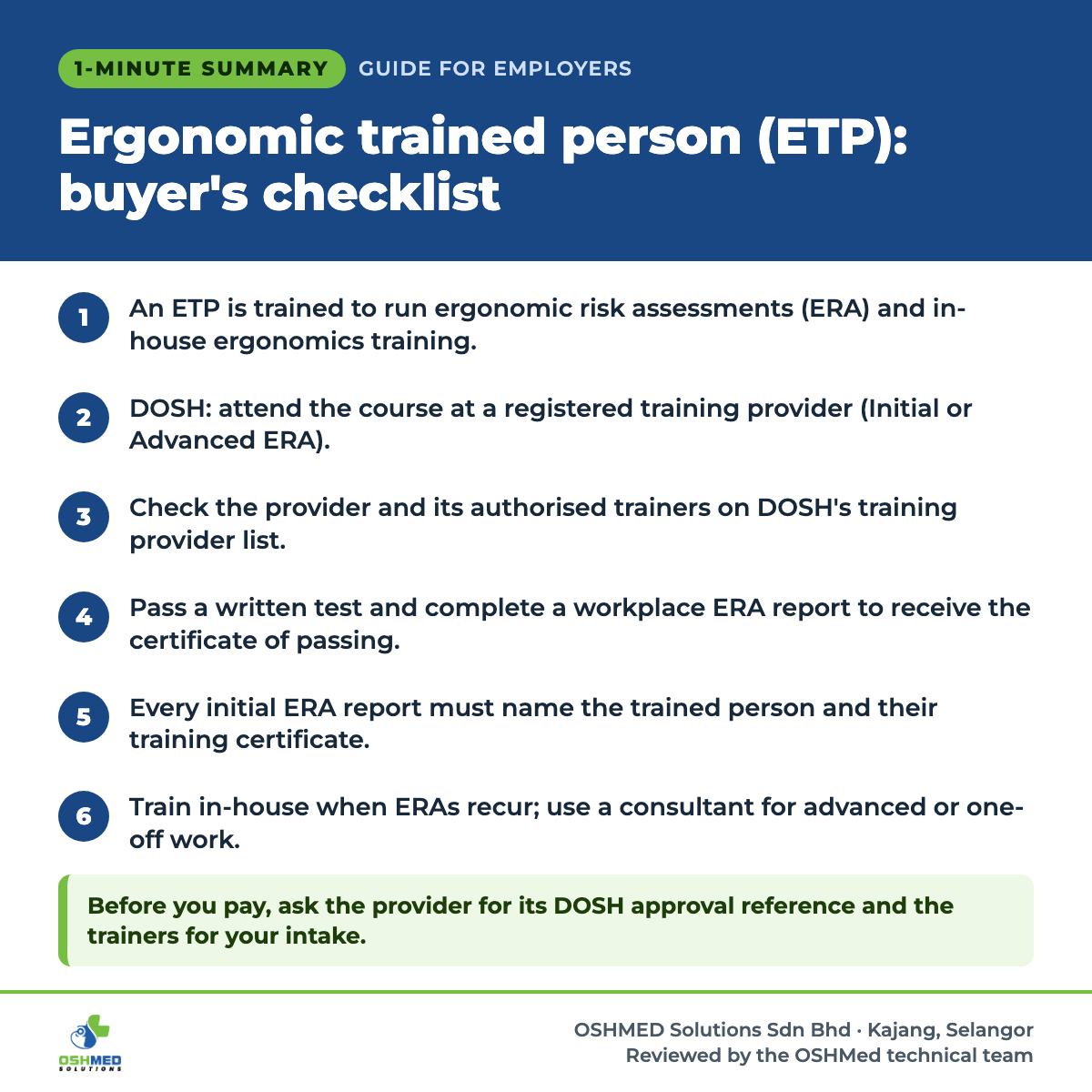
- An ETP is trained to run ergonomic risk assessments (ERA) and in-house ergonomics training.
- DOSH: attend the course at a registered training provider (Initial or Advanced ERA).
- Check the provider and its authorised trainers on DOSH's training provider list.
- Pass a written test and complete a workplace ERA report to receive the certificate of passing.
- Every initial ERA report must name the trained person and their training certificate.
- Train in-house when ERAs recur; use a consultant for advanced or one-off work.
What is an ergonomic trained person (ETP)?
Section 1.4.7 of the DOSH Guidelines on Ergonomics Risk Assessment at Workplace 2017 defines a trained person as someone who has undergone ergonomics risk assessment training and can conduct the assessment and in-house training for employees. DOSH calls this person an Ergonomics Trained Person (ETP) on its forms and lists.
In practice, the ETP leads the assessment team (section 2.3.1), starts each ERA with the initial ERA checklist, suggests solutions and reports the findings to management and the employees concerned (section 2.2).
Must the ETP course be run by a DOSH-registered training provider?
Yes, according to DOSH. Its ergonomics page states that ergonomically trained persons must attend an Ergonomic Management Course (Initial or Advanced ERA) at a registered training provider approved by the Department. Separately, section 31B(1)(b) of Act 514 says no person shall conduct an occupational safety and health training course unless registered as a training provider.
Breaching section 31B carries a fine of up to RM100,000 (section 31B(2)). Section 18B separately requires employers to assess workplace risks and apply the controls needed; a breach carries a fine of up to RM500,000, up to two years’ imprisonment, or both (section 19).
Self-check: train an in-house ETP or hire a consultant?
Answer seven questions about your workplace. They follow the ERA triggers and review rules in the DOSH 2017 guidelines. This is a planning aid, not an assessment of your ergonomic risk.
1. Do several work units, lines or shifts involve manual handling, repetitive work or awkward postures?
2. Do you change processes, work rates, layouts or staffing in those units more than once a year?
3. Have employees reported musculoskeletal pain or discomfort, or filed an ergonomics complaint, in the last 12 months?
4. Do you want someone in-house to run ergonomics awareness training for employees?
5. Do your current ERA reports lack the name of a trained person and their training certificate?
6. Is your need a single, one-off assessment, such as one new workstation?
7. Does the work need advanced methods such as RULA, REBA or MAC, or a workstation redesign?
Initial or advanced: which ETP course do your staff need?
Start with initial. A trained person screens each task with the initial ERA checklist; an advanced ERA follows only when scores reach the Table 3.15 minimums, using methods such as RULA, REBA, MAC, OCRA or ROSA. DOSH authorises the two courses separately and keeps separate ETP lists.
| Point | Initial ERA | Advanced ERA |
|---|---|---|
| What the ETP does | Screens tasks with the checklist and survey forms; writes the initial ERA report | Measures risk with established methods; sets improvement priorities |
| When used | Every ERA starts here (section 2.2) | When initial scores reach the Table 3.15 minimums |
| Training scope | Includes hands-on checklist practice and report writing (section 9.2.2.1) | Adds advanced methods for posture, manual handling, repetition, vibration and environment (section 9.2.2.2) |
| DOSH list | Initial Ergonomic Risk Assessment | Advance Ergonomic Risk Assessment |
For the scoring and the five advanced steps, see our guide to initial vs advanced ERA.
How do you check the DOSH lists before you book?
Use two DOSH lists. The registered training provider list for the ETP course, updated 16 October 2026, names 13 organisations across 30 entries, with each approval period and the authorised trainers. The Recognized List of Ergonomics Trained Persons shows registered individuals, with separate tables for initial and advanced ERA.
- Open the DOSH ETP training provider list: check the provider, approval period, course type and trainers.
- Search the initial or advanced ETP list by full name. On 28 October 2026, the lists held 5,986 and 2,003 entries respectively.
- File the certificate of passing with your ERA records; training records are among the records to keep (section 10.2).
DOSH’s provider list reminds participants that only trainers authorised under that provider’s name should teach the course. Ask which trainers will run your intake.
How do you become an ergonomic trained person?
Choose a DOSH-registered provider, attend the course and pass its assessment: DOSH’s module checklist expects written tests, report assignments and certificates of attendance and passing. With the passing certificate and a current employer letter, the participant can apply on DOSH’s Ergonomics Trained Person (ETP) registration form.
To prepare for the workplace report, you will need:
- A candidate with floor time and access to management, such as a safety and health officer or your OSH coordinator.
- Returned self-assessment and complaint forms (Appendices 1 and 2), or a plan to start them.
- HIRARC, job safety analysis or health risk assessment records, which can trigger an ERA (section 2.1).
- A list of work units, tasks and shifts, with photos of the main manual handling tasks.
Ready to train your own ergonomic trained person?
See the course outline, assessment and next intake on the OSHMed ETP course page. Training a group at your premises? Ask for an in-house course quote.
How do you compare ETP course providers and quotes?
Compare facts you can verify: the provider’s entry and approval period on DOSH’s list, the levels it is authorised for, the named trainers, the assessment method, report feedback, and whether the course can run at your premises. Ask for these points in writing with the quote.
| Check | Where to verify | Why it matters |
|---|---|---|
| On the DOSH list | Provider row, approval period | DOSH expects a registered provider |
| Level authorised | Course type column | Two providers are authorised for Initial only |
| Named trainers | Trainer column | Only authorised trainers should teach |
| Assessment and pass mark | Course outline | DOSH expects written tests and report assignments |
| Report deadline and feedback | Course outline | Every ERA depends on the report (section 6.1) |
| Public or in-house | Quote | Affects travel, timing and group size |
Every listed provider is approved by DOSH, so compare fit: level, timing, location and support after the course.
Should you train an in-house ETP or hire a consultant?
Train in-house when ERAs will recur: several work units, frequent process or staffing changes, or ongoing musculoskeletal complaints. Hire a consultant for a one-off need or specialist advanced work. The guidelines let the trained person engage external consultants when expertise is inadequate, particularly for advanced ERA (section 9.3).
| Option | Fits when | What the guidelines say |
|---|---|---|
| Train an in-house ETP | ERAs recur after changes or complaints; you want in-house awareness training | Review after significant change or complaints (section 7); a simple process takes 1 to 2 hours (section 2.4.1) |
| Hire a consultant | One-off need, no staff to train, advanced methods or workstation redesign | Consultants for advanced ERA (section 9.3); ergonomist preferred for workstation configuration (section 4.4) |
| Both | Your ETP screens and reports; a consultant supports advanced ERA | Initial first, advanced only when needed (section 2.2) |
Either way, the employer must apply timely controls and inform affected employees (section 8), and keep assessment reports for at least 30 years (section 10.3). Prefer us to do the assessment? See our ergonomic risk assessment (ERA) service.
What does the OSHMed ETP course cover?
The OSHMed Ergonomic Trained Person for Initial Ergonomic Risk Assessment course runs over two days and follows the DOSH 2017 guidelines. Assessment is a one-hour written test worth 30 marks and a workplace initial ERA report worth 70 marks, submitted within 14 days after the course. The pass mark is 60%.
OSHMED Solutions Sdn Bhd in Kajang, Selangor, is a DOSH-registered training provider for the ETP course (SL/22/22/181036, valid until 21 July 2028), authorised for both Initial and Advanced ERA courses. Participants practise with self-assessment and complaint forms, the Cornell Musculoskeletal Questionnaire (CMQ) and the DOSH ERA checklists. We also run in-house OSH training at employers’ premises. For the workplace case, read 5 reasons ETP training is essential.
- Employees report musculoskeletal pain, discomfort or an ergonomics complaint.
- An occupational health doctor, DOSH or SOCSO asks for an ERA.
- You are changing a process, work rate, layout or staffing.
- Your ERA reports do not name a trained person with a certificate.
Before you decide: three common objections
Three objections often delay ETP training: the checklist looks simple enough to use without a course, someone already attended an ergonomics talk, and two days away from work feels costly. Each is checked below against the 2017 guidelines, so you can judge the gap before committing budget.
"We can download the checklist and do it ourselves."
The initial ERA checklist is in the guidelines (Appendix 6), but every initial ERA report must name the trained person and their training certificate (section 6.1). DOSH expects that training from a registered provider.
"Our safety officer already attended an ergonomics talk."
Awareness training for employees (section 9.2.1) is not trained person training. Initial ERA training must at least cover hands-on use of the checklist and report writing (section 9.2.2.1).
"Two days away from work is too much."
A simple work process can be assessed in one to two hours (section 2.4.1), and ERAs are reviewed after significant changes or complaints (section 7). An in-house ETP makes each review routine.
Frequently asked questions
What is an ergonomic trained person?
Someone who has completed ergonomics risk assessment training and can conduct the ERA and in-house ergonomics training for employees (section 1.4.7 of the DOSH 2017 guidelines). DOSH lists registered ETPs on its website.
Who can conduct an initial ergonomic risk assessment?
A trained person. The guidelines say the trained person should start each ERA with the initial ERA checklist and report the findings (section 2.2). DOSH states that trained persons must attend the Ergonomic Management Course at a DOSH-registered training provider.
How do I check the DOSH ergonomic trained person list?
On dosh.gov.my, open Senarai Kelulusan & Kebenaran, then Recognized List, then Ergonomics Trained Person. Initial and advanced ERA have separate searchable tables showing the name, company and registration date.
What is the difference between initial and advanced ETP?
Initial ERA is a checklist screening of risk factors. Advanced ERA follows when scores reach the Table 3.15 minimums and uses methods such as RULA, REBA, MAC or ROSA. DOSH authorises the two courses separately and keeps separate ETP lists.
Can we hire a consultant instead of training an ETP?
Yes. The guidelines allow external consultants where expertise is inadequate, particularly for advanced ERA (section 9.3). An in-house ETP makes sense when ERAs recur after changes or complaints (section 7).
Your next step
Run the self-check above, then confirm your shortlisted provider and trainers on DOSH’s list. When ready, see the ETP course page for intakes and registration.
Planning other assessments at the same site? Scope the ERA together with a noise risk assessment so one visit covers both.
Train your ETP, or let us run the first ERA
Register a staff member for the ETP course, or request a quote for an ergonomic risk assessment if you need the assessment done before training.
Sources and references
Checked against the official documents listed below on 28 October 2026. Laws change: always confirm the current version on the DOSH (JKKP) website.
- Guidelines on Ergonomics Risk Assessment at Workplace 2017 (sections 1.4.7, 2.1 to 2.4, 4.4, 6.1, 7, 8, 9.2, 9.3, 10), DOSH Malaysia
- Registered Training Provider Ergonomic Management Course (ETP course requirement and forms), DOSH Malaysia
- List of registered training providers and authorised trainers for the Ergonomic Management Course for Ergonomic Trained Person (ETP), updated 16 October 2026, DOSH Malaysia
- Recognized List: Ergonomics Trained Person, Initial Ergonomic Risk Assessment, DOSH Malaysia
- Recognized List: Ergonomics Trained Person, Advance Ergonomic Risk Assessment, DOSH Malaysia
- Ergonomics Trained Person (ETP) Registration Form, revision 3.1.2025, DOSH Malaysia
- Ergonomic Management Course Training Module Checklist, revision 3.1.2025, DOSH Malaysia
- Occupational Safety and Health Act 1994 (Act 514), reprint incorporating Act A1648 (sections 18B, 19, 31B), DOSH Malaysia
Disclaimer: This article is general information for employers and is not legal advice. Requirements depend on your workplace, processes and the current law. For a decision on your premises, speak to a DOSH-registered competent person or contact DOSH (JKKP).